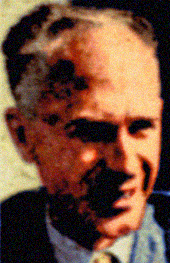
Rambling Reporter, Ernie Pyle (1941-42)

The Pittsburgh Press (December 15, 1941)

Ernie’s on the road now, his column resumes soon

Rambling Reporter starts journeys again after long leave of absence due to wife’s illness

Here is good news for Pittsburgh Press readers who have been phoning and writing to ask when Ernie Pyle would be resuming his column.

The Roving Reporter is back on the road again. His wife is on the mend.

A few months ago, Ernie was in Edmonton, Alberta, ready to fly to Alaska via the new stepping-stone airports carved out of the Western Canadian wilderness. But word came that Mrs. Pyle had suffered a sudden and severe illness, so he flew to her bedside at Albuquerque, New Mexico.

Weeks later, when Mrs. Pyle was up and around, he made arrangements to go to the Orient – to Honolulu, Manila, Hong Kong, Chungking, over the Burma Road and down to Singapore, and on to Java and Australia and New Zealand.

But at the last minute the government cancelled the bookings of several Clipper passengers, including Ernie, to make room for some materials urgently needed in the Far East. That particular Clipper landed in Hawaii about the time the Japanese bombardment of Pearl Harbor was ending, and has now returned to the West Coast.

Today Ernie is in San Francisco. His first column will appear in a day or two in The Pittsburgh Press.

1 Like

The Pittsburgh Press (December 16, 1941)

Ernie Pyle’s column starts again Friday!

In a world full to overflowing with grim and momentous events, we are glad to welcome back to this newspaper a columnist who is concerned more often than not with “the little things of life” – Ernie Pyle, the Roving Reporter.

Ernie isn’t all sweetness and light, by any means, as is well known to those who followed his memorable dispatches from London during the Battle of Britain. But his is the human touch.

Today he is in San Francisco. His experiences in the air raids and blackouts of London give him a splendid background for writing about the civil-defense preparations on the West Coast.

Ernie has been out of the paper for several months, because of his wife’s illness. She is convalescing now, and Ernie has hit the road again – a road that has taken him to England and Scotland, through Mexico and Central and South America, to Hawaii, to Alaska and the Bering Sea, through Canada, and into each of our own 48 states.

His first column will appear Friday in The Press – exclusively!

The Pittsburgh Press (December 19, 1941)

Rambling Reporter

By Ernie Pyle

SAN FRANCISCO – The long rest is over. All long rests are over, for everybody. A new vitality is abroad in our land, and even those of us who are wan and frail sense in ourselves an overpowering impulsion to flail and strike around, doing something.

For four months this column and its author have lain in hibernation. In a way it was a sweet repose, and we discovered that it is pleasant not to work or worry or feel the surge of worldly things. But war changes all these feelings. It makes a restlessness, and an eagerness to be up and about. Hence this column, a month ahead of its planned date, comes trumpeting back to life.

We are under no illusion that there is anything this space can contribute to the great force that America now must have. But we do know that the faintest of us must be active now, even if only for ourselves. It is impossible for hands or minds to lie in easy composure on days like these. Even mine must scramble anxiously back to work. For me, as for millions of others, things did not turn out as they had been planned.

Some six weeks ago That Girl grew definitely better (I will tell you about her in a later column), and I knew that sooner or later I must be on my way. We laid out an itinerary.

We decided upon a winter roaming around the Orient – the Philippines, Hongkong, Chungking, the Burma Road, Rangoon, Singapore and the Dutch East Indies.

All arrangements were made. The red tape was vanquished. Out came the old passport, and on its traveled pages there went more ink of many colors.

The Army takes his seat

Final things were done at home. Bags packed. Money drawn. Vaccination certificates looked up. Letters written. Bookings made. Priorities for travel confirmed.

I was booked to leave San Francisco for Manila on the Clipper of December 2 – the week before the new war came. But at the last minute my seat was taken away by the Army, to make room for supplies urgently needed in the Far East.

Then I found passage to Honolulu by boat, expecting to catch a later Clipper there. But once again the Army parried my thrust. It commandeered the entire boat.

As a last resort, I was arranging on a Saturday to cross the Pacific by bomber. And then came, next day, that shocking Sunday at Pearl Harbor.

Automatically everything was off. I was still in Albuquerque at that time. All that Sunday was a daze. The news seemed too horrible. Albuquerque took it hard – for in the Philippines there are 2,000 New Mexico boys. The jitters began to take hold of people.

Monday was just the same. I don’t remember at all what I did on Monday. I only remember that all that day people were talking, talking, talking, and that nobody knew what he was saying or what he was thinking.

And just after dark came the then frightful rumor that two Japanese carriers were off San Francisco, and that the entire coast was to be blacked out.

That was enough for me. It was definitely some place to go, something you could tie your emotions to. So I went to the phone and asked how soon I could get a plane. They said at 5 the next morning.

Even the flight was warlike. When we left Albuquerque before dawn, we had clearance from the Army only as far as Dagget, Cal. We were over Dagget by 8 a.m. and still no clearance. So we waited up there over the bare Mojave Desert, waited in gigantic circlings in the air until word did come.

Then they cleared us to Palmdale, and again over Palmdale we circled and circled, waiting on the war. Finally they ordered us on, but we did not land at the great air terminal at Burbank. No, we went down in a pasture-like place many miles away and they took us on in by bus. The Army was running things now.

There were gulls in Dover, too

Late that afternoon we did get to San Francisco. The sun was shining, and I’ll always remember the thousands of seagulls sitting alongside the runway as we landed. I remember the gulls off Dover, too, in England.

There were two odd little coincidences for me in this arrival in bomb-expectant San Francisco. For one thing it was exactly a year, to the day, from my arrival in London. For another, San Francisco did have an alarm and a blackout that night, and I slept serenely through it, just as I had slept through my first real air raid on my first night in London. A man with a conscience as clear as that ought to be put in jail on suspicion.

So now we are in San Francisco – looking with deep curiosity into the hours ahead. Nothing has happened here yet, but one is an ostrich to declare that nothing ever will. We shall wait a little while and see.

San Francisco is exciting these days. For there is suspense here, and wonderment of what the night will bring, and a feeling of drastic urgency. Several times I’ve heard these words, said not in braggadocio, but more in a fateful resignation:

“Well, if it comes it’ll be bad here, but I guess we can take it, too.”

Yes, I guess we can.

The Pittsburgh Press (December 20, 1941)

Rambling Reporter

By Ernie Pyle

SAN FRANCISCO – To the people of San Francisco the blackout is variously frightening, grim, exciting or a nuisance. To me it is something warm and tingling, as from an old book of good memories.

All last winter I lived in the darkness of England. I didn’t mind it – in fact, I liked it. But in no stretch of the imagination did I ever then picture myself walking the streets of one of our own American cities in aboriginal darkness – blindfolded by Nature and learning again to move by the outstretched feeling tips of my toes. But here it is.

We were at the home of friends in the Pacific Heights section when the sirens sounded for my first American blackout. It was early in the evening. We had not yet eaten. San Francisco had had several previous blackouts, but people still were only learning what to do and how to act under peril.

We turned our electric switches and then watched from the window as the light of this lovely, hilly city gradually – and it seemed so awfully reluctantly – went out. Then we threw a pitcher of water on the burning fireplace, got our shielded flashlights, and went outdoors to let the night take us in. We felt our way up into a little park, from where we could look down over the city. All around us there was nothing now but Nature’s own night.

City is serious now

I had never before seen on this certain hill from where we watched. I kept complaining and asking if we couldn’t get to a higher place, where we could look down on the city. And my friends assured me that we WERE looking down on the city. It was incredible.

In the darkness of the grassy park, we bumped into a man with a dog. The dog kept rubbing against my knee, and I reached down and petted it.

“What kind is it?” I asked, for I couldn’t see the dog I was petting. “A young Airdale,” he said. And then he said something that really described the spirit of San Francisco that night. He said:

“I ran up here right after the first alarm. There were still lights all over town. And all over town I could hear people shouting ‘Turn out those lights!’ Hundreds of voices in every direction were shouting it. It was like an angry growl washing over the city.”

And so it was. We heard that angry growl all through the hours that we walked the streets. San Francisco is serious now. The people aren’t making-believe any more.

The greatest difference between San Francisco and Londen in blackout is that all traffic stops here. Only police cars and ambulances, with lights out, dare move. The streets might be dusty remnants of a city dead and uninhabited for a hundred years.

Another difference is that in London there is some faint light on the streets, while here there is none. Over there autos move with one very dim and hooded headlight. Vague little oases of light tinge the street corners, from heavily hooded street lights.

Of course the London blackout is permanent, from dusk till dawn. But here, and in other coast cities, the blackout goes on only during the actual danger periods of the alert.

San Franciscans still have much to learn in the ways and habits of the blackout, I was amused at the fervor of some of the citizens. One of our party made a tent of his coat and lit a cigarette. And several times, as we walked along, people angrily told him to put it out.

Eat in the darkness

Actually, it’s all right to carry a cigarette. In London you dare not light one on the street. But if you light it inside, and then go out, it’s even advisable to carry a cigarette. Its glowing end serves as a tiny torch and keeps people from running into you. And a burning cigarette end cannot be seen from a plane.

To my chagrin, these neophyte San Franciscans seemed to get about in the dark just as well as I did. We walked for an hour and a half, but none of our party stumbled or fell. There were two little girls of 13 with us, and they laughed and enjoyed it all.

When we got home, we experienced one thing that I never knew in England – darkness inside a house. Few people here have had time to put up blackout curtains, so they dare not turn on a light in a room with a window.

So our host, by a dim flashlight, put the fried chicken on the plates and put the plates into the laps of each individual guest. Such fritter things as salad, vegetables, knives and forks were left in the kitchen.

We all ate with our hands. We couldn’t even see the chicken – just had to feel what piece it was and then hunt where to bite. It was swell. Made us feel vital or something.

I think London would have been proud of San Francisco in its blackout. I know I was.

The Pittsburgh Press (December 22, 1941)

Rambling Reporter

By Ernie Pyle

SAN FRANCISCO – The war and that first Japanese plane scare caught San Francisco with its pants down.

But now that the first jitters are over San Francisco is pulling its pants on fast.

At first there was a terrible confusion of mind all over town. Some people were scared stiff; some refused to believe there was any danger at all; the majority didn’t even know what they thought.

But since then, the public mind has settled down, the people in charge have fired up their boilers, and the business of creating a system whereby San Francisco will care for itself if the bombers come is well under way.

This city began studying its civil defense last spring. By August it had formulated an all-inclusive plan, and had it printed in booklet form. People tell me it is one of the best plans in the country.

But it was just a paper plan, and nothing more. No new fire equipment was bought, no uniforms or tools for air raid wardens were ordered, no shelter sites were picked. It was just like a guy, with a sure-fire scheme for making a million dollars, who sits around a hash-house talking about it instead of going out and making it.

They put out a call for volunteers for civil defense in November, but only 3,000 registered, when actually 100,000 will be needed. There was apathy everywhere. San Franciscans just weren’t interested.

42,000 sign up in first week

All that has changed. There is action everywhere. Within a week after the war started, 40,000 people had signed up for civil defense.

Even if the raiders should come before this new defense organization is all hung together and running smoothly, it wouldn’t be such a debacle as it might have been.

For the Red Cross has not been asleep. It has its whole organization trained and equipped and spotted all over the city. They say that, if the bombers had come that first night, the Red Cross and medical set-ups could have handled 10,000 casualties.

The slow start in civil defense here just seems to be an old English-speaking trait. England was and is magnificent in her civil defense, but she was just about as slow as San Francisco to get started.

For example, London had been bombed constantly for four months before the great “fire night” of last December 29. Yet, despite those months of experience and warning, the British weren’t ready for an all-out fire raid, and if the weather hadn’t turned bad that night the Germans might have burned London down.

But you learn fast under direct peril, and before the winter was over old British grandmas and tiny British children were putting out incendiaries as casually and unheroically as though they were blowing out matches.

They think bombs will come

The first two nights of blackout here, most people were convinced that Japanese planes actually were over the city. But by the time the third blackout came along, six days after the war began, people began figuring this way – well, if there were Japanese planes, why hasn’t the Navy found the carrier and sunk it by this time?

So now many people believe there are no Japanese planes around, and that there never were any. The public agrees that the Army did a wise thing in making the scare real at first, and in taking no chances.

Most San Franciscans are thoroughly convinced, however, that the Japanese bombers will come sooner or later, and so they’re going about their civil defense preparations with the greatest seriousness.

The blackout regulations are plenty strict. They forbid any private vehicle to move after the sirens sound. They forbid the showing of any light whatever, even cigarettes or flashlights. Violators can get up to six months in jail and a $500 fine. (In England, as I told you yesterday, it’s all right to smoke cigarettes on the street and to use dim flashlights, pointed downward.)

It won’t take long for blackouts to be running smoothly here. Already I can sense how naturally and easily people are falling into the new blackout life. They’ll soon be able to live in it, just as Londoners do. And from what I’ve seen of them, I think they will take actual bombings in just the same stoic way the British have.

The Pittsburgh Press (December 23, 1941)

Rambling Reporter

By Ernie Pyle

SAN FRANCISCO – San Francisco is gradually taking on the outward signs of a city at war.

When I arrived, the city looked the same as usual. I rode in from the airport with a man who lives here and had been away for a week. “Why,” he said with surprise, “it looks just like it did when I left.”

But day by day things are changing. The warlike effect isn’t great yet, but there are touches here and there.

There are piles of sand on the streets, and you see buckets of sand in apartment houses and public buildings. Permanent air-raid sirens are being installed. Bars and other public places are blacking out their windows. Hundreds of Neon signs have been turned off for the duration, and the city has lost some of its Christmas-tree color.

So far, only one building in town has been sandbagged. That is the telephone building. It probably was done at the Army’s request. Two helmeted sentries stand guard.

The sandbags are stacked in a pyramid-like slope clear up to the second story. Whoever supervised the job must have visited England, for it has been done well. And as soon as the bags were in place, carpenters built a board framework over them, to prevent weathering.

That is one thing that often makes London look ratty. In a damp climate the bags will weather and fall apart in less than six months. The sand dribbles cut and gives a moth-eaten effect. The English have boxed in many of their sandbagged places.

War hits Christmas shopping

Typical war placards are beginning to spring up. You see the famous “Open for Business as Usual” sign that became so popular in England.

When I first saw these signs here I thought, “Aren’t they a little premature? There haven’t been any bombs yet.” Then I discovered that the signs had been up for some time, and they don’t mean business as usual despite the bombers. They mean business as usual despite the strike.

A hotel and restaurant strike has been going on here for months. The hotels are operating anyway, and that’s what the signs mean. When the bombing do come they don’t have to get new signs.

In Chinatown all the stores left open have signs saying, “This Is a Chinese Store.”

And the discovery that knocked me cold is that about two-thirds of the stores in Chinatown are closed and padlocked by the Government – because they were owned by Japanese!

The opening of war hit Christmas shopping an awful smack. People apparently were afraid to venture from their homes. But city officials and the papers have been drumming it into the public that the best way to conduct the war is to keep on going about your natural business. The first scare is over now and people are coming out again. You can hardly get through the streets.

The big stores, incidentally, have all put in new wartime hours – 8:45 to 4:45 – in order to give people time to get home before dark in case of a blackout.

Authentic ‘war face’ appears

There are no barrage balloons over San Francisco. Yet there is something else that gives vaguely the same effect. I just happened to notice it today when I looked out the window.

The day is clear and the wind is blowing. And from the flagpole of every high building in town there flies a huge American flag. The wind blows them out straight, and they make quite a startling picture against the whitish sky. I stood at my window and counted more than 40, just as I used to count barrage balloons from my window in London.

You seldom see an airplane over San Francisco now. There are no guns on rooftops, as you see in London. But on some of the grassy hilltops you can see sound detectors and guns.

There are no gas masks for the public. You don’t see many uniforms on the streets – probably because nobody is getting leave these days. Occasionally you see a soldier in a tin hat.

There are no barbed-wire entanglements here. From high office buildings, looking down on the docks, you can see a white ocean liner painted completely black in one day. And then in another day or two it has disappeared. The public has been barred from the Embarcadero, or waterfront.

There are no crisscrossed strips of paper on windows to prevent shattering, but there probably will be soon. There is one big building here whose front is entirely of glass. I’ll bet passerby in the last week have remarked 20,000 times, “Boy, what wouldn’t a bomb do to that!”

The people of San Francisco must have read pretty thoroughly about England, for they seem to know how to talk correctly, and how to put an authentic “war face” on their still peaceful city.

The Pittsburgh Press (December 24, 1941)

Rambling Reporter

By Ernie Pyle

SAN FRANCISCO – The war blackouts in San Francisco are much stricter and much darker than England’s.

For in England some tiny bit of light is allowed – such as dim headlights, diffused and hooded street lights, and dimmed flashlights.

But here no light of any kind is permitted. It is against the law now to use even a dimmed flashlight, or to smoke a cigarette on the street. When the blackout goes on, this city goes back to the darkness of a million years ago, and it is truly as black as the inside of the well-known goat.

The justification for this strictness is that San Franciscans aren’t blacked out all night long, every night, as England is. These coastal cities are blacked out only when the warning sirens blow, and the alerts are usually not very long. Consequently it is possible just to stop everything.

In the first few days of the war, that happened two or three times a night. But now that the people have been scared into taking their blackouts seriously, and now that Jap planes are not believed around, we go for a week at a time without any blackouts at all.

But there will undoubtedly be frequent practice ones for the duration of the war, and people know they must be prepared to live in a blackout at any moment, so everybody is getting ready and trying to adjust himself to it.

Everyone wants flashlights

There has been a terrific run on flashlights. The first day I was here there were long lines of people waiting in front of the flashlight counters. Today most of the stores are sold out. And now flashlights can’t be used after all.

Material for blacking out windows is getting the big run now. But no really definite advice has been issued about how to black out windows, so people are buying a lot of stuff they’ll have to throw away as soon as they discover that light will show through it.

Getting in the groove of blackout living takes considerable cutting and trying. For example, when I arrived my favorite hotel, the Californian, had a red candle in each room, and alongside it a card of instructions (just as in London).

The card said: “Blackouts and What to Do: Turn off all lights in rooms and bathrooms. Light candle on dresser and place it on bottom of bathtub. Leave bathroom door open – enough light will be provided. Pull down all shads. Open one window slightly.”

But now the candles and cards have disappeared, for they found that even a candle in the bathtub would make a glow through the window.

Since the blackouts aren’t permanent, the hotel does not intend to put blackout curtains on the room windows. But it has blacked out the dining room and the lobby, completely.

The dining room now has heavy black satin taped over the windows. It stays there in the daytime, too. As in London’s nicer places, it is pleated and done so neatly that it is actually attractive. On the inside hang two huge Christmas wreaths.

The front lobby windows have been hung with enormously heavy black drapes, which can be pulled the second the sirens sound.

All lights ordered out

And just this afternoon a new sign, printed in black letters on yellow cardboard, appeared in each room. It said:

“Blackout Notice: All room lights to be turned out at once. Candles and flashlights prohibited in rooms. All halls, lobby and dining room lighted. When leaving your room shut all windows. Close hall door and take your key. Elevators will be in operation. Remain calm, but follow these rules. Hotel Californian is of steel and concrete construction, so remain inside of the building.”

Since the blackouts here aren’t night-long affairs, few resident owners are blacking out their entire homes. The favorite, and sensible, custom is to equip one room for complete blackout, and then just sit in that one room until the “all clear” sounds.

As in London, each person blacks out according to his own choice of material. You can use anything you want so long as it works. Here the run is on heavy drapes, black paper put on with stickum tape, black paint on the windows, and beaverboard coverings which can be set in when the sirens blow.

So far, the city has not built any public shelters, and it is doubtful if any will be built. A survey has been made of downtown basements that would make good shelters, and soon signs will go up along the street designating the spots for shoppers or workers who get caught in a raid. They have exactly the same thing in London.

Lots of owners of private residences here are thinking about family shelters. Before many weeks, I expect a good many thousand San Francisco families will have their own private dungeons to burrow into if the bombers come.

The Pittsburgh Press (December 26, 1941)

Rambling Reporter

By Ernie Pyle

SAN FRANCISCO – It happens, in this time of national peril, that I have one good friend in San Francisco who is Japanese.

Or rather I should say American-Japanese. For although this girl looks as Japanese as Hirohito, she was born in California, has never been to Japan, has never wanted to go, doesn’t know anybody there, and speaks very poor Japanese. She is 23.

She is as loyal to America as anybody, not because she is consciously and mechanically patriotic but because, hell, this is her country the same as mine, and always has been.

So I thought it would be interesting to chat with her, and see how the thousands of perfectly loyal American-Japanese like herself are faring these days.

Well, to tell the truth, they aren’t faring so badly. In fact, I’ve been sort of proud of the general attitude of Californians toward the local Japanese. I’ve seen very little display of dangerous fanaticism.

Goes about as she always did

But to get on with our girl friend. This is what she says:

She goes about the city just as she always did. She holds her head up and walks down the street and looks people in the face, because she is American. She was downtown every day in the Christmas rush, and nobody looked mean at her or said anything nasty to her.

Two days after war was declared, she called up two or three of the big downtown stores and asked if she could still use her charge accounts. They said, “Sure.”

My girl’s husband – they have been marred just two months – owns a store here. In the first two days of war, the Treasury Department closed every store in San Francisco that even employed an alien Japanese. But our couple had no alien employees, so they stayed open.

My girl’s store is being made a first-aid station in San Francisco’s defense scheme. And she herself has registered for civil defense. She doesn’t know what they’ll assign her to, but she can roll bandages and do lots of handy little things.

My girl has no accent at all. It sometimes seems incongruous to hear such wholly American speech coming from such a wholly Japanese face. She uses such phrases as “that hysterically hectic Sunday,” and “give the devil his due.”

She says she speaks Japanese only when she has to. She says the younger people hate to visit the older ones, because then they have to speak Japanese and they don’t speak it well.

She says the Government doesn’t have to work very hard to find out who are the disloyal Japanese in California, because they are turned in by the Japanese themselves.

My girl has considerable feeling against the Chinese. Not as between the two nations and their war, but just locally. She says the local Chinese have sure traded on America’s kind feeling toward China in the last few years.

Japs prepare ‘I am American’ pins

At one school here the Chinese children all showed up one morning with badges saying “I am Chinese.” So now the Japanese, in indignation, are preparing buttons for their children saying “I am an American.”

Financially, it is going to go hard with most of the American Japanese out here. Because many Americans who hire Japanese or patronize Japanese are going to quit. Not because they especially want to, but because they’re afraid they’ll be suspected if they keep on having Japanese in their homes or are seen taking clothes to a Japanese cleaner.

Thus poverty has already, in these few short weeks, begun to work itself upon the Japanese of California. And accentuating that poverty is the terrific Japanese pride.

The night I talked with my girl, she and her husband were making a tour distributing food and clothes to friends who were hard up. She said they had to be tactful about it, and under no circumstances could they offer money. She said some of the older people were so proud they’d had to send their gifts through the mail, anonymously.

At the end I asked my girl what conflict went on inside of people like her at this moment, for although they are Americans, pure Japanese blood does run in their veins.

And she said that most of them felt only a terrible shame. “We just feel that we must apologize to everybody for our ancestral people having done this awful thing,” she says.