WAR BULLETINS!
Dies says he was called off Jap inquiry
WASHINGTON – Chairman Martin Dies, D-Texas, of the House Un-American Activities Committee, charged on the floor of the House today that his committee had data as early as last September that “clearly indicated a planned (Japanese) attack on Manila and Pearl Harbor.” At that time, Mr. Dies said, the committee had the information indicating the planned attack on the Philippines and Hawaii.
No change toward Reds, Japs say
TOKYO (Official Japanese radio dispatches) – Premier Gen. Hideki Tojo told a special session of the Japanese Diet today that “there has been no change in the attitude of Japan toward the Soviet Union.” “On the other hand,” he said, “the Soviet Union has repeatedly declared that it considers itself bound by its neutrality pact with Japan.”
U.S. to pay owners for Normandie
WASHINGTON – The State Department announced today that the United States is taking over the French luxury liner Normandie in New York with the understanding that adequate compensation will be made to the owners. The announcement revealed that negotiations had been held with the French government for purchase of the ship.
Couple loses two sons in Pacific
HARRIMAN, Tex. – Mr. and Mrs. Noah Peddicord received two telegrams from the U.S. Bureau of Navigation within half an hour today. The first announced the death of their son Cecil; the second that of another son, J. B. Peddicord. Both were “killed in action in the Pacific.”
Nazis provoke ‘incidents,’ British say
LONDON – The Admiralty charged tonight that Germany is seeking to provoke incidents between the British and French navies and between Britain and Spain. The statement was made in denying that a British submarine sank a French steamer off the Balearic Islands December 9.
Anglo-American strategy parley likely
LONDON – Anglo-American parleys in Washington on the question of Allies’ high strategy, similar to conferences now going on in Moscow, appeared likely today.
90% in reserve, China says
CHUNGKING – Ninety percent of China’s war strength remains to be thrown into the conflict, the Kuomintang’s Central Executive Committee declared today in calling for redoubled economic, political and military effort.
British youth liquor ban asked
LONDON – Lady Astor demanded in the House of Commons today that the government prevent sales of liquor to persons under 18 working in factories. A government spokesman promised to consider the demand.
Dollar value drops in Shanghai
MANILA, Philippines – The American dollar, worth more than 40 Chinese dollars in Shanghai a few weeks ago, dropped to 37 percent of its previous exchange value, Radio Shanghai said today.
Berlin, Paris radios go off air
LONDON – Radio Berlin and Radio Paris went off the air suddenly at 1 p.m. today (7 a.m. ET). This usually indicates an air raid is in progress.
U.S. gunboat reported in Jap Navy
MANILA, Philippines – The U.S. gunboat Wake, captured by the Japanese at the outbreak of hostilities, has been incorporated into Japan’s navy “and given an appropriate Japanese name,” Radio Shanghai reported today.
Raid on Burma capital reported
NEW YORK – The British radio today broadcast Tokyo reports that Japanese planes had “fiercely” raided Rangoon, the capital of British Burma.
Czechs declare war on all U.S. foes
LONDON – The exiled Czechoslovakian government today proclaimed a state of war with all countries now at war with Great Britain and the United States.
89 killed in British air raids
NEW YORK – Civilian air raid casualties in Britain during November were 89 killed and 155 injured, a London broadcast heard here said today. The figure was the lowest since June 18, 1940.
‘Very sorry,’ Emperor tells Japs
LONDON – Emperor Hirohito told the Japanese Parliament today that he was “very sorry” Japan had been forced into war because Britain and the United States had attempted to thwart his wish to create a new order in East Asia, according to a Tokyo dispatch broadcast by the Berlin radio.
Reds aim at German border
MANILA – The Russian radio reported today that Red Army leaders, meeting in Kuibyshev, Russia, have drafted plans for operations to drive the Germans out of Russia “and beat the enemy on his own soil.” The broadcast, heard by the United Press, said the Soviet Command had determined to utilize its newly won “offensive positions” for a drive to push the Germans back to the Russo-German frontier.
RAF bombs southern Italy
ROME (Radio Rome broadcast) – British planes last night bombed the southern Italian naval base at Taranto and the air base at Brindisi, the High Command said today. The High Command said there was long and very fierce fighting 40 miles west of Tobruk in Libya yesterday.
Dutch wreck train, 50 Nazis die
NEW YORK – Fifty soldiers and officers were killed in the Netherlands December 10 when Dutch patriots wrecked “another” German troop train, the Russian news agency said today in a Moscow broadcast heard by the United Press listening post.
Nazis’ big guns shell Dover
DOVER, England – German long-range guns on the French coast fired for three hours across the English Channel last night, with some shells landing in the Dover vicinity.
RAF raids Nazi sub bases
LONDON – British bombers last night attacked Germany’s submarine bases at Ostend and Brest in Occupied Belgium and France. Bombers also mined enemy waters while fighter planes attacked an airdrome in occupied territory.

I DARE SAY —
Boy leaves girl
By Florence Fisher Parry
Well, we’ve looked at plenty of pictures, grandiose maps, fields of dead, read the horror and glory that goes with a World War. And then along comes a picture, just a glorified snapshot of a boy and a girl saying good-bye, and you’re undone. And the picture blurs before you.
In Life magazine this week there is such a picture. It could be of your boy or mine. A young corporal in the Air Force is whispering a good-bye to his girl. And she, too, could be your daughter or mine. Underneath the picture are these words:
“Now with the nation at War, most Christmas furloughs will be drastically cut or cancelled altogether, and this farewell scene takes on a deeper significance. It is something this happy boy and girl, thinking only of each other, may remember as long as they live.”
“Thinking only of each other.” That, dear reader, if you are a parent, you must somehow manage to remember. It is perhaps the most difficult thing of all for us to bear in mind. We are so apt to be caught up in our own parental emotions that we think of our sons as ours, as ours only. We think of this coming separation as a family thing, parents and sons about to be parted.
If we are mothers, our consuming love in this anguished moment becomes most possessive. We are overwhelmed with memories. Our sons seem to us as utterly ours as when they were little children.
And they’re not. They’re not. We belong to them, but they no longer belong to us. and we must face this fact, however hard it may be: Our sons, if they are old enough to go into this war, are men, with men’s emotions; and it is very likely that most of them are thinking of the separation facing them – not in family terms as much as in terms of parting from some young girl whom they secretly or avowedly find themselves loving. And this is entirely as it should be. We must not wish to have it otherwise.
Only natural
If you are the mother of a soldier about to leave, be glad that he is carrying with him the image of a girl he loves. Remember what this can mean to him – how it will sustain him, more determined to return.
He will be a better soldier. He will be a better fighter. He will be a better man if he carries with him the love of a girl. It may be hard for you to relinquish your place at a time like this. It may be hard to know that his snatched days of furlough or swift preparation are given over to writing her instead of you; of thinking of her instead of you. Keep a steady hold on your common sense, and do not mind too much when he betrays a preference to be with her instead of you.
That’s natural. That’s youth. That’s coming to youth. Now, above all times, is this true. Now, of all times, must we be willing to step aside and let love have its way. And if you need support, remember how, compared with this love of theirs, was your love in your day; how complete, how normal, how full of steady certainty and promise.
There is no parent in America who dares be so complacent now as to assume that this war is to be over soon. At the very time of life when romance and love, and marriage are the normal experiences of youth, lovers are being snatched apart. Who knows what sparse substitutes are in store for these young people?
It is not going to be fun to be young. It is not going to be fun to be in love. Youth is going to be called upon to bear the most unnatural burden of all.
Sweet sorrow
Do not, then, begrudge it its little uncertain hallowed moments now. And, of, mothers, even though your heart breaks, somehow manage to keep it under cover!
If you feel jealousy, suppress it, outwardly at least! Refrain from making your son feel awkward, or apologetic, or conscience-stricken, if, when he is home, he leaves you for some young date!
And those of you mothers who are not called upon to share your son’s love with another, do not feel too smug. Feel, rather, sorrow, that he has not yet known that starriest of all emotions! Feel pity that when he does leave you, there is only you to write to, to be homesick for, to love.
Look again at this little picture in “Life” – a boy and a girl saying good-bye, and read again the words beneath it:
“This farewell is something which this happy boy and girl, thinking only of each other, may remember as long as they live.”
As long as they live. A year, a long life-time. Who knows?
No one knows whether this snatched romantic moment is real or genuine, will last or melt away. But never mind. It has served. It has served the instant of parting; and in its way has done as much to lift your son into a state of high and valorous intention as anything that you, with all your care and love, have done for him.
The Washington Merry-Go-Round
By Drew Pearson and Robert S. Allen
WASHINGTON – Behind the scenes, President Roosevelt already has taken steps for a wartime censor with sweeping powers to dictate what war news shall be published or not published.
Already he has appointed a committee of three – Vice President Wallace, Postmaster General Walker and Attorney General Biddle to recommend a censor and draw up legislation giving authority to censor the press.
Actually, the censor won’t be called by that name. His official title will be Director of Public Information. But his function will be to supervise all reports of military operations and other information deemed of military significance.
At present, official reports on military events are issued in the form of communiques by the War and Navy Departments and by the commanding officers of units and areas. The White House also gives out frequent announcements and the various defense agencies do likewise.
There is no one central supervisory and distributing agency, as the British have in their Ministry of Information.
The three-man Cabinet committee asked by the president to select a censor have under consideration the following: Harold Ickes, hard-boiled Secretary of the Interior; Col. Donovan; Archibald MacLeish, Librarian of Congress and director of the recently created Office of Figures and Facts; and Ulric Bell, star correspondent of the Louisville Courier-Journal.
Senate resolution
The first thing the president did when he retired to Speaker Rayburn’s office, following his historic message asking Congress to declare war on Japan, was to ask for a drink of water.
A pitcher of ice water had been placed on the stand of the House “well” from which he delivered the message, but in the gripping excitement of the occasion the president overlooked it.
Second thing the president did was to relieve the tension with a wisecrack at the expense of the Senate committee which escorted him to and from the House chamber. The group consisted of Democratic Leader Alben Barkley of Kentucky, Republican Leader Charles McNary of Oregon and spry, 83-year-old Carter Glass of Virginia.
Having escorted the president out of the House chamber, they fidgeted to return to the Senate to take up the war resolution. Finally, Sen. Barkley explained: “Mr. President, we’re sorry, but we’ll have to go. Our colleagues are waiting in the Senate and we would like to join them.”
“You can’t fool me,” grinned the president. “I know the reason you fellows are so anxious to get away. You want to get back to the Senate so you can beat the House in passing the war resolution.”
The trio admitted this was the reason and rushed off.
Japanese knew
If the two Japanese ambassadors negotiating with Secretary Hull did not know their armed forces were going to attack, apparently they, themselves, were about the only Japanese around the embassy who remained in the dark.
Ryuichi Ando, listed officially as an attache of the Japanese Embassy, actually was a student at Swarthmore College. Living at the home of a peaceful Quaker family, he was very charming, polite and made a lot of friends.
However, on Sunday, November 30, just one week before the fatal attack on Hawaii, Ando returned to college from a trip to Washington and hastily packed his bags. Making polite farewells, he explained that he was leaving for Brazil – and vanished.
It was seven days later that the Japanese ambassadors delivered their final note to Secretary Hull – about 30 minutes after the attack on Honolulu began.
Censorship
One of the first South American newspapermen to file a message after the Hawaiian debacle was Fernando Ortiz Echague, Washington correspondent of La Nacion of Buenos Aires. La Nacion is not only one of the most influential papers in South America, but one of the biggest boosters of friendship with the United States.
Senor Echague’s message, therefore, was a very friendly one.
Several hours passed and the telegraph office finally told him his news dispatch had been held up by the naval censor – because it was written in Spanish.
Later it was discovered that all messages from Latin-American newspapermen were refused by the naval censor – because they were written in Spanish. And they continued to be refused, even though Russian, German and Italian censors read English and every other language in order to clear press dispatches quickly.
Finally Michael McDermott, able head of the State Department’s press relations, called the naval censor and said: “These men are friends of ours. They’re trying to consolidate public opinion for us in Latin-America. Just clear their dispatches for a few days until you get a Spanish-reading censor.”
“Orders is orders,” replied the Navy. “We can’t take a chance.”
McLemore: Red hot Japs have dice and it’s early evening in a big crap game – Cabby’s war analysis
By Henry McLemore
NEW YORK – So far as I am concerned the soundest American philosopher to emerge in the current war crisis is a New York taxicab driver.
His garb is a bit unconventional for a philosopher as his sartorial taste runs to a leather windbreaker with tie and cap to match. His language is even more unphilosophical and undoubtedly would astound the likes of Bertrand Russell and John Dewey, because it is sprinkled with such words and phrases as Little Joe, Boxcars and Snake Eyes.
“Listen, Mister,” the hacker said to me when the meter hit 45 cents as we moved down Fifth Avenue the other day, “Listen, the Japs got in that first punch. We’re hit. We don’t look so good right now maybe, but the way I look at it is this:
“You’ve seen a guy get red hot in a crap game, haven’t you? He throws a seven. He comes right back with eleven. He makes a tough point. A Little Joe, say. He makes seven-eight passes in a row. He looks like he’s gettin’ all the dough in the joint. But don’t forget this – it’s early in the evenin’. It’s what he’s got at four in the mornin’ when the game busts up that really counts.
Just a big crap game
“Mister, the way I look at it is that this war now is a helluva big crap game, just getting’ started. Them bums we’re fightin’ have got the dice now and makin’ a lot of passes. But you can’t take a good look at this country and its bankroll without knowin’ that when the game breaks up this country’s gonna have the dice, the dough and them dictators all rolled up in its kick.”
That cab driver could have cruised all over New York without ever picking up a passenger to whom his crapshooting analogy would have brought home the lessons of the early stages of the war so poignantly. At the risk of being drummed out of my local Browning Literary Society I must admit that the easiest way to make me see the light on any given subject is to reduce it to the terms of a dice game.
Like the Japs, I have often been red hot early in the evening and had 9 o’clock dreams of limousines, townhouses and the ability to pay my insurance premium all in one lump. But the house always caught up with me.
Dice always cooled off
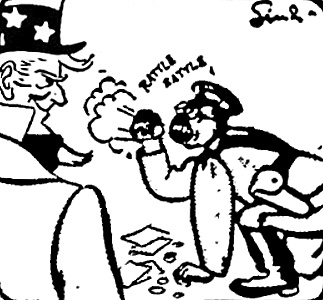
There always came a time when the dice cooled off and that wicked man with the little rake stopped pushing out chips and started pulling them away from me.
In the war right now, the Japs are the players and Uncle Sam is the house – he’s running the game. The dastardly, desperate little Nipponese are in the same spot you or I would be if we were bucking the crap table at Col. Bradley’s Palm Beach casino.
We start with twenty bucks, say. The Colonel starts with millions. Suppose we nick him for twenty and let the twenty ride. We get to eighty. We get to one hundred sixty. With luck we may even get to three hundred twenty.
But there is never a time in the game when we can afford to lose. One missed point, one set of snake eyes, one big boxcar and we’re through. The game is over for us. All the time we were running wild and throwing those hot points, the Colonel was sitting back on his millions and smiling. He not only had the dough but the house percentage in his favor.
Our Uncle Samuel is in the same position. For every one of those ships that went to the bottom in Pearl Harbor a hundred will eventually hit the ways. For every bomber the Japs turn out we’ll turn out twenty. For every pilot they train we’ll train a thousand.
When the going starts to get tough for Japan, along toward the morning of this war, they won’t even be as well off as the average crapshooter usually is, with a friend behind him to put up twenty or fifty bucks. Japan’s “pals,” the Messrs. Hitler and Mussolini, aren’t going to go for a touch when the military dice cool off. Four o’clock in the morning is coming all too soon for them.
As my hackie friend said: “All we gotta do is keep ‘em rolling.”
America urged to add foreign volunteer unit
‘Liberty Legion’ of aliens suggested as part of U.S. forces
WASHINGTON – Increasing insistence that the United States form and equip a “Liberty Legion” consisting entirely of foreign volunteers to serve with the American forces is being felt in various quarters.
High officials feel that one great advantage of the Japanese surprise attack has been to convince large numbers of Americans that “allies” are not really the insignificant factor that isolationists have tried to make out.
The U.S. authorities in the past year have been swamped with offers from refugees in this country offering their services and their lives to the U.S. if only they might be allowed at the same time to strike a blow for the freedom of their homelands. These offers have had to be refused, for the American Army was very distinctly to be a handpicked American Army.
May alter judgment
After the Pearl Harbor misfortune, U.S. Army authorities may be a little less prone to judge the military caliber of foreigners by the military misfortunes their countries may have undergone.
Thousands of South Americans, tough Mexicans, Cubans, unnaturalized Chinese, some Thais (Siamese), a few Japanese, refugees from each of the countries Hitler has overthrown, and finally, anti-Nazi Germans and anti-Fascist Italians, many of them filled with fanatical hatred, could swell the lists of a Liberty Legion.
Had the American administration realized earlier the value of able-bodied foreigners with military training capable of use as soldiers in a relatively short time, it would not have proceeded so vigorously in keeping out Spanish Republicans and even Republican Frenchmen while allowing into this country well-known Vichy agents favorable to France’s cooperation with Germany, agents of the Spanish Falange, and other notorious opponents of the ideas of Tom Paine, Thomas Jefferson and Abraham Lincoln.
Poles would be exception
A possible exception as recruits for the Liberty Legion are the Polish refugees. The Poles are among the world’s best soldiers. But their government already is forming a national Polish army in Canada and would prefer to have able-bodied Poles report for service there than serve in another body.
Czechs who wish to fight have, up until now, been sent to London to join the Czechoslovak forces serving with the British. An arrangement would be easy with both governments.
There would be nothing new in foreigners fighting in American wars. Aside from Lafayette and Steuben, the Pulaski Polish Legion helped Washington win the Revolutionary War. Germans, Hungarians, Poles, Italians, fought in the Civil War.
Elliott goes to coast
WASHINGTON – The War Department today assigned Capt. Elliott Roosevelt, Air Corps officer and son of President Roosevelt, to duty with the 6th Reconnaissance Squadron at Muroc, California, effective December 20. Capt. Roosevelt is not a pilot. Since entering the Army, he has spent some time at the Army’s experimental center at Wright Field, Ohio.
Ernie Pyle’s column starts again Friday!
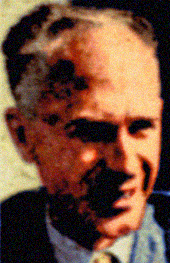
In a world full to overflowing with grim and momentous events, we are glad to welcome back to this newspaper a columnist who is concerned more often than not with “the little things of life” – Ernie Pyle, the Roving Reporter.
Ernie isn’t all sweetness and light, by any means, as is well known to those who followed his memorable dispatches from London during the Battle of Britain. But his is the human touch.
Today he is in San Francisco. His experiences in the air raids and blackouts of London give him a splendid background for writing about the civil-defense preparations on the West Coast.
Ernie has been out of the paper for several months, because of his wife’s illness. She is convalescing now, and Ernie has hit the road again – a road that has taken him to England and Scotland, through Mexico and Central and South America, to Hawaii, to Alaska and the Bering Sea, through Canada, and into each of our own 48 states.
His first column will appear Friday in The Press – exclusively!