The Pittsburgh Press (May 7, 1943)
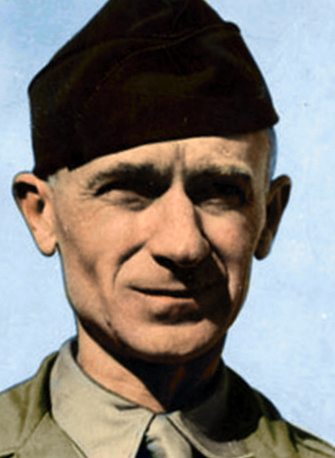
Roving Reporter
By Ernie Pyle
In the frontlines near Mateur, Tunisia – (by wireless)
The day I’m writing about in this column is one of those days when you sit down on a rock about once an hour, put your chin in your hand. And think to yourself:
What am I doing here, anyway?
On this unforgettable Tunisian day, between 3,000 and 4,000 shells have passed over our heads. True, most of them were in transit, en route to somewhere else, but enough of them were intended for us to make a fellow very somber before the day was over. And just as a sideline, a battle was going on a couple of hundred yards to our left, mines were blowing up jeeps on our right, and German machine-gun bullets were zinging past with annoying persistency.
My outfit was in what was laughingly called “reserve” for the day. But when you hear soldiers who have been through four big battles say with dead seriousness, “Brother, this is getting rugged!” you feel that you would rather be in complete retirement than in reserve.
Noise of guns brutal
All day we were a sort of crossroads for shells and bullets. All day guns roared in a complete circle around us. About three-eighths of this circle was German, and five-eighths of it American. Our guns were blasting the Huns’ hill positions ahead of us, and the Germans were blasting our gun positions behind us. Shells roared over us from every point of the compass. I don’t believe there was a whole minute in 14 hours of daylight when the air above us was silent.
The guns themselves were close enough to be brutal in their noise and, between shots, the air above us was filled with the intermixed rustle and whine of traveling shells. You can’t see a shell, unless you’re standing near the gun when it is fired, but its rush through the air makes such a loud sound that it seems impossible it can’t be seen. Some shells whine loudly throughout their flight. Others make only a toneless rustle. It’s an indescribable sound. The nearest I can come to it is the sound of jerking a stick through water.
Some apparently defective shells get out of shape and make queer noises. I remember one that sounded like a locomotive puffing hard at about 40 miles an hour. Another one made a rhythmic knocking sound as if turning end over end. We all had to laugh as it went over.
Close ones sound differently
They say you never hear the shell that hits you. Fortunately, I don’t know about that, but I do know that the closer they hit, the less time you hear them. Those landing within a hundred yards you hear only about a second before they hit. The sound produces a special kind of horror inside you that is something more than mere fright. It is a confused form of acute desperation.
Each time you are sure this is the one. You can’t help but duck. Whether you shut your eyes or not, I don’t know, but I do know you become instantly so weak that your joints feel all gone. It takes about 10 minutes to get back to normal.
Shells that come too close make veterans jump just the same as neophytes. Once we heard three shells in the air at the same time, all headed for us. It wasn’t possible for me to get three times as weak as usual, but after they had all crashed safely a hundred yards away, I know I would have had to grunt and strain mightily to lift a soda cracker.
Heinous bedlam after lull
Sometimes this enemy fire quiets down and you think the Germans are pulling back, until suddenly you are rudely awakened by a heinous bedlam of screaming shells, mortar bursts, and even machine-gun bullets.
Here is an example of these sudden changes. As things had died down late one afternoon, and the enemy was said to be several hills back. I was wandering around among some soldiers who were sitting and standing outside their foxholes during the lull. Somebody told me about a new man who had had a miraculous escape, so I walked around till I found him.
He was Pvt. Malcolm Harblin, of Peru, New York, a 24-year-old farmer who has been in the Army only since June. Pvt. Harblin is a small, pale fellow, quiet as a mouse. He wears silver-rimmed glasses. His steel helmet is too big for him. He looks incongruous on a battlefield. But he was all right in his very first battle, back at El Guettar – an 88mm shell hit right beside him, and a big fragment went between his left arm and his chest, tearing his jacket, shirt and undershirt all to pieces. But he wasn’t scratched.
Dud passes on first bounce
He still wears that ragged uniform, for it’s all he has. He was showing me the holes, and we were talking along nice and peaceful-like when all of a sudden here came that noise, and boy this one had all the tags on it.
Pvt. Harblin dived into his foxhole and I was right on top of him. But sometimes you don’t hear a shell soon enough, and in this case, we would have been too late, except that the shell was a dud. It hit the ground about 30 feet ahead of us, bounced past us so close we could almost have grabbed it, and finally wound up less than a hundred yards behind us.
Pvt. Harblin looked at me, and I looked at Pvt. Harblin. I just had strength enough to whisper bitterly at him:
You and your narrow escapes!