The Pittsburgh Press (August 4, 1944)

Pegler: Press propaganda
By Westbrook Pegler
St. Louis, Missouri –
At this distance it is possible to examine more clearly specimens of propaganda which, amid the general clamor of continentalism on the Eastern Seaboard, are indistinct noises in the campaign.
I should like to discuss a United Press dispatch published in today’s St. Louis Star-Times, a highly beholden New Deal paper and not Red, nor even pink, but of that pale orange hue which comes of mixing a very little red with a liberal splash of another primary color.
The UP reported that Russell Davenport would not support Tom Dewey for the Presidency.
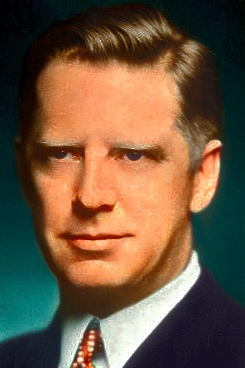
Not one American in 100,000 ever has heard of Russell Davenport. He is identified as the editor of Fortune, which sells by subscription only for $10 a year and thus can hardly be called a well-known magazine. Mr. Davenport is qualified as a quoteworthy person because he was a “close associate” of Wendell Willkie in 1940.
“Millions of other Republicans will find it necessary to make that decision,” not to support Mr. Dewey, Mr. Davenport was enabled to say on crowded press wires and on scarce white paper, as though this man had a recognized right to speak for multitudes.
Represents no party
But has he? He represents no party. Even in the 1940 campaign, he had no position in the Republican Party. He was, at most, a sleeve-puller for a personal hero. Such advertisement as he has had, was derived from this association and the fact that he is the husband of Marcia Davenport who wrote some books.
Yet, by exercise of the suave effrontery of the con man who greets the sucker with a booming “Well, if it isn’t my old friend, Joe Butch,” the unsuspecting victim is given to feel that he really does know Russell Davenport. For the moment, through his own stupidity, he just can’t place him.
Mr. Davenport announced his decision at a forum of the newly-organized New York Liberal Party. The reader is too proud to admit that he doesn’t know what the Liberal Party is. It is what the Communists call a fraction, or ideological offshoot, of the Communist Party.
The American Labor Party, or Communist Party, now controlled by Frank Roosevelt’s henchman, Sidney Hillman, advocates the Russian type of dictatorship. Mr. Davenport’s friends of the Liberal Party prefer the Hitlerian type of dictatorship, but, of course, without antisemitism.
Both groups agree, however, on all the essentials of totalitarian rule. They agree further on Mr. Roosevelt’s candidacy, and their only discord is a personal rivalry between Mr. Hillman and David Dubinsky of the Garment Workers’ Union, refugees both, who found here privilege, luxury and safety, but never have liked the way the Americans run their country.
No objection to persecution
Neither group has the slightest objection to persecution, of itself. Violence against American workers refusing to join a union, or to strike on the orders of union dictators, no less savage than the brutalities of Hitler’s Brownshirts, has left them calm.
Hideous slanders against decent Americans equivalent to Der Führer’s filthy anti-Jewish propaganda, is their common repartee. They force Americans who detest their ideas and candidates to attend their political rallies and contribute to their campaign funds.
Mr. Davenport announced his decision about the time that the primary returns revealed the nomination of Republican Ham Fish and Vito Marcantonio of the Communist front.
He said:
For weeks, Dewey resisted efforts to draw from him a repudiation of Ham Fish on the basis of his obstruction of attempts to prepare the country for war.
Mr. Marcantonio voted against every “attempt to prepare the country for war,” until Hitler attacked Russia. His Communist cohorts violently obstructed such efforts in the war plants. Mr. Fish’s obstruction consisted of his single vote in Congress. Mr. Marcantonio changed when Russia was attacked. Mr. Fish changed instantly when the United States was attacked.
Mr. Dewey did repudiate Mr. Fish. Mr. Roosevelt has not repudiated Mr. Marcantonio.
Yet here a political nobody is presented as a man of standing and a spokesman for millions in a dispatch from a reputable news agency, thus endowing him with a completely fictitious importance.