
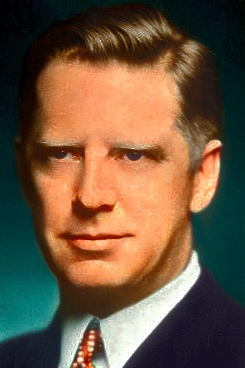
Pegler: Thomas the missionary?
By Westbrook Pegler
New York –
No good purpose could be served by the visit of R. J. Thomas and other American professional unioneers to the zone of war in France and the ulterior purpose is plain.
Certain New Deal gauleiters went abroad to take the heat off the soldiers’ resentment against strikes and slowdowns and the extortion of hundreds of millions of dollars from construction workers. They want those soldier votes for their candidate. They have another purpose – to soften up the soldiers for exploitation by the unions when they come back.
The choice of Thomas as one of the missionaries to an angry fighting army is the most significant selection. This man’s union, the United Auto Workers, having nowadays about one million head within its corrals, 90 percent of them either unwilling or uncomprehending captives, has a particularly bad record. It was the union in the memorable Allis-Chalmers Communist shutdown near Milwaukee in the days of the Hitler-Stalin alliance. Again, it was the union responsible for the North American Aviation blockade at Inglewood, California, which was broken only by troops of the regular Army. Neither one was a membership strike. They were Communist insurrections.
The object in both cases was to prevent the conversion of this nation’s industry from peace to war and thus to assure Britain’s defeat, as she stood alone against the Nazis. The Communists planned the dissolution of the United States into a mobocracy, under external force from triumphant Nazis and internal Communist force. After that Communist dictatorship was to come. The plan changed on June 22, 1941, when Hitler double-crossed his ally and the war became, in the view of Mr. Thomas’ Communist colleagues, a crusade for freedom in which we were welcome to participate. The Communists even berated us for not being able to send equipment to Russia in larger quantities, a failure which was largely their own doing.
The soldiers in France are too busy with more urgent matters to inform themselves that two of the more detestable Communist saboteurs involved in these two jobs have, ever since, enjoyed deferments in the draft on the ground that as professional unioneers they are essential to the war effort on the home front. It is doubtful that Thomas will remember to tell them that, or that he will explain the more spiritual aspect of CIO-unionism as propounded by his valued colleague, one Posner, known as Thomas de Lorenzo, who said that if it came to a question of sacrificing some advantage for Mr. Thomas’ union or sacrificing the life of an American flier, he would let the flier die. The question was one of deliberately retarded production of fighting planes for the Navy. And so deep was the position occupied by Thomas and De Lorenzo, under the political patronage of the Commander in Chief, that even Frank Knox, then secretary of the Navy, kept silent.
They were blasted out only when a subordinate in the Navy department privately appealed to certain members of the press to publicize this sector of labor’s gains under the New Deal. But it is incorrect to say that they were blasted out. The one called De Lorenzo got a vote of confidence from his subjects, who otherwise might have suffered from epidemic broken-leg, and brother Roosevelt’s government, forced to offer some rebuke, chose the mildest possible way. He got 30 days and a $500 fine for giving false data on a government questionnaire, but nothing for the sabotage. He may never serve the 30 days and the union may pay the fine.
This is the boldest political mission yet sent to the troops. The President’s own forays have the color, if not the exact odor, of legitimacy. Mrs. Roosevelt, after all, did go through the masquerade of wearing a Red Cross habit on her roundabout visit to her political protégé, Joe Lash, on Guadalcanal. But the union politicians have no such excuse or disguise for a mission which is purely political. They go as advocates of the fourth term and of all Roosevelt’s works and purposes. The immediate object was to deceive the troops by propaganda to which men so far from home and so preoccupied could not have the answers.
“This strike talk is purely propaganda,” said one of them.
That there have been more than 10,000 strikes in war plants since Pearl Harbor is well known at home, but the troops can’t know that. And even we, at home, can’t know the whole truth, because the Roosevelt Labor Department keeps the statistics and, being an accomplice, naturally will not squeal and implicate itself.