Rambling Reporter
By Ernie Pyle
TIMBERLINE LODGE, Ore. – My first day of skiing is over and, just as soon as I get rested up a little, I’m going on the warpath after the man who invented this outlandish mode of transportation. Give me an oxcart, instead, any day.
I know, from this first day, that I’ll never be a skier. All my instincts, my sentiments, my muscles and my ligaments cry out tonight, “Nuts to skiing!” If I had my way, I’d never so much as look at a ski again.
But a man with a determination can’t have his own way. I came up here to ski for a week, and if I gave up after only one day of trying, I could never again hold up my head in public.
Consequently, tomorrow at 10, barring famine or flood, I’ll be out there falling down as usual. Maybe, in one week, I can at least learn to fall with grace and precision.
Olaf Rodegard was our instructor today. Olaf is from Norway, but he’s been in this country 12 years, and his English is perfect. His voice is very soft, and he is kind and calm.
You can get ski instruction either in classes or privately up here. The classes run from 10 to 12 in the morning, from 2 to 4 in the afternoon. It costs $2 for a full day. I took the class, and it was almost the same as private, for there were just two girls and myself. We were all beginners.
Olaf strapped on my skis just outside the Lodge, and we had to walk (with the skis on) across the snow and ice about 300 yards to where we were going to practice.
Walking hard work
Taking the first step gave me one of the most ghastly moments of my life. Those skis felt like they were 100 yards long. I had a wild, caged-like sensation, and thought, if I could only snatch them off, my, how I could leap and slide and cavort!
But somehow I wobbled safely to the skiing grounds. Walking on skis is hard work. Even the experts look clumsy, just walking. Every 50 feet or so the muscles in my legs would give out, and I’d have to stop and rest. The girls didn’t seem to have any muscle trouble, and that made me feel badly.
Finally we got to our place – a gentle little slope, hidden behind nice fir trees. At least not many people could see our shameful clumsiness.
The first thing Olaf did was show us how to stop. Skiing is just like driving an auto in that respect – you’d better find out how to stop before you start.
You stop by pushing your legs apart, thus bringing the front points of your skis together, making a “V.” At least that’s the theory. But my leg muscles were so weak I couldn’t hold the skis in a “V” long enough. So I usually did what most ski novices do in an emergency – just fall over sideways into the snow, on purpose. That stops you.
The next thing Olaf gave us was the “stem turn.” That’s the first simple maneuver of skiing, but everything else is based on it. So we spent all day at it. All day? Ha! Those girls and I will need a year and a day before we can “stem turn.”
Olaf did the turn several times to show us, then called for one of us to start. I was just dying to lead off, but being a perfect gentleman at all altitudes, I waited and let the girls go ahead. I thought maybe, while they were sliding around, I could sneak away behind the trees and somehow get back to the lodge. But Olaf kept his eye on me.
Olaf says he’ll learn
Finally Olaf said to me, “All right, go ahead.” I just seemed to faint all over inside. My eyesight disappeared. I was numb. I tried to shout, “No, dammit, I won’t go!” But no sound came out. I gave a shove with my ski-poles and, Heaven help me, I was off.
I don’t know what happened, but somehow I made a perfect turn, “Did you say you’d never been on skis before?” Olaf asked, as though doubting my honesty.
“Never in my life, I said, naturally a little proud at his inference.
“Well, you’re all right,” he said. “You’ll make a good skier.”
That’s the way I am about everything. Just backwards. Always best at the beginning, I knew it would be like that. For that first turn was the only passable one I made all day.
On the second attempt I fell clear down. Other times I’d get to turning in the wrong direction and have to go that way. Once I forgot either how to turn or to stop, and ran right astraddle of a little fir tree, and skinned my legs all up.
During the day, I suppose the two girls and I skied down that little hill 50 times. I fell down at least 15 or 20 times, and so did they. We just couldn’t seem to learn.
This evening I asked Olaf, “Don’t you get sick of teaching dumb awkward clucks like me the same thing day after day?”
And Olaf, in his soft voice, said, “No, not when people really try to learn, as you all did today. But we get some people who think it’s romantic or something just to dress up in ski clothes, and they won’t even try to learn. That burns me up.”
“Well anyway,” I said. “I’m disgusted. I’ll never be able to ski.”
Olaf laughed. He said beginners are always disgusted. He said he’s seen people break up their brand new skis at the end of the first day, just as golfers break up their clubs.
“It’ll come to you all of a sudden,” he said. “You’re doing fine. Why, you made it over there and back twice today. The average person can’t do that on his first day.”
And thus soothed, flattered, oiled and pomaded by Olaf’s gentle compliments, I went glowingly in to eat, knowing damn well I’d never be able to ski, but elated nevertheless, I suppose that’s what it is about skiing – it’s insidious.
Fair Enough
By Westbrook Pegler
DETROIT – Adolf, my boy, if you could see what I have been seeing around Detroit, you would get yourself a quarter’s worth of clothes-line and do it today.
You think you are a pretty good man at war production, don’t you? Well, and so you are, in your league, but your league is strictly leaky-roof.
You have heard of the great auto industry of Detroit, of course. Biggest in the world, you remember, and your attempt to imitate it with your trashy little people’s wagon was an expression of your envy and awe.
Great factories sprawled all over Detroit and countless little feeder factories spotted around. Passenger cars, trucks, highway freighters and busses streaming out of the doors and away in numbers beyond belief. But you don’t need a description of the Detroit motor industry. You know what it was and the point that will be of special interest to you Is that today it is absolutely kaput, finished.
It has been wound up for the duration and the plants are being dismantled to build planes, tanks, engines for both planes and tanks, guns and other fighting tools which will be turned against you and your Japanese allies, and some of them are already building these things.
Wait ‘till Ford gets on your tail
Not only that, Adolf, but the Americans are building. in Detroit alone, new plants in your honor which will at least double the fabulous Detroit motor center which you and the rest of the world have heard so much about.
This is altogether aside from the other plants which are turning out war tools in the great facilities of that silly, futile, bickering American republic which you challenged, with your colossal but relatively puny machine shop. This is apart from the West Coast plane production, too. This is just Detroit that you are hearing about. It is Detroit times two and entirely devoted to the manufacture of a licking for your chosen people of the master race and the Japanese.
Just wait until you get Henry Ford on your tail. Go on, laugh. Sure, he said he could produce a thousand planes a day, which was a meaningless remark and better unsaid, because he meant he could do it if he didn’t have to make frequent changes and only after long preparation. But, Adolf, when old Henry actually sets himself a task and starts doing it, he always delivers and he is now making planes, engines and tanks, and on the side is running a big school for a steady turnover of young Navy flathats who come in more or less green and go out so well trained in the habits and makeup of various machines that they quality for rates and extra pay almost automatically.
That plant is really something, Adolf. You are a pretty good man, with your petulant bang and your idiotic mustache, and when you clap hands, your faceless people give guns, submarines, planes, bombs and all such, but pretty good isn’t good enough. Our Henry is special. That plant of his, no kidding, Adolf, is the damndest colossus the industrial world has ever known.
Less than a year ago, it was just country, with trees on it, and today it is a huge factory and a flying field, all new and all special jobs, already at work on his program.
Japanese papers please copy
I wouldn’t kid you. Adolf, or the American people. He isn’t booting bombers off the assembly lines as he ticked off Fords in the old plants, but he is going to outspeed all the old specialized aviation companies When he gets going, and he will pick up speed month by month.
You will be hearing from Henry, Adolf, and bear in mind, when you are talking about inefficiency of republics next time, that he didn’t start clearing off the trees until late last March and did it with his own money, too, without waiting for formal contracts with the Government. Man, when Henry gets those dice he sure do make his point and, remember, too, that in his spare time he was still turning out cars and doing some tanks and building another stupendous structure which is now actually putting out. engines for another type of ship and not mere samples, either, but enough of them to be described as production.
And the strange thing is, Hitler, that he didn’t want to do this, at all, He doesn’t hold with war at all, and the poetic passage that he is fondest of is the one that says: “Till the war-drum throbb’d no longer and the battle-flags were furled, in the parliament of man, the federation of the world.”
But he decided that you were a warmonger and so he is going to burn you down and it is going to be just too bad [for the German people, whom he regards as brothers, that they happen to be working for you.
No question about it now, Adolf. This American industrial war effort, at last, is something really super and you might save the German people considerable grief if you should get that clothes-line and do the human race that favor, today.
Japanese papers please copy.
Clapper: A wrong slant
By Raymond Clapper
WASHINGTON – Pearl Harbor woke up many people but it doesn’t seem to have changed Jesse Jones. In the face of unpleasant facts, he remains an incorrigible optimist.
Secretary Jones blandly predicts to a congressional committee that we will get all the rubber we need from the Far East by the end of 1943. He doesn’t think the Japanese can keep us out.
That kind of optimism can only do harm. It is one thing to have confidence in ultimate victory. But it is dangerous to underestimate the task of winning that victory.
To strive to knock the Japanese out by the end of 1943 is one thing. But to base our supply arrangements on the assumption that it will happen is taking an unwarranted risk. We have only a dribble of synthetic rubber in sight now because for months before Pearl Harbor, Secretary Jones didn’t think the Japanese would start a war and he allowed the synthetic rubber program to slide with only the most indifferent attention.
Winning back the Far East is the hardest job we ever undertook.
Allies can’t let China’s morale sink
Right now, the Administration is making a frantic effort to get through Congress a 500-million-dollar loan for China. London is shelling out another 200 millions. For military supplies? No. To help the Chinese fight “inflation,” it is said. To help Chinese morale, is a more direct way to put it. We simply can’t afford to let China drop out of the war. Undoubtedly Japan would like to make peace in China. Undoubtedly Japan is conducting a shrewd propaganda campaign to that end in China.
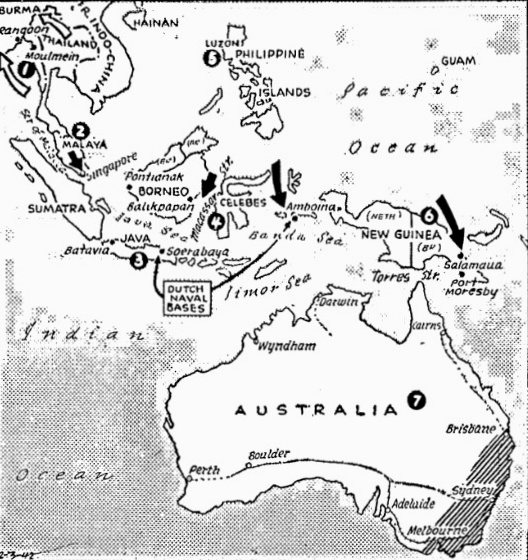
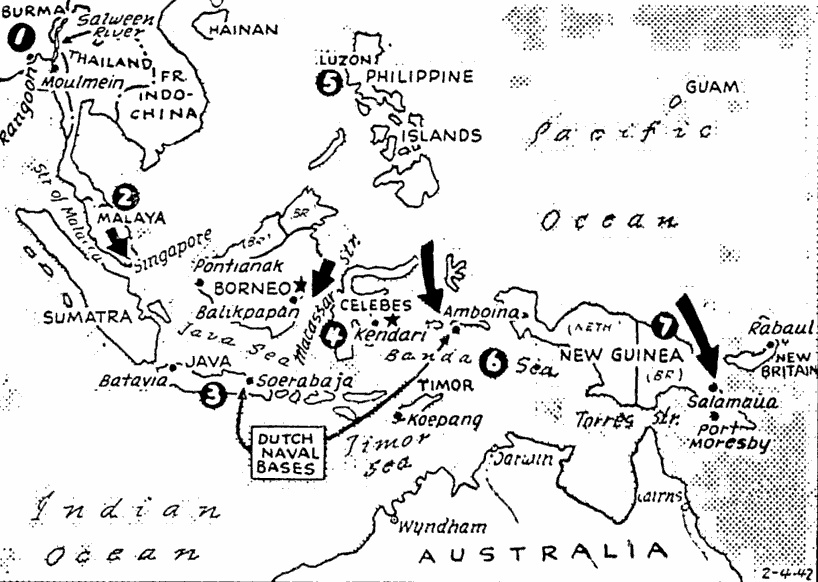
The battle is going against the United Nations all around. We cannot view with any optimism whatever the position of General MacArthur in the Philippines. Singapore is in grave danger. The footholds of the Occidental nations in the Far East are being shaken and it is but natural that the Japanese will attempt to wring the full propaganda value out of that situation.
After the Japanese advance is checked, we must face a long, hard struggle to drive them back to their home base. Nobody who is informed about the military task views it as an easy one or a short one.
Maybe we shall come out better than that. But in planning supplies essential for war purposes, we cannot base our estimates on a mere hope that things will turn out better. We must assume the worst and be prepared for it. The trouble at Pearl Harbor was that no one assumed the worst would happen.
Rank as first-rate nation at stake
We cannot count on the Japanese handing over the rubber plantations intact by the end of next year. We must proceed now as if we never expected to get them again.
If everybody took the attitude which Jesse Jones is encouraging, we would overnight fall back into the slackness which existed before Pearl Harbor. It is not safe for anyone to assume that he can drive his car as much as he likes and count on getting new tires at the end of next year. If the country gets into that state of mind, our whole war effort will bog down. To produce the war goods required, we must press and drive and sacrifice ruthlessly. Nothing short of that will give us what the fighting forces must have.
This job cannot be done with labor insisting on double time for Sunday, welders striking in a row about union dues, industrialists insisting on abnormal profits, or cotton Senators trying to sabotage the effort to hold farm prices in balance. Those are all expressions of the Pearl Harbor state of mind that Jesse Jones seems to share.
That state of mind came near to being the death of Britain. It was the death of France. Our existence as a first-rate nation is at stake literally. We cannot lose this war and remain a first-rate nation. This thing is serious and it is about time be all took it so.
Maj. Williams: Roberts Report
By Al Williams
“Japan must be bombed to defeat.”
Pearl Harbor is the most humiliating disaster – military and naval – ever suffered by American armed forces. And the Roberts Board of Inquiry report on that disaster – a whitewashing vindication of Brass Hatism does not meet the full needs.
That report told us little we didn’t know or sense as soon as the military and naval success of the Japs against Pearl Harbor was flashed to the American people. We knew that the local commanders – one general and one admiral – had been asleep on their jobs, like sentries asleep on posts.
It’s true that the Roberts Report told us a lot of harassing and almost unbelievable things about how frightfully delinquent and unprepared the Army and Navy were to meet the potentialities of modern war. The Roberts Report told us of anti-submarine and anti-tornado nets across the entrance to Pearl Harbor that had left open. It told us of the inexplicable delay of about one hour and 25 minutes between the destruction of a Jap submarine in the inshore coastal waters of Hawaii before a general “alert” was sounded.
Insufficient forces
In brush-odd paragraphs, it told us, “There was a deficiency in the provision of materiel (guns, planes, anti-air detection machinery) for the Hawaiian Area.” It relates how, “The Fleet was not charged with the defense of Pearl Harbor,” that “Insufficient forces were available to maintain all the defenses on a war footing for extended periods of time (five-day war?).” Unfortunately, the Japs planned a seven-day-a-week war.
It continues, “The national situation permitted only a partial filling of these requirements.”
The report states that the Secretaries of the Army and Navy and their staffs communicated with one another and supplied all the files of correspondence to the Roberts Board; that all kinds of general recommendations from Washington had been sent to local Army and Navy forces in the Hawaiian Area (without one check up to see if those recommendations had been received, much less acted upon). It states that Secretary Knox had written a warning that the Japs might attack Pearl Harbor – by air – recommending “the revision of joint defense plans with special emphasis on the coordination of Army and Navy operations against surprise aircraft raids.” (There is no evidence that the Secretary followed up this correspondence to see what had been done about revising the Army and Navy joint defense against surprise aircraft attacks).
The report tells how one warning after another out of Washington had supplied information pointing to the likelihood of Jap attacks against the Philippines, Trai, the Kra Isthmus or possible Borneo. This is complete evidence that the High Command in Washington was all set for the old type of warfare. The deep-seated, stubborn opposition of the Navy and Army high command to aviation – except as in an auxiliary capacity to land and sea forces – which is well known to the American public, all this led to the statement, “Without exception, they (the local commanders) believed that the chances of such a raid while the Pacific Fleet was based upon Pearl Harbor were practically nil.”
Brass hats make mistake
There’s the real key to the Jap surprise at Pearl Harbor. The local commanders, Army and Navy, reflecting what the brass hats had so long thought and planned, just didn’t believe the Japs, or anyone else, would dare to attack a base defended by a fleet. Yet British, Nazi and Italian airpower had attacked and destroyed sea power bases in Europe. That was all different – that couldn’t happen in Hawaii!
What the Roberts Report didn’t tell us is that plans for joint coordination of the Army and Navy are formulated by the General Board in Washington, composed of high-ranking Army and Navy officers.
Failure and lack of coordination of the Hawaiian Army and Navy forces was the real reason for the Pearl Harbor disaster. Oh, certainly, the local commanders “slept.” But didn’t the Army and Navy General Board in Washington sleep, too?
One general and one admiral are the goats. Of course they were guilty, but these two men are the products of a system. And it is the system which licked us at Pearl Harbor.