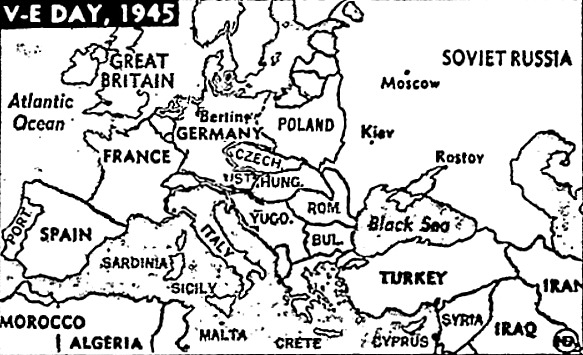
The Pittsburgh Press (May 8, 1945)
Chronology of World War II – from 1939 to today
From attack on Poland, struggle has involved almost every country
From the invasion of Poland by Germany on September 1, 1939, the war expanded until it encompassed virtually every part of the world.
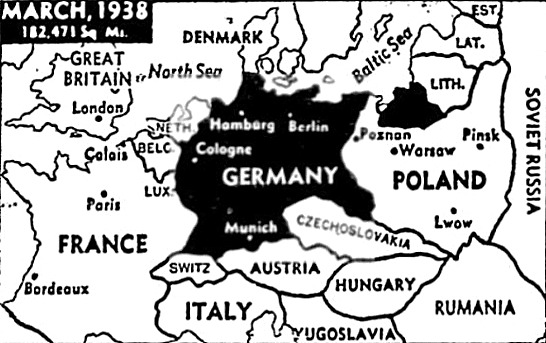
Pre-war Germany, before Austrian ‘Anschluss’ and annexation of Czechoslovakia.
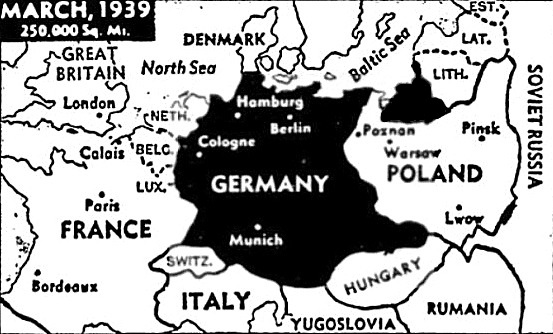
After Munich accord, which gave Germany Czechoslovakia, and after seizing Austria.
As the Allies moved toward victory, events in the war several years ago faded into the distance. To present a picture of the struggle, here is a chronology of important events in World War II:
1939
September 1: World War II starts with German invasion of Poland.
September 3: Britain, France declare war on Germany.
September 17: Russia invades Poland.
September 27: Germans capture Warsaw.
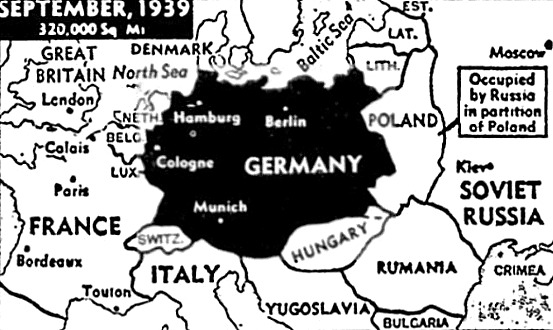
September 29: Germany and Russia divide Poland.
Poland invaded, surrenders in 26 days. Russia shares in partition of country.
October 14: Nazi U-boat sinks British battleship Royal Oak in Scapa Flow.
November 30: Russia invades Finland.
December 14: British cruisers Exeter, Ajax and Achilles battle German pocket battleship Graf Spee off Uruguay. Graf Spee takes refuge in Montevideo harbor.
December 17: Germans scuttle Graf Spee off Montevideo Harbor when time for repairs expires.
1940
February 1: Finland asks for “honorable peace.”
February 9: Russians drive through Mannerheim Line. Under Secretary of State Sumner Welles leaves for tour of embattled Europe.
February 17: British destroyer rescues 326 prisoners from German ship Altmark in Norwegian waters.
March 1: Russians capture Viipuri.
March 2: Sumner Welles talks with Hitler.
March 12: Russia, Finland sign peace treaty.
March 20: French Cabinet of Premier Edouard Daladier falls.
March 21: Paul Reynaud forms new French Cabinet.
April 8: Allies mine Norwegian territorial waters.
April 9: Germans occupy Denmark and invade Norway.
April 13: British battleship Warspite leads armada into Narvik, sinking seven German destroyers and merchant shipping.
April 15: British expeditionary force lands in Norway.
May 2: Prime Minister Chamberlain announces British withdrawal from all of Norway south of Trondheim.
May 10: Germany invades Holland, Belgium, launches offensive against France. Chamberlain resigns; Churchill becomes British prime minister.
May 14: Dutch armies cease resistance.
May 15: Nazis drive great bulge into French lines.
May 16: President Roosevelt asks Congress for more than billion dollars for defense.
May 17: Germans enter Brussels.
May 19: Maxine Weygand succeeds Maurice Gamelin as French commander; Germans 80 miles from Paris.
May 21: Germans reach Channel coast at Abbeville, cutting off British and Belgian forces.
May 28: King Leopold surrenders Belgian Army.
May 30: British begin evacuation at Dunkerque under rain of bombs.
June 3: Germans bomb Paris.
June 4: Dunkerque evacuation completed; 335,000 British soldiers saved, all equipment abandoned.
June 9: British evacuate Narvik, ending venture in Norway.
June 10: Italy declares war on France, Britain; Germans 25 miles from Paris; French government flees.
June 11: Italians invade British and French Somaliland.
June 13: Germans march into Paris.
June 15: Nazis capture Verdun; Russians march into Lithuania.
June 16: Marshal Henri Philippe Petain succeeds Reynaud as French premier.
June 17: Petain asks Germans for armistice terms; Russians enter Latvia, Estonia.
June 22: France signs armistice with Germany.
June 24: France signs armistice with Italy.
June 25: France give “cease firing” order.
June 28: Russians occupy Bessarabia and Bucovina, ceded by Romania.
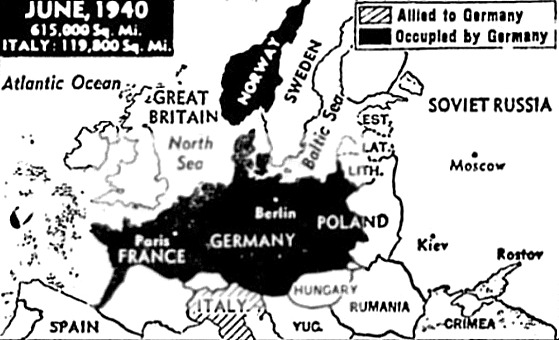
Invasion in West, with Nazi conquest of Norway, Denmark, the Lowlands and France.
July 2: Romania accepts German “protection.”
July 3: British sink three French battleships, disable fourth in battle at Oran, Algeria, when French refuse to surrender fleet. Other French ships interned by British.
July 10: French Parliament votes itself out of existence.
July 12: Petain picks Pierre Laval as vice-premier. President Roosevelt announces plan to call National Guard into federal service.
July 17: Britain agrees to close Burma Road supply line to China for three months.
August 4: Italians drive into British Somaliland.
August 12: Germans open aerial blitzkrieg against England.
August 14: British bomb Turin and Milan in Italy.
August 17: Germany announces total blockade of Britain.
August 19: British withdraw from British Somaliland.
August 20: Churchill announces plan to lease bases in British territory in Western Hemisphere to United States.
August 26: British bomb Berlin.
September 1: Mr. Roosevelt calls 60,000 National Guardsmen into federal service.
September 3: President announces trade of 50 overage U.S. destroyers for bases in British territory in New World.
September 6: King Carol of Romania abdicates, son Michael becomes monarch.
September 7: All-out bombing of London begins.
September 14: Italians invade Egypt from west.
September 16: President Roosevelt signs U.S. draft law.
September 22: France gives Japs rights to move troops into Indo-China.
September 23: British, French fight naval battle off Dakar.
September 27: Germany, Italy, Japan sign tri-power pact.
October 16: All U.S. men between 21 and 36 register for draft.
October 28: Italy invades Greece.
November 2: Counterattacking Greeks drive Italians into Albania.
November 9: Freighter City of Rayville sunk off Australia, first U.S. ship loss of war. Former Prime Minister Neville Chamberlain dies.
November 13: British torpedo planes attack Italian fleet at Taranto.
November 14: Greeks launch counteroffensive against Italians. Coventry devastated by German raid.
December 9: British launch offensive against Italians in Egypt.
December 11: British capture Italian base at Sidi Barani, Egypt.
December 14: Laval ousted from Vichy government.
December 31: Hitler, in New Year’s speech, promises victory in 1941.
1941
January 5: British capture Bardia, Libya.
January 6: President Roosevelt proclaims Four Freedoms necessary for peace; Freedom of Expression, worship, from want and fear.
January 7: President Roosevelt creates Office for Production Management, headed by William Knudsen and Sidney Hillman to run “arsenal of democracy.”
January 8: Mr. Roosevelt gives Congress 10 and a half billion-dollar defense budget.
January 9: German troops pour into Italy.
January 17: Churchill pleads for “avalanche” of U.S. weapons.
January 22: British capture Tobruk, Libya.
January 29: Greek Premier Metaxas dies.
January 30: Hitler warns all U.S. ships nearing Britain will be sunk; British capture Derna, Libya.
February 6: British capture Bengasi, Libya.
February 9: Churchill asks U.S.: “Give us the tools and we will do the job;” British fleet bombards Genoa; British capture El Agheila, Libya. Darlan named vice premier by Petain.
March 1: Bulgaria joins Axis; Nazi troops enter Bulgaria.
March 8: President Roosevelt signs Lend-Lease Bill.
March 12: British expeditionary force reaches Greece.
March 25: Yugoslavia joins Axis. Germany announces blockade zone extending to waters around Iceland.
March 27: Yugoslav Army stages anti-Axis coup, places King Peter on throne.
March 30: U.S. seizes Axis ships.
April 1: British capture Asmara, capital of Italian Eritrea.
April 4: British abandon Bengasi.
April 6: Germans invade Yugoslavia, Greece.
April 10: U.S. extends protection to Greenland.
April 13: Russia, Japan sign neutrality pact. Axis troops occupy Bardia.
April 18: Yugoslav Army surrenders.
April 23: Greek government flees Athens.
April 30: British evacuate 48,000 of 60,000 soldiers from Greece.
May 2: British invade Iraq.
May 6: Stalin becomes Soviet premier.
May 10: Rudolf Hess flies to Britain.
May 18: Italians surrender Ethiopia.
May 20: Nazi airborne troops begin attack on Crete.
May 21: Robin Moor, flying U.S. flag, sunk in North Atlantic.
May 24: Nazi battleship Bismarck sinks British battlecruiser Hood in North Atlantic.
May 27: British sink Bismarck. President Roosevelt proclaims existence of unlimited national emergency.
June 1: British evacuate Crete; Iraq surrenders to British.
June 4: Former Kaiser Wilhelm of Germany dies.
June 8: British, Free French invade Syria.
June 14: U.S. freezes all assets in America of Germany, Italy.
June 15: U.S. closes all Axis consulates.
June 22: Germany invades Russia.
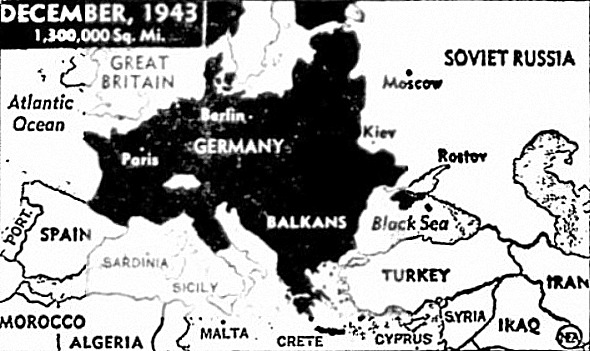
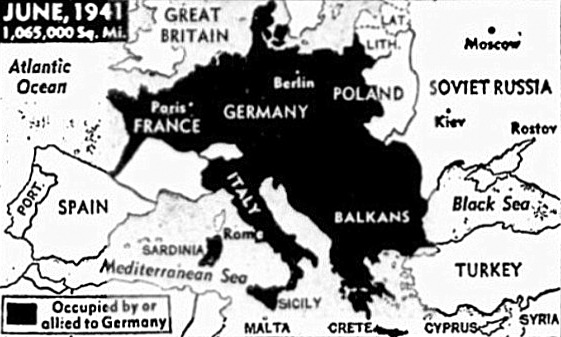
Taking the Balkans, Germany occupied Southeastern Europe by conquest or alliance.
July 3: Nazis capture Riga.
July 7: U.S. troops occupy Iceland.
July 12: British win in Syria. Stalin Line pierced, Nazis say.
July 13: Britain, Russia sign mutual aid pact.
July 17: Germans capture Smolensk.
July 24: Roosevelt freezes Jap assets in U.S.
August 1: Roosevelt bans export of aviation gas and oil.
August 4: U.S. pledges all-out aid to Russia. Japan cancels ship sailings to U.S.
August 9: Roosevelt, Churchill meet on warship in Atlantic.
August 14: Roosevelt-Churchill eight-point program of peace aims announced. Germans reach Black Sea.
August 25: British and Russian troops invade Iran.
August 28: Fighting ends in Iran.
August 30: Nazis capture Tallinn, Estonia; Finns capture Viipuri.
September 4: U.S. destroyer Greer attacked in Atlantic.
September 8: Germans encircle Leningrad.
October 14: Nazis 50 miles from Moscow.
October 15: Russian government moves to Kuibyshev, on Volga River.
October 17: U.S. destroyer Kearny damaged by torpedo in Atlantic.
October 25: Nazis take Kharkov, begin drive into Crimea.
October 30: U.S. destroyer Reuben James sunk in Atlantic.
November 5: Saburo Kurusu named Jap “peace envoy” to U.S.
November 15: Kurusu arrives in Washington.
November 16: Navy seizes German ship masquerading as U.S. vessel.
November 19: British invade Libya.
November 22: Nazis capture Rostov.
November 29: Nazis evacuate Rostov.
December 6: Roosevelt sends personal message to Emperor Hirohito of Japan.
December 7: Japs bomb Pearl Harbor and other U.S. possessions in Pacific. Tokyo announces a state of war with U.S. and Britain. Jap troops land in Malaya. Canada, Netherlands East Indies declare war on Japan.
December 8: U.S. declares war on Japan. Nazis abandon drive on Moscow.
December 9: Japs invade Philippines.
December 10: Japs sink battleship Prince of Wales and battlecruiser Repulse off Malaya.
December 11: U.S. declares war on Germany and Italy after Axis leaders announce hostilities. Jap battleship Haruna sunk off Philippines.
December 13: Russia wins great victory, driving Nazis back on three fronts and retaking 400 towns.
December 17: Maj. Gen. Walter Short and Rear Adm. Husband Kimmel, commanders at Pearl Harbor, removed in shakeup of Army, Navy.
December 19: Congress extends draft to all men from 20 to 44.
December 21: Hitler takes over command of German Army.
December 22: Prime Minister Churchill arrives in Washington; Japs capture Wake Island.
December 24: Japs invade Borneo.
December 25: Hongkong surrenders to Japs; British capture Bengasi.
December 31: Adm. Chester W. Nimitz takes command of Pacific Fleet.
1942
January 2: Twenty-six anti-Axis countries sign United Nations pact. Japs capture Manila.
January 23: Japs invade New Britain, New Guinea, north of Australia.
January 24: Pearl Harbor investigating committee blames disaster on Adm. Kimmel, Gen. Short.
January 26: U.S. troops land in Northern Ireland.
January 29: Nazis launch Libyan offensive, capture Bengasi.
January 31: British abandon Malaya.
February 1: U.S. naval task force raids Jap-held Gilbert and Marshall Islands.
February 8: Japs invade Singapore; British half Nazi drive in Libya 40 miles west of Tobruk.
February 15: Singapore falls to Japs.
February 28: Japs invade Java.
March 7: Japs capture Rangoon, Burma.
March 10: Southern Burma abandoned by British.
March 14: Allies announce loss of 13 warships in Java Sea battle between February 27 and March 1.
March 16: Arrival of U.S. troops in Australia announced.
March 17: Arrival of Gen. Douglas MacArthur in Australia from besieged Bataan Peninsula of Philippines announced.
March 25: American task force raid on Wake and Marcus Islands on February 24 announced by Navy.
March 30: Pacific War Council formed by Allies.
April 9: Bataan falls to Japs.
April 15: U.S. long-range bombers raid Philippines.
April 18: U.S. bombers under Doolittle raid Japan. Laval forms new Vichy government.
April 25: U.S. troops reach New Caledonia, French island east of Australia. French Gen. Henri H. Giraud escapes from Nazi prison camp.
April 30: Japs reach southern end of Burma Road.
May 5: British invade Madagascar, French island off East Africa.
May 6: Lt. Gen. Jonathan Wainwright surrenders Corregidor to Japs.
May 8: Results of Battle of Coral Sea announced; U.S. fleet sinks nine Jap warships.
May 27: Germans launch offensive in Libya.
May 31: RAF hits Cologne in first 1000-bomber attack.
June 3: Japs bomb Dutch Harbor.
June 4: Reinhard Heydrich, deputy Gestapo chief, dies eight days after wounding in Czechoslovakia.
June 6: Midway battle ends; 27 Jap warships sunk, damaged against U.S. loss of three vessels.
June 11: Britain, Russia sign 20-year alliance. Roosevelt, Soviet Foreign Commissar Molotov agree on necessity for second front in May 29-June 4 conference.
June 12: Japs land on Attu in Aleutians.
June 12: American fliers raid Ploesti oil fields of Romania.
June 18: Churchill arrives in Washington.
June 21: Nazis capture Tobruk.
July 1: Germans capture Sevastopol after 250-day siege in Crimea. Nazis under Marshal Erwin Rommel reach El Alamein, Egypt, 55 miles from Alexandria.
July 27: Germans capture Rostov.
July 29: Germans drive into Caucasus.
August 5: Germans cross Don River in Russia.
August 7: U.S. Marines land in Guadalcanal and other Solomon Islands.
August 9: Three American, one Australian cruiser lost in night battle off Guadalcanal. British intern Mohandas Gandhi.
August 12: Churchill reaches Moscow to confer with Stalin.
August 19: Canadian, British, American Commandos and Rangers raid Dieppe area of France, withdraw after nine hours.
August 30: Jap invaders trapped in Milne Bay area on southeastern tip of New Guinea.
September 13: Germans reach outskirts of Stalingrad.
September 28: Australians attack Japs only 32 miles from Port Moresby, New Guinea.
October 7: Navy announces abandonment of two Aleutian Islands by Japs.
October 12: Jap cruiser, four destroyers and transport sunk off Guadalcanal.
October 23: British under Gen. Bernard L. Montgomery begin offensive at El Alamein, Egypt.
November 6: French yield on Madagascar, sign armistice with British.
November 7: American, British forces under Gen. Dwight D. Eisenhower land in French Northwest Africa.
November 8: Vichy France breaks relations with United States.
November 11: Germans occupy all of France. French surrender to Allies in Northwest Africa.
November 13: Adm. Jean Francois Darlan takes over as French leader in Africa. Roosevelt signs bill to extend draft to 18-year-olds.
November 16: Twenty-three Jap ships, including battleship, sunk in November 13-15 battle near Guadalcanal. U.S. losses total two cruisers, six destroyers.
November 18: Allies cross Tunisian border.
November 20: British capture Bengasi.
November 21: Russians launch offensive at Stalingrad.
November 24: Gona, New Guinea, captured by Allies. Russians lift three-month siege of Stalingrad.
November 27: Germans seize French naval base of Toulon; French scuttle most of fleet.
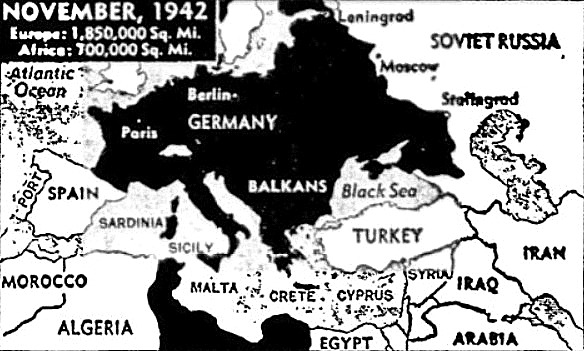
Deep in Russia, and with the Germans entrenched in North Africa and holding all France.
December 5: U.S. bombers raid Italy for first time, attacking Naples. Full Navy report on December 7, 1941, Pearl Harbor raid shows sinking or serious crippling of 10 warships, including five battleships, and damage to three other battleships and five smaller warcraft.
December 8: Allies pushed back near Tebourba, Tunisia.
December 12: British Eighth Army launches new drive in Libya.
December 15: German troops pour into Tunisia.
December 19: British push 40 miles into Burma.
December 24: Darlan assassinated.
December 27: Gen. Giraud named Darlan successor.