1943
January 11: Navy announces loss of carrier Hornet in battle in South Pacific October 26, 1942.
January 16: RAF raids Berlin heavily.
January 23: Eighth Army captures Tripoli.
January 26: Communique announces meeting of Roosevelt, Churchill near Casablanca to plan offensives for 1943.
January 27: U.S. Flying Fortresses, Liberators make first attack on Germany in heavy daylight raid on Wilhelmshaven.
January 29: Moscow announces trapping of seven German divisions west of Voronezh and capture of 100,000 prisoners since mid-January.
February 2: Russians announce surrender of Germans at Stalingrad.
February 9: Japs announce evacuation of forces from Guadalcanal.
February 14: Russians recapture Rostov.
February 15: U.S. forces suffer sharp setback in Said Sened sector of Tunisia.
February 16: Russians recapture Kharkov.
February 21: Germans capture Kasserine Pass, Tunisia.
February 25: Allies recapture Kasserine Pass.
March 4: Yank planes destroy 10 Jap warships, 12 transports in Bismarck Sea at cost of one bomber and three fighters.
March 15: Russians abandon Kharkov.
March 29: British Eighth Army pierces Mareth Line in Tunisia.
April 7: Eighth Army joins forces with American troops in Southern Tunisia.
April 21: President Roosevelt announces that Japs have executed at least some of the eight captured U.S. fliers who bombed Japan in April 1942.
April 23: U.S. Navy discloses occupation of Funafuti, island 450 miles south of Gilberts.
April 26: Russia suspends relations with Polish exile government.
May 7: British and American troops capture Tunis and Bizerte, Tunisia.
May 11: Churchill reaches Washington to confer with Roosevelt.
May 12: Allies announce surrender of Nazis in Tunisia.
May 14: U.S. troops land on Attu in Aleutians.
May 30: Japs admit Jap garrison on Attu has “perished.”
June 4: Revolting army leaders seize power in Argentina.
June 11: Allies capture Pantelleria after 18-day bombing.
June 12: Allied planes hammer Lampedusa into submission.
June 30: Gen. MacArthur starts offensive against Japs; Yanks land on Rendova and New Georgia Islands in Central Solomons and at Nassau Bay in New Guinea.
July 6: Battle of Kula Gulf ends in South Pacific; Japs lose nine warships, U.S. loses cruiser.
July 10: British and American forces land in Sicily.
July 25: Mussolini ousted as Italian premier; Marshal Badoglio takes over.
August 4: Russians capture Orel and Belgorod.
August 6: Yanks capture airfield at Munda, on New Georgia in the Solomons.
August 10: Churchill arrives in Quebec, Canada, for series of conferences with Roosevelt.
August 16: Yanks capture Vella Lavella Island in Solomons.
August 17: Allies complete conquest of Sicily.
August 21: U.S. forces occupy Kiska in Aleutians, find Japs have evacuated.
August 23: Red Army recaptures Kharkov.
August 28: King Boris of Bulgaria dies.
September 3: British land on toe of Italy.
September 6: Italy surrenders.
September 8: British, Americans land at Salerno, Naples. Russians recapture Stalino, free Donets Basin.
September 11: Bulk of Italian Navy escapes to Allies.
September 30: Naples captured by Allies.
October 13: Italy declares war on Germany, is accepted as Allied co-belligerent.
October 18: U.S. Secretary of State Cordell Hull and British Foreign Minister Eden reach Moscow for three-power conference.
October 29: Yanks land on Choiseul Island, in Northern Solomons.
November 1: United States, Britain, Russia and China agree at Moscow to fight their common enemies until unconditional surrender. Yanks land on shore of Empress Augusta Bay, on Bougainville Island in Solomons.
November 2: Russians drive into Crimea.
November 4: Germans flee across lower Dnepr River. Allied bombers wreck Jap fleet at Rabaul, New Britain, blasting 26 vessels, including five warships, and 108 planes.
November 6: Red Army recaptures Kiev.
November 11: Allied planes sink Jap cruiser, two destroyers, wreck 88 enemy planes at Rabaul.
November 15: U.S. bombers from Italy raid Sofia.
November 20: Americans invade Gilbert Islands.
November 22: More than 1000 RAF bombers blast Berlin in heaviest raid of war.
December 1: Roosevelt-Churchill meeting with Generalissimo Chiang Kai-shek at Cairo announced. Three leaders map plans for defeat of Japan.
December 2: Seventeen Allied ships sunk in Nazi raid on Bari, Italy.
December 3: Roosevelt and Churchill meet Stalin in Tehran, Iran, to map plans for defeat of Germany.
December 7: Japs capture Changteh, city in China’s rice bowl.
December 9: Chinese recapture Changteh.
December 17: Americans invade New Britain, landing at Arawe in South Pacific.
December 24: Gen. Eisenhower named chief of the Allied forces for the invasion of Western Europe.
December 26: British sink Nazi battleship Scharnhorst off Norway.
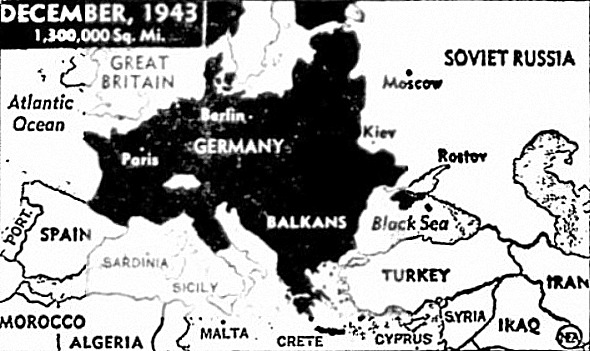
North Africa cleared of the Axis, Italy invaded and the Russians rolling back the Nazis.
1944
January 3: Russians reach the 1939 Polish border west of Kiev. Americans land at Saidor, Northern New Guinea.
January 5: Russians launch new offensive on Southern Ukrainian front.
January 10: Count Galeazzo Ciano, Mussolini’s son-in-law, executed as traitor to Fascism.
January 16: Gen. Eisenhower reaches London to take over invasion command.
January 22: Allies land at Anzio, near Rome.
January 25: Allies reach Cassino, Italy.
January 27: Red Army lifts siege of Leningrad after 2½ years. U.S. government announces murder of 5200 American prisoners and thousands of Philippine prisoners by Japs.
February 1: American troops land in Marshall Islands,
February 2: Russians cross Estonian border.
February 4: American warships shell Paramushiro.
February 8: Allies win the Huon Peninsula in New Guinea.
February 16: Americans invade Green Islands in Northern Solomons, trapping Japs to the south.
February 17: U.S. naval carrier task force attacks Truk, sinking 23 Jap ships and destroying 201 planes. Two thousand U.S. warplanes raid Germany.
February 23: Mariana Islands raided by U.S. task force.
March 1: Americans invade Admiralty Islands in Southwest Pacific.
March 4: American bombers raid Berlin.
March 8: Two thousand U.S. planes raid Berlin.
March 15: Cassino leveled by mass Allied plane and artillery bombardment.
March 18: Russians cross Dniester River border of Bessarabia.
March 22: Americans land on St. Matthias Islands, 600 miles south of Truk. Jap troops invade India.
March 30: Palau Islands, 550 miles east of the Philippines, raided by U.S. task force; 214 Jap planes, 28 ships blasted.
April 2: Russians cross Romanian border.
April 9: Gen. Giraud resigns, Gen. Charles de Gaulle taking full charge of French Committee of National Liberation.
April 10: Russians capture Odessa.
April 22: American troops land at Hollandia, Dutch New Guinea.
April 28: Navy Secretary Knox dies.
May 5: Japs announce the death in action of Adm. Mineichi Koga, chief of the Jap fleet. Gandhi released from internment.
May 9: Russians capture Sevastopol.
May 10: James Forrestal named Secretary of the Navy.
May 11: Allies launch offensive in Italy.
May 17: Americans invade Wakde Islands off Dutch New Guinea. Soerabaja, Java, raided by Allied carrier fleet.
May 18: Cassino captured by Allies; American-Chinese force takes Myitkyina airfield in Northern Burma.
May 23: Allies start offensive from Anzio beachhead.
May 25: Anzio beachhead linked with main Allied force in Italy.
May 28: Americans invade Biak Island, off Northwestern Dutch New Guinea.
June 2: U.S. planes launch shuttle bombing of Axis, taking off from Italy, raiding Romania and landing in Russia.
June 4: Allies capture Rome.
June 5: King Victor Emmanuel of Italy yields powers to son Humbert.
June 6: Allied forces invade France, landing on Normandy Peninsula.
June 9: Badoglio resigns as Italian premier; 71-year-old Ivanoe Bonomi named successor.
June 10: Russians launch offensive against Finland.
June 12: U.S. task force sinks and damages 29 Jap ships, down 141 Jap planes in Marianas.
June 14: Americans land on Saipan Island in Marianas; Naval carrier task force hits Bonin and Volcano Islands 600 miles from Japan.
June 15: B-29 Superfortresses, in first raid on Japan, hit Yawata, on Kyushu Island.
June 16: Germans launch heavy robot plane raids on Britain. U.S. orders Finnish minister to leave.
June 18: American troops drive across Cherbourg Peninsula in France, isolating big port of Cherbourg.
June 19: Two-day action between American carrier task force and Jap fleet in Mariana Islands area and east of Philippines, results in sinking of two Jap plane carriers, one by submarine, and sinking and damaging of 16 other Jap ships. Americans destroy 747 Jap planes at cost of 151 aircraft.
June 20: Russians capture Viipuri, Finland. Japs capture Changsha, China.
June 22: Red Army launches big summer offensive on White Russian front.
June 26: Americans capture Cherbourg.
July 20: Nazis announce attempt to kill Hitler, accuse Prussian generals of bombing attempt and anti-Nazi revolt; Nazis launch widespread purge of army officers. Tokyo announces Gen. Hideki Tojo removed as Jap premier, to be replaced by Adm. Kuniaki Koiso.
July 21: Navy announces U.S. invasion on July 20 of Guam, first U.S. island seized by Japs.
July 24: Navy announces U.S. invasion July 23 of Tinian Island, just south of Saipan in Marianas.
July 25: Americans launch all-out offensive against Germans in Normandy.
July 29: Roosevelt completes three-day conference in Hawaii with Gen. Douglas MacArthur and Adm. Chester W. Nimitz on Pacific war.
July 30: American forces land at Sansapor, Dutch New Guinea, 600 miles from Philippines.
August 1: U.S. troops reach Brittany Peninsula in breakout from Normandy. Russians reach Baltic, trap 200,000 Nazis in Latvia, Estonia. Risto Ryti resigns as president of Finland, to be succeeded by Marshal Mannerheim. Manuel Quezon, president of Philippines, dies at Saranac Lake, New York.
August 2: Turkey breaks relations with Germany.
August 15: Allied Army invades Southern France.
August 23: Romania breaks with Germany, announces decision to join Allies. Marseille captured by Allies.
August 25: Americans and French patriots liberate Paris.
August 31: Russians capture Bucharest.
September 3: British occupy Brussels.
September 4: Finland surrenders to Russia.
September 5: Russia declares war on Bulgaria. Bulgaria asks armistice of Russia seven hours after declaration of war.
September 8: Bulgaria declares war on Germany.
September 11: Americans invade Germany; U.S. troops from North and South France reach juncture. Roosevelt and Churchill begin “beat Japan” conference at Quebec.
September 15: Americans invade Morotai Island, off Halmahera, and land in Palau Islands, east of Philippines.
September 16: Yanks break through Siegfried Line east of Aachen.
September 17: Allied airborne army lands behind German lines in Holland.
September 19: Russia, Finland sign armistice.
September 27: Allied invasion forces land in Albania and islands off Yugoslavia.
October 5: British land in Greece.
October 6: Russians invade Hungary.
October 9: U.S., Britain, Russia and China announce plans for world peace organization to be called the United Nations. Churchill and Eden reach Moscow to discuss Polish dispute and other problems.
October 13: U.S. Pacific Fleet announces series of carrier-plane attacks on Formosa, which, with Superfortress raids from China bases, culminates in destruction of hundreds of Jap planes and scores of ships at Formosa and Philippines. Jap fleet comes out but turns tail at sight of U.S. fleet. Red Army captures Riga.
October 14: British occupy Athens.
October 16: Hungary seeks armistice terms, but Germany takes over country.
October 20: U.S. forces invade Philippines. Russians capture Belgrade.
October 23: Russia announces invasion of East Prussia.
October 24: Jap fleet emerges to challenge U.S. forces in Philippines. Naval-air battle costs Japs more than 34 warships sunk or damaged.
October 25: Russians announce drive into Northern Norway.
November 7: President Roosevelt re-elected to fourth term.
November 12: RAF bombers sink Nazi battleship Tirpitz in Norwegian fjord.
November 24: Tokyo undergoes first B-29 raid.
December 15: U.S. troops invade Mindoro Island, Philippines.
December 16: Nazis break through on Belgium-Luxembourg front.
December 30: Archbishop Damaskinos named regent of Greece.
1945
January 9: Americans invade Luzon Island.
January 11: Truce signed in Greek civil war.
January 13: Russia launches offensive in Poland.
January 17: Warsaw captured by Red Army.
January 20: Russians invade German Silesia.
January 29: First truck convoy reaches China over Ledo-Burma road.
February 3: Americans enter Manila.
February 7: Conference of Roosevelt, Churchill, Stalin at Yalta, Crimea, agrees on final blows to crush Germany, occupation of Reich and post-war peace organization.
February 15: Americans recapture Bataan Peninsula.
February 17: U.S. troops drive across Rhine River.
February 19: American landing on Iwo Island announced.
March 6: Americans capture Cologne.
March 7: U.S. troops drive across Rhine River.
March 22: U.S. Third Army crosses Rhine above Ludwigshafen.
March 24: Allies launch all-out drive across Rhine north of Ruhr.
April 1: Americans invade Okinawa Island.
April 5: Russia scraps neutrality pact with Japan.
April 12: President Roosevelt dies at Warm Springs, Georgia. Harry S. Truman sworn in as President.
April 13: Vienna captured by Russians.
April 21: Russians drive into Berlin.
April 25: United Nations conference on world security opens at San Francisco.
April 26: American, Russian armies link up in Germany at Torgau, on Elbe River, 75 miles south of Berlin.
April 28: Mussolini executed by Italian patriots.
May 1: Hitler’s death announced by Nazis; Adm. Karl Doenitz takes over as Fuehrer.
May 2: Nazi armies in Italy and Western Austria surrender. Russians capture Berlin.
May 4: Germans surrender in Northwest Germany, Denmark, Holland.
May 5: Four hundred thousand Germans surrender in Austria.
May 8: Victory in Europe proclaimed.
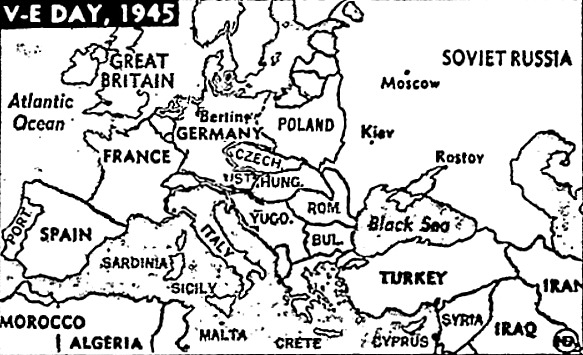
On Victory Day, Hitler’s once-mighty empire has shrunk to nothing.