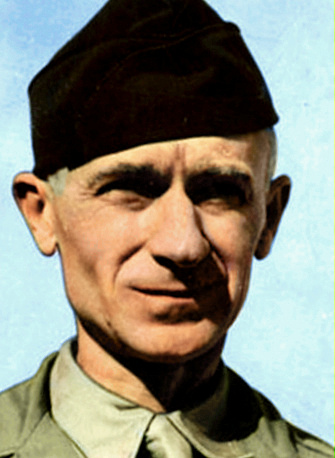
Roving Reporter
By Ernie Pyle
IN THE WESTERN PACIFIC (delayed) – It’s easy to get acquainted aboard a naval vessel.
The sailors are just as friendly as the soldiers I’d known on the other side. Furthermore, they’re so delighted to see a stranger and have somebody new to talk to that they aren’t a bit standoffish.
They’re all sick to death of the isolation and monotony of the vast Pacific. I believe they talk more about wanting to go home than even the soldiers in Europe.
Their lives really are empty lives. They have their work, and their movies, and their mail, and that’s just about all they do have. And nothing to look forward to.
They never see anybody but themselves, and that gets mighty old. They sail and sail, and never arrive anywhere. They’ve not even seen a native village for a year.
Three times they’ve been to remote, lifeless sandbars in the Pacific, and have been allowed to g0 ashore for a few hours and sit under palm trees and drink three cans of beer. That’s all.
They live well
Yet they do live well. Their food is the best I’ve run onto in this war. They have steaks and ice cream – they probably eat better than they would at home.
The boys ask you a thousand times how this compares with the other side. I can only answer that this is much better. They seem to expect you to say that, but they are a little disappointed too.
They say “but it’s tough to be away from home for more than a year, and never see anything but water and an occasional atoll.” And I say yes, I know it is, but there are boys who have been in Europe more than three years, and have slept on the ground a good part of that time. And they say yes, they guess in contrast their lives are pretty good.
Seaman Paul Begley looks at his wartime life philosophically. He is a farm boy from Rogersville, Tennessee. He talks a lot in a soft voice that is Southern clear through. He’s one of the plane pushers on the flight deck.
He says:
I can stand this monotony all right. The point with us is that we’ve got a pretty good chance of living through this. Think of the Marines who have to take the beaches, and the infantry in Germany. I can stand a lot of monotony if I know my chances are pretty good for coming out of it alive.
But others yell their heads off about their lot, and feel they’re being persecuted by being kept out of America a year. I’ve heard some boys say “I’d trade this for a foxhole any day.” You just have to keep your mouth shut to remarks like that.
At least 50 percent of the sailors’ conversation, when talking to a newcomer like myself, is about three things:
The terrible typhoon they went through off the Philippines; the times they were hit by Jap bombs; and their desire to get back to America.
Very few of the boys have developed any real love for the sea – the kind that will draw them back to it for a lifetime. Some of course will come back if things get tough after the war. But mostly they are temporary sailors, and the sea is not in their blood.
Proud of the ship
Taking it all in all, they’re good boys who do what is asked of them, and do it well. They are very sincere and genuine, and they are almost unanimously proud of their ship.
I think I’ve been asked a hundred times how I happened to come on this ship, with so many to choose from. It is always said in that hopeful tone of wondering if I chose it because it has such a noble reputation.
So, I tell them that I asked to be put on a light carrier like this, rather than a big one. But that being a newcomer to the Pacific I didn’t know one ship from another, so this was the ship the Navy put me on.
But that satisfies them just as well, for then they assume that the Navy itself considers their ship a superior one – which I’m sure it does.