Roving Reporter
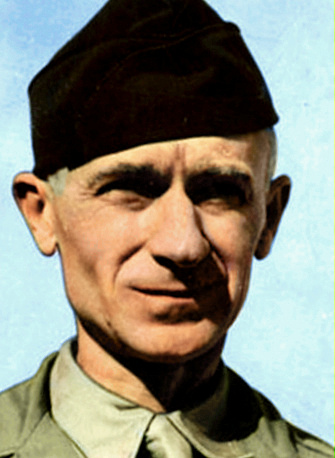
By Ernie Pyle
OKINAWA (via Navy radio) – An hour and a half before H-Hour at Okinawa, our vast naval fleet began its final, mighty bombardment of the shore with its big guns. They had been at it for a week, but this was a concentration whose fury hadn’t been approached before.
The power of the thing was ghastly. Great sheets of flame would flash out from a battery of guns, gray brownish smoke would puff up in a huge cloud, then the crash of sound and concussion would carry across the water and hit you. Multiply that by hundreds and you have bedlam.
Now and then the smoke from a battlewagon would come out in a smoke ring, an enormous one, 20 or 30 feet across, and float upward with perfect symmetry.
Then came our carrier planes, diving on the beaches. And torpedo planes, carrying heavy bombs and incendiaries that spread deep red flame.
Smoke and dust rose up from the shore, thousands of feet high, until finally the land was completely veiled.
Bombs and strafing machine guns and roaring engines mingled with the blended crash of naval bombardment and seemed to drown out all existence.
Assault waves form
The ghostly concussion set up vibrations in the air – a sort of flutter – which pained your ears and pounded upon you as though some almighty were beating you with invisible drumsticks,
During all this time, the waves of assault craft were forming up behind us.
The water was a turmoil of movement. Dispatch and control boats were running about. LSMs and LSTs were moving slowly forward to their unloading areas.
Motor torpedo boats dashed around as guides. Even the destroyers moved majestically across the fleet as they closed up for the bombardment of the shore.
From our little control ship and the scores like it, waves of assault craft were directed, advised, hurried up, or slowed down.
H-Hour was set for 8:30. By 8 a.m. directions were being radioed and a voice boomed out to sea to form up Waves 1 and 2, to hurry up, to get things moving.
Our first wave consisted solely of heavy guns on amphibious tanks which were to wade ashore and blast out the pillboxes on the beaches. One minute behind them came the second wave – the first of our foot troops.
After that, waves came at about 10-minute intervals. Wave 6 was on its way before Wave 1 ever hit the beach. Wave 15 was moving up before Wave 6 got to the beach. That’s the way it went.
We were on the control boat about an hour. I felt miserable and that awful weight was still on my heart. There’s nothing romantic whatever in knowing that an hour from now you may be dead. And the fury of our bombardment was in itself horrifying.
Some officers I knew came aboard. They weren’t going ashore until afternoon. They wanted to talk. I simply couldn’t carry on a conversation. I just couldn’t talk.
I got a drink of water, though I wasn’t thirsty. Then one sailor came up and introduced himself and said he read the column. Then a knot of sailors gathered around on deck.
So far, so good
One sailor with black, close-cropped hair and glasses offered me a cigar. I didn’t even have the wit to put down his name.
I told him I didn’t smoke cigars, but I would take one for our regimental colonel who practically lives on cigars, and was about out of them.
A few minutes later the sailor came up with five more cigars to give to the colonel. They wanted to give me candy, cigarettes, and cookies, but I told them I already had plenty.
Word came by radio that Waves 1 and 2 were ashore without much opposition and there were no mines on the beaches. So far, so good.
We looked at the shore through binoculars. We could see tanks moving across the fields and the men of the second wave walking inland, standing upright. There were a few splashes in the water at the beach, but we couldn’t make out any real fire coming from the shore.
It was all very indefinite and yet it was indicative. The weight began to lift. I wasn’t really conscious of it. But I found myself talking more easily with the sailors, and somehow the feeling gradually took hold of me that we were to be spared. The 7th Wave was to pick us up as it came by. I didn’t even see it approaching. Suddenly they called my name and said the boats were alongside.
I grabbed my pack and ran to the rail. I’m glad they came suddenly like that. The sailors shouted, “Good luck,” over and over and waved us off. We were on our way.