‘Heavies’ hit Nazis in France five blows
8th Air Force bombers attack from Pas-de-Calais to Toulouse – RAF and 15th strike
By David Anderson
South of France now gets attention of Allied fliers
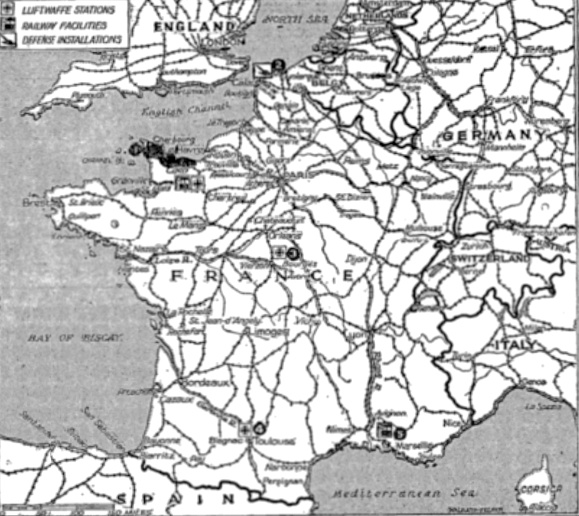
Behind the Normandy beachhead (shown in black at 1), U.S. and British planes continue to blast airfields and communications, while in the Pas-de-Calais area (2) they kept up their battering of rocket bomb installations. In central France, they attacked enemy plane nests at Bourges and Avord (3). Flying to points not far from the Spanish border, Allied airmen struck at fuel depots and airdromes around Toulouse and Blagnac (4). Meanwhile, Italy-based bombers smashed at railroads and bridges north and west of Marseille (5), on the southern coast.
SHAEF, England –
Flying high over the Normandy battle zone and southward another 400 miles to within 70 miles of the Spanish border, a powerful force of U.S. heavy bombers yesterday attacked a Nazi fuel dump and airdromes in the Toulouse area.
Other Liberators and Flying Fortresses striking from Italy blasted bridges over the Rhône River at Avignon, 170 miles east of Toulouse, and other enemy traffic and oil targets north and west of Marseille.
The 8th Air Force’s Fortresses and Liberators from Britain, also smashing at targets among the Nazis’ flying-bomb installations in Pas-de-Calais, made a third attack in the evening on Luftwaffe fields in northern France and bridges southeast of Paris. The airdromes hit included Villacoublay and Brétigny.
Steady Allied attacks from west and south Sunday night were indicated by Nazi radio reports of planes over Germany and the Danube area.
While these heavy-bomber missions were being carried out, medium and light components of the Allied air forces swarmed across northwestern France in search of German troop movements and on wrecking jobs against specific objectives.
The battle within the Battle of France is being waged relentlessly against the enemy’s pilotless plane installations in Pas-de-Calais.
Thousands of U.S., Canadian and British bombers and fighters continued yesterday their hammering of the well-concealed, strongly built placements buried in woods and scattered among farms in the strip of France back of the coast from Dieppe to Ostend, about 30 miles in depth.
In the twelve hours ended at 3:00 a.m. Sunday, at least 1,000 heavy bombers of the Royal Air Force went on duty over the Pas-de-Calais area.
Liberators of the 8th Air Force attacked 12 power stations connected with the robot bases and returned without loss.
The Nazis’ pilotless planes continued smashing homes and killing people in the south of England yesterday, although in a greatly reduced scale compared with last week.
Allied air operations in every form against the Nazis were stepped up yesterday compared with Saturday. Some idea of the scope of these operations will be gathered from Saturday’s activity when 6,000 sorties were flown on 200 missions.
The persistent U.S. and RAF fighter-bomber attacks on enemy communications leading in the direction of Normandy were maintained yesterday with the same intensity that has marked recent operations.
Bridges, fuel, Nazi tanks and rolling stock in the Dreux-Chartres-Mantes area were blasted and shot up. On the railroad between Chartres and Mantes, west of Paris, the tracks were severed in four places and direct hits were scored on a tunnel.
An outstanding success was achieved by a group of U.S. fighter-bombers that attacked chokepoints on the railway linking Paris and Orléans, a 75-mile stretch of electrified line carrying heavy traffic. It runs through a series of deep and narrow cuttings. Seven of these cuttings were bombed, the rails ripped up and the banks sent tumbling onto the roadbeds.