Leaders of the second front –
Montgomery, who conquered Rommel, wants another crack at Hitler’s Fox
Dour, Bible-reading man is commander of British
By Boyd Lewis, United Press staff writer
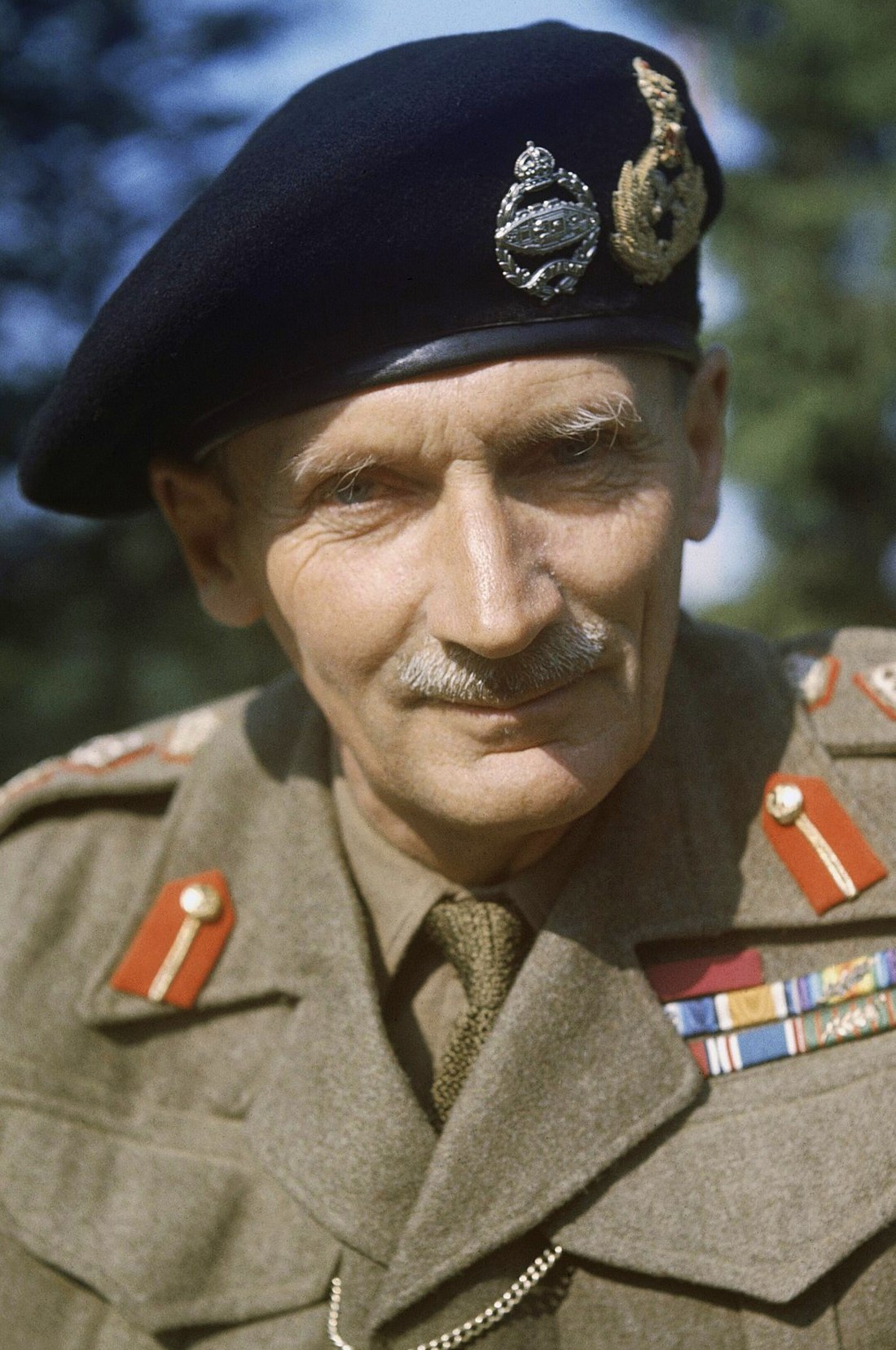
Gen. Montgomery
The name which Prime Minister Winston Churchill gave the world as the leader of Britain’s armies in the western shores of Europe is one which must have brought chills to many a Nazi spine.
Among those tingled spines, perhaps, was that of the erstwhile Nazi gutter fighter, Marshal Erwin Rommel, who has made a military career out of running away from Churchill’s choice – Gen. Sir Bernard Law Montgomery, “Monty of El Alamein.” Rommel has reportedly been dashing up and down the coast of occupied Europe in recent months under special orders from the Führer to put defenses in order.
Now he knows that the doughty, wiry, sharp-featured Monty, who hurled him back from the gates of Alexandria and has chased his armies all the way to Ortona, Italy, is again on his trail. If the attack on Europe proves to be another “rendezvous with Rommel,” no one will be more pleased than Gen. Montgomery.
A Spartan life
Mr. Churchill has described him as “Cromwellian.” To make himself fit for war, he has led an austere, Spartan life, neither drinking nor smoking. His passion for physical exercise is a legend among the officers under his command, who frequently have been rooted off their couches at dawn to romp over hills or along beaches.
He once said:
There is only one standard of fitness – the standard of total war.
If this means dog-trotting six or seven miles with full pack – that’s Monty’s prescription and no officer can complain, because he will be jogging along in the lead.
Thirty-four years of army training and Spartan living have hammered Gen. Montgomery down to a steel spring resiliency. No “desk general,” he is happiest when scooting along the frontline of battle in a tank, dressed in shorts, shirt, and tankman’s beret, with a revolver strapped to his hip.
‘Study of war’
Mr. Churchill once said:
Let me pay tribute to that vehement and formidable Gen. Montgomery, a Cromwellian figure, austere, severe, accomplished, tireless, his life given to study of war, who has attracted to himself in an unusual measure the confidence and devotion of his army.
What is the secret of this “confidence and devotion”? It cannot be his human qualities because he drives his troops like he drives himself – to the limits of their ability. There are none of the stories that some general inspire of little unexpected kindly or human traits.
Perhaps it is because he leads them brilliantly and colorfully. Perhaps it is because he wields his talents and his lore of warfare like a tempered weapon and leads them to success.
Son of minister
The son of the Ulster-born Bishop of Tasmania, this warrior kneels in prayer night and morning and reads the Bible every day of his life. He recommends reading of the Bible to all his officers. Like Cromwell and Chinese Gordon, he is a Christian soldier as well as a British officer.
In staff conferences he is a martinet. He is likely to begin with some such statement as this:
Gentlemen: You may now clear your throats for two minutes. I will then address you for 20 minutes, after which you may have 30 seconds for coughing before I resume. We will have no coughing while I am talking.
He is confident
He is supremely confident – confident to the point of calling his shots. On the day before he sent his troops against Rommel at El Alamein, Gen. Montgomery sat coolly balancing a fly swatter on his index finger in front of his tent.
He said:
During the moonlight tonight, terrific battles will be fought – terrific. When day breaks tomorrow, we shall see how we stand, but there is no doubt of the issue.
A few weeks earlier, before taking command of the 8th Army, he toured the front and found workmen digging defense works behind El Alamein.
He snapped:
What are you doing?
One of the men replied:
Digging defense works.
He ordered:
Then stop it! You will never need them.
Three weeks later, he sent them on the offensive to the skirl of bagpipes. Gen. Montgomery’s men have remained on that offensive ever since – across the undulating shore of North Africa, past Rommel’s Mareth Line, past Tunis, across Sicily and up the Italian boot on the Adriatic side.
Greatest opportunity
Now he comes to his greatest military opportunity, 34 years out of Sandhurst, Britain’s “West Point.”
As a young officer, he was known as an enthusiast for rugby and hockey and attached to the perfection of his military learning. His friends were surprised when he married in 1927 at 40. He ruled his household, according to one writer, “like a medieval knight.” The advent of a son was handled like a staff problem, with Gen. Montgomery issuing daily orders regarding his care, feeding and upbringing.
In World War I, he won the DSO, the Croix de Guerre, and was mentioned six times in dispatches. On the death of his wife in 1937, he devoted himself to the art of war making with furious zeal. In December 1941, he was appointed commanding general of the South-Eastern Command – the portion of England which juts closest to a possible invasion from the continent.
Audacity and science
In 1942, he went to Egypt and launched the 8th Army on its march. On that march he has fought with audacity and science, welding planes, tanks and men. The other day he paused in a sunlit Italian meadow to tell something of what he had learned to Frank Fisher of the United Press.
He said:
First you must win the battle of the air. That must come before you start a single land or sea engagement… it is the first great principle of modern warfare.
Second front generalissimo Dwight D. Eisenhower has already summoned Air Chf. Mshl. Sir Arthur Tedder, who won the battle of the air for Monty in Africa, to clear the skies and “carpet-bomb” the land defenses of Hitler’s Europe. Soon they will be ready for Monty to lead his men out in another bloody dawn like Alamein – this time aimed straight at Berlin!