America at war! (1941– ) (Part 1)

La Guardia criticizes sugar ration system

New York, March 9 (UP) –
Mayor F. H. La Guardia warned yesterday that the sugar rationing system as presently devised:

…will not work in the great big cities like New York.

Addressing a part of his regular weekly broadcast to Leon Henderson, Price Administrator, Mr. La Guardia said that regulations “are just fine” for cities up to 200,000 population, but in major cities:

…you can’t possibly check rationing, or it can’t be enforced.

New York City is ready for sugar rationing, Mr. La Guardia said, but he suggested that Mr. Henderson give “some thought” to changing regulations for larger cities.

18 feared dead in 4 Army, Navy plane crashes

Eight of victims missing since Thursday over Carolina coast
By the United Press

First Lady defends farm security plan

MacArthur ranks high in list of war’s 10 best generals

Skill in machine use stressed in choices
By Edward W. Beattie, United Press staff writer

Charlie the Jap, he doesn’t live there anymore

His flying ‘washing machines’ missed by MacArthur’s troops
By Frank Hewlett, United Press staff writer

Mass suicide! That’s story of Jap air attack on fleet

90 enemy aviators killed, at least 18 giant planes downed, witness to feat of Lt. O’Hare, mates say; anti-aircraft sharpshooting helps
By Francis McCarthy, United Press staff writer

The first detailed eyewitness account of one of the most lopsided victories of the war is contained in the following dispatch. It was written by Francis McCarthy, United Press staff writer, attached to the fleet, who from the deck of a heavy cruiser, watched American planes and anti-aircraft guns destroy an attacking Jap bomber force.

Reporter broadcasts battle to ship crew

Aboard a heavy cruiser, with U.S. Pacific Fleet, Feb. 20 (UP) – (delayed)
Hundreds of crewmen of this warship, below decks when 18 Jap heavy bombers attacked a U.S. fleet task force, heard United Press correspondent Francis McCarthy dictate a dramatic account of the engagement in which 16 and possibly 17 of the Jap planes were shot down.

McCarthy, witnessing the thrilling two-hour engagement from the bridge, was given permission to describe the action over the ship’s public address system. Naval officials said they believed it was the first time this had happened in American naval history.

British flee Rangoon after burning city

New commander-in-chief appointed for Burma front

Federal officials probe waterfront ship fires

Faddis criticizes Landis as Civilian Defense head

Reich Army seizes U.S. Berlin church

New York, March 9 (Religious News Service) –
The American Church in Berlin, a favorite place of worship for United States travelers in Germany during the pre-war years, has been seized by the German Army, according to word received here from the Department of State by the American and Foreign Christian Union, the owners of the church.

The American and Foreign Christian Union operates and owns both the American Church in Berlin and the American Church in Paris. The present status of the Paris church is unknown, it was stated here, although sufficient funds are available in France to support it for the next two years.

Rev. Stewart Hermann, pastor of the Berlin church, has been interned somewhere in Germany, it is believed. Following the outbreak of war with the United States, Mr. Hermann left Berlin and has not been heard from since.

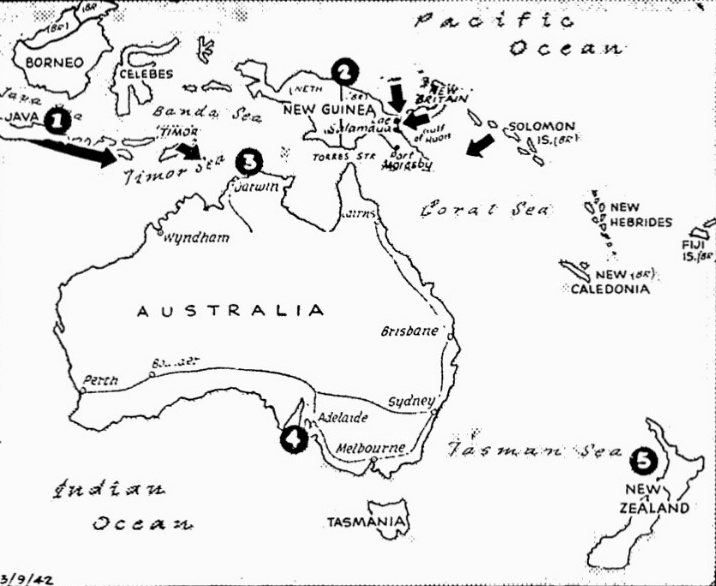
The battle for Australia –


1. Dutch deny that Java’s forces have surrenders, but end is near.
2. Japs land first troops on New Guinea; Aussies bomb invasion fleet.
3. Japs only 280 miles from Australia on Timor Island base.
4. Dutch leaders arrive in Adelaide from Java, say battle still rages.
5. U.S. and British supplies pour into New Zealand, Premier says.

Aussies bomb invasion fleet as enemy lands in New Guinea

Defenders go to hills as Japs arrive
By Brydon Taves, United Press staff writer

Jap-American hits evacuation order

USO shows to be free to all men in service

Industry branches organized by WPB

Work believed near on Alaskan highway

Boston guns manned as plane nears city

Voluntary censorship plan succeeding, director says

Lull reported in sub attacks off U.S. coasts

Worst may not be over; Brazilian vessel sunk; new drive feared

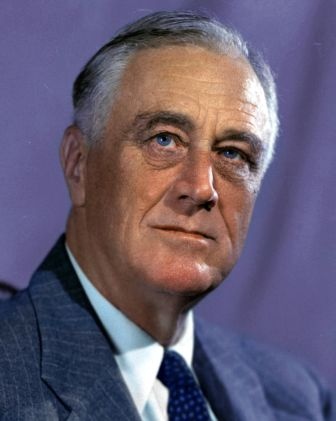
President Roosevelt’s broadcast on the 9th anniversary of the National Farm Program
March 9, 1942, 9:55 p.m. EWT

Audio of the speech:

My fellow Americans:

I want to say a word tonight to the farm families of America and also to the families that consume farm products of every kind. That means everybody – everywhere. No one can think back over the last nine years without coming to the conclusion that the most significant single fact in recent American history is the ability of the American people to face a tough situation and to take orderly and united action in their own behalf and in behalf of the things in which they believe.

There has been a considerable amount of discussion lately about the alleged complacency of the American people. Newspaper editors and commentators have been telling us that the American people are complacent – that they are apathetic.

I think I know the American people pretty well. A lot of them write to me. A lot of them send me messages of one sort or another. They talk to me pretty frankly. If there is one single thing of which I am certain, it is that the American people are not now, and have not been, complacent. On the contrary, they are keenly aware of the situation in which they find themselves, and they are wholeheartedly and entirely committed to action. Now, as a decade ago, they are facing up to the job they have to do, and they propose to see to it that the job is done.

Americans are preparing with all possible speed to take their places on the actual battlefronts, and some are there now. Workers in the mills and mines are laboring long hours, under great pressure, to turn out the weapons and equipment without which the war cannot be won. Men and women in thousands of communities are giving their time and energy in the work of civilian defense. And out in the country, farmers are straining every effort to produce the food which, like the tanks and planes, is absolutely indispensable to victory.

The members of each of these various groups know the extent to which they themselves are responding. But they do not always know what is being done by the others. And that gives an opportunity to the enemy to get in some deadly blows. That gives an opportunity to the enemy to spread malicious words. Labor, says the evil whisper, is sabotaging the war program with strikes and slowdowns and demands for higher wages. Business, it says, is gouging the country with unconscionable profits. And the farmer, according to this treacherous voice, is using the war to grab all he can.

Now it happens that, as a result of the war program, the incomes of all three groups on the average are substantially increased. Of course there are instances where a few businessmen or a few workers, or a few farmers, are demanding and getting more than they ought. But, in general, the increase to the different groups has been kept fairly well in balance, and there has been only a moderate rise in the cost of living in city and country up to now.

It seems to me that we ought to feel proud of the undoubted fact that we are getting cooperation and a reasonably fair balance among 90% of our population and that if less than 10% of the population is chiseling, we still have a pretty good average national record.

But if all prices keep on going up, we shall have inflation of a very dangerous kind – we shall have such a steep rise in prices and the cost of living that the entire nation will be hurt. That would greatly increase the cost of the war and the national debt, hamper the drive for victory, and inevitably plunge everyone – city workers and farmers alike – into ruinous deflation later on.

I wish someone would invent a better word than “inflation.” What we really mean is that even though we may not realize it at the moment, it is not a good thing for the country to upset all the old standards if the cost of living goes up through the roof and wages go up through the roof, and farm prices go up through the roof. Actually, in such a case, we are no better off than we were before as individuals or heads of families and it comes close to being true that that which goes up has to come down.

This fight against inflation is not fought with bullets or with bombs, but it is equally vital. It calls for cooperation and restraint and sacrifice on the part of every group. It calls for mutual good will and a willingness to believe in the other fellow’s good faith. It calls for unflagging vigilance and effective action by the government to prevent profiteering and unfair returns, alike for services and for goods.

So, on this ninth anniversary of the founding of the National Farm Program, we can all rededicate ourselves to the spirit with which this common effort by the farmers came to birth. Never before in our history has there been as much need for unstinting service to the country. Hard, trying, difficult days are ahead. How hard and how bitter they will be depends on how well we can keep our eyes, our thoughts, and our efforts directed toward the only thing that matters now for every one of us in the United Nations – winning the war.