100,000 will join in OCD canvass for scrap here
1,600 sector directors to lead volunteers in 30-day city drive
…
1,600 sector directors to lead volunteers in 30-day city drive
…
London, England (UP) –
London leave for American soldiers was made contingent on bed reservations today as the United States Army and Red Cross worked on a “foolproof” system of housing holidaying doughboys in the British capital.
Army sources said that following the overflow of soldiers in London during last week’s Jewish religious holidays, orders had been given to grant no more London leaves unless the soldiers asking for them had a bed reserved in town.
Mrs. Nancy H. Love, head of the Women’s Air Ferry Service, adjusts her helmet as she takes her place in an Army plane at Wilmington, Del. The WAFS will ferry planes from factory to Army airfields where they are needed.
It did not need President Roosevelt’s warning, in his Lend-Lease report to Congress, to inform thoughtful Americans that we cannot achieve maximum war production till our civilian economy has been stripped to the bone.
But President Roosevelt has been saying that, or something like it, for something like nine months. To date, however, the country, which shows every evidence of wanting leadership, has not been shown what specifically is necessary. Salvage drives have petered out in a welter of disorganization. Bond sales are not what should be largely because no one knows what next year’s tax demands will be. A little ginger in a few spots in Washington would do more good than speeches threatening action from time to time, and repeated every now and then.
The Pittsburgh Press (September 18, 1942)
By Ernie Pyle
LONDON – During the time I have been writing columns from London I have also been traveling around England quite a bit, looking at some of the American camps. So maybe in the next few columns I can tell you some of the things you’d like to know about our troops over here.
I’ll make up my own questions, and answer them myself. Such as, “Are the troops well fed?”
A lot of them would like to kill me for saying this, but I would say the answer is yes.
They are not as well fed as the troops in Northern Ireland, for up there they are on American rations and eat just as they ate back in the states.
In England, only the Air Forces and a few other camps are on American rations. The rest use British rations, cooked by American cooks.
British rations are duller and skimpier than ours, but they are sufficient. Many American soldiers lose weight in their first few weeks here. The reason is that they’re finicky about their food and don’t eat as much as they did at home.
But after a while they get accustomed to it and begin cleaning their plates again, and regain their weight.
The main complaint is the sameness of British food. Their vegetables are potatoes, cabbages and carrots, and they have the same thing over and over till the sight of it makes them see red.
At one camp I was shocked at the amount of stuff the soldier dumped into garbage cans after each meal. But that will straighten out, in two ways – the boys will get used to this different type of food, and also the Army plans eventually to get everybody back onto American rations.

Another question: “How is their health?”
It is fine. It is actually better than it was at home, despite the change in climate and food. What accounts for it I don’t know, but that’s what the medical corps reports.
This fine health may go down a little when England’s damp winter sets in, but so far it is above average.
Also, it is above average on venereal diseases. Among the English, venereal disease has increased alarmingly during three years of war, yet such cases among our troops here are only two-thirds of what the rate was back home.
Question: “How do our troops like England compared with Northern Ireland?”
With the exception of food, they like it much better here. They feel more at home with the people. The climate is less deadly. And they find the girls prettier.
In Ireland the is no place to go for a big time when they get leave. In England and Scotland there are London, Edinburgh, Glasgow and other big cities. Furthermore, camp conditions on the whole are better here than in Ireland.
Question: “Where are our troops, and how are they living?”
Naturally I can’t tell you specifically where they are. They are scattered, but they don’t fill England up as our troops fill Northern Ireland.
You can ride for hours and hours on a train without ever being near an American camp. They are what you might call sectionalized, rather than infiltrated into every British village and crossroads.
So far they are living mostly in camps formerly occupied by British troops. The British moved their troops into other camps, piling them in together to make room for the Americans. The British army calls this the squeezing-in program.
Some of our troops are in permanent brick or wooden barracks, some in huge tent camps, some in houses and barns, some in Nissen huts. Their living conditions vary. Those in barracks have excellent toilet and washing facilities. And they have canteens and nightly movies.
Those in tent camps and individual houses don’t have such perfect conveniences, but nowhere are conditions bad for wartime.
Question: “Do our troops have any one outstanding thing they gripe about?”
No. In all honesty, they haven’t a single gripe.
U.S. Navy Department (September 19, 1942)
South Pacific.
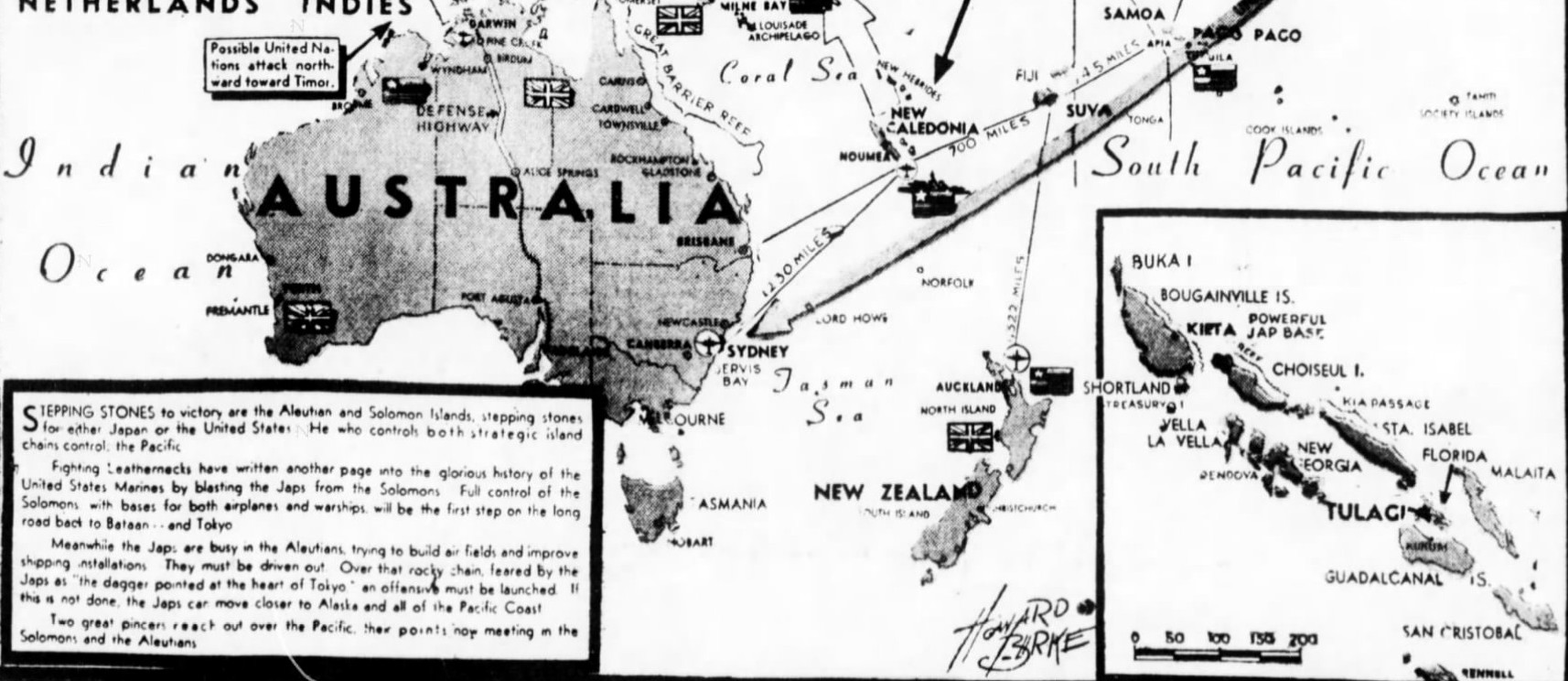
Since the unsuccessful attempt of the Japanese to recapture the airfield at Guadalcanal during the night of September 13-14, there has been a lull in the land-fighting on the island. These hostilities have been confined to minor patrol activity, sniping, and occasional skirmishes between small enemy units and U.S. Marines. Supplies and reinforcements have reached our forces.
On September 14, Army “Flying Fortresses” attacked a force of enemy ships to the northeastward of Tulagi. This force included battleships and cruisers. Heavy anti-aircraft fire was encountered but possible hits on two battleships were reported. When last seen, this force was retiring to the north.
On September 15, 16, and 17, Army long-range bombers strafed and bombed Rekata Bay and on September 16 and 17 bombed ships and shore installations at Gizo Island. Results of these attacks were undetermined although fires were observed after the attack on Rekata Bay on the 15th.
Brooklyn Eagle (September 19, 1942)
Flying Fortresses set fires at Rabaul and Lae – fighters rip Buna
…
Performance delayed for appearance – 2-minute demonstration unprecedented
…
London, England (UP) –
The marriage of Francoise Cabirol, assistant section officer in the British Women’s Auxiliary Air Force, to 1st Lt. Roy Ahalt, USAAF, of Downers Grove, Illinois, was announced today.
Ahalt won the Distinguished Flying Cross last year as a member of the Royal Canadian Air Force. Recently he was transferred to the American Army Air Force.
Agriculture committee urges drastic revision of manpower policy
…
Every now and then, we read that the United States Navy has suddenly seen the light, has become air-minded, and has given air officers a rank commensurate with the importance of aviation in modern war. But when the words are cleared away from the thought in the latest announcement, well, we begin to wonder.
In the latest instance, Rear Adm. John H. Towers, chief of the Navy Bureau of Aeronautics, has been made a vice admiral, and assigned to command the Pacific Fleet Air Force. Adm. Towers is the first combat pilot to achieve so high a rank. So far so good, but who is appointed to replace him as chief of the Bureau of Aeronautics? An airman? Not at all.
It is Rear Adm. John S. McCain, who whatever his qualifications as a seaman, did not learn to fly till he was 51 years old, far too old to qualify as a combat pilot. A man 58 years old, who only learned to fly seven years ago, whose whole life has been devoted to ships before that, becomes the naval air service’s representative in the Navy High Command.
The Pittsburgh Press (September 19, 1942)
By Ernie Pyle
LONDON – Some more questions and answers about our troops over here:
Question: “Do they make fun of the British custom of stopping for tea during the day?”
Boy, I’ll say they don’t. They take to it themselves like ducks to water.
In various headquarters officers scattered around England the secretaries and stenographers are British girls. Of course they must have their tea, so the American officers have tea also.
After this war is over there’ll be a lot of offices back in America that will stop work around 4 in the afternoon while everybody drinks tea.
As for the enlisted men – well, the other morning my peep driver and I decided to stop at a tea shop in a small English town for a cup of tea to warm us up. We found the place packed with American soldiers, drinking tea and eating doughnuts. They made a startling picture – dressed in overalls or battle dress, some of them in tin hats, all of them toughly trained and grimy looking – sitting there drinking tea at 10 o’clock in the morning.
Question: “Are they getting their mail regularly?”
Yes, and no. Some outfits seem to have good luck and others miserable luck. Some get their air mail across in a week. Others never do get some of their letters.
I talked to one soldier who had asked his wife to number her letters. So far he has got numbers 1, 7 and 23. The others must have been lost in the mail, probably due to mis-addressing and to his frequent changes in the outfits.
Packages are very slow coming through. I know any number of soldiers who have been told in letters from home that packages had been sent them two or three months ago but who haven’t got them yet.
Question: “Are troops being worked extremely hard?”
It all depends on the outfit. Mostly I would say yes. The actual fighting troops are toughened with long marches several times a week, up as high as 25 and 30 miles a day. They also have compulsory athletic games.
Some outfits play football, and they play plenty rough – on purpose. I was in a camp the other day where one soldier was put on K.P. duty for failing to show up to play football.
Also, many troops are going through specialized training, running tough obstacle courses.
Question: “How are the troops behaving themselves when off duty?”
Fine. The British are agreeably surprised. They had heard so much about Americans being wild men that they expected the worst. But cases of misconduct are exceptional.
Question: “How do they get along with the English?”
Perfectly all right. The average soldier likes the average Englishman, for they are very much alike. It’s the “upper classes” on both sides who do the dirt-slinging and brew up trouble between our nations.
If the theorists on both sides who are so worried about British-American relations and who keep viewing with alarm and pointing with good-intentioned do’s and don’ts would only keep their mouths shut there wouldn’t have to be any problem at all.
Most of our troops are in the country, and their contact is largely with small-town Englishmen. And small-town Englishmen look at things in about the same way as small-town Americans do.
The English are a little taken aback by some American traits – our colossal water drinking, our loud boisterousness, our speed both in driving cars and in getting an arm around a girl, our sometimes out-of-order boastfulness.
When put alongside Englishmen, Americans are sort of noisy people. We shout across the dining room for the waiter. We sing at the top of our lungs in the blackout. We push and yell and make a lot of sound with our fun.
But the British people seem to enjoy it and to be getting used to it and it’s only the snobbish minority who turn up their noses.
Question: “What do our troops want most of all?”
They want to get into action immediately, and to get more letters from home.
Völkischer Beobachter (September 20, 1942)
Von unserer Stockholmer Schriftleitung
StockhoIm, 19. September –
Der „Papuakrieg“, wie man in England die schweren Dschungelkämpfe auf Neuguinea bezeichnet, nähert sich rasch der Entscheidung‚ wie die eninschen Berichterstatter in Australien nach London berichten. Die englische Presse knüpft recht besorgte Betrachtungen darüber an, daß die australischen Truppen dem „Kampf mit dem unsichtbaren Gegner“ in keiner Weise gewachsen sind. Viele Soldaten seien aus kürzester Entfernung getroffen worden, ohne daß sie die ausgezeichnet getarnten Japaner auch nur gesehen hätten, und die amerikanischen Sachverständigen seien jetzt gezwungen gewesen, die:
…japanische Geschicklichkeit in der Taktik des Dschungelkrieges vorbehaltlos anzuerkennen.
Die japanische Bedrohung des nur noch 50 Kilometer entfernten Port Moresby hält nach wie vor an, und das Gefährlichste ist in den Augen der australischen Militärkreise die Erkenntnis, daß nicht nur hier eine schwerwiegende Entscheidung bevorsteht, sondern auch an den verschiedensten anderen Punkten im Operationsgebiet des Stillen Ozeans. Die Salomoninseln scheinen nach Auffassung englischer und amerikanischer Berichterstatter das nächste Hauptangriffsziel der Japaner zu sein. Außerdem aber erwartet man‚ wie ein „bisher immer sehr gut unterrichteter“ Korrespondent aus Sydney nach London meldet, Angriffe an anderen Stellen des südwestlichen Stillen Ozeans, doch solle man diesen Angriffen in London nicht allzu pessimistisch entgegensehen,
…denn so schlecht, wie ein großer Teil der amerikanischen und britischen Kommentatoren in der letzten Zeit immer behauptet haben, sei die Lage der Alliierten denn doch nicht.
Brooklyn Eagle (September 20, 1942)
Flying Fortresses block violent attempt to recoup losses
…