America at war! (1941– ) (Part 1)

The Pittsburgh Press (December 24, 1941)

JAPS BOMB MANILA IN WAVES
More invaders land; Wake probably lost

Americans fight ‘even or better’ on Luzon against half dozen thrusts
By Joe Alex Morris, United Press war editor

Gen. Douglas MacArthur took the field today in personal command of American-Philippine forces against a grand Japanese assault upon the Island of Luzon, bastion of America’s Far Eastern possessions.

The American commander-in-chief moved forward with advance echelons of his general headquarters to counter a full-scale Japanese attack aimed from half a dozen directions against the Philippine capital, Manila.

The Japanese supported their heavy attack on Luzon with waves of air raids on the Manila area and apparently indiscriminate bombing of rural Philippine towns and villages for the first time.

Strike at city proper

The attacks on Manila were directed chiefly at the port region, but correspondents said that for the first time the Japanese struck at objectives inside the city proper.

Elsewhere on the World War front the little island of Wake was admitted by the U.S. Navy probably to have fallen to the Japanese, the British garrison at Hongkong stubbornly fought against heavy Japanese odds, a big battle was developing in Northwest Malaya and Europe throbbed with a Nazi-inspired rumor campaign over Adolf Hitler’s winter moves.

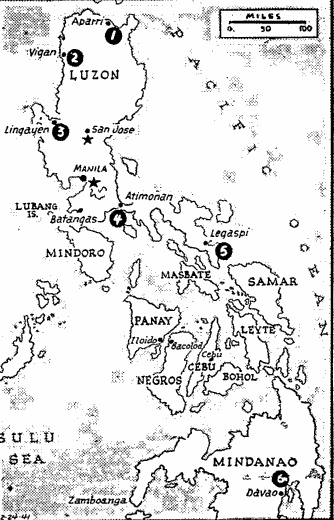
The Japs launched two main attacks against Luzon, the most important being an assault backed by an expeditionary force of 80,000 to 100,000 men along Lingayen Gulf 135 to 150 miles north of Manila and linked with the capital by a broad, flat river valley.

Land men to southeast

Some 75 miles southeast of Manila the Japanese put ashore a force from an estimated 40 transports – possibly 40,000 men – in the Atimonan region.

A third Japanese attempt in the Batangas region, 125 miles due south of Manila, was said by eyewitnesses to have been beaten off by American defense forces although an army communique at Washington indicated the Japanese may be renewing their landing attempts there.

The Japanese have three other minor footholds on Luzon at northern Aparri, western Vigan and southeastern Legaspi. On the southern island of Mindanao, they also are ashore at Davao but there have been few reliable reports on fighting in that region.

Even or better terms

American authorities announced they are considering declaring Manila an open city to attempt to free the population from the hazard of repeated air attacks.

Reports from the fronts indicated that despite an inferiority of numbers, American and Filipino troops are giving a good account of themselves in action against the Japanese. They were fighting on even or better terms, correspondents said.

Extending their operations eastward to the American island stepping stones on the air route from Hawaii to New Zealand and Australia, the Japanese carried out small scale attacks on Johnston and Palmyra Islands, the U.S. Navy reported, with negligible damage.

In Europe the British warned against placing too much emphasis on rumors of German drives into Spain or Turkey, taking the position that the Nazis were seeking to obscure their military plans with a “rumor screen.”

Propaganda Minister Paul Joseph Goebbels made a grim Christmas address by radio to the German people, taking the line that Germany is suffering greatly in a world full of enemies but still is able to protect herself.

The latest crop of unauthenticated reports chiefly concerning alleged German troop movements through France toward Spain and claims that Marshal Henry Philippe Petain was again about to resign.

A new front was opened up in the Philippines by the Japanese landing in considerable force at Atimonan, 75 miles southeast of Manila.

U.S. faces two fronts

Although Atimonan is considerably closer to Manila than Lingayen Gulf the terrain difficulties of an advance to the Philippines capital made it appear that the second big Japanese landing is designed primarily to divide Gen. MacArthur’s forces and make him fight on two fronts.

The American battle lines on the Lingayen Front were holding well but communiques from U.S. headquarters made it clear that they have a most difficult task confronting them. The communiques reported Americans fighting against “great odds” and spoke repeatedly of “heavy pressure,” “heavy” Japanese forces, and heavy fighting.

However, United Press staff correspondents at the Lingayen Front revealed that the Japanese are paying heavily for any gains. The forces of Maj. Gen. Jonathan M. Wainwright, commanding on the Lingayen Front, were said to be outnumbered by that portion of the Japanese force of 80,000 to 100,000 men which got ashore.

‘Forward’ troops in action

Gen. MacArthur’s headquarters announced that forward troops of Manila headquarters have been sent into action. The announcement did not make clear whether these are reserve forces or the first detachments of Gen. MacArthur’s main forces which have been held in reserve until the Japanese battle pians became fully revealed.

The Japanese air assaults on the Manila area were by far the heaviest yet directed at the Philippines capital region. The Japanese were employing bombs as large as half a ton and casualties were admitted to have been large.

As Manila firemen battled to subdue fires set in one raid, the Japanese planes came over again and dropped more bombs.

Jap transports sunk

Reports from refugees from Davao. where the Japanese have landed on the southern Mindanao coast, said that seven Japanese transports were sunk in the landing operation there. Rumors circulated that large numbers of transports were sunk off Lingayen coast, but there was no official statement, although American bombing planes are known to have attacked the Japanese persistently.

Reports from Hongkong, received as late as 12:30 p.m. in London (6:30 a.m. EST) said that the British garrison still holds out and has even succeeded in bettering its position on the central part of the island despite giving ground on the southern shore near Repulse Bay. Chinese attacks behind the Japanese lines from Kowloon to Canton were said to have increased in vigor.

The Chinese were said to have captured Namling, 50 miles north of Hongkong.

In Malaya the fighting was centered in a defense quadruple established by the British in a region 40 miles wide and 20 miles deep just north of the important communications and road center of Ipoh, 285 miles north of Singapore. The Japanese were attacking persistently but without success thus far.

The Japanese, claiming the occupation of Wake Island, admitted the loss of two more destroyers. This brought the Japanese admitted losses to four destroyers at Wake.

WAR BULLETINS!

Another Nazi general killed in Russia

BERLIN (Official German broadcast) – Lt. Gen. Friedrich Bergmann, commander of an infantry division, has been killed in fighting on the central sector of the Russian Front, the official DNB News Agency reported today.

Nazis execute three more Frenchmen

VICHY – German military authorities in Paris today announced the execution of three Frenchmen, one for activity favoring the enemy and two for illegal possession of firearms. In all, 206 Frenchmen have been executed in Occupied France since the Germans started reprisals for anti-German activities.

Dutch ‘get’ 13 Jap ships

BATAVIA – Dutch submarines and aircraft have sunk 13 Japanese transports and tankers and seriously damaged four others in the Pacific warfare, the Netherlands High Command said today in a communique which asserted that Dutch army bombers left a Japanese transport in a sinking condition off Kuching, Sarawak. The communique said that the transport was heavily bombed when army bombers attacked a concentration of Japanese ships off the Sarawak capital.

Chinese drive nearer Hong Kong

CHUNGKING – Chinese forces have captured Namling, 50 miles north of Hong Kong on the important Kowloon-Canton railway, the official Chinese news agency said today. Namling is the next big station north of Shamchun on the Kowloon-Canton railway. It was taken Monday by Chinese troops waging an offensive against Japanese forces on the mainland opposite Hong Kong. The Chinese attacks were designed to relieve Japanese pressure on the British crown colony.

RAF batters Nazi warships

LONDON – British bombers launched another attack last night on two German battleships and a cruiser at the Brest naval base in occupied France while other Royal Air Force planes attacked objectives at Cologne and elsewhere in Western Germany, an Air Ministry communique said today.

Japs on move in China

CHUNGKING – Less than 6000 Japanese troops have launched three minor offensives in Hunan, Anhwei and Kiangsu Provinces, presumably to delay Chinese plans for a general counteroffensive, the National Party newspaper, Central Daily News, reported today. Two of the drives were said to have been repulsed. A third unit of about 2000 men was reported to have entered a Chinese-held city.

Mass starvation reported in Greece

BEIRUT, Syria – Refugees arriving here today said there was mass starvation in Greece. They said that in the Athens area alone, 2400 persons had starved to death in a single week. The refugees reported that a delegation from Geneva was seeking support for a plan to set aside a Turkish port or a Greek island from which food shipments in neutral vessels can be taken for distribution to starving towns in Greece.

American woman killed in Hong Kong

WASHINGTON – An American citizen, Miss Florence Webb, has been killed by shell splinters in Hong Kong, according to a report received at the State Department. According to the department’s records, Miss Webb was born in Shanghai on June 15, 1908. The American consul general in Hong Kong reported there was no other death or injury to any American, but that living conditions there had become extremely dangerous.

12 Jap planes downed in Burma

CHUNGKING, China – Reliable advices said today that 12 Japanese planes had been shot down in a heavy attack on Rangoon, capital of Burma, and that three British planes were lost. Britain claimed nine Japanese bombing planes and one fighter plane in a raid on Rangoon yesterday.

British claim Malaya victory

NEW YORK – The British radio broadcast news dispatches from Singapore today asserting that “wave after wave of Japanese infantry has been wiped out in fierce fighting around Kuala Kangsar near Ipoh” in Malaya. The broadcast was heard by the Columbia Broadcasting System.

Death for German profiteers

LONDON – Adolf Hitler has decreed the death penalty for profiteering in the collection of clothing for the German army or depriving the troops of the apparel, Radio Berlin said today.

Spain hints of new front

MADRID – Spanish newspapers today prominently displayed Berlin dispatches of “important events” soon in the Mediterranean. Informed Spanish quarters believed that the next few days will see swiftly moving developments.


Russia sought as member of Allied council

Churchill is confident of victory as White House conferences continue
By Lyle C. Wilson, United Press staff writer

WASHINGTON (UP) – Tremendous Japanese pressure on Singapore and the Philippines promised today to move President Roosevelt and Prime Minister Winston Churchill quickly to bring Russia into their White House War Council.

They continued their discussions last night and today in meetings broken only for sleep and for an amazing interlude – an American press conference. Some 200 British and American correspondents crowded into the president’s big Oval Office. Answering their questions, Mr. Churchill proved himself as able a verbal boxer as the president.

It was a good show while it lasted and then the war talks were resumed. It is strictly an Anglo-American meeting so far. But all the Allies are to be kept advised and, presumably, ultimately to join in discussions which will make the White House the actual anti-Axis headquarters for World War II.

These facts developed after 17 days of war with Japan and less than two days of Anglo-American war councilling here:

  • That our own Pacific Ocean is the immediate danger spot to the Allied cause.

  • Germany is retreating before Russian thrusts in Europe.

  • The Atlantic lifeline by which Great Britain obtains supplies from Canada and the United States is functioning better than ever.

  • British forces are giving the Axis at least a preliminary licking in North Africa.

  • The British home front is quiet.

  • But in the Pacific, the Allied forces are on the defensive at almost every point. Guam is gone and Wake Island has been invaded. Hong Kong, Singapore and the Philippines are under desperate attack.

That is the story told by the maps unrolled before Mr. Roosevelt, Mr. Churchill and the experts who comprise the Anglo-American War Council. And that is the problem they seek to solve.

Meanwhile, Anglo-American military and technical conferees prepared a “strategic plan” of joint war action for the approval of the president and Mr. Churchill.

Meet with Americans

British experts brought here by the Prime Minister are meeting with American officials in various conferences. Their findings and recommendations will be submitted eventually to Mr. Churchill and Mr. Roosevelt and the full conference of U.S.-British war leaders.

Britain is represented in the talks among experts by Capt. C. E. Lambe of the Navy, Brig. Douglas of the Army, and RAF Air Cmdr. W. F. Dickson. They form the Joint Planning Committee. It is their task daily to analyze developments on the various fronts and work out means to meet them.

One of the men who has had an opportunity to spend some time with Mr. Churchill said that the principal object of his visit here was to evolve with Mr. Roosevelt plans for defeat of Japan and integration of those plans with the war against our major enemy – Germany. The men directly concerned approach the task in confidence and good spirits.

Mr. Churchill’s “terrible anxiety” for Singapore scarcely exaggerates uneasiness here over the Philippines where Japanese forces are attempting a pincer movement against Manila. That war theater, where neither ally was prepared for the sudden ferocity of the Japanese attack, is understood to be the matter of most immediate concern to the chief figures in this conference.

Russia’s part is question

So obvious were some of the advantages of more active Soviet Union cooperation in the Allied action against Japan in the Pacific that Washingtonians were asking each other, “Has the Russian been called in yet?” In Washington, “the Russian” is Ambassador Maxim Litvinov.

Beyond that were rumors – no more – that Josef Stalin, premier of the Soviet Union, would join the White House parley. But there were 10 bets to 1 against that.

There were disadvantages, too, as potential checks against any emergency call upon the Soviet Union to aid, by closer cooperation in the Anglo-American allies’ effort to divert Japan from the Philippines and from Singapore. Most notable of these was the preoccupation of the Red armies with the job of driving back or defeating German armies in continental Europe. Any hostile Russian move toward Japan easily could put the Red armies in the position now unhappily occupied by Nazi troops on the continent where they are fighting a war on two fronts. But Siberian bases near Vladivostok would be welcomed by American military strategists who, given the opportunity, would like to carry the war to Japan in a series of mass bombing raids.

Roosevelt, Churchill lead tree ceremony

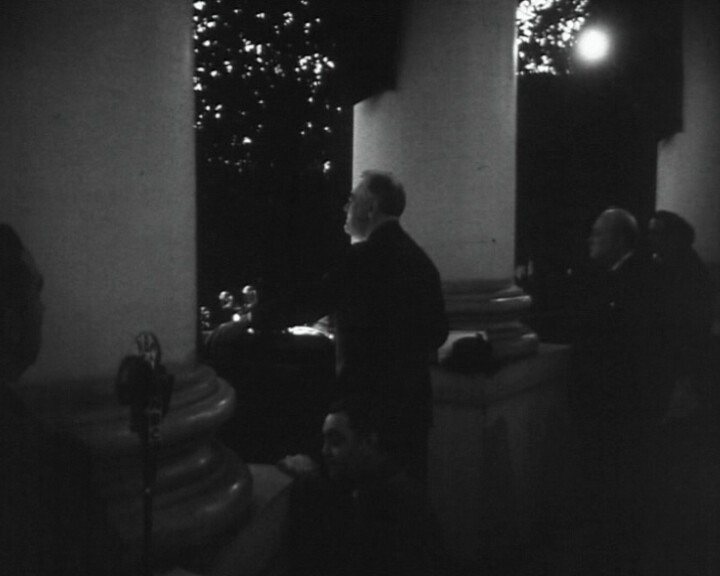
WASHINGTON (UP) – President Roosevelt and Prime Minister Winston Churchill were to take time out from their war conferences long enough late today to wish peace on earth, goodwill to men, as the leaders of the two mightiest nations lead the community Christmas tree services on the White House grounds.

Despite extraordinary war protection of the White House grounds, the public will be permitted to enter the lower portion of the Executive Mansion front lawn for the traditional Christmas ceremonies.

The president and the prime minister will both address the crowd, their remarks being broadcast throughout the world.

Problem still defensive

Our forces, however, are so engaged by Japan’s aggressive and well-planned moves against the Philippines that the problem for the time being is apparently defensive. And no one recognizes more than the two gentlemen directing the Anglo-American War Council that wars are not won by defensive strategies.

Two poached eggs impress Churchill

WASHINGTON (UP) – Two poached eggs for breakfast!

Prime Minister Churchill’s astonishment at seeing two eggs on his breakfast tray at the White House was revealed by Mrs. Franklin D. Roosevelt today.

“Why, we have only one egg a week at home,” he told the First Lady.

“The fact that he made so much of it typifies to me the difference between day-by-day living in England and in the United States,” she said.

Sore thumbing out of the difficulties in the Pacific is the fact that sea power and notably battleships have taken a tremendous licking so far from airplanes equipped with bombs and torpedoes. Britain suffered a similar and punishing blow to her sea power from German aviation in the battle for Crete last May.

Those experiences add up to a demand for airplanes and more airplanes. That the production phase of the Anglo-American War Council is concerned primarily with ways and means to get more airplanes manufactured and manned quickly is reasonably obvious.

In his press conference appearance, during which Mr. Roosevelt gave him the whole stage, Mr. Churchill was careful to avoid underestimating our enemies anywhere and notably in Europe. He believes Germany will not collapse but must be knocked out.

Unity of command seen

He explained that creation of a supreme command would be difficult, and with his words, the idea apparently went out the window. But a unification of command in various war theaters is evidently in the making with American officers, as reported, in line for full responsibility in the Pacific.


WASHINGTON (UP) – The United States and Canada today embarked on a joint “all-out war production effort” – a program which President Roosevelt said will demonstrate that the continent of America, through democratic processes, can outproduce the industrial machine Hitler created through “brute force and enslavement.”

The program calling for pooling of raw materials and productive facilities and removal of hindering tariff barriers, was drafted by the joint U.S.-Canadian committee set up last year to study problems of supply.
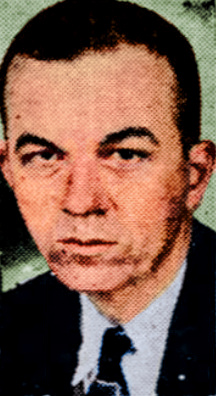
Churchill ‘stands up’…
Stokes: Prime Minister ‘weakens,’ grants mass interview

It isn’t done in England and British reporters gape as premier submits to questions, mounts a chair
By Thomas L. Stokes, Scripps-Howard staff writer

Churchill shows ability as verbal boxer


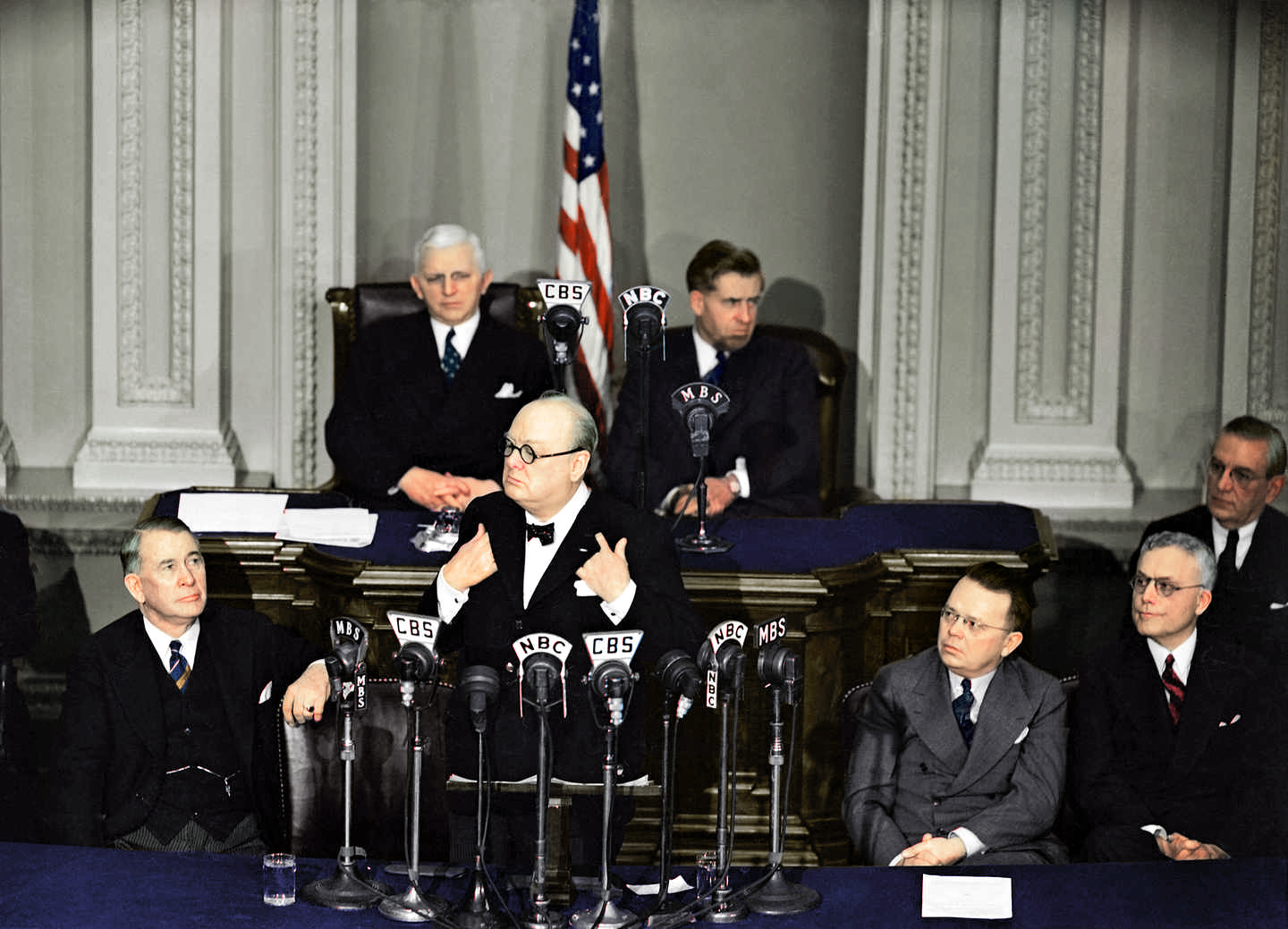
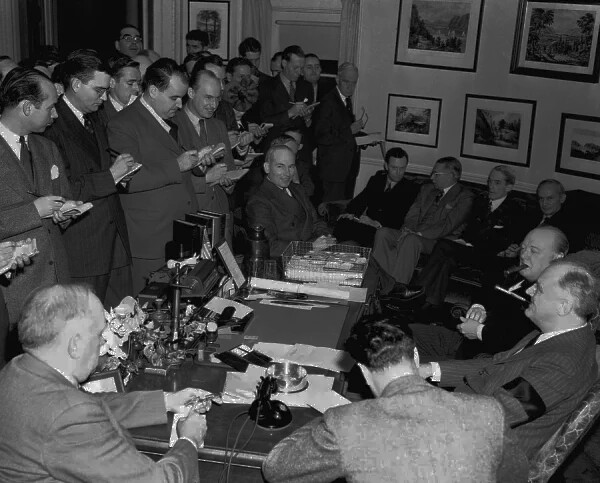
British Prime Minister Winston Churchill displayed real form as a verbal boxer as he parred thrusts with newspapermen in a White House press conference yesterday following his first War Council conferences with President Roosevelt. The president is shown above, nearest camera, with the British prime minister.

WASHINGTON – When the prime minister of Great Britain climbs on a chair in the office of the President of the United States—

Well, that’s something.

When the prime minister of Great Britain gives a mass interview to the press—

That, too, is something.

It isn’t done in England, and British newspapermen present for that interview in President Roosevelt’s office late yesterday looked on, astonished, as Winston Churchill submitted willingly to questions.

His bright, quick repartee reminded American reporters packed into the Oval Room of nothing so much as the man who sat smoking a cigarette beside the Prime Minister – Mr. Roosevelt himself.

Laughter from men unafraid

Thus was sealed formally in engaging informality the alliance of the English-speaking peoples under the leadership of the two men behind a White House desk. The round-faced, chubby Prime Minister with his eternal cigar, whose demeanor is so cheerful, whose eye has such a confident twinkle, despite all he’s been through. The President of the United States, whose smile lighted up the furrows of care and worry in a face that has, so often in these latter days, looked squarely into a world full of trouble.

You could feel the quickening pulse of free peoples in the very atmosphere of that room; because, more than anything else, of the simplicity of the occasion – of the comfortable laughter from men unafraid.

Two men imbued with the essence of democracy talked across a desk to representatives of a free press and a free people.

On the desks were the knickknacks that clutter up the homes and desks of democratic people. In a basket in one corner, usually reserved for presidential papers, Christmas gifts were neatly wrapped.

The President and the Prime Minister sat talking together as newspaper correspondents filed into the room, a slow stream because of the necessary careful inspection of their credentials by Secret Service men outside.

President had news

“All in!” came the word from Bill Donaldson, superintendent of the House press gallery.

The President had some news, about the creation of an office of transportation, about a meeting at 5 o’clock of the Anglo-American coordinating staff. Then he explained that he’d suggested that the Prime Minister need not answer questions, but the Prime Minister had said he would like to.

Somebody asked the Prime Minister a question.

“Let’s see you – stand up,” came a shout from the crowd.

The President turned to Mr. Churchill and asked him if he would stand up.

He did. But still he could not be seen by many in the rear of the room, as he realized. So, he climbed it right up at the big leather chair.

A cheer broke out, and he stood there, smiling, for the spontaneous ovation.

Confident of victory

Then he sat down and answered questions, numbers of them.

He was confident of victory, but warned against over-optimism about a collapse in Germany anytime soon. What he wants is a collapse externally administered. Don’t count on a collapse from within.

He was grateful for the entry of the United States into the war, for Russia’s amazing stand against Hitler.

Then, and his voice was almost hushed, he spoke of England’s dark and lonely months in 1940.

And, before the mind’s eye, there rose the specter of tumbling homes, of grim, gaunt people in air raid shelters, of desperate hopes.

But no more.

That was a man, now, who sat beside him.

And millions and millions of others in great cities and small towns and on the farms, ready to stand beside him in a common cause, and work for it and fight for it.

He finished, and smiled again.


10 days before Pearl Harbor…
Lucey: Commanders warned

Congressmen told officers were tipped raid might come anytime at any place
By Charles T. Lucey, Scripps-Howard staff writer

WASHINGTON – High Navy Department officials have informed congressmen that all U.S. naval commanders were advised on November 26 or November 27 – 10 days before the Pearl Harbor attack – that an enemy assault might come at any moment.

There was no attempt, it was said, to predict just where the blow might fall.

Presumably the Army’s overseas garrison commanders were similarly advised.

Whether these orders were a direct result of the warning Secretary of State Hull is reported to have given the War and Navy Departments is uncertain, but this is believed likely.

That Mr. Hull, at a critical stage in his conversations with the Japanese envoys, did advise the affected departments to be prepared for the worst, has not been denied at the State Department. Asked about such reports, Secretary Hull commented only that the State Department’s record was clear.

Mr. Hull, according to reports, gave his warning after Ambassadors Nomura and Kurusu had received this country’s final proposals for a peaceful solution of differences with Japan, and when he had become convinced that war would be extremely difficult to avert.

The reports in Congress of the Navy’s warning to its commanders appear to be in conflict with a statement made by Secretary of the Navy Knox on his return from Pearl Harbor. Asked then to comment on reports that the Navy had been forewarned, he replied that it had not been.

There have been stories too, that a senator had transmitted to the State Department information concerning certain Japanese activities prior to the assault on Hawaii, and still others that Hawaiian newspapers had published warnings of an impending attack by the Japanese.

Officials say all these reports will be studied by the commission, headed by Justice Owen J. Roberts, which President Roosevelt appointed to find out what happened at Pearl Harbor.

Secretary Hull has vehemently denied another of the widely-circulated Hawaiian attack reports – that he had asked the War and Navy Departments to withdraw patrols around Hawaii during the Japanese peace-or-war talks.

He said there was no shred of truth to any such report.


Hawaii reinforced…
U.S. aviators prove ability

Fliers who got into air superior to Japs
By Frank Tremaine, United Press staff writer

HONOLULU (UP) – Large reinforcements of fighter and bomber planes have arrived from the mainland, the Army revealed today.

Officers said, coincidentally, that the sneak Japanese attacks on December 7 had not changed their opinion of Japanese planes and pilots – American planes and their pilots are superior in every respect.

They said the enemy’s success was due only to initial surprise and illustrative of American superiority was the fact that, although only 14 American planes got into the air from Wheeler Field, they shot down 12 to 15 Japanese aircraft. Only two American planes were lost in the air.

“If we had had any warning, it would have been duck soup because our equipment is so superior,” one officer said.

Copies of U.S. planes

He said American planes outmaneuvered and outspeeded at the Japanese, whose machine-gunning was inaccurate. Japanese planes, motors and propellers were copies of American designs, he said. Many planes did not have retractable landing gear. Many had old World War vintage, drum-fed Lewis guns fired from rear seats. The officer said they used a fighter type greatly resembling the old American AT-12, and wrecked Japanese planes appeared to have been built in 1939 or 1940.

The Army took a group of correspondents to Hickam and Wheeler Fields and Schofield Barracks to see the progress that had been made in repairing them. Hickam Field had been considerably cleaned up since I saw it during the raids on December 7.

Officers said the planes which attacked Hickam, while another group simultaneously swooped on Pearl Harbor, came from out at sea. They bombed a row of hangars, and then swung to the left toward Pearl Harbor, over the barracks, leaving a second group of hangars and the control tower untouched. There was considerable strafing, even of unoccupied quarters.

Runways intact

The Japanese first dive-bombed the air depot, then strafed it, the officer said. Incendiaries started destructive fires, and explosives bent girders and did considerable damage. However, the officer said, the aircraft in the depot were mostly old.

He said a “distinct series” of attacks between 8 a.m. and noon left the runways intact. They were concentrated largely on hangars and barracks. The latter were badly damaged, but could still be used, because they were made of reinforced concrete.

However, much of the air force personnel is living in tents and quarters evacuated by civilians and eating from field kitchens.

I saw numerous wrecked planes, but also many in the air, and we were shown aircraft that had just arrived from the West Coast.

The officers said casualties in the barracks were not as large as had at first feared. The top floors were gutted by fires started by incendiaries, but few bombs broke through the first floors.

Not so hot shots

I saw one crater 100 feet from a hospital. The officers said Japanese bombing was not as accurate as first reports would indicate.

Among indications I saw of inaccuracy were ten craters in a baseball field.

From Hickam, we were driven to Wheeler Field, next to Schofield Barracks. The first attack of two formations on Wheeler came from the north, the officer said, and was concentrated on the industrial area at the western end of the field, on hangars and line planes from hangars. They returned 15 minutes after the first attack to strafe what they had bombed. Most of the Wheeler Field casualties were caused by bombs, the officer said.

He said the attack apparently was carried out by three distinct echelons, concentrating on Wheeler and Hickam fields and Pearl Harbor, although later in the morning Bellows Field was strafed. The officer said all the Japanese planes apparently were based on carriers, and he believed 550-pound bombs were the largest they had used.

Most of the planes outside of the hangar line were saved, but many of those near the hangars were burned. The officer pointed out that many planes previously reported lost already were back in the air, and that parts of irreparably damaged planes had been salvaged and assembled into new craft. Planes are now widely dispersed and protected by bunkers to obviate mass destruction.

He praised the pilots who braved machine gun bullets and bombs to get to their planes and take off. Others whose planes were lost before they could reach them, stood around with tears in their eyes, praying for a serviceable plane, he said.

The damage to Schofield Barracks was hardly worth mentioning, it was so slight.

The tour ended on top of Kolekole Pass in the Waianae range, where the officer explained defenses against invasion. The details cannot be divulged, but it can be said that any invader would get a hot reception.

Grand battle under way…
Philippine GHQ goes to front

MacArthur takes command of ‘all-out’ defense
By Frank Hewlett, United Press staff writer

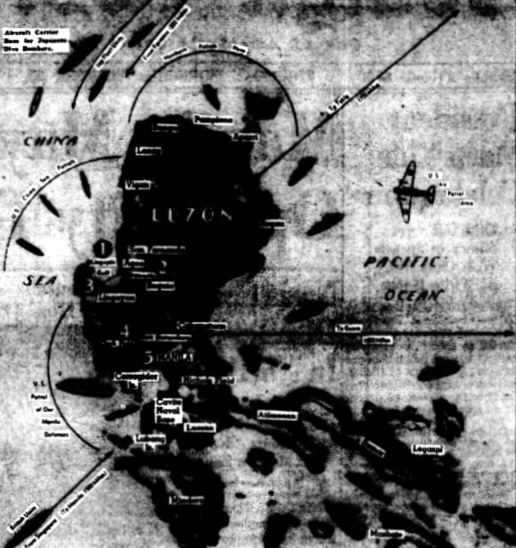
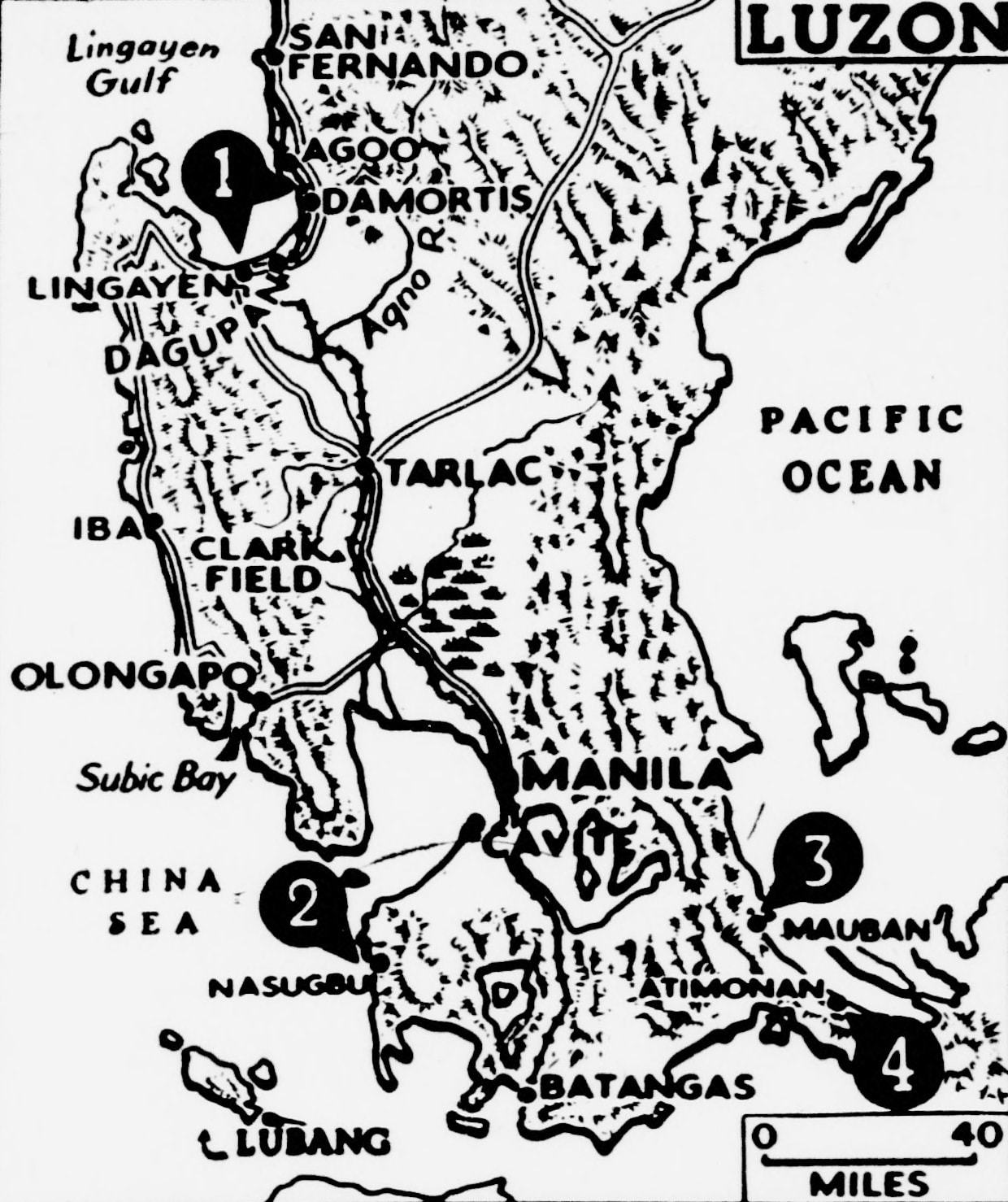
The Philippine front


The Japanese are battling U.S.-Philippine forces at six invasion points, indicated by numbers in the map above. Stars indicate where heavy air raids struck Manila and San Jose, 80 miles north of the city, where a refugee camp was bombed. The new invasion point is at Atimonan (4), 75 miles southeast of Manila. Another new invasion is threatened in the same sector at Batangas, 65 miles south of Manila.

MANILA (UP) – Gen. Douglas MacArthur, commander of U.S. forces in the Far East, took the field today, assuming personal command of American and Philippine forces combatting an all-out Japanese air and land assault against this capital and bastion of American defenses in the Pacific.

Gen. MacArthur sent into the battle raging on the Lingayen Gulf 135 miles north of Manila and on the eastern Atimonan area 75 miles distant the “forward echelon” of his general headquarters.

The announcement was taken to indicate that the grand battle of the Philippines has begun.

Reports from Batangas, 65 miles due south of Manila, said that American armed forces have repulsed all Japanese attempts to obtain a foothold in that area and have inflicted heavy casualties upon the Japanese.

The Japanese, having moved an expeditionary force estimated at 80,000 to 100,000 men to the Lingayen Gulf, approached the southwest coast with a force possibly half that large and started a concentrated air attack on Manila that gave this capital four air alarms between dawn to dusk.

Gen. MacArthur, playing a waiting game until the full strength and tactics of the Japanese had been revealed, had refrained from committing his main forces to battle.

The announcement that he had gone to the front to take personal command of operations and that GHQ units are rushing to the firing line clearly pointed to a major engagement in which the immediate fate of the Philippines may be decided.

The odds of numbers were on the side of the Japanese. They appear to have sent against the island of Luzon alone a force of upwards of 150,000 men. In addition to the major landings at Lingayen and Atimonan, there were smaller forces landed at Vigan, Legaspi and Aparri.

The size of Gen. MacArthur’s defending army is a military secret. However, U.S. communiques reported that American troops in the Lingayen front – by far the most vital since it is linked by a broad valley and easy terrain to Manila – are outnumbered by the Japanese.

On Gen. MacArthur’s side, however, was the advantage of interior communications and a central position which enables him to shift troops from front to front as Japanese attacks develop. The Japanese, in contract, were operating on the perimeter of the island without direct contract between the separate attacking forces.

Gen. MacArthur’s decision to take the field also may be linked with the announcement by authorities that Manila may be declared an open city to spare it, if possible, from repeated Japanese bombing attacks.

The Japanese air force was heavily engaged today. In addition to attacking Manila area objectives, the Japanese attempted to bomb Clark Field, northwest of Manila. One of three attacking planes was shot down by anti-aircraft gunners.

Many casualties in Manila

U.S. and Philippine forces, already heavily outnumbered and facing increasing odds as the Japanese landed additional reinforcements, were fighting furious offensives in the zones southeast and northeast of Manila as the Japanese planes struck at the capital in waves.

Numerous civilian casualties, including fatalities, were caused by demolition and incendiary bombs in the first of three raids on the port area. A fourth air raid alarm was sounded late in the day but apparently no bombs were dropped.

Authoritative Army sources said Japanese claims to the capture of Davao City, in their drive on Mindanao Island south of Luzon, were untrue, but it was admitted that unreliable communications made it difficult to assess the exact situation.

Forty Japanese troop transports had appeared off the Luzon Island coast 75 miles southeast of Manila to reinforce a new Japanese landing group in the Atimonan area, when the first enemy planes appeared over the capital and air-raid sirens sounded at 11:14 a.m. (9:14 p.m. Tuesday ET).

Within a few minutes, bombs, estimated to weigh as much as 1000 pounds, were dropping in the port area and smoke could be seen rising from fires.

Battles rage on two fronts

By mid-afternoon, the third raid of the day was under way.

Filipino firemen fought under a rain of incendiary and explosive bombs to put out fires.

Though casualties were severe among people who remained in the open, those who took cover in the numerous air raid shelters of the port area emerged safe.

A dispatch from Mindanao to the Manila newspaper El Debate quoted evacuees from Davao City as asserting that seven Japanese transports had been sunk there.

The landing at Atimonan, and the threat of far larger landings, brought the Japanese offensive within dangerous striking distance of Manila.

In Northern Luzon, the Japanese were about 120 miles from the city in their invasion area near Santo Tomas.

May seize railroad

In the south, the Japanese faced rough country and determined opposition, but they had landed in a favorable area and the threat remained that they would land men at Batangas which would be an even more serious threat.

Experts suggested that the Atimonan invasion force would seek to strike westward from the popular excursion beach on which they landed, and there was believed a strong possibility that the Atimonan force would seek a junction with the Legaspi troops 135 miles to the south.

A railroad which extends from Manila to the southeast end of Luzon lies only 11 miles from Atimonan and could be used between that area and Legaspi.

Bomb refugee camp

The Atimonan force had first between them and Manila a difficult mountain area. Their path lay along the national highway and through the Quezon National Park in a general northwesterly direction. Their road would take them within 22 miles of Lucena, capital of Tayabas Province, 60 miles south of Manila and 38 miles northeast of Batangas, where new Japanese transports had been sighted.

Philippines anger mounted at additional reports of a Japanese bombing of a refugee camp at San Jose, in Nueva Ecija Province, 80 miles north of Manila.

Numerous civilians were killed, largely Philippine women and children from the Manila area.

Japs draw crowd, kill 100

A witness to a Japanese attack on an unidentified town in the same area said:

“The people of this town thought the planes were American. They could not identify them at the great height at which the planes were flying. However, they could not believe that the Japanese would attack a town in which there was not a single military objective.

“The planes feigned a dogfight, and the people thronged to the streets, thinking the planes were maneuvering. At this point, the planes swept down and machine-gunned the streets.

“The planes dropped several incendiary and demolition bombs which set fire to and destroyed half the town proper, including the entire commercial district.

“From 50 to 100 citizens were killed outright and hundreds were wounded.”


Manila’s port area rocked by savage Jap bombings

By Robert Crabb, United Press staff writer

MANILA (UP) – Manila’s thickly populated port area rocked today under attacks by waves of Japanese bombers.

For the first time today, Japanese planes, with obvious intention, attacked objectives inside Manila proper instead of confining their attention to targets outside the congested city.

Also for the first time, according to dispatches and a telephonic check of the Luzon provinces, Japanese bombers began widespread and apparently indiscriminate bombing of small towns and other civilian objectives.

Four air raid alarms sounded in Manila up to dusk tonight. The all-clear of the fourth alarm sounded at 5:30 p.m. (3:30 a.m. EST).

Considerable casualties

Waves of Japanese planes made savage attacks on the first two raids and considerable casualties were reported. No Japanese planes were spotted from central Manila during the third and fourth alarm of the day.

I cannot report all the details of the attacks on the port area. But a large office building was hit as was a garage.

As on previous occasions, the Japanese also directed an attack against Nichols Field, the Army air base just outside Manila. Damage there was reported slight, although some buildings were damaged.

I am certain some Japanese planes were shot down and others have been reported damaged, but this is unconfirmed.

It was a welcome sight to see a large group of planes appearing over the city in pursuit of the Japanese. There must have been at least 16 American ships in immediate pursuit of the Japanese.

Fires rage in Manila

Soon after the first alarm, watchers in the United Press Building in the center of the city saw smoke rising from fires less than half a mile away.

Touring the raid area after the first alarm period, I found a popular Army and Navy nightclub slightly damaged by splinters.

Across the street, bomb fragments and debris had damaged a large garage and partly wrecked cars and trucks inside. A bomb had struck in the curb in front of the building.

So far as I could see, all bombs in this raid landed in the port area.

I saw numerous casualties – all persons who had failed to use air raid shelters. In a shelter alongside a building which was severely damaged, 30 persons emerged unharmed. Less than 200 feet away, numerous persons were killed.

An Ordnance Department soldier, searching for delayed action bombs, said the Japanese had used bombs of 1,100 pounds.

Of between 10 and 15 bombs dropped in the main raid area, more than half landed in open spaces without doing damage.

One bomb landed close to a main pier.

The second alarm came while Manila’s Filipino firemen were fighting fires started during the first raid.

No sign of panic

The firemen stuck to their posts while other people ran to shelter, and they put out all fires started in the first raid within half an hour.

When the second alarm sounded, the firemen had the streets to themselves.

There was no sign of panic among civilians. Traffic policemen calmly directed cars and pedestrians on the way to shelter waited as usual until they had the “Go” sign to cross streets.

Weisblatt: Lingayen defenders praised by general

By Franz Weisblatt, United Press staff writer

U.S. ARMY FHQ, North Luzon Front (UP) – U.S. and Philippine forces, heavily outnumbered, have been holding off the furious attacks of a Japanese invasion army for three days, Maj. Gen. Jonathan M. Wainwright, commanding the northern Luzon forces, said today.

As I arrived from the battlefront, where I had seen the action in the Gulf of Lingayen, I was handed the following communiqué by Gen. Wainwright:

“During the last few days heavy fighting has been in progress in the north Luzon sector.

“Although greatly outnumbered, the troops in this sector have conducted themselves with valor and have engaged the enemy where they have found them.

“Special commendation is due to the 26th Cavalry (Filipino), which has been in the thick of the fray from the very outset and particularly distinguished itself in engagements at Damortis and Binalonan, both engagements a part of the general battle of Lingayen Gulf.”

Edson: Dies hearings on Jap action were opposed

Use of committee data was frowned upon before war
By Peter Edson, special to the Pittsburgh Press

WASHINGTON – If anyone in the United States has a right to get up and shout “I told you so!” it is the Hon. Martin Dies of Orange, Texas.

Since 1939, he has been yelling about un-American activities and nobody would listen. He played the tune so often and so loud and so long that it got to be three times as tiresome as “Who’s Afraid of the Big Bad Wolf?”

Then came Pearl Harbor and Secretary of the Navy Knox’s admission that the fifth column work there was the most effective since Norway.

Jap probe quashed

Congressman Dies is famed principally for his digs at the Communists, and more recently for his exposes of Nazi activities. Most people won’t recall that Mr. Dies ever raised much Cain about the Japs and in that respect they’ll be correct, for the simple reason that the lid was put on the Dies Committee investigations of the Jap fifth column in America before they had a chance to get started.

It is of course impossible to guess what might have happened if Mr. Dies had held his hearings on Japanese activities in America. Everyone might have yawned that Martin was at it again, and gone on dreaming. On the other hand, the hearing might have had the good fortune to wake everybody up.

Fleets secrets revealed

Some of the Dies investigators’ evidence is rather sensational – Japanese battle maps of the Pacific, U.S. fleet formations supposed to be secret, directories of every Jap in the United States, with his address and telephone number, handbooks of diagrams and photographs of every ship in the U.S. Navy. All of this was material obtained from Japs resident on the West Coast.

In fairness, it should be made clear that the Dies Committee had nothing at all on Japanese activities in Hawaii. Their investigators weren’t permitted to investigate there. But now that appeasing the Japanese no longer does any good, perhaps a more realistic attitude of the situation is permissible.


The Washington Merry-Go-Round

By Drew Pearson and Robert S. Allen

WASHINGTON – The action of the House Naval Affairs Committee in slashing the proposed expansion of our two-ocean navy was due chiefly to shortages of materials and construction equipment.

However, Rear Adm. Samuel Robinson, Chief of the Bureau of Ships, ran into a blunt barrage of questions about the worth of the battleship under modern combat conditions. Committee members sharply suggested that in view of the battleship’s record in this war, the Navy might be wise to build no more.

Adm. Robinson contended that this would be impractical, since the United States needed battleships “if our enemies continue to use them for combat purposes.”

“What is your honest private opinion of the battleship?” he was asked. “Do you think this. type of ship is worth all the money it costs and the time and labor required to build them?”

“I’m sorry, gentlemen, but it’s not my function to answer that question,” sidestepped Adm. Robinson with a smile. “I’m not a policy man. My job is to build ships after it is decided they are needed. However, I have my own ideas about the battleship.”

This drew laughter, and the admiral was pressed no further.

Adm. Robinson also was quizzed closely about the high cost of certain vessels which the Navy proposed in the expansion program, chiefly an aircraft carrier at an estimated 85 million dollars.

“Higher labor and material costs are the biggest factors," Adm. Robinson explained. “For instance, we have a new type of armor-plate for our ships which is far stronger than that used by any other nation. It costs $60 a ton, three times as much as the armor-plate we formerly used.”

“How about the labor supply?” “We have plenty of labor to carry out our shipbuilding program,” Adm. Robinson said. “Also plenty of facilities. Getting materials and machine tools is our big problem right now. However, the shortage doesn’t amount to a bottleneck. In fact, production is running a little ahead of schedule and will be greatly expedited by next spring.”

Dies agent

The press agent of New York’s Stanley Theater, which shows Russian pictures, received a phone call from a man who said he was a Dies Committee agent. He asked for a pass to see the Soviet film at the Stanley.

“I’m sorry,” said the publicity man, “but the manager it getting rather strict about passes. I’ll have to pretend you are a drama critic.”

“That’s all right with me,” said the Dies agent.

Result was that the agent of Communist-hating Dies got a pass as the drama critic of the Communist “Daily Worker.”

News censor price

Byron Price, dapper Associated Press executive, owes his appointment as wartime censor to two old newspaper friends, now big-shot presidential advisers.

One was White House secretary Steve Early, a one-time AP man who worked under Mr. Price; the other was Lowell Mellett, former Scripps-Haward newspaper editor and a colleague of Mr. Price’s in the Gridiron Club.

In picking Mr. Price, the President turned down two outstanding newspaper men. One, Jonathan Daniels, editor of the Raleigh (North Carolina) News & Observer, was favored by the President personally, but the objection was raised that Mr. Daniels wasn’t “well-known enough.”

This seems peculiar, because Mr. Daniels besides being the son of Josephus Daniels, ex-secretary of the Navy and until recently ambassador to Mexico, also is author of two best sellers and a regular contributor to a number of leading magazines. There isn’t a newspaper man in the country who doesn’t know who Jonathan Daniels is.

The other ace newsman passed over was Ulric Bell, crusading Washington correspondent of the Louisville Courier-Journal, another great southern paper. Mr. Bell, it was contended, didn’t have “sufficient executive experience.”

This also seemed strange, since Mr. Bell, almost single-handed, organized and directed Fight for Freedom, Inc., which, on a shoe- string, waged a slashing nationwide fight against the lavishly financed America First Committee and its numerous franking privilege supporters in Congress.

Mail bag

C. H. S., Sacramento, California – According to the clerk of the United States District Court in Los Angeles, the tax lien against Dr. Francis E. Townsend has not been satisfied and discharged. Amount of the lien is $20,412.92. (The lien is usually more than the actual amount of tax delinquency, to cover other charges.) Bureau of Internal Revenue states that the case against Dr. Townsend is still outstanding… C. R. V., St. Louis, Missouri. The reason Civil Service employees pay a higher tax rate than officers in military service is because the American Legion and other veterans’ organizations have successfully lobbied in favor of special tax consideration for service men, past and present. The exemption is stated in Section 19.22 A-3, Regulation 103, of the Income Tax Law.


McLemore: War’s a blessing; maybe now we can dry our hands on handkerchiefs legally

By Henry McLemore

NEW YORK – The first new game to come out of the war is “silver lining.”

It’s a parlor game, and it not only is a lot of fun but has a most salutary effect on the morale.

“Silver lining” is a very simple pastime. No equipment whatsoever is required and any number from one to one million can play it.

All you have to do to play it is to think up blessings or near blessings that the war has brought about. I scored a clean 100 points the other night by finding something to be grateful for in the paper shortage that the emergency has brought on.

With a paper shortage existing, I explained, the paper towel and the paper napkin are doomed. There were shouts of “hear, hear.” Particularly from the menfolk present when I mentioned the possible extinction of these blights on civilization.

Consider the paper napkin, end while you’re considering it slap its pesky little fare. What man has ever been able to keep a paper napkin on his lap? It offers many of the same problems that flying a kite does.

Whoops! There it goes

It is not heavy enough or well trained enough to sit quietly or the lap. Just when you get one balanced on the lap someone opens a door in another part of the house and the slight draft sends it sailing across the room. Paper napkins aren’t large enough to tuck in. Resort to this inelegant measure and just enough sticks above the beltline to look as if your undershirt were showing.

The paper napkin’s big brother, the paper towel, is an American invention that occupies the same place in the esteem of the average male that beriberi, malaria, and visiting in-laws do.

One of the major curses of the paper towel is that it never has been standardized. Use a paper towel in one place and a big sign says “rub – don’t blot.” So you rub until you have enough lint on you to qualify as a rag-pickers helper. Use a paper towel in another place and a big sign warns “blot – don’t rub. Before you know it you get confused and start blotting when you should rub and rubbing when you should blot, and the upshot is a mess. None of the warning feigns are really worded right. What they should say is “blot or rub until your patience is exhausted. Then get out your handkerchief and dry your hands and face the best you can.”

Hooray! Fishing is out

There is an item in the papers today that you can use for the time you play “silver lining.” It concerns fishhooks. Fishhooks now rate as a military supply and there is certain to be a shortage of them.

What a blessing for those who don’t like to fish. Oh, you may say, there aren’t any people who don’t like to fish. You’re wrong there, brother. There are thousands of people who have just been wailing for an excuse to refuse to go fishing. I know it isn’t considered manly to admit that you don’t like to fish. Americans are supposed to love to wear themselves out catching things that swim. But there are those who consider fishing not only next to nothing, but nothing itself.

Another blessing of the war is that it has eliminated the horror of the income tax. Sure, I know it is going to be dreadfully high, and that a man won’t have much more than enough to mail a postcard when it is paid, but no one will mind paying it. The tax will go into weapons for the defeat of the Axis and that makes laying it on the line a pleasure. Next year no patriotic American can look upon March 15 except as a day that affords him an opportunity to make it tough on the enemy.

The war has eliminated the necessity of listening to isolationists and interventionists argue by the hour. There isn’t any such thing as an isolationist now. and if you don’t think that is a blessing then you never went to an America First rally or heard those former ivory tower tenants on the radio. Speaking along these lines the war really made the “Lone Eagle” lone, didn’t it? That’s another blessing.

Yes sir. “Silver lining”’ is a good game. Come around to the house tomorrow and we’ll play it. Don’t knock, just walk right in.


Simms: Allied cause brighter than 1917 Christmas

Roosevelt, Churchill plan all-out war on Hitler and his stooges
By William Philip Simms, Scripps-Howard foreign editor

WASHINGTON – Christmas Eve, 1941, finds the outlook for the United States, Great Britain and their friends somewhat brighter than on the same date in 1917.

Today, at the White House, President Roosevelt, Prime Minister Churchill, Lord Beaverbrook and their staffs are celebrating the advent of yuletide by planning an all-out war on Hitler and his stooges. And the betting is they will amply succeed.

Twenty-four years ago the Teutonic coalition was encamped everywhere on Allied soil – pretty much as it is today. And a German victory seemed just around the corner.

Russia was knocked out

The Austro-Germans had just smashed the Italians on the Isonzo Russia had been knocked out. All that remained to do in the east was to force the helpless Bolsheviks to sign on the dotted line – as pretty soon they did. Rumania had been given the coup de grace at Bucharest.

Only the Western Front remained, to be cracked and Marshals Ludendorff and von Hindenburg were getting ready to do that. Already they were planning to withdraw troops and material from the east, concentrate all available forces against the French, British, Americans and their Allies in the west, order the Bulgarians to take care of the side show in Macedonia and have the Austrians finish off Italy.

America had entered the war by this time but the Germans were discounting them. It would take six months to a year for the Americans to count in the battle and the general staff formally pledged itself to win the war within four to six months. The Americans, therefore, would arrive too late.

There was Irish trouble

Meanwhile, the British were unable to rake up any appreciable number of recruits They were already making use of “bantams,” as the misfits and undersized were called. Then there was the chronic Irish trouble. In France, the government seemed to be at the end of its rope. There was unrest at home and trouble at the front, where the morale of certain units was far from brilliant.

Almost any way she looked, Germany’s future seemed filled with promise. Her vista stretched all the way from Lapland to Turkey and from the Straits of Dover to the Caspian Sea. Finland, Estonia, Latvia, Lithuania, Poland, Belgium, Luxembourg, Rumania, Serbia, Montenegro and the Ukraine seemed tagged definitely as vassal states under the greater German empire.

It was a glowing picture. Of course it would cost something, but Marshals von Hindenburg and Ludendorff even had that figured out. Their first estimate was one million German casualties, but this was soon revised to 1½ millions. You can’t get something for nothing, they said.

In February, 1918, the two Prussian war gods gave the Reichstag their solemn assurance that they would cut the Allied armies in two, sweep the British into the sea, drive the French southward, take Paris and the Channel ports and dictate peace at Versailles before autumn. And, at the time, it looked as if they might do it. Things were gloomy for the Allies.

June brought the turn

On March 21 the mightiest army the world had ever seen was hurled against the Allies on the Western Front. On March 23, the Germans began their long-range shelling of Paris. In four days the British Fifth Army had been annihilated and Sir Douglas Haig’s order of the day frankly stated that he stood with his “back to the wall.” For weeks thereafter it seemed to be all over but the shouting.

Then, in June, came the turn. First the German advance was halted. Then it was driven back. By this time our own marines and other fighters were in the show and more and more Americans were pouring into the line.

From one day to another, almost the situation did a right-about-face. One day, it seemed, the Allies were beaten. The next the Germans were definitely on the run.


Perkins: Trouble seen without ruling on closed shop

Labor peace joker cited by industry spokesman; Murray pleased
By Fred W. Perkins, Press Washington writer

WASHINGTON – When the nation’s Christmas package labeled “war labor agreement” is unwrapped, a Jack-in-the-box pops out.

The 12 management spokesmen who took part in the four days of conferences gave warning of the contents in a statement today, when they pointed out that the pact makes no disposition of the issue which brought on the more momentous stoppages to defense production – the closed shop or the open shop for American workmen.

Management and its sympathizers in Congress wanted the closed-shop question frozen for the duration of the war, as it was in World War I. The agreement, so far as it stands now, leaves the issue in position to be brought up at any time by any union that thinks it can make a case for exclusive control of labor in an industry or individual plant.

Roosevelt may help

There is the chance that President Roosevelt, in setting up the new War Labor Board agreed to by the AFL, the CIO and the industrialists, may respond to the management plea “that the board should not accept for arbitration or consideration the issue of the closed shop, requiring that a person become or remain a member of a labor organization if he is to get or hold a job.”

Circumstances surrounding formulation of the agreement indicated this chance was slight, and the president’s letter acknowledging the agreement was read as forecasting that the closed-shop question, when brought up, will be left finally to arbitrators.

Murray delighted

Management is still licking burned fingers from its most recent experience with arbitration, when John L. Lewis of the United Mine Workers finally won from an arbitrator the complete union shop which had been denied by the National Defense Mediation Board and by the president himself.

Philip Murray, president of the CIO, hailed the new agreement “with delight,” and said that in addition to promising an end to strikes and lockouts it “gives to labor the right to conciliate, mediate and arbitrate all disputes between workers and their employers.” He appealed to all CIO units, to help in winning the war by providing uninterrupted operation and maximum production.

Early action expected

The management representatives signed a declaration that “the closed shop is the most highly controversial and emotional question in industrial relations today. To accept it as an issue for government arbitration would intensify agitation, increase labor disputes and divert the energy of both labor and management from the vital job of production. Unless this issue is resolved in advance, it will impair the effectiveness of the proposed war labor board.”

President Roosevelt was expected to act without much delay in setting up the war labor board, despite the demands on his attention from the Churchill conferences. Outside of getting the agency in early operation there would be another advantage – congressional demands for union-restrictive legislation would be further forestalled.

May replace NDMB

The new War Labor Board probably will replace the National Defense Mediation Board set up nine months ago by Mr. Roosevelt to mediate disputes affecting defense. Mr. Davis, chairman of the NDMB, has been mentioned as chairman of the new board.

There appeared to be considerable support for a “judicial” body rather than a matching of industry and labor representatives, as was done in the case of the 12-man Defense Mediation Board. In that case, membership would be selected without regard to labor or industry connections.

The First World War Labor Board, established in 1918 by President Woodrow Wilson, consisted of 12 members, six representing industry and six labor. Frank Walsh, labor representative and former President William Howard Taft, industry representative, were named co-chairmen.

Shipyard welders resume work

SAN FRANCISCO – Individual welders who had struck against San Francisco Bay shipyards to enforce their demands for autonomy, were returning to work today amid pleas to support the national defense effort.

Contracts of 672 million dollars in the Bay area alone were jeopardized by the strike, called by the United Welders, Cutters and Helpers (Inc.) which has revolted against rule by the AFL.

An appeal for the Navy to take over the yards was voiced by Karl V. Morris, international president, who arrived yesterday.

He telegraphed President Roosevelt urging him to instruct the Navy to take over temporarily all West Coast shipyards, and to “help us reach a fair settlement of the issues involved.”

Welders contend that if they work under the civil service rules afforded by the Navy, the AFL has no control over their membership.


Mowrer: Allies list five successes as their ‘Christmas gift’

North Atlantic U-boat cleanup, Russian victories and British sweep in Africa show that ‘we do all right’
By Edgar Ansel Mowrer

WASHINGTON – Against serious and unquestioned Japanese successes in the Pacific Ocean and the Far East, citizens of the democracies can celebrate Christmas this year with the feeling that our side is not doing so badly.

On the credit side of the ledger, we can chalk up:

  • Almost a clean sweep of submarines from the North Atlantic sea lanes, which means the unhampered delivery of goods to Britain.

  • A much safer position in the South Atlantic, which means that supplies en route to Aden and Australia, as well as to West African places, have an overwhelming chance of arriving.

  • The greatest defensive battle of all times just successfully completed by the Russians with the temporary dislocation of Hitler’s armies.

  • Half of North Africa swept clean of Nazis by the British.

  • Promises of vastly increased war production within the United States.

Democracies doing well

Add to these benefits the fact that Japanese aggression brought the United States into the war before it was too late to win it and it becomes clear that on points the democracies are doing pretty well and that the American people can sincerely give thanks this Christmas Eve.

Decidedly this does not mean we cannot lose the war by the same sort of complacency that cost us the disaster at Pearl Harbor. But it certainly means that if the Americans cut out wrangling, strikes, and futilities of various kinds, sacrifice a portion of their comfort and devote 60 percent of their energies and income to winning the war, the chances for the aggressors are distinctly on the slim side.

While the Navy received a black eye in Hawaii, while it will be weeks and months before offensive naval warfare against Japan itself can be attempted, in the Atlantic, the American cruisers and destroyers, by all-out operation of the convoy system they adopted a couple of months ago, have almost prevented ship losses completely.

In recent weeks almost no ships have been sunk between here and the British Isles.

Report U-boats sunk

The reason became clear when the Navy announced Sunday that not less than 14 German submarines had been sunk or damaged in the North Atlantic.

Testimony from Russia as to the amount of Germans killed and booty taken by the Russians is beginning to verify the Soviet claims of a really great victory and not merely a strategic retreat of which German leaders and some Americans have tried to convince us. Whether the Russians can turn their victory into a German debacle remains to be seen. But it will take weeks before many a German division will be fit again to fight anywhere.

Hitler’s potential drive across the Mediterranean, or at Britain, or at Iceland, will have to be made with, fresh troops. The growing unrest in the conquered countries, proven by the growing list of German soldiers and officers assassinated, will limit German possibilities of stripping the garrisons of these countries for offensives somewhere else.

War production figures are bad

War production figures are still frankly bad. Looking back, converted isolationists in Washington now admit that had we gone all-out in the summer of 1940 when France’s fall gave warning of what was coming, we could now be producing two, three or even four times as much as we are producing. The passage to a 24-hour, seven-day weekly routine soon will solve the problem.

Washington authorities are now admitting that the danger in the Far East – the danger of losing Singapore, or Rangoon, or the Philippines – is very real. The loss of these places might prolong the war for months, or years.

But the future conceivably may produce surprises that would offset the Pearl Harbor reverse and its consequences, and allow us to win in what might be called the normal period.


Income ceiling may be needed to pay for war

U.S. would take all above fixed figure, tax rest of salary

WASHINGTON (UP) – Congressional tax leaders believed today that the wartime need for revenue may make it necessary ultimately to fix an arbitrary individual income ceiling, perhaps $15,000, $20,000 or $25,000.

Such a plan, if adopted, would mean that no person could retain income earned in excess of the ceiling, even though he might have to pay taxes on the amount of income he would be permitted to keep.

For example, if a taxpayer’s income was $50,000 a year and the ceiling was fixed at $15,000, the government would confiscate $35,000 outright and require regular income taxes paid on the $15,000.

Still in talk stage

The fixed income ceiling idea still is in the “talk” stage.

However, Rep. Allen T. Treadway, R-Massachusetts, ranking Republican member of the House Ways and Means Committee which originates all revenue bills, said that kind of taxation was “within the realm of possibility.” He did not think Congress would get to such extreme measures soon, but if war demands continue to increase, such a program might be inevitable, he said.

“This is an all-out effort,” he said, “and that’s just what it means. If a man earns $25,000, regardless of the kind of living standard he thinks he must maintain, he has more than he needs.

“If he has been used to keeping a big racing stable as a means of spending his income, he would just have to get along without racing to help the successful termination of this war.”

Withholding tax urged

Meantime, most congressional tax authorities saw no chance of writing taxes into the 1942 revenue bill that would keep federal income anywhere near abreast of war expenditures.

Meantime, Albert G. Hart, associate professor of economics at Iowa University, asked the committee to reconsider the withholding tax program which he proposed last summer. Secretary of the Treasury Henry Morgenthau Jr. recently suggested that the Ways and Means Committee start work immediately on a $4,800,000,000 revenue program that included 15 percent income tax to be withheld from the wage-earner’s check and paid to the government by employers.

Mr. Hart’s proposal would eliminate all other forms of taxation and establish a sliding scale withholding rate designed to meet 90 percent of government expenditures.

Canadian ship feared sunk by Japs in Pacific

Vessel two days overdue; West Coast submarine hunt continues
By Leicester Wagner, United Press staff writer

SAN FRANCISCO (UP) – A Canadian freighter, the 2,410-ton Rosebank out of Vancouver, today was two days overdue at a California port and authorities feared it may have fallen prey to the Japanese submarines lurking off the coast.

The submarines, in six days of activity sometimes within sight of California coastal cities, had attacked seven U.S. vessels, but had succeeded in sinking only one, or perhaps two. The 8,272-ton Standard Oil tanker Montebello, struck by a torpedo, shelled by the submarine’s deck gun, and pelted by a smaller caliber gun, was known to have gone down. The tanker Emidio, attacked Saturday, was abandoned by its crew, but the Navy did not reveal whether it had been sunk.

No warning given

The other five ships reached the safety of port undamaged.

Lives claimed by the underwater raiders totaled five. They were all of the Emidio.

The Navy, which combed the Pacific for the submarines with every facility at its command, and the crew of other coastal steamers which continued to ply their courses to keep supplies flowing between the Pacific ports, knew that they were against ruthless enemy seamen.

In no case has an attacker given warning to its unarmed, lonely quarry before firing the first torpedo or the first shell. In both the cases of the Emidio and the Montebello, the code of war has been ignored and the lifeboats of the escaping crews have been shelled. That was how three of the Emidio’s crew members lost their lives.

The submarines yesterday had their most active day since the first attack last Thursday. They sank the Montebello and a few miles away attacked the Richfield tanker Larry Doheny. They also chased the Texas company tanker Idaho into port.

American sailors good, Japs admit

LOS ANGELES (UP) – Japan paid tribute to American sailors for their “skilled technique” in submarine warfare and admitted “it is stupid” to believe Britain and the United States can be defeated in a short time, according to a broadcast of Tokyo radio heard by NBC.

“It is stupid to think that Britain, which has maintained supremacy of the seven seas, and the United States, with its abundance of natural resources, can be defeated within a short time,” the Tokyo radio said.

“Supremacy of submarines is of vital importance judging from recent appointments of various United States commanders of the Pacific defense.

“These commanders are authorities on submarine warfare. Supremacy of submarines and the best of strategy mean little without skilled technique and highly trained crew. Thus, we are reluctant to admit, the American sailors possess.”

U.S. retaliation secret

The Navy revealed that the Idaho had been followed for three days by a submarine which once surfaced and demanded to know its identity. The Navy did not reveal whether any shots were fired at the Idaho.

Authorities clamped down even stricter censorship over ship movements and Allied information. The Navy requested news services not to reveal the location of future submarine attacks.

Likewise, under a blanket of silence were details of the Navy retaliation for the attacks, although it was known that Army and Navy bombers answered calls for aid from two of the attacked ships and dropped depth charges in the vicinity.

Crews of the attacked vessels described the submarines as rather large and fast enough to do more than 20 knots and run circles around cargo ships.


Philippine invasion plans made by Japan months ago

Ability of enemy convoy to approach Luzon shows fleet comes from nearby bases, experts say

WASHINGTON (UP) – Military experts today believe that before the war, the Japanese made elaborate preparations at nearby bases for the invasion of the Philippines.

The ability of a large Japanese convoy bearing an estimated 80,000 to 100,000 men to approach Lingayen Gulf on the west coast of Luzon as closely as it did without early detection, indicated that the invasion fleet had come from a base or bases so near that most of the trip was made at night.

In the opinion of the experts, these bases may be located on Hainan Island, about 500 miles across the China Sea from Lingayen Gulf, and Formosa, a Japanese island possession about 300 miles from the northern tip of Luzon.

Weeks before the Japanese surprise assault on Pearl Harbor, information reached here of large-scale movement of Japanese troops and supplies to Hainan. The impression here was that these operations were a prelude to an attack on Thailand or possibly preparations for an invasion of the Dutch East Indies.

The move on Thailand and the attack on Malaya, however, was apparently launched by troops which had been concentrated in French Indo-China rather than by the forces which had been moved into Hainan, the expert said.

Reports from Manila that the Japanese had air support for their landing operations in Lingayen Gulf indicated, the experts said, that both sea and land-based planes were being used. Fighting planes, based in Hainan or Formosa, would not have sufficient range to participate in covering operations, the experts said, and apparently the Japanese were using aircraft carriers in the China Sea. Land-based bombers could be used, however.

Hainan and Formosa provide the Japanese with important bases for the maintenance of supplies to the invasion army. There also was a possibility that Japan might be using some of the hundreds of small uninhabited or sparsely settled Philippine Islands as caches for supplies.


Wake probably captured by Japs, U.S. Navy reports

Heroic resistance of Marines believed over after sinking two enemy destroyers in final landing
By Rex Chaney, United Press staff writer

WASHINGTON (UP) – Wake Island, coral-studded U.S. island in the mid-Pacific, apparently has fallen to the Japanese after a heroic resistance by the Marine garrison for 16 days against 14 attacks which cost the enemy four warships and several planes.

The Navy announced that radio communication with Wake has been cut and that the island’s capture “is probable.”

The Navy communique indicated that the heroic Marine garrison fell yesterday just before Christmas came to Wake Island. It is now Christmas on the little outpost which lies 2,004 miles west of Honolulu and across the international date line.

Guam, the United States’ furthermost outpost toward the Philippines, was taken December 13.

The Navy communique announcing the “probable” fall of Wake also said that the Japanese had shelled Palmyra and Johnston Islands, American possessions in the South Pacific.

But Midway, another island base which lies between Hawaii and Wake, still is holding out.

Went down fighting

The Marines at Wake went down fighting, the Navy indicated. Two enemy destroyers were lost in the final and successful Japanese attempt to put a landing party ashore on the four-mile-long island. In the early days of the war, the defending garrison’s airmen succeeded in sinking a light cruiser and a destroyer attempting to support an enemy landing operation.

The garrison had fought off 13 air and naval assaults. But in the 14th attack, the enemy managed to gain a foothold on the island.

This occurred the morning of December 23 (Wake Island Time) after a strong air attack was launched by the enemy. Several Japanese planes were shot down.

After the Navy was advised the Japanese had landed on Wake, there was silence. Efforts to make communication with the heroic band of Marines were futile. It was then that the Navy decided that the island probably was lost. The occupation was completed December 24 (Wake Time).

Wake log recited

Here is the log of the history-making fight put up by the Marines, as reported in Navy communiques:

December 11: The Marine garrison at Wake has fought off four separate attacks by enemy aircraft and naval units in the last 48 hours. Despite loss of some defending planes and damage to material and personnel, Marine fliers managed to sink a light cruiser and a destroyer.

December 12: The resistance of Wake continues.

December 13: Wake continues to resist.

December 14: Two additional bombing attacks on Wake, first light and second in great force. Two enemy bombers shot down. The Marines continue to resist.

December 15: Wake continues to resist.

December 16: Wake had two additional bombing attacks, the first light and the second heavy. Wake is countering the blows of the enemy.

December 19: Two additional air attacks on Wake. The garrison continues to counter these blows.

December 21: Wake fought off two additional attacks by enemy aircraft.

December 23: Wake sustained another strong air attack. Several enemy planes shot down. Japanese effected a landing on the morning of the 23rd (Wake Time).

December 24: “Radio communication with Wake has been severed and the capture of the island is probable. Two enemy destroyers were lost in the final landing operations.”

Wake was of strategic importance to the United States because of its value as an air base for patrol and bombing purposes.

It apparently was deemed unwise for the Navy to attempt to relieve the garrison under existing circumstances.


Japs circulate atrocity tales

Whip nation into frenzy by ‘horror’ stories

SAN FRANCISCO (UP) – The Tokyo radio revealed today that a campaign to whip the Japanese people into a frenzied hatred of the United States is underway.

Broadcasting the first atrocity fabrication against Americans – a propaganda technique used by the Nazis against the Poles, then the British, and finally against the Russians – the Tokyo radio asserted that “peaceful Japanese nationals” were machine-gunned by American troops on the Philippine island of Mindanao.

“This cruelty of the United States soldiers was not surprising as we have often heard of the lynchings in the Southern states,” the radio said. “American movies show the activities of American gangsters but we find United States soldiers, the cream of American manhood, engaging in gangster-like activities. If American doughboys want to machine-gun somebody, why don’t they pick on Japanese soldiers rather than taking to their heels and butchering helpless Japanese civilians?

“The military and official circles here express more disgust than indignation at the details of the cold-blooded murder of innocent Japanese residents at Davao by desperate American civilians and soldiers following the landing of Japanese forces at Davao. They also pointed out the marked contrast between the villainy of American forces and the magnanimous treatment which has been accorded to enemy nationals held in Japan and war prisoners captured by the Japanese.”


Nazi propaganda shift eyed by U.S.

WASHINGTON (UP) – U.S. intelligence services are studying a recent about-face by German propaganda radio broadcasts which, it is reported, may be designed to lull Americans into a “sense of false security” coincident with some new Nazi military move.

Since formal declaration of war between Germany and the United States, the Berlin shortwave broadcasts were said by officials familiar with the day-to-day reports to have changed from wholesale, vitriolic attacks to one of “general implication” that the present war is a quarrel between the United States and Japan – not Germany.

New Nazi propaganda policy also was said to be directed chiefly at “domestic cleavage” by attacks on individuals such as the President instead of condemning the United States as a whole.

This new policy was likened by officials to that employed by the Germans before they invaded now-conquered countries as well as that directed at Britain, by Lord Haw Haw prior to large-scale air attacks.

The Berlin radio also was said to be giving out “hints” of some new military move “in other languages” for consumption in other countries. These broadcasts have been heard in this country.

Greetings to armed forces…
Roosevelt sees triumph over ‘the forces of evil’

WASHINGTON (UP) – President Roosevelt sent Christmas greetings today to members of the United States armed forces and told them that “you are setting an inspiring example for all the people, as you have done so often in the past.”

The president, signing the message as Franklin D. Roosevelt, commander-in-chief, said he was confident that “during the year which lies before us, you will triumph on all fronts against the forces of evil which are arrayed against us.”

“In the crisis which confronts the nation, our people have full faith in the steadfastness and the high devotion to duty demonstrated by the men in all ranks of our Army and Navy,” the message said.

“In sending my personal Christmas greeting to you, I feel that I should add a special measure of gratitude to the admiration and affection which I have always felt, and have expressed in other years.”


Editorial: The blessing of unity

We can be of good cheer about the way the war is going. Not happy, certainly, in the midst of suffering; but we can be deeply thankful that all the sacrifice, so far as we can see, leads to ultimate victory. It is not so hard to struggle through the long darkness when we are sustained by faith in the outcome.

This faith in the right and might of our cause, which inspires Americans at this Christmas season, is not wishful thinking. The record is clear that we and our Allies are defending ourselves and others against aggressors. Equally clear is the fact that the Allied potential strength far exceeds that of the Axis – in men, in materials, in machines.

The problem is to make that potential superiority effective in production and in battle, quickly. Once we can overcome the enemy’s initial advantage of advance preparedness and surprise attack, it will be a war of attrition in which all the odds favor us. From that time on, the collapse of the enemy from without and within may be even more rapid than we dare hope.

But until we have converted our vast potential strength into a fighting reality, it would be madness to allow our faith in eventual victory to blind us to the almost superhuman effort required now and to the almost inevitable defeats along the way.

In the far Pacific the situation probably will be worse before it is better. And another Hitler offensive against Britain somewhere, even more ferocious than his Russian attack, is to be taken for granted.

Fortunately, America has achieved the national unity essential to morale in adversity, and essential to the all-out victory effort on the home front and on the battle front. Hitler and Hirohito didn’t plan it that way, but their attacking fire fused our many factions, parties, and classes into one America. That is our national blessing this Christmas.

And tomorrow, while we are enjoying the blessings of this national unity, our President and the head of the great British Commonwealth of Nations will be working at the White House to perfect a larger unity among those who fight with us for a fairer and peaceful world for all men.


Editorial: Christmas, 1941

It is no easy matter on Christmas Day in this Year of Our Lord 1941 to put aside, even for a little while, the sentiments of anger and vengeance that have with good reason inspired Americans since the Battle of Pearl Harbor.

But it will be a good thing if we who can and will pause for this one day, and recapture fleetingly the warmth and friendliness and affection, the peace and goodwill, that this holy day has always represented. There is hard work ahead. There is bad news ahead, inevitably, before the good can come. Many a door now wreathed for Christmas may be draped, before the new year is out, for an American killed in action.

But this one day, at least, those of us who are not on the firing fronts can grasp this opportunity to enjoy, and to reflect on, the solid things that our troops and fleets and air squadrons are now risking life to defend – the homes and churches, the traditions, above all the decency, that foredoomed fanatics beyond the seas have in their recklessness seen fit to challenge.


Editorial: Pershing asks it

Many now retired Army officers who served with special distinction in the First World War were recommended for promotions which they did not receive before the war ended. A 1940 law gave most of them the honor of being advanced one grade on the retired list, without increase in pay or allowances.

That law, however, applies only to officers below the rank of brigadier general. The recognition it extends to others is thus denied to six brigadiers and one major general, all decorated for exceptionally meritorious service or gallantry in action. At the request of the American Legion, Rep. Canfield of New Jersey has introduced a bill to give these seven generals the same honor and the measure is before the House Committee on Military Affairs.

Gen. Pershing, in a letter to Mr. Canfield, has urged its passage. He feels that the unjustified discrimination against a handful of the officers who served under him should be corrected. We hope Congress will response with prompt action.


Ferguson: The trees

By Mrs. Walter Ferguson

Children, Santa Claus and trees. Add them up and the answer is Christmas. This week, millions of women will trim little evergreens and put them into windows where lighted candles will make a gleaming over the land. It is our poor, fumbling, human way of reasserting our belief in the Star of Bethlehem.

In the beginning people felt very close to the trees. Maybe that is the reason for the present Yuletide anachronism, when forests are uprooted and transplanted in cities where many little boys and girls have never known what it means to live among trees.

I can never cease feeling sorry for those children. Since the sweetest memories of my own infancy hold a remembrance of the arch of sheltering boughs, and my favorite playhouses were built among the gnarled roots of giant oaks, the thought of toddlers without these delights saddens my heart.

I’ve often looked with a shudder at city school grounds – bare cement courts, hard brick walls, cold corridors. Happily, some of the youngsters can go home to trees, but many others can’t. Of that companionship they are wholly bereft.

When I was a little girl our parents kept up a beautiful old custom. Each time a baby was born, a tree was planted to celebrate the event. And so all the village children had green mansions of their own. The trees sheltered us in play; they soothed our tiredness with leafy lullabys; they curtained our windows for the night’s rest.

And when one among us died we let him sleep where the trees grew thickest, so he would not be lonesome. We felt then, though we could not prove it with words, that a man is never lonely if he has a tree for a companion and friend.


Background of news –
Wartime Christmas, 1917 and 1941

By Editorial Research Reports

The situation at Christmas, 1941, of the United States at war, is different in almost every respect from the situation at Christmas, 1917. Now the nation is distinctly on the defensive, with a severe naval loss not many days before, with its territory in the Pacific invaded, and with its mainland preparing for attack from the air. In 1917, no soil under the United States flag was under attack or even in danger of attack. With the war only 18 days old at Christmas, 1941, there have been several thousand deaths and casualties in action; with the war 8½ months old at Christmas, 1917, U.S. forces had suffered only a few casualties, all at sea.

In 1917, the United States had entered war with only lackadaisical preparation. The Army and Navy had possessed exactly 55 airplanes, 51 of which the Advisory Committee on Aeronautics pronounced obsolete. By Christmas, 1917, not a single U.S.-produced combat plane had been completed. But conscription (21-31) had been in effect for 7½ months, and 1,100,000 men were in the Army. By Christmas, 1941, with conscription (21-36) in effect for 1⅓ years, the Army has a strength of perhaps 1,750,000 (announced as 1,589,000 on October 9, 1941).

Christmas in 1941 sees no immediate prospect of an American Expeditionary Force being sent to foreign lands outside the Western Hemisphere. At Christmas, 1917, 165,000 men were already in Europe, although no American units were yet in the active battle line. The millionth soldier to be sent abroad had just been inducted into service. (The average American soldier who saw actual fighting in France had had nine months’ training – six months in the United States, two abroad, one in an inactive section of the front.) Some of the Christmas boxes sent to American soldiers in France were not delivered until the following spring.

By Christmas, 1917, the number of flying officers in the Army and Navy had grown to 1,100, from 75 at the outbreak of the war. But no U.S.-produced new machine guns or field guns had yet been completed. The federal debt was around seven billion dollars; at Christmas, 1941, it was $57 billion.

At Christmas, 1917, the new Communist government of Russia was conducting peace negotiations with Germany, and War Commissar Leon Trotsky was complaining that Germany had violated the armistice terms by shifting large numbers of troops from the Russian to the French front. At Christmas, 1941, Germany is again withdrawing troops from the Russian front, but this time involuntarily.

At Christmas, 1917, President Wilson was preparing to have the government take over the railroads, unable without such imposed unification to handle the war transportation problem satisfactorily. Secretary of War Newton D. Baker warned that Germany was about to launch another drive for peace. Food Administrator Herbert C. Hoover was protesting at the methods used by a Senate committee investigating the shortage of sugar.

The outlook for 1942…
Chief worry of railroads is shortage of materials

New year presents both challenge and opportunity to carriers, association chief reports
By John J. Pelley, President, Association of American Railroads

America faces a war year. Only by planning their lives with care can Americans contribute their utmost in time and energy towards the final victory. To help them plan, outstanding men in government and industry have written six analytical articles, of which the one below is the fourth.

NEW YORK – On April 6, 1917, the United States declared war against Germany. On April 11 – only five days later – the railroads, meeting in Washington, D.C., pledged themselves individually and collectively to do their part in winning the war. They were the first industry to take such patriotic action.

On December 8, 1941, the United States declared war against Japan. Within 24 hours, the railroads meeting in Chicago, answered their country’s call by taking definite steps to keep themselves ahead of the nation’s transportation demands.

They agreed to spend millions of dollars for additional equipment to handle speedily and efficiently the increase in traffic that will result from the “all-out” war effort.

By October 1, 1942, the railroads hope to have a freight car ownership of approximately 1,765,000 – the number that it is now believed will be needed to handle the year’s peak load. To reach this goal, the railroads have ordered, or will order 114,000 cars for delivery between now and next October.

In order to move the anticipated rise in traffic, additional locomotives will be required. To meet this situation, the railroads have ordered, or will order, more than 970 new locomotives for installation by next October 1, thereby bringing their locomotive ownership up more than 42,000.

Past year’s record

Look at the record of what railroads accompanied during the past year:

They handled an estimated 470,000,000,000 ton-miles of freight – an all-time high.

They loaded during the peak period more than 900,000 cars a week – a job that many people thought could not be done.

They handled approximately 28,700,000,000 passenger-miles – the greatest number in any year since 1929.

21 million soldiers

They handled more than two and a half million members of the armed forces of the United States while maintaining their regular passenger service.

They delivered more than a million and a half cars of freight to government defense construction projects, and did this so well that no time was lost because of any failure of rail transportation.

They delivered export freight which at time equalled, if not surpassed, the peak volume that passed through the major ports during World War I.

Financial summary

On the financial side, the railroad story for the year can be briefed as follows:

Total operating revenues approximated $5,350,000,000 – an increase of 24.5 percent over 1940 and the largest aggregate revenues recorded since 1929, when the total was $6,279,520,544.

Net railway operating income was about one billion dollars as compared with $682,133,478 in 1940 and $1,251,697,938 in 1929, while net income after fixed and contingent charges amounted to approximately 500 million dollars, or more than 300 million dollars over 1940 and about 395 million dollars less than in 1929.

Operating costs up

Operating expenses for the year also rose substantially, and they are estimated at $3,660,000,000, or 18.5 percent more than in 1940. The ratio of operating expenses to revenues averaged about 68 percent.

Railroad taxes soared to new heights – 555 million dollars – which was 40 percent above the preceding 12 months and 158 million dollars greater than in 1929, the next largest year. These taxes took approximately 10 and a half cents of each dollar or operating revenue – a greater proportion than for any previous year in the history of the railroad industry.

Concerning prospects for the coming year, there is every reason to believe that rail traffic will increase at least 10 percent. While this would mean greater railroad revenues, operating expenses are certain to rise sharply, particularly because of the increased wages and added expenses incident to wartime operation.

Wages boosted

The railroads, as the result of mediatory efforts by government agencies, granted the wage demands of their employees in order to avert a threatened nation-wide strike, and this alone will add to railroad costs next year approximately 269 million dollars, not including the resultant increased payroll taxes of about 16 million dollars.

The total increased operating expenses are estimated to be at least a million dollars a day more than in 1941.

In order to meet these increased expenses and keep the railroad plant abreast of demands, the railroads must have commensurate earnings. For this reason, increases are essential at this time.

To the railroads, 1942 presents both a challenge and an opportunity. If they obtain the materials they require, they will continue to fulfill their pledge to the nation “to meet to the full the demands of commerce and the needs of national defense.”


Aspinwall airmen to get Distinguished Flying Cross

Honor urged for part he played in flight to Philippines

A 27-year-old Aspinwall airman participated in a secret mass flight of Army bombers from Honolulu to the Philippines last September, the War Department revealed today.

And for “heroism and extraordinary achievement” during the flight, the War Department recommended the airman, Lt. Edward C Teats, he awarded the Distinguished Flying Cross highest honor which can be given for service out- side of actual combat.

Lt. Teats, who is the son of Mr. and Mrs. A. C. Teats of Fox Chapel Rd., Aspinwall, was one of 75 Air Corps men cited in the War Department’s report which asked President Roosevelt to certify them for Distinguished Flying Crosses.

Kelly also named

Among his buddies, the War Department revealed, was the late Capt. Colin P. Kelly Jr., America’s No. 1 war hero, who lost his life in sinking the Japanese battleship Haruna two weeks ago.

The War Department said the flight covered an estimated 7000 miles over an “uncharted and circuitous route” deep in the South Pacific.

The planes, all huge four-engined bombers which are now “heavily engaged in the defense of the islands” against Japanese invasion, left Honolulu September 5, the War Department said, and landed at Fort Stotsenburg in the Philippines September 12.

Aspinwall graduate

Lt. Teats, a graduate of Aspinwall High School, where he was a member of the football team, later enrolled at the University of Pittsburgh to study aeronautical engineering.

He quit school in his senior year, however, to enlist in the Flying Cadets and was commissioned a second lieutenant in February 1939. He was promoted to first lieutenant last January.

While at Pitt, he was a member of the band and orchestra and of Pi Kappa Alpha, social fraternity.

He was married in June 1940 to Miss Virginia B. Cameron of Seattle, Washington, at a military wedding. The lieutenant’s wife was a Pittsburgh visitor last month.

In Philippines

His family said his last letter, dated November 20, was mailed from the Philippines, indicating he had remained there.

Besides Lt. Teats, two other Pennsylvanians who took part in the flight were recommended for Distinguished Flying Crosses.

They were Tech. Sgt. John M. Geckler, 35, of Clifton Heights, Delaware County, and Pvt. James E. Sehoen, 26, of Belaire, Lancaster County.

Commanding the flight was Maj. Emmet O’Donnell Jr. of Brooklyn, who also was cited for a Distinguished Flying Cross. Air Corps officials said they believed the award of 75 “crosses” would be the largest such mass award on record.

Monahan: Lunts acting very mysterious; other stage-screen items

By Kaspar Monahan

In popular parlance, what’s cooking? That’s what Mr. Sam Nixon would like to know and he said as much to the powers that be in New York in a long-distance telephone call yesterday.

He might as well have saved his shekels as far as learning what play it is the Lunts will do in his edifice the week of February 2, name of the author, title, etc. But the Lunts are keeping it all a deep, dark secret and nobody in New York seems to have an inkling of their latest production. All I know is that the play will probably open here “cold.” But a guy can guess – I have an idea that the Lunts and one of their favorite playwrights (maybe Robert E. Sherwood) have what they hope to be will be a powerful, smashing, illuminating drama with an up-to-the-minute slant on America’s entry into the war. Maybe so, and maybe not. Maybe it’ll be a gentle, poetic thing about as remote from war and the bruising actualities as a valentine sent by a lovesick adolescent to the unresponsive snip next door.

But while mystified, Mr. Nixon is happy, for he has definite bookings to keep his showhouse lighted up clear through to March. And this time, he’s positive there’ll be no further shifting of schedules. After “Hellzapoppin’” will come “Pal Joey” on January 5; then, “Panama Hattie,” January 12; the Dennis King company of Noel Coward’s “Blithe Spirit,” January 19; Helen Hayes in “Candle in the Wind,” January 26; the Lunts in “…?”, February 2; “Louisiana Purchase,” two weeks starting February 9; “Tobacco Road,” February 23. From then on there are enough shows in sight to keep the Nixon open until May or a little later. To the true show-lover, I know of no better way than this of saying Merry Christmas.”

“WOOKEY” CLOSING: It’s bad news that “The Wookey” is quitting, for the notice is up that it will close Saturday, January 3, and there’s no chance of it’s going on tour. Seems that the show’s realistic air-raid scenes are too much for the jangled nerves of New Yorkers who fear make-believe may turn into terrifying reality any minute. Apparently the producers think the hinterlanders are just as jittery. I don’t think so… And “Hope For Harvest,” starring Fred March, is due to close this Saturday evening, bringing his Broadway batting average to two strike-outs and one hit, the hit being “The American Way,” the other strike-out being “Your Obedient Husband.”

MINUS ACTORS: There are no actors in the Warner Theater’s “Target for Tonight” – no actors in the sense that those who appear in the picture are pretending to be other persons. They are only being themselves, for they are the daring pilots of the RAF, and the film shows them in an actual air raid over German-held territory, dropping their “eggs” on oil dumps and other military objectives. “Shots” were taken by cameramen riding the bombers…

“You’re in the Army Now,” starting Friday at the Stanley presents a new comedy team in Jimmy Durante and Phil Silvers. By mistake, while peddling vacuum cleaners, they sign enlistment papers – and from then on the two bewildered dopes are involved in a series of scrapes…

OPENING TODAY: “H. M. Pulham, Esq.,” with Robert Young, Hedy Lamarr and Ruth Hussey at the Penn. In it Young, a staid Bostonian, has an “affair” with a career girl (Hedy Lamarr), meeting her many years later. The Senator’s “I Wake Up Screaming” involves the murder of a beautiful girl (Carole Landis) and others enmeshed in the mystery are Betty Grable as the victim’s sister, and Victor Mature, playing a Broadway promoter…

Companion picture to “Target for Tonight” at the Warner is “Henry Aldridge for President,” presenting a new “Henry.” Jimmy Lydon, who had an important role in “Goodbye. Mr. Chips.” Cast includes June Preisser in this story of high school hijinks. … The Barry’s dualer consists of “Flying Cadets,” with Edmund Lowe and Peggy Moran, plus “The Stork Pays Off,” with Maxie Rosenbloom and Rochelle Hudson.


Coming films will present new players

Young unknowns getting big break in studios, and they’re good, too
By Paul Harrison

HOLLYWOOD – It’s true that Jack Oakie is still playing college freshman roles, and that many of the boy-meets-girl situations in the movies involve pairs of well-preserved veterans who are in fear and danger of becoming grandparents, but youth is beginning to get a break in Hollywood.

There are a few striking evidences of the trend around several studios, but most examples are at Paramount. Just starting is “Out of the Frying Pan,” with Edward H. Griffith producing and directing a top-budgeted version of the play without a star name in the cast. They’re mostly able youngsters who have been seen before in minor roles.

Although no players have been chosen yet for “For Whom the Bell Tolls,” it seems likely that Henry King will make it with people of whom you’ve never heard.

The co-stars of another film in mid-production, called “Dr. Broadway,” are Macdonald Carey and Jean Phillips.

If you saw the New York plays last season, you’ll remember Carey as Gertrude Lawrence’s leading man in “Lady in the Dark,” but he’s brand-new to the screen.

An important drama now under way is “This Gun for Hire.” Veronica Lake and Robert Preston have the romantic leads, but the real acting role belongs to a slim, intense young man named Alan Ladd.

It was a dual role of a father and son that brought him to the attention of Sue Carol, ex-star who’s now an agent. In two years, she found about 30 movie jobs for him, but they were all unimportant.


Hollywood

By Hedda Hopper

Christmas, like everything else in Hollywood, changes with the times. Before income tax, stock market crashes, wars, when milk and honey were flowing from every pore. Christmas in Hollywood was something that would have made even Marie Antoinett’s heart skip a beat in admiration. Our Christmas gifts were opulent, extravagant and sometimes grotesque. Our Christmas trees, if they could have got ‘em tall enough, would have reached to the sky. I remember one that almost did. They hard to cut off the limbs, cut it in half. haul it from one mountain to another in two trucks, then set it up again in architectural style like you would a skyscraper.

But I’m afraid those days are gone forever, and maybe it’s a good thing, too. Life was so easy then, and giving was too often only to impress others, instead of coming from the heart.

This year, now that war is here, things are a little different. A few days ago the trade in the shops picked up. But 10 days ago, when I did my shopping, you could have fired off a gun and not hit anybody but the clerks. Which was too bad. Storekeepers who bought on trust weren’t responsible for the war, and shouldn’t suffer more than anybody else. What started out to be a record sale dwindled to half expectations.

But our shopkeepers are still mighty grateful that there are Hollywood producers, because without them the fur and the jewelry business would have gone boom. I remember some time ago when a star who was on the downbeat ordered on approval six fur coats and a wad of jewelry. These, she announced gaily, were gifts from important so-and-so’s. She even had herself photographed in them before returning them to the shops. And the gag worked. Pretty pictures of her again appeared in the papers which brought her back to the producers’ minds, and she got a good part, which started her on a second career. Also, the folks who were supposed to have sent those beautiful gifts were too flattered to deny it.

But today let’s forget all that and count our blessings. The fact that we can have trees, with all the little bright balls and bells and do-dads, instead of bombs raining down on us is something truly to be grateful for. And that we can still sit down to that turkey dinner with all the trimmings, and with what’s left over, feed half of Europe. And that at last we have a unified front instead of every fellow pulling for himself. I’m grateful to be in a business that is almost indispensable entertainment. We can still ride in autos. And continue looking at pictures or a play, even if there is a blackout.

Yes, when we count our blessings, there’s little to grumble about. True, we haven’t as many lighted outdoor trees as we had last year. because with the fear of blackouts some people just skipped the whole idea. We no longer have to keep a special closet and maid to mark the kind of gift received and then put another name on instead of the sender’s so we can give it away next year. Some of those little swaps were very embarrassing. It put a strain on the memory, keeping the names and presents properly classified. We won’t have to rush down to the stores to exchange perfume, because there’s so little of it nowadays we’re grateful for any kind. People this year stopped giving just to build up goodwill.

In years gone by, Christmas became a business pure and simple. If stars didn’t give, they were called tightwads. If they did, and it was expensive, the present and giver were lauded to the skies. The tragic thing about that system was that those slipping down the hill of fame, who needed encouragement, got less and less, and the failures were forgotten entirely.

Our Christmas cards used to be a thing of beauty. Tom Mix paid $5 apiece for his. But this year that money’s gone to help Ann Lehr’s charity, the Motion Picture Relief Fund, Community Chest, Red Cross, to buy Defense Bonds and food for those less fortunate in England.

Then there’s the story of the writer who got oodles and oodles of presents, and while moving into a new home, ordered a taxi and filled it to the very roof with her presents. The taxi and the driver disappeared and were never heard of again. But she raised such a howl that all her presents were duplicated by New Year’s.

The gifts that touch the hearts of Hollywood, this year as in the past, come from the fans – a handkerchief tucked into a letter, a fruit cake, a scarf, a book mark, not worth a great deal but a real expression of pleasure given. One Boston fan whom I’ve never seen has sent me a charming card every Christmas, Thanksgiving. Easter and Mother’s Day for 10 years. And while you may be wallowing in fur coats and diamond bracelets, when a stranger remembers you, that comes from the heart and it reaches out and touches yours. There’s one thing we in America this year prize above all else, and that is freedom. If we had nothing but a crust of bread and a glass of milk, and still had our freedom, it would still be the greatest country and greatest Christmas any of us have ever known.


‘Boomps-a-Daisy’ girl writes of ‘old baldy’ and other types she encounters in aisles

She and her sister dancers avoid drunks – prefer the ‘cute young lads’
By Arleen Robinson

EDITOR’S NOTE: The following article is by the star “aisle dancer” in “Hellzapoppin’,” opening tomorrow evening at the Nixon. The “boomps-a-daisy,” by the way, is just about the most popular novelty in a zany show crammed with novelties.

“Would you like to learn the ‘Boomps-a-Daisy’?”

This is the question I have asked at every performance of “Hellzapoppin’” during the last 12 months. We girls leave the stage, come down stairways into the aisles at this point in the entertainment and invite male customers to do with us the dance in which partners pat hands, whirl and then bump hips and then pat hands again.

I have now danced the “Boomps-a-Daisy” in 134 cities of the United States and Canada, and have had over 510 strangers as partners.

As we come off the stage the first thing we notice is the facial expres- sions in the audience. Some men have a “please choose me” look and to save time they are our first choice. Sometimes looks are deceiv- ing, so “if at first you don’t succeed, we try, try again.” Then we find the types.

Good ‘old baldy’

First type is the chorus girls’ old standby, the old baldy. They are quite agreeable, although their wives usually give you a mean look. Old baldy is quite a man among the ladies. He is flirtatious, squeezes your hand, and gives you a line; if you would only give him your telephone number he could make it worth your while. To most girls this is quite funny, and we just exit with a sweet smile.

Next is the young, good-looking type. He is usually rather bored, but he continues to dance as though he is doing you a big favor. The homely, bashful type is always a bother, as he is terribly self-conscious of everyone looking at him. After he has danced once, he sits down, so we must go for another partner.

Once in a while we find the overanxious type who is half out of his seat and jumps up immediately. This type gets all excited and mixed up and loses all vitality and enthusiasm by the end of the number. Over-anxious finally sits down exhausted!

No drunks, please!

Then we might see our pet, the young boy between 10 and 15 years old who is cute about learning. As far as we are concerned he is much sweeter and more sensible than the others who could be his daddy. The type that is really a personality is the would-be politician. He is always making an impression and beams from ear to ear. Makes a point of waving to all his friends in the audience, hands you a card explaining any favor he can do for you, he will be more than willing – no obligation.

Last but not lease, there is always one of the inebriated type. He would like to know when there is an intermission so he can buy the girls a little drink. He thinks the “Boomps-a-Daisy” is lots of fun and a slap, instead of a bump, is very amusing to him. We shy away from this type as much as possible.

However, if it weren’t for “Boomps-a-Daisy” the girls wouldn’t have any real Hellzapoppin, or any food for thought or conversation back-stage.

Ray Arcel’s idea of new heavyweight champion…
Young, fast boxer who can take punch and lash out with lethal left hook will lift Joe Louis’ crown

By Jack Guenther, United Press writer

NEW YORK (UP) – This column really shouldn’t have been written before December 25 because it contains a Christmas present for every fight manager in the United States – a complete set of blue prints of the boxer who someday will knock the world heavyweight crown from Joe Louis’ kinky head.

The specifications and dimensions aren’t mine. They were drawn up by a man who has been knitting good, bad and indifferent boxers together again for so long he carries sutures in every pocket, twirls a swab stick in his mouth instead of a tooth pick and prefers spirits of ammonia to beer.

He is Ray Arcel, a lean, graying operative of undetermined years. He has been a trainer and a second since 1914 and around Lammers’ Lane he is known as the “Meat Wagon.” That’s because it has been his task to drag 10 of Louis’ rivals back to their corners and revive them.

Must weigh no more than 185

In the course of these duties, Arcel has met just about every fighter in the world who couldn’t defeat Louis, including Galento, Godoy, McCoy, Brescia, Nova, Uzcudun, John Henry Lewis, Buddy Baer and others. In view of this, a flash of sheer genius prompted me to ask Arcel if he had any definite ideas of the sort of man who could defeat Louis. He had, and here they are:

Must be able to take punch

On the physical side he would be a boy around 23 who stood five feet, 11 inches tall and weighed 180 or 185 pounds. No heavier, because then he would lose speed and he can’t afford to do that. His neck would be short, his chest and stomach well-muscled and his hands strong so that they wouldn’t fail him when he needed them most.

His first professional equipment would be the ability to take a punch and not only keep his feet but keep moving forward. He would have a lethal left hook. That’s important because a left hook has put Louis on the floor twice and can again. The boy also would be able to dodge, bob, weave, duck and punch at the same time he advanced.

As for mental make-up, get this straight at once – he wouldn’t be a thinker. Arcel says Louis can’t be out-smarted, stared into submission or lured into traps at this advance date of his career. The boy would be able to count 10, of course, but brains wouldn’t matter if he had enough of the killer instinct.

Keep punching

“That’s my man, briefly,” Arcel said wistfully. “That’s the boy for me. And do you know what I’d tell him when I sent him out of the corner? I’d say to him, ‘Get out there and start punching, Bub, and forget everything in the world except the point of Louis’ chin and the imaginary target over his head. And don’t stop punching as long as you’re on your feet’.”

Even for a dream man this task wouldn’t be just whipped cream and cherry tarts. Arcel considers Louis one of the really great fighters; next to Benny Leonard, the Arcel idol, maybe the greatest he has seen.

Arcel bobs and weaves

After studying this blue print at length, I could think of only one man it would fit – the mean, hungry Jack Dempsey of 1919-22. I mentioned this to Arcel, but he was too smart to be enveloped by an argument which flares every time the boys sit down at a bar and begin dreaming up impossible bouts.

“Maybe I’m thinking of Dempsey and maybe I’m not,” he grinned. “You guess. I can’t compare men who were 20 years apart. Why, Buddy Baer had Louis on the floor once and could have knocked him out last May. Boxing is funny that way. But I will say I can’t see how any man could have whipped the Dempsey of the Firpo or Willard bouts. On the other hand, I can’t see anyone beating the Louis of the Carnera or second Schmeling fights. But, boy, oh boy, what a riot those two – Dempsey and Louis – would have put on while it lasted.”

Williams: Son’s Christmas wish from Army tops all sportsmen’s greetings

By Joe Williams

NEW YORK – Christmas cards and notes from: Jim Farley, Tim Mara, Joe McCarthy, Frank Leahy, Craig Wood, Arthur Donovan, and One-eyed Connolly.

From the scholarly James W. Coffroth, who was the Tex Rickard of his day; G. Herman Ruth who was G. Herman Ruth of his day, too. Tommy Silence, who was the first to tip us off to a young skinny ballplayer named Ted Williams. Barney Gallant, whose book “My Past Pursues Me” tells of a night in his old cafe that Heywood Broun and your agent spent with Rockne. Doc Pothro smiling extravagantly… As what manager just pardoned by the Phillies wouldn’t be?

From Frank Stevens of the many gracious Stevens. And it just occurs to us we have known four generations of the family. A recipe from Larry MacPhail captioned “How to Cook a Turkey.” Coming from a showman this sounds ominous, and bespeaks no great optimism for the ‘42 Brooklyns. Joe Cook’s usual card, a penny poster filled with Christmas seals. And didn’t we read the lovable comedian has been ill? Steve Hannagan bravely omitting any mention of Miami Beach and Sun Valley.

From Bill Carey a quotation from James Russell Lowell; the Erickson brothers, wishing the chalk eaters all the best but failing to present the winter book price on Alsab; a patriotic note by Will B. Johnstone showing Old Glory fluttering over the capitol dome; a faraway hello from Artie McGovern, now in Arizona. It was at about this time of the year that Artie would be starting to work on Ruth’s midriff, remember?

Johnston lampoons boxers

From Mr. and Mrs. Daniel R. Topping, or should that be Mr. and Mrs. Sonja Henie? A lovely bird print from John Kieran, who is said to be vaguely familiar with the National Audubon Society. An English coaching scene from Michael Strauss Jacobs, known to the better cauliflower circles as Uncle Mike. This year greetings from all the Jack Dempseys, who are back together again, much to everybody’s happiness.

From Alfred Gwynne Vanderbilt, Col. John Reed Kilpatrick, Jimmy Kelly, Judge James E. Dooley, the Nabob of Narragansett, Sen. Johnny Kilbane, Jim Braddock, S. Mortimer Auerbach, Pop Meyer (and how is the rubber tire situation going to affect his 500-mile race?) Steve Harder, Indianapolis’ man about town; Toots Shor in a Santa Claus suit, by way of an original touch; Barrister Dave Satz gloating over Harvard’s fine football season; James J. Johnston lampooning the two Baers, Nova and Conn as “four great pugilistic rabbits.” You can always trust James to keep his cards in the proper spirit.

Rickenbacker’s card

From Capt. Eddie Rickenbacker: "The year 1941 has been a memorable one for us all. It has tried the truest and staunchest hearts of men and women throughout the world. It has made possible a full appreciation of the heritage and liberties we enjoy. With the coming of the holiday season and the dawn of a New Year, may I wish for you and yours the good fortune and happiness that have been mine.” … It seems only a week or so ago we were trying to phone an Atlanta hospital to learn if the gallant ace of World War I would live through the night.

A simple one from Rudy Vallee, who modestly reveals he has “donated this year’s Christmas card money through the Hollywood Guild to make the day happier for a less fortunate family.” From: Gen. Hugh Johnson, who must be itching to pull a trigger these days; from Red Strader of St. Mary’s and Will Stevens, now in Vallejo, California, and the tub beater who first called the Saints the Galloping Gaels; from Carl Snavely, Andy Kerr, Lou Little, Jimmy Crowley and Herb Kopf, the Manhattan coach, who with a break or two, would have had a remarkable season. Wasn’t half bad as it was.

From bike race promoter

From Frank Hague with a gold embossed plea to “let Jersey prosper;” Gus Van, still our favorite minstrel man. And as the years roll along you realize more and more what a tremendous team Van and Schenck made. From H. Allen Smith searching for the Yuletide spirit through the wrong end of a telescope; from Henry P. Edwards, gravely quoting from the Constitution; from Gen. John Phelan, Packy O’Gatty, Dave Driscoll, Red Barber, Hole-In-One Walter Grego; Tommy Lyman, first of the torch singers; Whacko Jack White and the droll Fred Allen and Portland, theirs being a card half an inch deep and two inches wide with the stirring notation “Conserve paper.”

From Harry Mendel, and whatever became of the six-day bike race? Ed Dudley; Publicist Tom Deegan, who goes combative by presenting his youngster with a shotgun; the three Abes, Attell, Greene and Yager; Tim Hall, mine host of Saratoga, who never misses a heavyweight championship; Philadelphia Jack O’Brien; Mr. and Mrs. George Zaharias, who would be the Babe Didricksons to you; PGA’s Fred Corcoran; Baltimore’s Joe Tipman; Detroit’s Spike Briggs; Cleveland’s Billy Evans; New York’s Rube Goldberg, enclosing a thin wafer of wood with the slogan, “Let’s all knock wood for victory in 1942;” Billy McCarney, Dan Morgan, as well as Sgt. Dan, Junior… And lots of others… Including a very special one that thrills us and tears our heart… “Dear Dad: I won’t be seeing you for the holidays after all. It came quicker than we figured; so we’re shoving off. Drink one for me and thumbs up until I get back… Pvt. Charles E. Willams, (----) Infantry, (----) Division.

Give ‘em hell, Son. We’ll try to be worthy of you back here on the home front.


Dear Santa Claus

Some things sports’ ‘big shots’ would like to find tomorrow morning
By Paul Scheffels, United Press staff writer

NEW YORK (UP) – The mails are clogged around this time every year with appeals addressed to the man with the white beard and red outerwear to lift the lid from the horn of plenty and hand out holiday happiness.

Despite the whimsical canard that has put America’s competitive sports minority above ordinary folk, fighters, managers, baseball players and athletes in general have just as lengthy a Christmas list as yours.

Here are some of the items the country’s leading sports figures would like to have from Santa Claus.

Don Barnes, prexy of the St. Louis Browns: Joe DiMaggio.

Mickey Owen: A pot of glue.

Yale University alumni: Jock Sutherland and Bruce Smith.

Joe Louis: A rest.

Ford Frick: A National League team to beat the Yankees in the World Series.

Will Harridge: A carbon copy of that team to provide competition for the Yankees in the American League.

Jim Farley: The Yankees.

Hockey managers: Some customers.

Mel Ott: Some players not quite so eligible for social security.

The rest of the National Football League: The Chicago Bears in the Army.

The Dodgers: Southpaw Ernie White of the Cardinals.

The Cardinals: The Brooklyn Bridge and a blank check for Ernie White.

Harry Balogh: More 12-syllable words.

Oregon State: Some sunshine at Durham, scene of the “Rose Bowl” game.

Duke: Some snow at Durham.

Mike Jacobs: A muzzle – for Jimmy Johnston.

Jimmy Johnston: A piece of Mike Jacobs, preferably his scalp.

Leo Durocher: Higbe quintuplets, about 20 years old.

Buddy Baer: A suit of armor for January 9.

Sammy Angott: A couple more fights with Lew Jenkins.

Ace Parker: Unbreakable bones.

Ray Arcel: A fighter to beat Louis.

Maxie Baer: An audience.

Bernie Bierman: Nothing. He’s got everything but the Big Ten charter.

Ted Williams: Baseball all year ‘round.

Tradition is upheld by radio

Christmas show goes on as always
By Si Steinhauser

Radio will be true to the tradition of the entertainment world this Christmas season as the show must and will go on without a blackout of traditional happiness. There will be the prayers that all may soon again return to live in a world at peace as it should be.

This afternoon at 5 o’clock President Roosevelt will light Washington’s community tree, symbolic of trees everywhere and as he pushes a button illuminating the giant yule tree the chief executive will extend greetings. Winston Churchill will be present and may speak.

At 9 o’clock KDKA will bring an all-star Red Cross show, with pickups from coast-to-coast and top stars of the entertainment world.

Then will follow a Christmas Eve and a day Thursday observance of the Yuletide with com-mercial broadcasts offering appropriate special features.

At 9 a.m. Thursday King George of England will extend greetings to the allied nations.

Here are the special highlights planned by networks and Pittsburgh stations, all of course subject to change as conditions may require:

Wednesday

10:45 a.m.: (KQV) Wall Street Christmas carols.

2:00: (Blue Network) British Red Cross.

3:30: (WJAS) “Night Before Christmas” dramatization.

5:00: (All Stations) President Roosevelt lights community tree. U.S. Marine band plays. Pan-American announcers describe ceremony to their homeland.

6:30: (KDKA) Negro spiritual.

6.30: (WCAE) Judge M. A. Musmanno in “Santa Claus in Court.”

7:00: (WJAS) Amos ‘n’ Andy in “Story of the Lord’s Prayer.”

8:00: (KDKA) “Santa Comes Across” play.

8:00: (KQV) Quiz Kids Christmas Party

8:00: (WJAS) “Dear Santa Claus,” starring Edward G. Robinson.

9:00: (KDKA) Red Cross all-star program.

9:00: (KQV) Bethlehem, Pa., contributes portrayal of Christmas Eve 200 years ago from Moravian Church.

10:15: (WJAS) Inland Division Children’s Chorus of Dayton, Ohio.

11:15: (KDKA) Williamsburg, Va., parish services.

11:30: (WJAS) Eamon de Valera for Eire

11:30: (KDKA) Shadyside Presbyterian Church services

11:30: (NBC) Frank Black conducts NBC Symphony in Christmas greeting to Latin-America.

11:45: (WJAS) Gregorian chants by monks and seminarians of St. Meinrad Monastery St. Meinrad, Indiana

Midnight: (CBS) Sir Thomas Beecham directs CBS orchestra and chorus in hour-long carol program.

Midnight: (WCAE) Christmas Eve Mass, from St. Patrick’s Cathedral, New York, with Archbishop Francis J. Spellman, celebrant

Midnight: (WJAS) Old St. Patrick’s Church. Father James Cox officiating.

Christmas Day

8:15: (NBC Blue) Broadcast of toy distribution to poor children by New York police and firemen

9:00: (KDKA-WJAS-KQV) King George of Britain.

9:15: (Blue Network) Breakfast Club Xmas party

9:15: (WJAS) U.S. children greet army fathers in London.

10:30: (KQV) British children in United States, Canada and South Africa greet parents.

1:00: (NBC) Council for Democracy program – Dr. Frank Black and the NBC Symphony Orchestra; Children’s Choir of the Jan Huss Church in New York City, representing Czechoslovakia; Dan Quartet, representing Poland; Norwegian Lutheran Mixed Choir of 75 voices, for Norway; Kamiel Le Fevre, carillonneur, from Riverside Church, New York Cit, for Belgium; Henry Pensis, former musical director of Radio Luxembourg; Charles Boyer, for Free France (from Hollywood); Radenkovitch and Mirkovitch, for Yugoslavia; Dr. Lin Yutang, for China; Raymond Massey, for Canada; Nicola Mascona, Metropolitan Opera basso, for Greece; Fredric March and Lt. Robert Montgomery, masters of ceremony.

1:30: (Blue Network) Rev. Ralph S. Meadowcroft sermon.

2:30: (KQV) Polish Christmas Party.

3:30: (WCAE) Army Christmas.

4:00: (WJAS) “Plot to Overthrow Christmas,” by Norman Corwin, author of the Bill of Rights broadcast.

8:00: (WJAS) Death Valley Days Christmas greeting from mine shaft in Grass Valley, California.

9:00: (KDKA) Bing Crosby sings “Adeste Fidelis” and “Silent Night.”

10:00: (KDKA) Lionel Barrymore as Scrooge in Dickens’ “Christmas Carol.”

10:20: (WJAS) William Saroyan play “There’s Something I Got to Tell You.”

11:00: (CBS) “Christmas in the New World,” radio tour of Western Hemisphere.

Rambling Reporter

By Ernie Pyle

SAN FRANCISCO – The war blackouts in San Francisco are much stricter and much darker than England’s.

For in England some tiny bit of light is allowed – such as dim headlights, diffused and hooded street lights, and dimmed flashlights.

But here no light of any kind is permitted. It is against the law now to use even a dimmed flashlight, or to smoke a cigarette on the street. When the blackout goes on, this city goes back to the darkness of a million years ago, and it is truly as black as the inside of the well-known goat.

The justification for this strictness is that San Franciscans aren’t blacked out all night long, every night, as England is. These coastal cities are blacked out only when the warning sirens blow, and the alerts are usually not very long. Consequently it is possible just to stop everything.

In the first few days of the war, that happened two or three times a night. But now that the people have been scared into taking their blackouts seriously, and now that Jap planes are not believed around, we go for a week at a time without any blackouts at all.

But there will undoubtedly be frequent practice ones for the duration of the war, and people know they must be prepared to live in a blackout at any moment, so everybody is getting ready and trying to adjust himself to it.

Everyone wants flashlights

There has been a terrific run on flashlights. The first day I was here there were long lines of people waiting in front of the flashlight counters. Today most of the stores are sold out. And now flashlights can’t be used after all.

Material for blacking out windows is getting the big run now. But no really definite advice has been issued about how to black out windows, so people are buying a lot of stuff they’ll have to throw away as soon as they discover that light will show through it.

Getting in the groove of blackout living takes considerable cutting and trying. For example, when I arrived my favorite hotel, the Californian, had a red candle in each room, and alongside it a card of instructions (just as in London).

The card said: “Blackouts and What to Do: Turn off all lights in rooms and bathrooms. Light candle on dresser and place it on bottom of bathtub. Leave bathroom door open – enough light will be provided. Pull down all shads. Open one window slightly.”

But now the candles and cards have disappeared, for they found that even a candle in the bathtub would make a glow through the window.

Since the blackouts aren’t permanent, the hotel does not intend to put blackout curtains on the room windows. But it has blacked out the dining room and the lobby, completely.

The dining room now has heavy black satin taped over the windows. It stays there in the daytime, too. As in London’s nicer places, it is pleated and done so neatly that it is actually attractive. On the inside hang two huge Christmas wreaths.

The front lobby windows have been hung with enormously heavy black drapes, which can be pulled the second the sirens sound.

All lights ordered out

And just this afternoon a new sign, printed in black letters on yellow cardboard, appeared in each room. It said:

“Blackout Notice: All room lights to be turned out at once. Candles and flashlights prohibited in rooms. All halls, lobby and dining room lighted. When leaving your room shut all windows. Close hall door and take your key. Elevators will be in operation. Remain calm, but follow these rules. Hotel Californian is of steel and concrete construction, so remain inside of the building.”

Since the blackouts here aren’t night-long affairs, few resident owners are blacking out their entire homes. The favorite, and sensible, custom is to equip one room for complete blackout, and then just sit in that one room until the “all clear” sounds.

As in London, each person blacks out according to his own choice of material. You can use anything you want so long as it works. Here the run is on heavy drapes, black paper put on with stickum tape, black paint on the windows, and beaverboard coverings which can be set in when the sirens blow.

So far, the city has not built any public shelters, and it is doubtful if any will be built. A survey has been made of downtown basements that would make good shelters, and soon signs will go up along the street designating the spots for shoppers or workers who get caught in a raid. They have exactly the same thing in London.

Lots of owners of private residences here are thinking about family shelters. Before many weeks, I expect a good many thousand San Francisco families will have their own private dungeons to burrow into if the bombers come.


Fair Enough

By Westbrook Pegler

NEW YORK – A small strike of welders at shipyards and other plants in San Francisco has been denounced by Sidney Hillman as “a shocking act of disloyalty” and repudiated by the national secretary of their independent parent union in Washington as an irresponsible action by officials of the locals.

These be harsh words, and the disavowal of the strike by the national headquarters puts the strikers and their leaders on a miserable spot. In fact, the strike was very unwise but, of all the strikes that have retarded the war effort, this nevertheless is one of the least reprehensible. The welders, robbed and exploited for years by the unions of other crafts, have been put in a desperate mood by the arrogance and rapacity of these other unions which have shown them not even fairness, much less mercy.

Mine strike was more destructive

Now other unions which also struck and slowed down work before Pearl Harbor will take a sanctimonious attitude toward the San Francisco welders because their strike came after the Japanese assault made war official. But the strike in the captive mines was incomparably more destructive at a time when the Japanese attack was actively in preparation and the man who called that strike not only was rewarded with a closed shop and total victory but was invited to sit in as one of the great spokesmen of American labor in the conference on unity of labor and industry.

The welders’ strike is a jurisdictional dispute but not in the mean and narrow understanding of that term. They should not have struck but their grievances are not mere matters of petty inter-union jealousy and greed for dues. These men have been kicked around, fleeced and sneered at for years by boss unioneers who have refused to acknowledge that welding is a craft and have permitted other unions to treat them as their rightful prey.

About a month ago, a welder telephoned me from Washington, where a meeting was in progress, and said: “We are desperate. They is going to be fighting and I may get killed but I will kill some of them before I get mine. I have got a wife and two kids living in a trailer near a job in Baltimore and I have got in my pocket now receipts for more than $600 that I had to pay out to other AFL unions in the last year. Another man in this room with me now has got cards in 26 AFL unions that he had to buy so he could work on Jobs in various parts of the country.”

Whether or not welding is a distinct craft, it certainly is a distinct occupation and as much a craft as hod-carrying or ditch-digging. But, unlike hod-carriers and ditch-diggers, who have their own union, and a disgraceful racket, the welders must buy the right to work from the union having local jurisdiction in each separate job. They are skilled migrants and, being migrants, are usually, in the union sense of the word, “foreigners” in the localities where they find themselves, and are treated by the local unions about the same as an ignorant, crooked highway patrolman treats a motor tourist far from home.

Public owes welders a hearing

The welders struck an ordnance plant construction job at Morgantown, W. Va., about a month ago in protest against exactions by a steamfitters’ local which claimed jurisdiction over them. One of their representatives then declared that 17 different metal trades unions of the AFL claimed the right to fees and dues from welders and added that two welders on the Morgantown job had been compelled to take out cards in the bakers’ union when they installed equipment in a big bakery. He said the Morgantown strikers had been paying 7 percent of their wages in assessments alone, in addition to the regular dues, without any right to know what was done with their money.

In Baton Rouge, La., and Orange, Tex., big groups of welders heaped their multiple cards, transfer tickets, permits and receipts from many AFL unions, representing thousands of dollars on their earnings, and burned them publicly the day after Pearl Harbor as a gesture of protest and independence. This was unwise as they thus destroyed their evidence, but the men were boiling mad.

There are said to be 126,000 welders and the editor of their craft paper in Los Angeles estimates that they pay 27 million dollars a year to various AFL unions in which they have no effective membership rights.

Recently the welders were assured that the multiple-card racket would be waived through the kindness of the extortioners, themselves. They apprehended, however, that the hundreds of locals around the country would not respect this concession.

So, the public owes the welders a hearing and congress owes them relief as men driven to desperate folly, verging on military sabotage, by the racketeers of an archaic and dishonest union system.


editorialclapper.up

Clapper: Public thinking

By Raymond Clapper

WASHINGTON – I hope a way will be found to give the widest circulation to Vice President Wallace’s discussion of the foundations of the peace in the January Atlantic Monthly. We need thinking by the public in this field far more than in the business of military strategy.

In fighting the war we must rely on the decisions of those in command who have the secret information. Back-seat driving in military matters is necessarily advice given in ignorance of many controlling facts. It is therefore useless, if nothing worse.

This is not true concerning organization of the peace. There legislative decisions will have to be made. They will be made in a setting of public discussion. An informed public opinion is necessary. Otherwise we shall be at the mercy of demagogues looking for short-range votes instead of long-range good. As Blair Moody says in a provocative book on these questions, “Boom or Bust,” the first thing a demagogue learns is that it is easier to frighten a thousand persons than to educate one. Vice President Wallace, out of a rather large experience and knowledge, is trying to throw light on a subject that is complex and yet as vital to our future security as winning the war.

Modern world is an economic unit

We know now, Vice President Wallace says, that the modern world must be recognized for what it is – an economic unit. If that fact is not clearly kept in mind from now on, we are liable to trap ourselves into short-run decisions that will work long-run harm.

It is just as if Detroit were considered an economic unit apart from the United States. Detroit is going to hit some hard weeks of unemployment while the auto industry is changing over to war work. Some officials here fear that as many as 200,000 men may be temporarily unemployed. That is a tragedy in Detroit and one that the Government must seek to alleviate in every possible way. But production of autos has to be drastically cut to win the war. The ultimate benefit must prevail over the immediate loss.

We went through this same thing nationally when we shoved up the tariff twice after the war at the very time that we should have made it easier to import goods. That short-run decision contributed to the economic collapse which hit other countries first and then backfired on us with the worst and longest depression in our history.

Raw materials will be allocated

Under the pressure of war we can make some of these decisions at the risk of the local damage that so often is an unavoidable by-product.

We have just done it in the agreement with Canada to abolish tariff walls for the duration of the war. From now on the United States and Canada will consider themselves one economic unit. President Roosevelt will ask for whatever legislation is necessary to make this arrangement effective. Milo Perkins, director of the Board of Economic Warfare, was chairman of the American negotiators.

Because top war production by both countries is necessary, it does not make sense to obstruct the exchange of materials by imposing tariffs. If we have something Canada needs or Canada has something we need, the important thing is to get it where it is needed. Each country will fit its production into that of the other country. Scarce raw materials will be allocated between the two countries in any way that will contribute to the maximum combined war output.

This is not a specific pattern for postwar relations, which will be governed by other considerations – economic well-being rather than actual survival. The same attitude of mind, however, is the pattern needed – a flexible, realistic wrestling with the actual problems, rather than incantations that have come down to us from the McKinley administration, which may have been all right for quite different days.


Maj. Williams: Fair warning

By Maj. Al Williams

If destiny ever handed a nation a warning to take stock of itself and its military and naval fitness, we have been handed such notice. Until we Americans begin thinking of modern warfare, of national, defense or national offense, in terms of air fleets capable of traversing any ocean and reaching any continent – on their own and without surface forces – we will continue to tempt destiny.

The true conception of airpower in all its current and future significance must permeate and sink through each and every layer of our social, political and economic system. In each and every heart there must be an abrupt awakening. In each and every mind there must shed that light of pure, logical thinking which will turn to doing first things first and making us into an airpower nation.

National defense forces or war machines for aggression do not just happen. From somewhere near the top of the nation, from some position demanding attention and even obedience, must come the command and the plans for building our air forces to dimensions overbalancing all other such forces in the world. We have all the raw materials. We have production facilities equaled nowhere else in the world. We are a motor-conscious nation, made so by the mechanized age originated by our people.

We have the tools

Nowhere else in the whole world are there so many people of all ages familiar with the general principles and handling knowledge of internal combustion engines. Approximately one-fourth of our American people can drive autos. I know it is a long stretch from driving motor cars to flying airplanes, but the essence and heart of the airplane is its motor, and the nation that operates 25 to 30 millions self-propelled land vehicles can certainly outfly nations where only 5 or 10 percent of the people can steer or drive self-propelled vehicles. We Americans have everything but the will to build and operate an American airpower which would dwarf that of the whole world combined.

In capital letters – yes, in neon lights if necessary – it must be sold day and night to the American people. I doubt whether the word “sold” is the proper term. We are not even tapping the overflow of young Americans eager and clamoring to man this airpower. In short, we have everything to do the job, except the command and the plans (the latter to be supplied on a moment’s notice after the command). I know it might have been the way of a powerful, rich nation to indulge in academic debate and waste time arguing in support of the status quo of armament, but this is war and we are at war.

I know there are some who will evade the absolute necessity for facing stark facts by pleading that this is not the time to revamp our national defense system. But against this I insist with old-fashioned logic that “there is no better place to start from than where you stand.”

What price do you think France would count too high to be able to turn back the pages of time and translate her Maginot billions into French airpower that would have darkened the skies of Europe?

British revamped her system

What would the British give today for a chance to build their warship fleets into air fleets? England revamped her defense system in the last World War when she was in far worse straits than we are today. It was then, with her back to the wall, that England tore her air services from the army and navy to build the Royal Air Force.

Hold the Philippines, Wake, Midway, and Hawaii if we can. But to beat Japan we must do it by bombing Japan. And we can only bomb Japan with air fleets taking the high road to Japan, from Alaska along the Aleutian Islands to Kamchatka and thence to Japan.

And to get the necessary air fleets to do this job, we must provide an air command (call it a “United States Air Force,” or call it what you will – as long as we get it) and win this war.

“Japan must be bombed to defeat.”


Millett: 1942 will test women of United States

By Ruth Millett

The year 1942 will test the loyalty, the courage, the patience of the American woman. And it’s my humble bet that she will pass the test with flying colors.

1942 will show whether, beneath her smart coiffure, the modern woman has as much old-fashioned common-sense as the women who helped their men build America. It will show whether her carefully cared for hands are just as capable of performing any task that comes her way as were the work-hardened hands of her great-grandmother that could hold a rifle, guide a plow or rock a crying baby.

It will show whether a woman used to standing beside her man can step back to stand behind him – strengthening him with her own courage, her own faith, and her own serenity of spirit.

Yes, 1942 will test American womanhood. Have we as much courage as those earlier American women? Have we their pioneer spirit?

We’ll soon know. For there will be great sacrifices asked, of American women in 1942. The greatest, of course, will be the cheerful, courageous sending of our men into the fight that has been forced upon us.

And always there will be the worry, the anxiety, the fear we must learn to control.

Our role in national defense at least – at first – will not be spectacular.

1942 will show us up for what we are underneath our make-up.

Knowing that, let’s give an account of ourselves that will make our grandchildren as proud of us as we are proud of America’s pioneer women.

Youngstown Vindicator (December 24, 1941)

Lawrence: Labor pact is held valueless

By David Lawrence

WASHINGTON – Outwardly the conference of industry and labor union leaders has come to an agreement. Actually nothing of the kind has occurred. Some way had to be found, however, to save the face of the conference and to spare the President another humiliating defeat in handling the labor problem.

The agreement just reached merely provides that there shall be no strikes and that disputes shall be settled peacefully. Such a pious hope is easy to put down on paper but much harder to achieve in day-by-day affairs.

The truth about the conference is that neither side won out and nothing more was accomplished than to turn the labor problem back to where it was before the United Mine Workers rejected appeal after appeal by the President and two separate decisions by the Defense Mediation Board and permitted a widespread coal strike instead.

The new board

The new agreement provides that a war labor board shall be set up to handle disputes. Twelve labor leaders promised not to strike but to take disputes to the new board. This is not binding on the national and international unions. The locals still can do as they please.

But employers are bound. They were before the conference started. Congress bound them hand and foot, first with the Wagner law and second with the plant seizure statute, which already has been interpreted by the administration to mean that a plant can be seized and management ousted whenever the employer doesn’t obey the decree of a mediation board set up by the government.

The new war labor board probably will have some new personnel but it also will have some of the members of the old Defense Mediation Board. The board made its first mistake by refusing to set forth principles to guide management and labor and insisted instead on deciding in favor of a closed shop in one case and a union maintenance agreement in another and then against the closed shop in another case, so the unions and management couldn’t very well find a precedent to guide them in any case.

No policy achieved

The employers asked for a statement of policy this time so that where closed shops already existed they would not be disturbed but that no new situations could be created permitting a dispute on the closed shop issue. But the labor leaders refused to enter into any such arrangement.

Now, when the closed shop issue comes up. it will have to be decided by the War Labor Board. An invitation in effect has been extended to the rank and file of labor unions throughout the country to demand the closed shop or union shop or union maintenance or any other form of monopoly, and the government will not raise a finger to prevent such agitation or to stop such friction inside the American industrial mechanism.

It is being said that the new War Labor Board can freeze the closed shop issue. But if it does and labor doesn’t like it, labor is still free to call strikes. The local unions are a law unto themselves. They can be urged by the executive councils of the national AFL or CIO to refrain from striking but they need not do so. They cannot be penalized. Wildcat strikes and “unauthorized” strikes are not uncommon. The last coal strike included work stoppage in many commercial mines which the CIO never took the trouble to discourage, even though no strike was officially called.

Only generalities

The President has given the country the impression that the labor-management agreement means labor peace. He has congratulated both sides. He begged them to come to an agreement of some kind. They took refuge in generalities.

Now apparently the administration, stressing the idea that an agreement for labor peace exists, will try to discourage labor legislation which would put labor unions on the same footing as other citizens who are asked to make sacrifices. The unions are expected to refrain from striking because of the patriotic urge but all during the time the President has been declaring that America is in peril, the cry of danger had relatively little effect. Strikes were called just the same.

The responsibility for governing the American people is equally that of the Congress and the President. If Congress is willing to take a chance on more work stoppage now that war has come, will the American people be willing to take such a chance? The worst phase of the mishandling of the labor problem is that employers have been given another setback and another discouragement when they are expected to get maximum production. It is still New Deal politics here and plenty of special privilege for the favored groups that brought the New Deal into power.


On the Record…
Hitler has lost the war – but U.S. has not yet won it

By Dorothy Thompson

It is apparent from a careful study of official news from Germany that this is approximately what has happened:

No preparations were made by the Germans for a winter campaign in Russia. Such preparations would have necessitated different equipment, lubrication, clothing. The German generals warned Hitler at the beginning of the campaign against its hazards. But he had an “intuition” about it.

The first general offensive on June 22, which swept Russia off her feet by surprise attack, and the first offensive against Moscow, which began on October 2, were perhaps the most brilliant military campaigns in history.

The second offensive against Moscow started on November 16, against the opposition of the generals to beginning it so late. But Hitler insisted, for the Nazi propaganda machine had announced to the world that the knockout blow was imminent.

But by the end of November it had become perfectly apparent to Gen. Field Marshal Walther von Brauchitsch that the offensive was, as he had feared, a suicidal mistake.

Like any officer anxious to preserve his men and equipment intact, Marshal von Brauchitsch now counseled retreat to reasonably strategical positions. Such a retreat required immediate action, removal of all heavy equipment concentrated before Moscow, and quick, orderly withdrawal of the army. This was still possible, because the Russians were not yet ready for a strong counteroffensive.

Such a retreat would have been a normal military maneuver.

But Hitler had political plans. The taking of Moscow was to coincide with the Japanese attack on Pearl Harbor.

The Japanese, however, were wavering. The Japanese people were against the war, and in the Japanese government counsels were divided. Should the Germans begin to retreat before Japan had entered the war, Japan might not attack. Therefore, Hitler ordered the army to continue fighting before Moscow, and German communiques announced victories, and repudiated all Russian reports as “sheer propaganda.”

By the time the Japanese attacked Pearl Harbor the military moment for orderly retreat from Moscow had been lost. Russia had had time to prepare her counteroffensive, and what the generals had planned as a strategical retreat became a rout.

A retreat is made in order to save men and materiel and to provide for a new offensive. But the retreat of the German armies is as expensive in lives and in materiel as was their advance. It is a defeat, not a retreat. Hitler gives away the fact in his speech. He says, “The struggle is nearing its turning point.”

If the Germans had had nothing but victories until now – as their propaganda has maintained – “turning point” would have only one discouraging meaning. But Hitler profiles victory and, therefore, now admits: We have suffered defeat and under my leadership must turn it into victory.

Army vs. party

As always happens in catastrophe, the question of responsibility is involved. And now the old quarrel between army and Nazi party, which broke out in the purge of 1934, rages again. The generals blame the party strategists for demanding an impossible task. The party strategists blame the generals for promising to the world what Mr. Goebbels ridiculously publicized – the knockout blow.

Pearl Harbor occurring in the midst of a German defeat, became, for the generals, no asset, but another catastrophe. It meant the entrance of the United States into the war.

Now, the party politicians had to decide whether or not to declare war on America. The question arose as to which would be less bad for German and European morale – for Germany to declare war or to receive a declaration or war from us. Beyond doubt, the generals advised Hitler to seek an armistice with Russia and Britain before the United States came into war. Peace feelers were put out to Russia, but not accepted. Hitler postponed for 24 hours his speech acknowledging that state of war existed between Germany and the United States. In those 24 hours it seems certain that the generals were warning Hitler and turning down each one of his various brilliant intuitive ideas for a new campaign here or there.

But Hitler was out on a limb from which he could not retreat.

And now he trusts none of his leading generals. Of course, his party advisers arc flattering him that his generals are idiots. So, contrary to 1934, he has thrown in his lot with the party instead of the generals and assumes the command of the army himself.

We shall now see a war waged with the utmost recklessness. It will be a war full of startling surprises that even may bring Hitler temporary victories.

War lost – but not won

But Germany has lost this war – which doesn’t mean that we have won it. Our object now must be to get it over as rapidly as possible. For Hitler, who associates his own suicide with Germany’s, will try to be the Samson of Germany and civilization, if cornered.

No such development m this one can remain unrealized by the people of Germany. The losses in every family are too great; the winter will be too terrible; too many people know the truth.

Now, therefore, is the time for the United States to wage the most brilliant psychological warfare against Germany and Italy and among the people of Europe. But no strategy of psychological warfare has been developed, and no command and staff capable of waging it have been created. It is a negligence which will prolong the war, and it should be remedied immediately.


U.S. War Department (December 24, 1941)

Communique No. 27

PHILIPPINE THEATER – The Commanding General, U.S. Army Forces in the Far East, reports that Japanese troops today landed in two additional areas on the island of Luzon.

One landing was accomplished near Mauban, about 30 miles north of Atimonan, where troops landed last night.

The other landing was effected near Nasugbu in Batangas Province, on the west side of Luzon, 50 miles southwest of Manila.

The size of these forces has not yet been determined.

Beachheads previously seized by the invaders are being rapidly enlarged as landing forces are augmented.

Heavy fighting continues near the Lingayen Gulf where the main invasion effort is being made.

Although the Philippine troops are greatly outnumbered, they are offering stiff resistance to the Japanese forces in a series of delaying actions.

It is estimated that at least 100 enemy transports, in several convoys, are now in waters around the Philippine Islands. Each of these fleets of troopships is accompanied by strong naval and air escort.

Intense enemy air activity continues in the Manila area. Consideration is being given to the withdrawal of the commonwealth government and military forces from Manila. This would make it possible to declare Manila an open city and spare the civilian residents unnecessary casualties from aerial bombardment.

There is nothing to report from other areas.

Christmas Message by the President to the Nation
December 24, 1941, 5:10 p.m. EST

The White House, Washington, D.C.

Broadcast (CBS):

Fellow workers for freedom:

There are many men and women in America – sincere and faithful men and women – who are asking themselves this Christmas:

How can we light our trees? How can we give our gifts?

How can we meet and worship with love and with uplifted spirit and heart in a world at war, a world of fighting and suffering and death?

How can we pause, even for a day, even for Christmas Day, in our urgent labor of arming a decent humanity against the enemies which beset it?

How can we put the world aside, as men and women put the world aside in peaceful years, to rejoice in the birth of Christ?

These are natural – inevitable – questions in every part of the world which is resisting the evil thing.

And even as we ask these questions, we know the answer. There is another preparation demanded of this Nation beyond and beside the preparation of weapons and materials of war. There is demanded also of us the preparation of our hearts; the arming of our hearts. And when we make ready our hearts for the labor and the suffering and the ultimate victory which lie ahead, then we observe Christmas Day – with all of its memories and all of its meanings – as we should.

Looking into the days to come, I have set aside a day of prayer, and in that Proclamation, I have said:

“The year 1941 has brought upon our Nation a war of aggression by powers dominated by arrogant rulers whose selfish purpose is to destroy free institutions. They would thereby take from the freedom-loving peoples of the earth the hard-won liberties gained over many centuries.

“The new year of 1942 calls for the courage and the resolution of old and young to help to win a world struggle in order that we may preserve all we hold dear.

“We are confident in our devotion to country, in our love of freedom, in our inheritance of courage. But our strength, as the strength of all men everywhere, is of greater avail as God upholds us.

“Therefore, I do hereby appoint the first day of the year 1942 as a day of prayer, of asking forgiveness for our shortcomings of the past, of consecration to the tasks of the present, of asking God’s help in days to come.

“We need His guidance that this people may be humble in spirit but strong in the conviction of the right; steadfast to endure sacrifice, and brave to achieve a victory of liberty and peace.”

Our strongest weapon in this war is that conviction of the dignity and brotherhood of man which Christmas Day signifies – more than any other day or any other symbol.

Against enemies who preach the principles of hate and practice them, we set our faith in human love and in God’s care for us and all men everywhere.

It is in that spirit, and with particular thoughtfulness of those, our sons and brothers, who serve in our armed forces on land and sea, near and far, those who serve for us and endure for us that we light our Christmas candles now across the continent from one coast to the other on this Christmas Eve.

We have joined with many other Nations and peoples in a very great cause. Millions of them have been engaged in the task of defending good with their life-blood for months and for years.

One of their great leaders stands beside me. He and his people in many parts of the world are having their Christmas trees with their little children around them, just as we do here. He and his people have pointed the way in courage and in sacrifice for the sake of little children everywhere.

And so I am asking my associate, my old and good friend, to say a word to the people of America, old and young, tonight Winston Churchill, Prime Minister of Great Britain.

Christmas Message from Prime Minister Churchill
December 24, 1941, 5:16 p.m. EST

Fellow workers, in the course of freedom, I have the honour to add a pendant to the necklace of that Christmas goodwill and kindliness which my illustrious friend the President has encircled the homes and families of the United States by his message of Christmas eve which he just delivered.

I spend this anniversary and festival far from my country, far from my family, and yet I cannot truthfully say that I feel far from home. Whether it be by the ties of blood on my mother’s side, or the friendships I have developed here over many years of active life, or the commanding sentiment of comradeship in the common cause of great peoples who speak the same language, who kneel at the same altars and, to a very large extent, pursue the same ideals, whichever it may be, or all of them together, I cannot feel myself a stranger here in the centre and at the summit of the United States. I feel a sense of unity and fraternal association which, added to the kindliness of your welcome, convinces me that I have a right to sit at your fireside and share your Christmas joys.

Fellow workers, fellow soldiers in the cause, this is a strange Christmas Eve. Almost the whole world is locked in deadly struggle. Armed with the most terrible weapons which science can devise, the nations advance upon each other. Ill would it be for us this Christmastide if we were not sure that no greed for the lands or wealth of any other people, no vulgar ambition, no morbid lust for material gain at the expense of others, had led us to the field. Ill would it be for us if that were so. Here in the midst of war, raging and roaring over all the lands and seas, creeping nearer to our hearts and homes. Here amid all these tumults, we have tonight the peace of the spirit in each cottage home and in every generous heart.

Therefore we may cast aside, for this night at least, the cares and dangers which beset us, and make for the children an evening of happiness in a world of storm. Here, then, for one night only, each home throughout the English-speaking world should be a brightly-lighted island of happiness and peace. Let the children have their night of fun and laughter. Let the gifts of Father Christmas delight their play. Let us grown-ups share to the full in their unstinted pleasures before we turn again to the stern task and the formidable year that lie before us, resolved that, by our sacrifice and daring, these same children shall not be robbed of their inheritance or denied their right to live in a free and decent world.

And so, in God’s mercy, a happy Christmas to you all.

Völkischer Beobachter (December 25, 1941)

Das veränderte Weltbild

Von Wilhelm Weiß

Weihnachten 1916. Das dritte Kriegsweihnachten im Weltkrieg sah die damalige Mittelmächte in einer militärischen Lage, die mit der Lage einer von allen Seiten eingeschlossenen und belagerten Festung zu vergleichen war. Im Westen waren alle Versuche, den Stellungskrieg durch gewaltige Materialangriffe zu überwinden und nach dem gelungenen Durchbruch wieder zur Operation zu gelangen, gescheitert. Der deutsche Ansturm auf Verdun, auf den mächtigen Eckpfeiler der feindlichen Stellung, blieb nach der Eroberung der Forts Douaumont und Vaux auf dem Vorfeld der großen Maasfestung liegen. Die Sommeoffensive der Alliierten erforderte die Zusammenfassung eines großen Teiles der verfügbaren deutschen Reserven zu ihrer Abwehr. Nach dem Wendepunkt, der im September 1914 an der Marne eintrat, war es der kaiserlichen Armee nicht mehr gelungen, im Westen die strategische Entscheidung zu erzwingen und die feindliche Front zu sprengen. Die Engländer und Franzosen standen von Nieuwport bis zur Schweizer Grenze und versperrten der deutschen Armee den Weg nach Westen zum Atlantik.

Auch im Osten war der große und kraftvolle Durchbruch, den die Mittelmächte 1915 in Galizien erzwangen, im Laufe von mehreren Monaten wieder vom Stellungskrieg aufgefangen worden. Der Krieg war an der Düna, in Polen, in Ostgalizien und auf den Karpaten in einer durchlaufenden Linie erstarrt. Nur der rumänische Feldzug im Jahre 1916 hat den Krieg vorübergehend noch einmal in Gestalt des Bewegungskrieges gezeigt. Entscheidend waren auch diese Waffenerfolge nicht, obwohl den Mittelmächten im Jahre 1915 noch der Einbruch in Serbien und die Vereinigung mit den bulgarischen Streitkräften gelungen war. Zum Durchbruch nach Saloniki und zum Mittelmeer reichte die Kraft so wenig aus wie im Westen, wo der Durchbruch zum Kanal den Deutschen während der ganzen Kriegsdauer versagt bleiben sollte. Die Isonzofront riegelte die Heere der Mittelmächte nach Süden ab. Im Norden, wo das Reich den einzigen unmittelbaren Zugang zum Meer hatte, war Deutschland durch die englische Flotte blockiert. Die Blockade schloß vom Meer her den Ring, der um die Mitte Europas von England und seinen Verbündeten gelegt worden war. Die Seeschlacht am Skagerrak am 31. Mai 1916 wird für alle Zeiten ein Ruhmesblatt für die deutsche Kriegsmarine bleiben. Aber trotz der großen Verluste, die sie der britischen Flotte schlug, vermochte sie die Blockade nicht zu sprengen. Die Aktionsmöglichkelt Deutschlands zur See blieb auf die Enge des nassen Dreiecks vor der Elbe- und Wesermündung beschränkt.

Die strategische Lage der Mittelmächte im dritten Kriegswinter war zweifellos schlecht. Auch die Übernahme des Oberbefehls durch Hindenburg und Ludendorff, die im Herbst 1916 erfolgte, konnte daran nichts Entscheidendes mehr ändern. Die Operationsfreiheit war nicht mehr gegen eine Weltkoalition zurückzugewinnen, die nahezu alle Völker und Reiche der Erde zum Kampf gegen Deutschland vereinigt hatte. Die Lage Deutschlands im Weltkrieg ist ein Schulbeispiel dafür, wie das Schicksal des Reiches abhängig ist von der militärischen und politischen Macht, die es auf dem europäischen Festland auszuüben vermag. Der Weltkrieg, der vor 25 Jahren gegen uns geführt wurde, konnte nur deshalb mit einem Siege unserer Feinde enden, weil diese ihre Machtpositionen rings um das Reich auf dem Festlande selbst behaupten und immer stärker ausbauen konnten. Von Calais bis Saloniki, von der Ostsee bis zum Schwarzen Meer standen die Einschließungstruppen der Feinde, die die Mittelmächte von der gesamten übrigen Welt hermetisch abschlossen. Nirgendwo auf der Erde fanden sonst noch irgendwelche Kampfhandlungen statt, die geeignet gewesen wären, einen entscheidenden Einfluß auf den Verlauf des Krieges auszuüben.

Kriegsweihnachten 1941. Wieder steht das deutsche Volk und mit ihm die deutsche Wehrmacht im dritten Kriegswinter. Aber welch ein Unterschied der militärischen und politischen Lage gegen das Jahr 1916! Die Mauern, die vor 25 Jahren unseren Soldaten im Westen und im Osten, im Norden und im Süden unüberwindlich den Weg versperrten, sind in diesem Krieg überall niedergelegt. Der Durchbruch zum Kanal am 20. Mai 1940 war die entscheidende Operation, die in wenigen Wochen die feindliche Front im Westen restlos zum Einsturz brachte. Seit der Niederlage Frankreichs beherrscht die deutsche Wehrmacht die gesamte Küste am Atlantischen Ozean von der Biskaya bis zur Nordsee. Vorher schon hatte das kühne Norwegenunternehmen die Nordflanke des Reiches von dem britischen Druck befreit. Von Kirkenes bis zu den Pyrenäen weht das Hakenkreuz. Aus der deutschen Westfront von ehedem ist heute die Westfront Europas geworden. Der Schützengraben, der vor 25 Jahren die deutschen Kräfte an jeder Expansion hinderte, ist einer gewaltigen militärischen Stellung gewichen, die mit dem Schutz des Reiches zugleich die Verteidigung Europas in sich schließt.

Die strategische Operationsfreiheit nach Westen hatte die Sicherung der südlichen Flanke zur Voraussetzung. Auch das hatte der Weltkrieg erwiesen, daß die Verteidigung des Reiches sich nicht auf das rein militärische Gebiet allein beschränken konnte. Das Bündnis, das die beiden Führer der Achsenvölker, Adolf Hitler und Benito Mussolini, miteinander geschlossen hatten, bedeutete daher schon vor Ausbruch der Feindseligkeiten eine grundlegende Änderung der gesamtstrategischen Ausgangslage. Heute beherrscht die Achse unumstritten die gesamte Nordsüdverbindung des Kontinents vom Nordkap bis nach Sizilien. Der Feldzug auf dem Balkan im Frühjahr 1941 ist in wenigen Wochen an das Ziel gelangt, das im Weltkrieg auch durch die vereinigten Anstrengungen der Mittelmächte nie erreicht wurde. Die Besetzung von Saloniki und von ganz Griechenland, einschließlich Kretas, hindert Churchill endgültig daran, ein zweites Mal jenes Flankenmanöver zu unternehmen, mit dem 1918 vom Ägäischen Meer her der Einbruch in die mitteieuropäische Festung erfolgte und die Stellung der Mittelmächte aufgerollt wurde.

Bleibt noch der Osten. Die Reihe der Vernichtungsschlachten, die hier die deutsche Wehrmacht seit dem 22. Juni dieses Jahres schlug, ist uns noch unmittelbar gegenwärtig. Der Feldzug gegen die Sowjetunion hat nicht nur Europa von der unmittelbar drohenden bolschewistischen Gefahr befreit, sondern er hat im Rahmen der strategischen Gesamtplanung des Führers auch noch das andere Ziel erreicht, nämlich ebenso wie im Westen Raum nach Osten zu gewinnen und so die Absperrung Mitteleuropas auch vom Osten her unmöglich zu machen. Der Vergleich mit dem Verlauf der Ostfront Ende 1916 zeigt am deutlichsten, wie dieser Plan heute schon weitgehend verwirklicht ist. Der Stillstand der Operationen, der durch den Einbruch des Winters in den Riesenräumen des Sowjetreiches erzwungen worden ist, ändert nichts an der Tatsache, daß die deutsche Wehrmacht ihre Stellungen diesmal bis vor Moskau und bis zum Asowschen Meer vorschieben und auf diese Weise eine Aktionsfreiheit auf dem russischen Kriegsschauplatz gewinnen konnte, über die das kaiserliche Heer niemals verfügte.

Gewiß: der bolschewistische Gegner hat sich als der gefährlichste militärische Feind erwiesen, der den Achsenmächten bisher entgegengetreten ist. Die seit 20 Jahren systematisch- durchgeführte Militarisierung eines 180-Millionen-Volkes hatte zur Folge, daß der Bolschewismus eine riesige Kriegsmaschine ins Feld stellen konnte, deren Zerstörung Zeit und Kraft erfordert. Aber man verkennt völlig den Charakter des deutschen Soldaten, wenn man ihn für fähig hält, die soldatischen Qualitäten des Feindes zu unterschätzen und sich durch leichte Siege den Blick für die Wirklichkeit des Krieges trüben zu lassen. Die deutsche Wehrmacht hat die Lehren des Weltkrieges nicht vergessen und kennt daher die Schwere und Härte eines Kampfes, in den sich die größten Weltmächte der Erde zur Vernichtung des Reiches miteinander verbündet haben. Sie weiß aber auch, wie in diesem Krieg durch die geniale Feldherrnkunst des Führers bisher restlos alle Schwierigkeiten vermieden oder gemeistert wurden, mit denen die deutsche Kriegführung seinerzeit nicht fertig werden konnte.

Die Ostfront ist heute die einzige europäische Front, an der Deutschland noch zu kämpfen gezwungen ist. 1916 mußte sich die deutsche Armee ebenso wie die Jahre vorher und nachher auf dem europäischen Festlande nicht nur im Osten, sondern ebenso im Westen und im Süden eines gewaltigen Heeres von Feinden erwehren, die 1941 überall zu Boden geworfen und aus dem Feld geschlagen worden sind. In seinem Tagesbefehl vom 19. Dezember 1941 sagt der Führer: „Von der neuen Ostfront wird nichts anderes erwartet, als was die deutschen Soldaten einst vor 25 Jahren in vier russischen Kriegswintern schon geleistet hatten.“ Diese Erwartung des Führers wird sich erfüllen. Der Nationalsozialismus hat seinerzeit, ohne im Besitz der Macht zu sein, ein Reich erobert. Und das nationalsozialistische Reich ist, ohne über die Machtmittel und Kraftreserven der Welt zu verfügen, die stärkste Macht Europas und eine neue Weltmacht geworden. Auch unsere Feinde werden sich daher noch von dem Irrtum überzeugen müssen, zu glauben, daß der Weg, auf dem Deutschland sich zur Weltmacht emporgekämpft hat, leichter gewesen wäre als der Entschluß, diese Macht bis zum letzten zu verteidigen.

Daß der Entscheidungskampf um unser weltpolitisches Schicksal erbittert und hartnäckig sein würde, war uns von dem Augenblick an klar, in dem uns die Londoner Plutokraten zynisch vor die Wahl stellten, entweder das gedemütigte und unfreie Volk der Habenichtse für alle Zeiten zu bleiben, oder aber auf die britische Kriegserklärung gefaßt zu sein. Wir wählten das letztere, wahrhaftig nicht, weil wir die Auseinandersetzung mit dem größten Imperium der Erde für einen militärischen Spaziergang ansahen. Sondern wir nahmen den Krieg auf uns, weil wir wußten, daß jede echte Revolution erst durch den Sieg auf dem Schlachtfeld ihre geschichtliche Rechtfertigung und Bestätigung erhält. Man täuscht sich daher in London und anderswo, wenn man sich dort der Hoffnung hingeben sollte, daß unser Wille zum Sieg über die steinreichen Lords der City und über die Juden im Kreml jemals schwächer werden könnte wie unser Fanatismus, der sie zu unseren Todfeinden machte, als wir Nationalsozialisten wurden.

Dazu kommt noch ein anderes Moment, das die strategische Gesamtlage heute von jener vor 25 Jahren grundlegend unterscheidet. Mit dem Beginn der Feindseligkeiten zwischen Japan und Nordamerika hat der Krieg nunmehr alle Erdteile erfaßt.

Ein neuer Weltkrieg ist entbrannt. Und wir empfinden es heute immer deutlicher, daß der Weltkrieg 1918 nicht zu Ende gegangen ist, sondern jetzt erst seine Fortsetzung erlebt, in der die notwendige Entscheidung fallen wird. Und ebenso, wie sich in Europa die militärische Lage gegenüber dem ersten Weltkrieg entscheidend zu unseren Gunsten verändert hat, ebenso zeigt auch die strategische Weltlage heute ein völlig verändertes Gesicht. Auch diese Änderung ist im übrigen nicht nur mit militärischen, sondern ebensosehr mit politischen Mitteln herbeigeführt worden. Schon 1936 folgte dem Zusammenschluß Deutschlands und Italiens zur Achse die Unterzeichnung des ersten Antikominternpaktes zwischen Deutschland, Italien und Japan. Im Herbst vorigen Jahres schlossen die drei Nationen den Dreimächtepakt ab, der das Dreieck Berlin—Rom—Tokio auf die Ebene einer weltpolitischen Koalition erhob. Vor wenigen Tagen, am 11. Dezember 1941, hat diese Koalition, unmittelbar nach dem Kriegsausbruch in Ostasien, den Charakter eines untrennbaren Kriegsbündnisses erhalten.

Aus dem deutsch-polnischen Konflikt von 1939 ist in wenig mehr als zwei Jahren der neue totale Weltkrieg geworden. Ein Beweis, wie unerträglich die Spannung geworden sein muß, von der die Probleme unserer Zeit auf der ganzen Welt beherrscht sind. Dabei zeigte die Kriegführung unserer britischen Feinde vom ersten Augenblick an die Tendenz, den Krieg auszuweiten und die ganze Welt. mit in den Kampf zu verwickeln. Man glaubte in London — wie auch in allen anderen Fragen der Kriegführung gegen das Reich — sich an das Vorbild von 1914 bis 1918 halten zu können, und war der Meinung, daß es möglich sein würde, auch diesen Weltkrieg in der Praxis zu einem Krieg der ganzen Welt gegen Deutschland zu machen. Diese Hoffnung ist in den vergangenen zwei Jahren zunächst in Europa in einer für England schmerzhaften Weise enttäuscht worden. Das Bestreben Churchills, dafür Roosevelt-Amerika gegen die Achsenmächte zu mobilisieren, hatte zwar Erfolg, aber das Ergebnis leidet an einem nicht minder schmerzlichen Schönheitsfehler; Nordamerika muß heute einen Zweifrontenkrieg nach Westen und nach Osten führen, und England selbst kämpft heute in Ostasien verzweifelt um die Behauptung seiner Machtstellungen und Stützpunkte, die im letzten Krieg keinen Augenblick bedroht waren. Churchill hat heute wieder seinen Weltkrieg. Aber die Position des britischen Weitreiches ist dadurch nicht stärker, sondern im Gegenteil schwächer geworden.

Das hat der Pazifikkrieg in den erstem 14 Tagen mit einer Deutlichkeit gezeigt, auf die man in London und Washington offenbar nicht gefaßt war. Die Grundlage der amerikanisch-britischen Kriegführung gegen Japan bildete das Vertrauen auf die gemeinsame Überlegenheit auf dem Meere. Dieses Vertrauen dürfte heute bereits zerstört und erledigt sein. Die Voraussetzung für den erfolgreichen Einsatz der maritimen Überlegenheit war die Vereinigung der amerikanischen und _britischen Seestreitkräfte. Diese Vereinigung hat der vernichtende Schlag der Japaner gegen den amerikanischen Flottenstützpunkt Pearl Harbour verhindert. Auch nach der Versenkung der beiden britischen Schlachtschiffe bei Singapur ist an die Vereinigung der beiden Flotten zunächst nicht mehr zu denken Mit dem gleichzeitigen Angriff der japanischen Landstreitkräfte auf Hongkong und Singapur sowie durch die Landung auf den Philippinen und auf Borneo hat der Pazifikkrieg einen Anfang genommen, der den Japanern alle Chancen gibt. Die Bedrohung Singapurs bedeutet für England eine Sorge, die durch den Kriegseintritt Roosevelts nicht annähernd aufgewogen wird. Die Ausschaltung Singapurs öffnet den Japanern nicht nur den Weg zu den reichen Rohstoffquellen Niederländisch-Indiens, sondern sie bringt Japan außerdem in die unmittelbare Nachbarschaft Indiens selbst. Dem britischen Weltreich erwächst damit in einer seiner Schlüsselstellungen eine unmittelbare Gefahr, um die es sich jedenfalls im letzten Weltkrieg keine Sorgen zu machen brauchte.

Die Rückwirkung des Krieges in Ostasien auf die Lage in Europa ist unbestreitbar. Jedes Schlachtschiff und jeder Kreuzer, jedes Flugzeug und das ganze Kriegsmaterial, das England im Fernen Osten einsetzen muß, fehlt im Kampf gegen die Achsenmächte. Jedes Regiment, das Australien, Neuseeland oder Indien nach Afrika entsenden, fehlt künftig auf der Malaiischen Halbinsel oder an anderen Fronten Ostasiens.

Anders als der Krieg von 1914 bis 1918 ist der neue Weltkrieg zum totalen Krieg geworden. Den plutokratischen Drahtziehern in London ist diesmal der billige Versuch mißlungen, mit dem Gewicht der ganzen Welt die Mitte Europas zu erdrücken. Mit der Befreiung des Kontinents vom britischen Terror hat sich eine europäische Revolution, getragen vom Nationalsozialismus und Faschismus, den Weg ins Freie gebahnt. Und mit diesen revolutionären Völkern der Achse kämpft heute auf der anderen Seite der Welt die aufsteigende Macht Japan, deren Kampf von dem gleichen Ziele erfüllt ist, sich von der Vorherrschaft raumfremder und imperialistischer Mächte zu befreien. Es ist das gleiche geistige Gesetz, das den gemeinsamen Kampf der Völker des Dreimächtepakts beherrscht. In diesem Gesetz ist der Sozialismus eines neuen Zeitalters im Kampf gegen eine unzeitgemäß gewordene kapitalistische Weltordnung lebendig geworden. Die Opfer, die der dritte Kriegswinter von unseren Völkern verlangt, finden daher ihre Rechtfertigung in der Gewißheit des Sieges, für den sie gebracht werden.


Konzentrischer Vormarsch auf Manila
Großangriff japanischer Luftverbände auf Rangoon

vb. Wien, 24. Dezember
Die Nachrichten vom ostasiatischen Kriegsschauplatz melden neue erfolgreiche japanische Operationen auf allen Fronten von Rangoon bis zur kalifornischen Küste der USA: Rangoon, die Hauptstadt Burmas, wurde bombardiert, auf der Mailaienhalbinsel sind heftige Kämpfe um das Zinnzentrum Ipoh im Gange, auf den Philippinen haben die Japaner neue Truppen gelandet, der USA-Stützpunkt Wake ist in japanischer Hand, der USA-Tanker „Montebello“ ist vor der kalifornischen Küste von japanischen U-Booten versenkt worden.

Japanische Luftgeschwader unternahmen am Dienstag einen Massenangriff auf Rangoon. Sie bombardierten den Flugplatz mit den Flugzeughallen, den Bahnhof, die Kasernen sowie die Regierungsgebäude. Eine Reihe von großen Bränden wurde beobachtet. Die japanischen Flugzeuge, die vollzählig zu ihren Ausgangsplätzen zurückkehrten, schossen 24 britische Flugzeuge ab und vernichteten 10 am Boden.

Rangoon hatte nach der letzten Zählung von 1931 400.000 Einwohner. Es ist die Hauptstadt der britischen Kolonie Burma, die 600.000 Quadratkilometer groß ist und fast 15 Millionen Einwohner zählt. Burma untersteht seit dem 1. April 1937 nicht mehr dem Vizekönig von Indien, sondern dem Burma-Office in London. Burma war bisher der Stapelplatz für die britischamerikanischen Waffenlieferungen an das Tschungking-Regime.

Die Bombardierung Rangoons steht in engem Zusammenhang mit der Schlacht um Ipoh, dem Zentrum der reichsten Zinngruben der Welt. Ipoh, eine Stadt von 53.000 Einwohnern, Liegt im Sultanat Perak, das zu den föderierten Malaienstaaten gehört. Wie diese, so ist auch Perak einem britischen Hohekommissar unterstellt.

Von drei Seiten gegen Singapur

Japanische Landungstruppen rücken aus drei Richtungen: von Nordwesten aus der eroberten Provinz Wellesley, von Norden aus der Provinz Perak und von Osten aus der Provinz Kelantan heran. Die Briten haben nach dem Verlust von Penang an der Straße von Malakka ihre Streitkräfte aus dem Norden der Halbinsel zurückgenommen und zwischen Ipoh und Kuala Kangsar neue Stellungen bezogen.

Das Kampfgelände ist — wie durchweg ganz Malakka — sehr gebirgig, unmittelbar östlich von Ipoh erhebt sich der beinahe 2500 Meter hohe Gunong Ghala, westlich, nahe der Küste, der 1650 Meter hohe Guongbubu. Das Gelände verflacht sich gegen Süden und erreicht in der Provinz Lower Perak nur noch geringere Höhen.

Die Briten kämpfen bei Ipoh nicht nur um die reichen Zinngruben von Perak, sondern gleichzeitig um Singapur. Sie kämpfen damit um zwei Dinge, die für das Empire von größter Bedeutung sind: Singapur ist die Sicherung für Indien und der Rückhalt Australiens und Indonesiens.

Heftige Tankkämpfe

Zu den Kämpfen auf den Philippinen werden aus Manila noch folgende Einzelheiten berichtet: Die neuen bei Atimolan gegenüber von Lucena gelandeten japanischen Streitkräfte sind die stärksten Verbände, die bisher auf den Philippinen außer den an der Lingyyenbucht gelandet wurden. Es werden weiter heftige Angriffe der japanischen Infanterie und Tanks gemeldet. Die japanischen Truppen dringen vom Landungsplatz aus nach Norden in Richtung auf Manila vor. Dabei haben sie gebirgiges Gelände zu überwinden. Außerdem heißt, daß ein japanischer Transporter vor der Küste in der Nähe Batangas gesichtet wurde.

Die größte Philippinenbrücke beschädigt

Um die Nachschubwege der USA-Truppen auf Lingayen auf der Philippineninsel Lumn zu stören, haben die Japaner die zum Schlachtfeld führenden Brücken und sonstige Verkehrswege systematisch bombardiert. Berichte aus Manila bestätigen, daß es den japanischen Flugzeugen gelungen ist, einen schweren Treffer auf die Stahlbrücke von Villasis in der Provinz Panrasian zu erzielen, durch den die Brücke schwer beschädigt wurde. Die Brücke von Villasis ist die längste Brücke auf den Philippinen und liegt etwa 30 Meilen von Lingayen entfernt landeinwärts an dem Hauptverkehrsweg nach Manila.

21 USA-Schiffe vernichtet

Die Marineabteilung des Kaiserlichen Hauptquartiers gab, wie Domei berichtet, um 16 Uhr bekannt, daß bei den Luftangriffen vom 20. und 21. Dezember gegen die Überreste der philippinischen Luftwaffe 21 USA-Flugzeuge vernichtet wurden. Hierzu wird gemeldet, daß drei große feindliche Flugzeuge abgeschossen und vier große sowie 14 kleine Flugzeuge am Boden vernichtet wurden.

Das Kaiserliche Hauptquartier bestätigte wie Domei berichtet, daß sich die Insel Wake nun vollständig in japanischen Händen befindet. Hierzu wurde bekanntgegeben, daß die erste japanische Landungsabteilung während der stürmischen Nacht zum 12. Dezember auf der Insel gelandet wurde, während die vollständige Besetzung am 23. Dezember erfolgte. Gleichzeitig wurde bekanntgegeben, daß die Japaner im Verlaufe der Landungsoperationen zwei Zerstörer verloren haben.

Der 8272 BRT große USA-Tanker „Montebello“ wurde am Dienstag vor der kalifornischen Küste durch ein japanisches U-Boot versenkt, wie aus einer Reuter-Meldung hervorgeht. Ein anderer nordamerikanischer Tanker, dessen Name nicht angegeben wird, beschädigt worden.

Die Aufbringung des über 10.000 BRT großen Passagier- und Kühldampfers „President Harrison“ durch die Japaner wird in einem amtlichen Bericht des Washingtoner Marineministeriums zugegeben.


Ein Interview mit dem Reichsaußenminister:
Am Ende kann nur der vollkommene Sieg stehen

dnb. Berlin, 24. Dezember
Der Reichsminister des Auswärtigen von Ribbentrop gewährte dem Vertreter der spanischen Nachrichtenagentur Efe, Herrn Artis, eine Unterredung, in der er die alleinige Schuld Roosevelts am Ausbruch dieses Weltkrieges festnagelte und dem Willen der im Dreierpakt verbündeten Mächte zum kompromißlosen Kampf bis zum Endsiege Ausdruck gab. Im einzelnen beantwortete der Reichsaußenminister dem Vertreter des spanischen Nachrichtenbüros folgende Fragen:

„Welche Gründe waren hinsichtlich das Kriegseintritts Japans und Amerikas für diese Entwicklung entscheidend, und wie beurteilen Sie die Folgen dieser Kriegsausweitung?“

Der Reichsaußenminister erwiderte:

„Die Schuld an dieser Kriegsausweitung liegt ausschließlich bei Mr. Roosevelt. Roosevelt wollte Japan von seinen natürlichen Rohstoffquellen abschneiden und dem japanischen Volke in Ostasien das Gesetz der Wallstreet-Millionäre vorschreiben, kurz, er wollte Japan strangulieren, so wie es Mr. Churchill im Verein mit Mr. Roosevelt versucht hat, in Europa Deutschland und Italien zu strangulieren.

Mr. Roosevelt hat nunmehr einen Schlag erhalten, von dem er sich so leicht nicht mehr erholen wird: In den ersten drei Tagen seit Eröffnung der Feindseligkeiten ist es den Japanern in der Tat gelungen, praktisch die gesamte pazifische Schlachtflotte der USA zu vernichten und die letzten England noch zur Verfügung stehenden modernen Schlachtschiffe, die es nach Ostasien entsandt hatte, zu versenken. Darüber hinaus hat es Japan fertiggebracht, in den ersten Tagen des Konfliktes fast die gesamte Luftflotte der beiden Staaten in Ostasien zu vernichten. Damit hat unser japanischer Bundesgenosse innerhalb dreier Tage die Suprematie zur See und die Herrschaft in der Luft im ostasiatischen Raum für Japan hergestellt.“

„Können Sie mir, Herr Außenminister, einiges darüber sagen, wie es zu dieser Zusammenarbeit zwischen der Achse und Japan gekommen ist? Wurde dieselbe bereits seit langem vorbereitet, um, wie Deutschlands Feinde sagen, eines Tages mit dieser Kombination die Demokratien anzugreifen?“

„Nichts ist falscher als eine solche Behauptung“, sagte der Reichsaußenminister mit besonderem Nachdruck. „Schon bald nach der Machtergreifung durch den Nationalsozialismus wurde die deutsche Außenpolitik entscheidend beeinflußt von dem unüberbrückbaren Gegensatz zum Bolschewismus und zu dessen Träger, der Komintern in Moskau.

Ich habe daher bereits im Jahre 1933 auf Wunsch des Führers die ersten Fäden mit Tokio angeknüpft und dort auch Verständnis für den von uns angestrebten Zusammenschluß aller ordnungsliebenden Staaten gegen die bolschewistische Zersetzung gefunden. Daß die Gedanken des faschistischen Italiens, dessen Duce als erster in Europa den Bolschewismus in seinem Staate beseitigt hatte, in gleicher Richtung liefen, war selbstverständlich. Aus dieser Ideengemeinschaft der drei Großmächte Deutschland, Italien und Japan ist dann in den Jahren 1936/37 der Zusammenschluß gegen den Kommunismus im Antikominternpakt erfolgt. Ausdrücklich wurde in den Pakt eine Bestimmung aufgenommen, wonach jeder antibolschewistisch eingestellten Nation der Beitritt zu dieser Gemeinschaft offenstehen sollte.

So ist als einer der ersten Staaten Spanien dem Antikominternpakt beigetreten Deutschland hat sich dann bemüht, auch England zum Beitritt zu diesem Ordnungsblock zu bewegen. Die Salonbolschewisten von London, jene Vertreter der traurigsten politischen Erscheinung unserer Zeit, haben mir das niemals verziehen!

„Wie beurteilen Sie die allgemeine Kriegslage und wie sehen Sie die weitere Entwicklung dieses größten Ringens voraus, das es je gegeben und das jetzt die ganze Welt umfaßt? Was wird am Ende dieses Kampfes stehen? Wie wird der Friede aussehen? Man spricht von Friedensvermittlung der Neutralen, von deutschen Friedensfühlern in Moskau usw. Ist etwas Wahres an diesen Gerüchten?“

„Von Frieden zu sprechen, ist jetzt nicht die Zeit. Jetzt heißt es Kampf und nochmals Kampf. Mit einem Heroismus und Fanatismus ohnegleichen wird dieser Krieg von Deutschland, Italien und Japan und seinen Verbündeten bis zum endgültigen Sieg geführt werden.

Die Männer, die an den vielen weltweiten Fronten der Dreierpaktmächte. stehen, wissen sehr genau, daß im Falle ihres Versagens nicht nur sie verloren sind, sondern von einem erbarmungslosen Gegner Frauen und Kinder und ihr Land vernichtet, ja praktisch ihr ganzes Volk ausgelöscht würde. Deshalb werden wir diesen Kampf kompromißlos und erbarmungslos kämpfen, bis der Gegner endgültig geschlagen und das Leben unserer Völker für alle Zukunft vor der Bedrohung durch Bolschewismus und Plutokratien gesichert ist. Die Sehnen des weltpolitischen Dreiecks sind jetzt straff gespannt, und es ist meine Überzeugung, daß jeder, der sich dieser stärksten Mächtekombination der Welt entgegenstellt, daran zerbrechen wird. Das hat England bei seinen Landungsversuchen in Europa erfahren, das haben die Staaten Europas erfahren, die sich uns entgegenstellten, und das hat zur Vernichtung der russischen Kernarmee und zur Besetzung des größten Teiles des europäischen Rußlands geführt. Und in den letzten zehn Tagen hat die Schlagkraft unseres japanischen Partners im Pazifik den Amerikanern und Engländern eine entscheidende Niederlage beigebracht, die in diesem Krieg kaum wieder gutzumachen ist.

Was nun die Frage deutscher Friedensfühler in Moskau betrifft“, sagte der Reichsaußenminister mit einem Lächeln, „so ist dies nichts als dummes Geschwätz.

In Rußland wird erst dann der Kampf eingestellt werden, wenn nicht nur jede Bedrohung, sondern auch jede ernste Beunruhigung Europas vom Osten her ein für allemal ausgeschlossen ist. Dies wird eine der Hauptaufgaben der deutschen Wehrmacht im kommenden Jahr 1942 sein, in dem der Führer die deutsche Armee persönlich befehligen wird. Auch Ihre tapfere spanische Division und Verbände anderer europäischer Staaten werden hierbei mithelfen.

Nachdem im Jahre 1941 in planmäßiger Durchführung der ihr gestellten Aufgabe die deutsche Wehrmacht die sowjetische Kernarmee vernichtet oder gefangengenommen und den größten Teil des europäischen Rußlands besetzt hat, hat nunmehr durch den Einbruch des Winters unser weiteres offensives Vordringen eine Unterbrechung erfahren. Die deutsche Armee bezieht zur Zeit ihre Stellungen für den Winter. Im Rahmen der dadurch notwendig gewordenen Umgruppierung und Frontverkürzungen räumt man da und dort planmassig gewisse vorspringende Abschnitte.

Wenn die Russen nun in diese geräumten Abschnitte mit ihren zusammengekratzten Verbänden wie immer ohne Rücksicht auf Menschen und Material hineinstoßen und dabei durch unsere Nachhuten gewaltige Verluste erleiden, so kann uns dies nur recht sein.

Wenn aber dieses Vorrücken dann von den Russen und mehr noch von den Engländern der Welt als „Sieg“ verkündet wird, so mag man daran die Bescheidenheit der bisherigen Erfolge unserer Gegner und ihre wahre niederdrückende Gesamtlage ermessen. An der planmäßigen Durchführung der unseren siegreichen Armeen gestellten Aufgaben für das nächste Jahr wird dies gar nichts ändern.

Die russische Frage wird von der deutschen Wehrmacht im kommenden Jahr endgültig bereinigt werden. Den Angelsachsen aber treten nunmehr auf allen Kriegsschauplätzen die Mächte des Dreierpakts gemeinsam entgegen. Die engste Zusammenarbeit zwischen der politischen, militärischen und wirtschaftlichen Leitung der Dreierpaktmächte und ihrer Bundesgenossen ist jetzt herbeigeführt, und so lange der Krieg noch dauern mag — und mag dies noch Jahre sein —, um so fanatischer wird unser Kampfeswille und unser Entschluß sein, nicht eher die Waffen niederzulegen, als bis diesmal ganze Arbeit geschafft ist. Sie können ruhig nach Spanien berichten:

So sicher, wie die Erde um die Sonne sich dreht, wird am Ende dieses großen Ringens nur der vollkommene Sieg Deutschlands und seiner Verbündeten stehen.“

U.S. War Department (December 25, 1941)

Communique No. 28

PHILIPPINE THEATER – Intense fighting continues on all important fronts on Luzon Island. American and Philippine troops launched counterattacks which met with local successes, particularly in the vicinity of Atimonan, southeast of Manila.

Enemy aerial activity continues heavy with attacks on various towns in central Luzon.

WEST COAST – An American Army bomber from Lt. Gen. John L. DeWitt’s Western Defense Command successfully attacked an enemy submarine off the California coast. Soon after the submarine was sighted it made an emergency dive. A bomb was dropped and the submarine emerged and then sank. Two more bombs were dropped apparently scoring direct hits and filling the air with debris.

There is nothing to report from other areas.


Pittsburgh Post-Gazette (December 25, 1941)

MANILA MAY BE PROCLAIMED OPEN CITY TO ESCAPE BOMBING
MacArthur forces slowing up Japs’ drives on capital

Enemy lands heavy reinforcements but meets stiff U.S. resistance along both north and south fronts
By R. P. Cronin Jr., Associated Press staff writer

Where Battle of Pacific is raging


This map gives an excellent idea of the theater of war in the Philippines where new landings were made by the Japanese and four air raids were carried out on Manila. Outnumbered defense forces fought valiantly, but in the face of new threats, authorities were considering declaring Manila an open city to save it from bombing. New Japanese landings were reported yesterday at Lingayen (1) in the Gulf of Lingayen, and at Atimonan in lower center of map. Fighting was reported raging in the Gulf of Lingayen at Agoo (3) where the Japs landed tanks and other equipment. Jap landings in forces were also reported at Damortis (2). To meet the enemy in this area U.S. troops were rushed forward from Clark Field and Fort Stotsenburg (4) and were declared to be more than holding their own. The air raids over Manila (5) started big fires in the Fort McKinley area.

MANILA, Thursday (AP) – United States Army forces with Gen. Douglas MacArthur personally in the field staved off Japanese advances toward Manila from both the north and south this Christmas Day, but the invaders continued to land in such numbers that they left no doubt that the battle for this Philippine capital itself now is on.

Yesterday, Gen. MacArthur and his aides disclosed they were considering declaring Manila an open city, in which case it would not be defended and the Japanese would be expected to spare it from attack.

No final decision yet reached

This morning, a spokesman said that no final decision had as yet been made on this point.

Bitter fighting occurred throughout yesterday in both the Lingayen sector, about 125 miles north and west of Manila, and in the Atimonan area, 75 miles to the southeast.

Only minor skirmishes occurred during the night, however, the army command announced in a communique issued shortly before 8 a.m. today (6 p.m. Wednesday EST) and a spokesman added that there were no important changes on the front-line positions overnight.

Text of statement

The command left no doubt, however, that the Japanese pressure continued. The statement said:

“It was a very quiet night, but there still was Japanese pressure both north and south. Practically the only activity overnight was small skirmishes by patrols.”

Earlier it was disclosed that Japanese reinforcements continued landing in the Lingayen and Atimonan sectors as their advance forces battled their way toward Manila.

Manila had an air raid warning at 1:40 a.m., but the spokesman said it was believed to have been a false alarm.

The main thrust apparently was coming from the Lingayen region.

On both the Lingayen and Atimonan sectors the defenders were opposing numerically superior forces.

Although the Atimonan region was nearer Manila, the Japanese were believed to have landed there only as a supplemental threat to the main drive from the north. Because of the rugged terrain about Atimonan the peril was not as great from that sector.

No word on Davao situation

As this dispatch was filed at 1:30 a.m. (11:30 a.m. Wednesday EST), there remained complete silence about the situation at Davao, port on the big southern island of Mindanao where the Japanese landed in force last week.

Gen. Douglas MacArthur, the commander-in-chief of the U.S. Armed Forces of the Far East, personally took the field last night along with his staff.

Consistent Japanese aerial activity in the provinces obviously was designed to disrupt communication and prevent American and Filipino reinforcements from reaching the battle zones.

The complete silence regarding the Davao situation was inexplicable except as evidence that all communications were cut. The Mindanao campaign is a battle for short-cut sea lanes leading to Borneo.

A landing attempt by light Japanese forces was repulsed yesterday at Mauban.

The War Department in Washington announced late Wednesday, in advices that apparently covered later developments, that a landing had in fact been made at Mauban, which is about 30 miles above Atimonan and some 45 miles southeast of Manila.

Widespread Jap air raids

Fourteen towns were reported bombed in widespread Japanese air raids. Among those attacked were the railroad centers of Cabanatuan, Nueva Ecija Province and Calamba in Laguna Province. Other strategic points were bombed in Pangasinan, Tarlac and Tayabas Provinces. Scores were killed or wounded, including more than 20 known dead in Manila.

During yesterday a total of five Japanese planes were shot down, thus bringing the known total since the start of the invasion to 83. The figure is undoubtedly higher than that.

Despite everything the raiders could do, the crowds completed their Christmas shopping here in Manila, ducking from stores to shelters during the alerts, and then returned to their blacked-out homes. Food was still plentiful, but there was no light after nightfall.

Capital has four alarms

Heavily outnumbered on the new southern front about Atimonan and struggling against great odds in the Lingayen area to the north, American and Filipino troops beat back gallantly at the invader’s rising pressure.

Four air raid alarms shrilled over Manila before dusk – the fourth Japanese raid setting in the Fort McKinley district one of the greatest fires yet seen in the Manila area – and Gen. MacArthur’s headquarters announced that the military authorities were considering declaring this capital an open city, and thus one which could not be legitimately bombed.

This fourth visitation was only of nine minutes’ duration, but during those minutes, a cloud of dense black smoke miles wide arose from the McKinley vicinity. Twenty U.S. fighter planes swept southward in pursuit of the raiders.

Office boy describes attack

Emilio Quinton, as Associated Press office boy, thus described the attack as an eyewitness:

“Many Japanese planes flew over. They were high up. About 25 American planes were in the air and two of them started a dogfight. The two Americans, roaring very loudly, went up under some of the Japanese. They curved and twisted quickly. Three Japanese bombing planes came tumbling down to the ground. When the Japanese planes hit, the fire started.”

Buildings reported afire

An Associated Press photographer reported in from the scene that some buildings were burning.

The first of the day’s raids was by nine Japanese bombers which hit the port area with heavy bombs and left black smoke rising. There was an explosion that shook the city, but American anti-aircraft guns threw aloft a tremendous barrage and one of the attacking craft fell from formation and trailed smoke as it disappeared from view.

Appearing over Fort McKinley, the assailants were driven off by heavy ground fire, and dropped no bombs there.

The second alarm was sounded just after 1 p.m. and the all-clear came at 1:48. The third was heard around 3 p.m., but no enemy plane appeared over the city and the all-clear was signaled half an hour later.

U.S. tanks go to front

While the second alarm was in progress, a big fleet of American tanks sped away from the city toward one of the fighting fronts. Civilians ran from their shelters to cheer the departing columns.

While the dual Japanese thrust – from the Lingayen area some 125 miles northwest of Manila and from Atimonan 75 miles southeast of the city – took the outward form of a pincer movement some observers expressed the opinion that the only immediately dangerous drive was from Lingayen. Any substantial Japanese progress from Atimonan, they said, could be halted by dynamiting the bridges and mountain road which the invader must take, in operations similar to those which had halted the initial Japanese push from Legaspi in extreme Southern Luzon.

Defenders hard beset

In two communiques during the day, however, Gen. MacArthur’s headquarters made it plain that the defenders were hard beset.

“Forty transports are off the coast at Atimonan,” said one. “Fighting is very heavy. Troops of the U.S. armed forces of the Far East are behaving very well but are greatly outnumbered.

“There is very heavy fighting in the north. Our troops there are behaving admirably against great odds.”

‘Open city’ status might save Manila

International law would bar attack, give it to winner
By the Associated Press

If Manila is declared an open city as expected, that capital would be neutralized under international law, with the occupants refraining from military operations and the enemy enjoined from attacking it. The main guarantee behind the declaration is that the open city contains no legitimate military objectives.

The general rule as enacted by The Hague Convention of jurists declares: “Aerial (and other) bombardment is legitimate only when directed at a military objective, that is to say, an object of which the destruction or injury would constitute a distinct military advantage to the belligerent.”

Goes intact to winner

The purpose of the open city declaration is to avoid destruction and civilian casualties. The open city thus goes intact to the winner of the battle for it, which must be waged outside the city itself.

Paris was saved by this means after the Germans bombed it systemically only once, and other cities in Europe fell to the Nazis more or less intact. Rotterdam was reported to have been declared open before the Germans destroyed a great part of it in a mass bombing attack, described later as an object lesson in dive-bombing.

Belgrade was declared an open city, but the Germans bombed it terrifically, declaring it contained prime military objectives.

The Germans meticulously avoided bombing Athens proper before Greece fell, always keeping their bombs in the objectives outside, particularly the nearby port of Piraeus, which was wrecked.

BULLETINS!

LONDON, Thursday (UP) – The Air Ministry announced today that a coastal command Beaufort plane torpedoed a large enemy fleet auxiliary tanker off the north coast of Spain yesterday.

CHUNGKING, China, Thursday (AP) – A telegram from Hong Kong filed yesterday, said that no Americans had been reported killed or injured in the invaded crown colony since the death of Miss Florence Webb of Shanghai, early in the siege.

VALETTA, Malta, Thursday (AP) – Two severe raids were made on Malta last night in a sharp intensification of the air attack on this British Mediterranean island naval base just south of Italy. Three German bombers were brought down and one other was declared “probably destroyed.”

DUBLIN, Thursday (AP) – Eamon de Valera, prime minister of Erie, told Americans in a Christmas broadcast today that his country must hew to its course of neutrality to save its unity – “unless we are attacked.” Now, he said, Eire is “united as perhaps never before in history. Unless we are attacked, any change from neutrality would destroy this unity.”

Master plan to beat Axis being drafted

American and English experts combine efforts in Washington

WASHINGTON, Dec. 24 (UP) – Anglo-American strategists, spurred by word that Japanese was attacking with new fury in the Pacific, today drafted for approval of President Roosevelt and British Prime Minister Winston Churchill a master plan to defeat the Axis.

It is being pieced together at the War Department, in naval offices and in hotel rooms of the 80-odd British technical experts who accompanied Churchill to this country. Among them are the Empire’s shrewdest military minds – men who plot Britain’s struggle against the tripartite powers on land, on sea and in the air.

Much time needed

They include Capt. E. H. Lambe, deputy director of plans of the British Navy; Brig. V. Douglas, director of plans for the Army, and W. F. Dickson, commander of the hard-hitting Royal Air Force, in close association with Britain’s High Command and Churchill’s war cabinet.

Despite the urgency of the situation in the Pacific, where a showdown impends in the battle of the Philippines, it is believed considerable time will be required to perfect the overall strategy plan.

Experts pointed to the multiple problems involved. Developments must be anticipated on a front that stretches from the rice fields of Japan, to New York’s skyscrapers, to London’s Limehouse and to the frozen wastes of Russia. To this task is added the responsibility for meeting effectively continuous shifting of battle lines.

The war being fought on a world front has raised two important problems – production and supply – which must be dealt with by the Anglo-American council. An inter-allied supply council is expected to be created.

Expansions necessary

Munitions production must be expanded immediately in all Allied countries, especially the United States. Churchill said yesterday the problem of getting tanks, planes, guns and ships to crush the Axis would fare when American production reached its peak.

Importance of this aspect of the Allied plan is shown by the presence here of Lord Beaverbrook, British supply minister, and a large staff. He has been in constant touch with Harry L. Hopkins, lend-lease administrator.

Basic plans for the joint Allied thrust against the Axis were made at a two-hour meeting of the council last night. Churchill said at his side-by-side press conference with the President that unified action in the Pacific – at present the No. 1 front – already had been agreed to.

It was said in informed quarters that one of the primary objectives of Churchill’s historic visit is to perfect an Anglo-American plan for the destruction of Japan, and to fuse it with proposed operations against Germany and her tag- along satellites.

Newspapers critical

London newspapers today were critical about the failure of the two nations to have a program. for defense of their bastions in the Pacific – a situation which, coupled with the surprise element injected by Japan, has confronted the Allies with an extremely grave crisis.

The towering pressure being brought by the Japanese on United States and British outposts may move the President and Churchill to bring Russia into the war council. Thus far the talks have been purely Anglo-American, but Mr. Roosevelt repeatedly has emphasized they are preliminary. He and Churchill have made it plain they will be expanded to include Russia, China, the Netherlands and their Allies.

Gerald Campbell, director of the British press service, said today any invitations to other powers to participate would be issued by the president. He added that all present and future conversations will be pointed toward achievement of “worldwide victory.”

He found comfort in the fact the Allies are moving closer together at a time when Hitler is having troubles with his army leaders; when resistance is growing in Nazi-conquered lands, and when dissension is reported spreading in Italy.

Anxiety is reflected

But Allied military experts reflected the “terrible anxiety” which Churchill registered about the Far Eastern situation. It is no secret they would like an opportunity to carry the war to Japan from Siberian bases near Vladivostok.

Russia, on the other hand, is not eager to engage in war on two fronts which would result if she made a hostile move toward Japan. Yet, with the Philippines, the Malay states and Hong Kong imperiled, Allied action in that theater will be largely defensive sending reinforcements and offensive action coming chiefly from Russian bases.

The strategists know wars are not won by defensive action.

While the technical experts seeded the war plans, the president and Churchill were busy. A constant stream of reports from London poured into the special White House quarters prepared for the prime minister. War maps stud the walls and Churchill was said to be working harder – if possible – than he does at home.

Mr. Roosevelt called in Vice President Henry A. Wallace and Under Secretary of State Sumner Welles. Both are experts in Latin American affairs. Welles will lead the American delegation to the forthcoming hemispheric defense conference at Rio de Janeiro.

The president said yesterday the nations to the south which have declared war on the Axis or are aiding in the United States effort would be fully advised of the Anglo-American conversations.

Meantime, Adm. Ernest J. King, new commander-in-chief of the fleet, predicted an ultimate Allied triumph.

“The way to victory is long,” he said. “The going will be hard. We will do the best with what we’ve got. We must have more planes and ships – at once. Then it will be our turn to strike. We will win – in time.”


President starts Yule celebration

Faith in future shown in speech with Churchill at White House

WASHINGTON, Dec. 24 (AP) – President Roosevelt and Prime Minister Churchill paused in their war planning tonight to give the nation and its allies a message of Christmas cheer and confidence that the fight for a free and decent world would be won.

They spoke, the president first and then the prime minister, at the annual ceremony of lighting the national community Christmas tree here. Mr. Roosevelt pressed the button that set its many varicolored lights sparkling.

Then, the chief executive told a throng of immediate listeners, and myriads more sitting at their radios, that the “conviction of the dignity and brotherhood of man which Christmas Day signifies” was America’s strongest war weapon.

Faith is in human love

“Against enemies who preach the principles of hate and practice them,” he said, “we set our faith in human love and in God’s care for us and all men everywhere.

“It is in that spirit, and with particular thoughtfulness of those, our sons and brothers, who serve in our armed forces on land and sea, near and far, those who serve for us and endure for us – that we light our Christmas candles now across the continent from one coast to the other on this Christmas evening.”

Many were asking, he said, how in a world of fighting, suffering and death, they could celebrate Christmas, or pause in the urgent labor of arming “a decent humanity” against its enemies.

“Even as we ask these questions, we know the answer,” he said. “There is another preparation demanded of this nation beyond and beside the preparation of weapons and materials of war. There is demanded of us the arming of our hearts.”

Hearts are made ready

“And when we make ready our hearts for the labor and the suffering and the ultimate victory which lie ahead, then we observe Christmas Day – with all of its memories and all of its meanings – as we should.”

Churchill said the children of the English-speaking world would not be “robbed of their inheritance, or denied the right to live in a free and decent world.” It was, he said, a “strange” Christmas Eve.

“Almost the whole world is locked in deadly struggle,” he said. “Armed with the most terrible weapons which science can devise, the nations advance upon each other. Ill would it be for us this Christmastide if we were not sure that no greed for lands or wealth of any other people has led us to the field; that no vulgar ambition, no sordid lust for material gain at the expense of others has led us to the field.

“Here in the midst of war, raging and roaring over all the lands and seas, creeping nearer to our hearts and homes – here, amid all the tumult, we have tonight the peace of the spirit in each cottage home and in every generous heart.

Seek happiness for children

“Therefore, we may cast aside for this night at least the cares and dangers which beset us, and make for the children an evening of happiness in a world of storm.

“Here then, for one night only, each home throughout the English-speaking world should be a brightly-lighted island of happiness and peace. Let the children have their night of fun and laughter – let the gifts of Father Christmas delight their play. Let us grownups share to the full in their unstinted pleasures before we turn again to the stern task and the formidable years that lie before us, resolved that, by our sacrifice and daring, these same children shall not be robbed of their inheritance or denied their right to live in a free and decent world.

“And so, in God’s mercy, a Happy Christmas to you all.”

40,000 cheer chiefs

A lone red light, an airplane beacon, winked on at the tip of the Washington Monument as the president walked out onto the South Portico on the arm of Rear Adm. John R. Beardall, his naval aide, with Churchill following close behind. Each was attired in dark business clothes, minus overcoat or hat.

A crowd, estimated at 40,000, clustered in the middle of the grounds and around the fence outside, cheered wildly and the Marine Band struck up “Hail to the Chief.”

Churchill put on a pair of horn-rimmed spectacles before he began to speak and then he and the president stood silently for the most part, but chatting occasionally, while a chorus led the assembled throng in Christmas carols and the Marine Band played “God Save the King” and “The Star-Spangled Banner.”

Mrs. Roosevelt, likewise bare-headed, was a few feet away from the leaders of the two nations and standing beside exiled members of Norway’s royal household.

Exiled royalty present

Crown Prince Olav and Princess Martha were present to join in the Christmas ceremony, along with their three children, Princesses Ragnhild and Astrid and Prince Harald.

Wearing a fur coat and a black hat with a fluff of feathers, Princess Martha leaned over from time to time to whisper in the ear of little Harald or to smooth his curly blonde hair. But Harald fidgeted and squirmed through most of the program.

Dusk had fallen midway through the services and lights burned in the State Department and Treasury, to either side of the White House. Before he began his address, Mr. Roosevelt pushed a button which set ablaze the lights in the 30-foot spruce tree at the far end of the White House grounds.

Living tree is lighted

“And now, for the ninth time,” the president said, “I light the living community Christmas tree of the nation’s capital.”

There was a brief tinkle of chimes and then the chief executive began to speak.

Churchill followed him, using but a few gestures and being interrupted frequently by applause.

Previously, Mr. Roosevelt had a personal message to the nation’s fighting forces, expressing confidence that the year to come would see them triumphant over the country’s enemies.

“In the crisis which confronts the nation,” he wrote, “our people have full faith in the steadfastness and the high devotion to duty demonstrated by the men in all ranks of our Army and Navy. You are setting an inspiring example for all the people, as you have done so often in the past.

Greeting to armed forces

“In sending my personal Christmas greeting to you, I feel that I should add a special measure of gratitude to the admiration and affection which I have always felt and have expressed in other years.

“I am confident that during the year which lies before us, you will triumph on all fronts against the forces of evil which are arrayed against us.”

Secretary of the Navy Knox saluted the Navy with “wherever our duties may take us, we are united – united in confidence in each other – united in devotion to our country’s cause.”


Churchill talk is scheduled by Congress

Cabinet, Supreme Court and other officials to attend

WASHINGTON, Dec. 24 (UP) – Prime Minister Winston Churchill will address an informal joint session of Congress at 12:30 p.m. EST Friday, Senate Democratic Leader Alben W. Barkley announced tonight.

Members of the Supreme Court, the Cabinet and other high government officials will be invited to hear the British leader, who is in Washington to plot with President Roosevelt the strategy for destroying Hitlerism.

Not without precedent

There is a possibility Mr. Roosevelt may attend the session which, though rare, is not without precedent.

The late Ramsey MacDonald, when he was British prime minister, also addressed a joint session. During World War I, dignitaries of England, Belgium, France, Italy and Russia did likewise.

Barkley said the Senate will hold its scheduled meeting at noon and then stand in recess while Churchill speaks.

Churchill will face old friends, and also some legislators who bitterly criticized him for “seeking to pull the United States into war” before the Japanese bombed Hawaii.

It is understood he may express the Empire’s gratitude for the billions of lend-lease aid which Congress voted, and possibly use the occasion to officially deny that lend-lease privileges have been abused.


Small firms new hope for defense speed

Roosevelt, Churchill to widen scope of ‘all out’ drive

WASHINGTON, Dec. 24 (AP) – A reliable government source said that a probable result of Prime Minister Churchill’s conference with President Roosevelt would be to give the little business man the job of pushing United States war production up to top speed.

The Briton’s immediate major purpose in the meetings, this source asserted, was to emphasize the need for “all out” production of war materials, which in England was attained only by spreading contracts to the little fellow and using fountain pen and sewing machine plants to make guns and shells.

The informant described President Roosevelt as “sympathetic” to this objective, and said an announcement of production policy changes was hoped for after Christmas.

British concern over the continuance of adequate supplies since Japan’s attack on Hawaii opened a new war front was reflected from another direction with publication of official rebuttal of charges of British misuse of materials obtained through the lend-lease administration.

This rebuttal, mimeographed in the form of a booklet almost an inch thick and released for publication by the British Supply Council, answered scores of allegations and went into minute detail, even down to the question of how much time the British purchasing mission in Washington spends in drinking tea.

“The British do drink tea,” the report said, “but no work stops while they are drinking it.”

Look to ‘little fellows’

The reference to the tea was the one humorous touch in the otherwise deadly serious, carefully documented publication. Reiterated time and again was the denial that Britain had used lease-lend articles to enable her to compete in commercial markets with this country.

While all this was taking place, war production sources disclosed that the “spread the war contracts to the little fellow” program, previously embarked on in the United States, was still bogged down, in spite of demonstration trains and clinics intended to prepare small manufacturers to convert their factories from peacetime to wartime work.

These sources said that of 80,000 small plants that could be changed over in whole or in part, only 10,000 or less were actually operating.

Decision action awaited

Blaming this on the Army’s dislike for the time-consuming supervision that the converted small factories would require, they said the situation had reached the point where a severe scaling down of the recently announced “victory” program would be necessary unless a change be made.

They said this situation had been reported to Mr. Roosevelt before Mr. Churchill’s arrival, and that this knowledge, coupled with the urgings of the British, was expected to bring decisive action.

Wake Island men fought with valor

Small garrison sank four ships, destroyed many enemy airplanes

WASHINGTON, Dec. 24 (AP) – The Navy wrote a reluctant “finis” to the Marines’ gallant defense of Wake Island today in an account of how fewer than 400 fighting “leathernecks” held out against overwhelming odds for 14 days and destroyed four Japanese warships before surrendering the tiny mid-Pacific outpost.

The Navy conceded that radio communications with the Wake garrison had been severed and that “the capture of the island is probable.” Later it gave out details as to the number of the men and the meager arms at their disposal which presumably would have been kept a military secret unless all hope of further resistance had been abandoned.

Brilliant chapter ends

The Navy’s admission ended a brilliant chapter in the Marine Corps’ already glorious victory. The island’s heroic defenders consisted of 13 Marine Corps officers, 365 Marines, one naval medical officer and six enlisted men of the Navy Medical Corps, all under the command of a 38-year-old resident of the nation’s capital, Maj. James P. S. Devereux.

With a pitifully small amount of equipment, including only 12 fighter planes and six five-inch guns to start with, the “leathernecks” beat off wave after wave of enemy attacks both from sea and air. Cut off from outside aid, they repulsed four separate attacks in the first 48 hours of their siege which started December 9, but lost most of their planes in those actions.

They sank a Japanese light cruiser and one destroyer by air attack, however, in those first engagements. In the closing hours of the siege, during which terse Navy announcements that “the Marines at Wake continue to resist” had excited the admiration of the entire country, the defenders had been so badly battered, the Navy said, that only one three-inch battery of four guns remained effective when the Japs launched their final drive to force a landing.

Battered day and night

The garrison was battered day and night by heavy enemy attacks which apparently caused many casualties and destroyed one after another the defenders’ meager stock of weapons but the Marines managed to put two more enemy destroyers out of action.

The Japanese apparently succeeded in landing soon after that, however, and from then on there was no word from the little garrison.

As the Navy told the story, Wake’s defenders were in “serious trouble” by December 21.

“Seventeen heavy Japanese bombers attacked the island and were beaten off after heavy damage,” the Navy said. “The three-inch batteries were struck, the power plant was damaged, and the diesel oil building and its equipment was destroyed. Only one three-inch battery of four guns was now effective.

“The following day (December 22), the Wake defenders reported that they had sustained still another heavy attack by air, but that several enemy ships and a transport were moving in. This landing attempt was in great force, but two enemy destroyers were put out of action by the Marines before the invaders could effect a landing.

“For many hours, the issue was in doubt. On December 23, Tokio claimed that Wake Island was completely occupied by Japanese forces and the Navy Department was forced to admit that all communications with Wake had ceased.”

Located approximately 2,000 miles west of Honolulu, Wake Island was one of a chain of small naval air bases designed for the use of the Navy’s long-range patrol planes. It was also used as a stopping point for trans-Pacific Clipper planes.


New World colonies of France stressed in U.S. strategy

Economic status virtually negligible, holdings could be used effectively by either Allies or Axis forces
By Gayle Talbot, Wide World sports columnist

NEW YORK, Dec. 24 – The United States’ interest in France’s tattered string of colonial possessions in this past of the word is due to the strategic importance of the group, rather than their value as a source of vital raw material, as was the case in our recent occupation of Dutch Guiana.

Except for their vast production of sugar and rum (there were 286 distilleries in Martinique and Guadeloupe alone at last count). the 10 islands and one piece of mainland that make up Vichy’s remaining colonies in the Western Hemisphere are comparatively poor and overcrowded. But they occupy locations that scarcely can be ignored.

Martinique and Guadeloupe and five smaller islands lie along a great curving chain of islands that mark the eastern gateway to the Caribbean sea and the approaches to the Panama Canal. St. Lucia, site of one of the United States’ new leased defense bases, is almost in sight of Martinique.

Devil’s Island among group

French Guiana, which includes the notorious Devil’s Island penal colony, is on the northeast coast of South America, adjoining Dutch Guiana, which we occupied with consent of the Netherlands government to guard our supply of bauxite. Its occupation by an enemy would present an obvious menace.

Far up in the North, off the bleak, fog-shrouded shores of Greenland and, incidentally, near another United States defense base, lie the two barren, poverty-ridden little islands of Miquelon and St. Pierre. Their combined area of 93 square miles is inhabited by fewer than 5,000 hardy souls, who make their living chiefly from the fishing industries.

St. Pierre knew years of prosperity and high jinks back in the prohibition era, when it made a convenient trans-shipment point for liquor being smuggled in from the other side, but when that ended the little island settled back into its exile.

Planes not on Martinique

Up to the time of France’s capitulation in the present war, Martinique was a depot for war supplies en route from this country to French ports.

The armistice caught several units of the French fleet in port at Martinique, including the aircraft carrier Bearn, and they have been there ever since.

Under a special agreement made with the United States last year and which Secretary Hull indicated this week is to be continued, the warships were immobilized and the islands permitted to continue their commercial relations.

Several hundred American-made military planes, meantime, have sat out in the Martinique weather and slowly reverted to junk.

The total population of the Vichy possessions was 591,872 at the last census in 1936, with an area of 66,790 square miles on rocky, volcanic Martinique’s 385 square miles were crowded 246,712 inhabitants and 192 distilleries. The pre-war military force comprised one company of infantry and a battery of field artillery.

Dakar enters the picture

Both Guadeloupe and Martinique are essentially agricultural. A third of Guadeloupe’s 1,271 square miles are under production, principally of sugar, bananas, coffee and cacao.

Sugar is the leading export; rum second. Before the war France took nearly all of both crops, and with the cutting off of that market Guadeloupe is estimated to have lost 99 percent of its external trade.

Heat-plagued French Guiana, a source of great potential wealth, is only 2,200 miles from Vichy-controlled Dakar on the African coast.

Least developed of any European colony in America, French Guiana and the territory of Inani, its hinterland dependency, cover a total of 64,000 square miles, most of it pure jungle. Its population at the last census was about 37,000, not counting the 6,000-odd convicts on the penal settlement of Maroni, better known as Devil’s Island.

Convicts present a problem

From reports, the convicts have become an increasingly serious problem since the settlement was cut off from the Homeland. Two thirds of its imports formerly were supplied by France.

Only about 7,000 acres are under cultivation, but the region has immense forests and produces considerable gold by placer mining. Cayenne, the principal city, is a regular stop on the coastal Pan-American Airways Line in South America.


724 evacuees land from Alaska

SEATTLE, Dec. 24 (AP) – A second ship bringing evacuees from Alaska points, most of them families of servicemen or of civilian employees working on defense projects in the North, has arrived here, Naval Headquarters reported today. Most of the 724 evacuees were women and children.


Thai envoy pleads nation not guilty

WASHINGTON, Dec. 24 (AP) – Thailand’s minister of the United States, M. R. Seni Pramoj, appealed to the American people not to judge hastily his country’s capitulation to Japanese armed might.

At a press conference he asserted that the Thai people have not yet been proven guilty of the accusation that their capitulation was prearranged. “The evidence thus far available,” he said, “comes only through dispatches furnished by the perfidious Japanese.”


Holiday spirit fills soldiers in Iceland

U.S. troops make Christmas plans just as at home
By Phil Ault, United Press staff writer

REYKJAVIK, Iceland, Dec. 24 (UP) – Uncle Sam’s soldiers, sailors and marines are going to have a Merry Christmas at this outpost not far from Santa Claus’ home at the North Pole.

Today they were decorating huts and practicing carols for the night before Christmas – the first in a foreign land for most of the boys who hail from such far-away places as Brooklyn and San Francisco.

Materials are limited

Although this is a bleak, barren land, the boys are trying to catch the holiday spirit with what limited materials are available.

Thousands of sacks of letters, Christmas cards and presents from home are swamping the Army post office. They were sent late in November and arrived on time, although a few Thanksgiving greetings were mixed up with the Christmas mail.

A shipment of Christmas trees and decorations from the Red Cross is expected to arrive hourly. Red Cross gifts – a sweater and something else such as a toilet article – already are here.

Most camps will have parties with home-talent shows and songfests for tonight. Tomorrow the boys will stuff themselves at a big dinner. Midnight masses will be held in Reykjavik Chapel and a series of Protestant services will be conducted Christmas morning at the various camps.

The Army newspaper White Falcon is distributing a souvenir issue in which Maj. Gen. Charles H. Bonesteel, head of the United States Army here, tells the troops:

“Although we are at war and far from home, I am sure that the special significance of Christmas will be as strong with us as ever and when, in the years to come, we look back in retrospect to our service in this northern outpost, it will be with a feeling of great pride that we did all in our power to safeguard our country and the principles for which she stands.”

Sent gifts home

The soldiers’ presents to loved ones at home left here a long time ago. They had trouble digging up appropriate gifts in this barren country. Most sent home souvenir handkerchiefs on which miniature maps of Iceland were stitched and glamorous booklets filled with pictures of the country’s wonders – but including the almost daily wind-blown rain. Almost all other merchandise suitable for gifts was imported from Britain and the United States and the prices were beyond most reaches.

Shops in Reykjavik are gaily. decorated and experiencing the same holiday rush – in a comparative degree, of course – you find on Pittsburgh’s Fifth Avenue.

Pictures of Santa Claus decorate the windows. Signs proclaim: “Gledileg Jol” – Merry Christmas. Salvation Army donation boxes are on every corner, but the bell-ringing Santa Clauses who lend a personal touch to the drive at home are absent.


Torpedoing takes one life…
Enemy sub cripples freighter off California

Other lumber ships believed attacked; undersea craft possibly sunk by planes

LONG BEACH, California, Dec. 24 (AP) – An enemy submarine torpedo badly crippled the 5,696-ton freighter Absaroka with the loss of one life today, and naval authorities said they had unconfirmed reports that one or possibly two other lumber schooners also had been attacked in California waters.

American planes dropped depth charges in the vicinity of the attack on the Absaroka with undisclosed results.

The Absaroka, owned by the McCormick line, began settling rapidly after being struck, but tugs quickly took it in tow and struggled to haul it into port.

The Absaroka, owned by the McCormick line, began settling rapidly after being struck, but tugs quickly took it in tow and struggled to haul it into port.

The casualty was identified as Joseph Ryan, 63, of San Francisco. The remainder of the crew of 34 was rescued.

Naval authorities authorized publication of reports that a number of American planes, arriving over the Absaroka shortly after she was attacked, dropped depth bombs in an effort to knock out the submarine, presumably Japanese. Whether the attempt was successful was not revealed.

They announced that the four-masted schooner Dorothy Phillips entered a California port tonight, down by the stern but proceeding under her own power, the extent or cause of her damage had not been determined, but it was believed she may have been the schooner previously reported to the Navy as having been disabled by a submarine attack near where the Absaroka incident occurred.

The Navy also heard reports that another lumber schooner, Barbara C., may have been attacked.


Survivors reach land

Five of 35 torpedo victims are dead

HONOLULU, Dec. 24 (AP) – Survivors of the American freighter Lahaina told today of nine terrifying days in a stormy sea, with 35 men crowded into a 20-foot lifeboat after their ship was shelled and sunk December 11 by an enemy submarine 800 miles out.

As the lifeboat headed for safety, two men leaped overboard, two perished aboard the small boat from exposure and a fifth died a few hours after the craft, under makeshift sail, reached a beach on Maui Island.

Thee they were mistaken for an enemy landing party until they could make their identity known.

Gaunt and exhausted, 30 men including Capt. Hanso Mathiesen put ashore at Spreckelsville, Maui, at dawn last Sunday.


Younger men are advanced fast in Army

Colonels, generals being selected for war experience

MEMPHIS, Tennessee, Dec. 24 (AP) – To place America’s fighting troops under men combining the vitality and daring of youth with the judgment of age, the War Department today is turning mostly to officers who began their military careers in World War I.

The Army, stepping up the pace of an extensive rejuvenation program started last summer, is filling the ranks of its colonels and generals – the key commanders – with men in their late 40s and early 50s, a study of recent appointments shows.

Were commissioned early

Most of these officers were commissioned shortly before the World War began or in its early stages.

Mass turnovers have taken place since war was declared two weeks ago. The War Department ordered the immediate replacement of overage officers so that all units of the Army would be prepared to move into combat zones with the least possible delay. The replacements still are far from complete.

Of all ranks affected by the age limits, colonels and lieutenant colonels proportionately are the ones principally to be replaced. For instance, three-fourths of the staff chiefs of Second Army headquarters are being changed, and about two-thirds of the regimental commanders in Second Army divisions are affected. The turnover is in about the same ratio throughout most of the nation’s land forces.

General at 49

Typical of the new blood taking hold is Brig. Gen. Paul J. Mueller, Second Army’s new chief of staff, who at 49 is one of Uncle Sam’s youngest generals. The sharp-featured, blue-eyed officer is a 1915 graduate of the U.S. Military Academy. Age limit for brigadiers is 60, for major generals 62.

The colonels newly brought into command are mostly in their late 40s and the lieutenant colonels in their early 40s; the age limit for colonels is 55, for lieutenant colonels 52.

The lopping-off of senior officers over the age limits is bringing promotion to so many officers in the lower grades, that the number of overage majors, captains and lieutenants has been greatly reduced. The age limit for majors is 47, for captains 42, for first lieutenants 35 and for second lieutenants 30.


U.S. troops may now use Mexican soil

Permission granted also for American warcraft and planes

MEXICO CITY, Dec. 24 (UP) – The Mexican government tonight authorized the passage of U.S. troops onto Mexican soil and granted permission to American warcraft and military planes for the use of Mexican harbors and bases.**

The action was taken in a secret session by the Senate in approving legislation submitted by President Manuel Avila Camacho on December 16.

In urging the measure, Camacho said he considered the move “indispensable” in view of the “grave and evident danger to Mexico,” which would be represented by the slightest weakness in the organization of continental defense.

The legislation provides, in addition to the casting aside of the international boundary as far as American troops movements south are concerned, for the turning over to the U.S. Navy “within Mexican possibilities” of strategic harbors and bases.


Army rejects German baron

DETROIT, Dec. 24 (AP) – Army recruiting officers disclosed today that Baron Egon Karl von Mauchenheim, 28, who fled Germany in 1935 and entered the United States illegally, had applied for enlistment but had been refused because he is an alien.

An opportunity for the baron to become a citizen was contained in a special bill passed by Congress in 1939 but the measure was vetoed by the President. Immigration authorities are seeing to deport him.


Arrest 2,944 enemy aliens

Total increased 58 since last Saturday

WASHINGTON, Dec. 24 (AP) – Attorney General Biddle announced today that the Federal Bureau of Investigation had arrested 2,944 enemy aliens since the outbreak of the war. This was an increase of 58 since Saturday and included 39 additional Germans, 13 Japanese and six Italians.

At the same time the attorney general announced the appointment of alien enemy hearing boards in 24 judicial districts. Boards for 32 districts previously had been chosen, leaving 36 boards yet to be selected.

The board members, placed on the Justice Department payroll at $1 a year, will hear evidence against the aliens and make a recommendation as to whether they should be interned, paroled or released unconditionally.


U.S. assured on treatment

Diplomats, others referred to by Japs

WASHINGTON, Dec. 24 (UP) – The Japanese government has informed the United States, through the Swiss legation in Tokio, that all American citizens and U.S. diplomatic and consular officials in Japan, Manchukuo and Japanese-occupied China are receiving fair and courteous treatment.


Brother killed, youth enlists

CARLISLE, Pennsylvania, Dec. 24 (AP) – Raymond Dwight Burton, machine gunner in the first World War, left immediately for Harrisburg today to enlist in the Army after receiving word that his brother, Pvt. Paul Burton, 19, had been killed in action against the Japanese.

The Evening Star (December 25, 1941)

BOMBER SINKS SUB OFF CALIFORNIA
U.S. plane’s direct hits filled air with debris, Army says

American flyer’s success avenges increasing attacks on shipping
By the Associated Press

Bombs which scored direct hits and Ailed “the air with debris” sank a Japanese submarine off the California coast, the Army announced today, thus serving at least in part to avenge attacks on American merchantmen in that vicinity.

The Japanese subs had approached in some attacks within two miles of the California shore to attack tankers ana other vessels.

Tersely, the Army communique said:

“An American bomber from Gen. DeWitt’s Western Defense Command successfully attacked an enemy submarine off the California coast. Soon after the submarine was sighted it made an emergency dive. A bomb was dropped and the submarine emerged and then sank. Two more bombs were dropped, apparently scoring direct hits and filling the air with debris.”

Previous successes against submarines had been announced only in general terms. Secretary of the Navy Knox revealed Sunday that up to then the Navy and “probably sunk or damaged at least 14 enemy submarines” in the Atlantic and had “effectively dealt with several Japanese submarines” in the Pacific.

American planes hit back after sub attacks ship

LONG BEACH, California (AP) – Striking once again almost to the western shoreline of the United States, a submarine has torpedoed an American freighter, causing one death, and there were reports of two other possible attacks.

Rising just off the California coast yesterday, the submarine sent on torpedo wild, but with a second shot cut a hole 20 feet wide in the 5,696-ton lumber freighter Absaroka.

Joseph Ryan, 63, of San Francisco was crushed in a fall of lumber on the McCormick Line vessel. Hundreds of persons, watching from the shore and from small fishing craft, saw the submarine submerge as American airplanes roared to the scene. Great spurts of water were seen and the Navy said depth bombs were dropped.

Part of the Absaroka’s cargo was jettisoned. Tugs towed the badly listing freighter to a port. Authorities said she would have sunk except for the load of lumber, which floated her.

Meanwhile, the Navy announced that two other ships had been in some kind of trouble and that a third, previously listed as missing and probably sunk, had arrived safely at a port.

The four-masted schooner Dorothy Phillips was disclosed as entering a California port last night under her own power despite a list to the stern. The nature of the damage was not announced, but the Navy earlier had received a report that a schooner had been disabled by a submarine not far from the Absaroka torpedoing.

The Navy also heard a report that another lumber schooner, the Barbara C., was fired on near the Absaroka. The ship’s officers reportedly were uncertain whether the shots, which went wide, were from a submarine or were being fired at a submarine by shore batteries.

The safe arrival was the Canadian freighter Rosebank, two days overdue with a cargo of newsprint.

Another ship escapes

Capt. Thomas Hill, skipper of the Standard Oil tanker H. M. Storey which was attacked by a submarine Monday, disclosed on safe arrival in port that the Storey had been attacked twice, but escaped damage.

Thirty-three men escaped from the Absaroka into lifeboats and were rescued by Coast Guard and inshore patrol boats which rushed to the scene. Several survivors were injured, none seriously.

Said Seaman Herbert Tephen, 20, of Portland, Oregon: “I was in the forecastle when the torpedo struck. There was a terrific impact and the ship seemed to spin around.

“I heard a dull, booming sound and as I raced to the deck and fell the noise was horrifying, with the lumber load on the after deck spewed into the air in every direction.”

‘We weren’t even afraid’

Joseph Scott, 46, also of Portland, said it was his fifth torpedoing experience – the others were during the first World War – and his “easiest.”

“Why, mate,” he grinned, “we were in plain sight of land, there were rescue boats on the way, we weren’t in any danger and we weren’t even afraid.”

He added: “In those other torpedoings there was always a bang or a blast. But this one was a sort of slow jar, with nothing but a rumble, because she hit us well below the water line. There wasn’t any panic.”

This is the list of attacks along the California coast prior to yesterday’s:

December 18: SS Samoa dodges submarine torpedo and five shells, escapes.

December 20: Oil tanker Emidio shelled, torpedoed and “probably sunk”; five missing, 31 rescued.

December 22: Tanker Agwiworld shelled, escapes.

December 22: Tanker H. M. Storey escapes torpedo fire under smoke screen.

December 23: Tanker Montebello torpedoed, shelled and sunk; crew of 36 saved. Tanker Larry Doheny dodges torpedoes and shells, escapes; tanker Idaho escapes after sighting submarine.


Hong Kong falls, Japs announce

Colony governor meets with foes, Tokio declares

TOKIO (Official Broadcast, AP) – Imperial Headquarters announced tonight that the British crown colony of Hong Kong had fallen and within the hour the news, heralded by a fanfare of martial music, was flashed to the Japanese people by radio as a “Christmas present” from their armed forces.

The announcement was brief: “The enemy at Hong Kong, no longer able to withstand our continuous attacks, surrendered at 5:50 p.m. (3:50 a.m. EST), December 25. Consequently Imperial troops were ordered to cease firing at 7:30 p.m. (5:30 a.m., EST)”

The British Colonial Office announced this evening that Hong Kong’s resistance was ended.

Governor meets Japanese

Domei reported a short time later that high representatives of the Japanese Army and Sir Mark Young, British governor of Hong Kong, were meeting at the Peninsular Hotel at Kowloon, across Victoria Harbor from Hong Kong Island.

Domei said that five hours before the surrender two British non-combatants brought the Japanese a message from the British governor declaring he would not yet give up resistance.

A Domei broadcast of the surrender described Hong Kong as “a glowing Christmas present to the Japanese nation” and said the capture “could have been achieved in much shorter order had it not been for the stubborn disregard by the British garrison for repeated Japanese advices to abandon resistance in the interests of the safety of residents of the island.”

Although the hour was late on a holiday night newspapers rushed out extras which have been reserved for the biggest war news.

The day is not celebrated as Christmas in pagan Japan, but rather as the 15th anniversary of the accession of Emperor Hirohito. Actually the day is the anniversary of the death of the old Emperor, Taisho, rather than the actual accession.

Exploitation declared ended

Domei declared that the fall of Hong Kong “marks the banishment of the last vestige of British imperialism on Chinese soil and brings to an end century-long exploitation.”

The last Japanese reports of the fight for Hong Kong, just before word of the surrender, said the Japanese occupation was proceeding rapidly with the last British garrison forces bottled up in fortifications of Stanley Peninsula and the western district of the island.

These reports said the Japanese had captured Tytam Reservoir and were shelling the British on Mount Davis and Brick Hill.

The mainland frontier of the British crown colony of Hong Kong on the southeast coast of China was attacked by the Japanese on the fateful December 7 when the armed forces of the empire of the rising sun struck simultaneously at the United States and Britain.

For only the few first days of the fight were hopes harbored that the colony’s costly defenses could hold out indefinitely without support.

The sinking of the British battleship Prince of Wales and the battle cruiser Repulse off Malaya, which cost Britain her heaviest naval units known to be in Far East waters, prevented any naval stroke to save the colony.

Chinese try two sorties

The Chinese Armies of Generalissimo Chiang Kai-shek attempted two sorties toward Canton, striking at the rear of the Japanese lines and forcing diversion of some troops, but a Chinese spokesman said these attacks were not in the strength of a general offensive and probably could not save the British colony.

In the first week of fighting the British were forced to withdraw under artillery fire, aerial bombardment and tank attack, from their foothold on the mainland.

The Japanese claimed the capture of Kowloon, big mainland community of the colony across Victoria Harbor from Hong Kong Island, December 14.

At once the fight for the island began, with Japanese landings made across the narrow water barrier under cover of heavy bombardment.

London newspapers summed up the situation at once as critical and prepared the British public for eventual word that the colony Britain had held for a century had been lost.

They said the island’s strongest defenses and biggest guns were fixed to beat off attack by sea and had not been intended to withstand heavy assault from the mainland. British, Canadian and Indian defense troops – their number estimated by the Japanese at more than 20,000 – were pushed back slowly to strongholds on heights rising 1,700 feet, back from the beaches.

Stubbornness praised

Japanese broadcasts praised the stubbornness of the British garrison’s defense, and the defenders, who twice rejected ultimatums to surrender, claimed a heavy toll of the attacking forces.

Crippled communications made their contact with the outside world slow and interrupted. The last word from them came in communiques dated Tuesday and Wednesday.

The first said fighting was continuing with undiminished fury, with the enemy attacking continuously and making a slight penetration into the Mount Cameron area.

The second said the Japanese had made no further important advances and that the lines at Mount Cameron were being maintained.

Britain took over Hong Kong Island in the Opium War from 1839 to 1842 and the mainland district was ceded later by China.

Hong Kong Island, slightly larger than New York City, had a normal population of 1,000,000 persons – approximately 20,000 of them European and American residents.


U.S. front holds in Philippines

2 more Nipponese ships credited to American subs

BULLETIN

ON THE LINGAYEN FRONT, Philippines (AP) – Japanese infantry and light tank forces were at Binalonan, 110 miles north of Manila, today, driving south toward the capital on the main highway.

MANILA (AP) – Defenders of the Philippines are “more than holding their own on all fronts” and U.S. submarines have accounted for two and possibly four more Japanese naval craft, Army and Navy spokesmen said today/

A spokesman for the U.S. armed forces of the Far East announced brightening outlook for land forces of the Philippines at 4:25 p.m. (2:25 a.m. EST), saying that from all reports being received they were giving better than they received from the reinforced invasion legions of Japan.

“Intense fighting” continued on all important fronts on Luzon Island, in the Philippines, with counterattacks by American and Filipino troops resulting in “local successes, particularly in the vicinity of Atimonan, southeast of Manila,” War Department communique No. 28, covering the Philippine situation up to 10:30 a.m. today declared. Enemy aerial activity continued heavy, the communique said.*

Japanese Imperial Headquarters in Tokio declared that additional reinforcements had been landed at Lamon Bay, southeast of Manila, and claimed further gains had been made by forces landed earlier elsewhere on Luzon Island.

Adm. Thomas C. Hart, commander in chief of the Asiatic Fleet, told in an interview of the victories at sea, a follow-up to two submarine successes reported last week.

A large Japanese transport and ι minesweeper are known to have been destroyed, he said, and another transport and a seaplane tender were regarded as probably sunk.

Japs reinforce troops

In the land fighting, however, a U.S. Army spokesman told of fresh Japanese reinforcements and there was evidence that belligerents already regard Manila as an open city.

“Fighting continues on all fronts,” the Army spokesman said. “There has been no material change in the situation. The enemy continues to be reinforced.”

U.S. and Filipino troops skirmished overnight with advance guards of the invaders without a decisive action, the spokesman said.

While it was officially reported that no decision had been made on a proposal to declare Manila an open city and silence its defenses voluntarily to spare civilians and their property from further attacks, an uneventful cruise of three formations of Japanese bombers above the capital and Manila Bay fortifications for an hour today was regarded by observers as of significance.

The planes neither dropped bombs nor drew anti-aircraft fire from the ground batteries that had hurled shells into the air at every previous approach of enemy squadrons.

The scream of air-raid sirens mingled with the tolling of Christmas church bells in a second alarm this morning, but the all-clear sounded half an hour later with no enemy planes sighted over the city.

Japs make two new landings in Manila battle


The War Department has reported that Nipponese forces made landings at two additional areas on the Philippine Island of Luzon as the battle for Manila itself gained intensity. One landing was at Nasugbu (2), about 15 miles south of the capital. The other was near Mauban (3), about 30 miles north of Atimonan (4), where heavy fighting raged. Arrows at (1) indicate beach heads along the Lingayen Gulf, where the Japanese were developing their main thrust toward Manila. (AP Wirephoto)

Main threat at Lingayen

The main threat against the outnumbered American and Filipino forces still appeared to be in the Lingayen sector, 125 miles northeast of Manila, with a landing in force at Atimonan, 75 miles southeast of the capital, as a pincer diversion.

A War Department communique last night, however, reported two new Japanese invasions, one at Nasugbu, about 15 miles below the entrance to Manila Bay and only 50 miles south west of the capital. The other was said to be near Mauban, 20 miles up the Lamon Bay coast above Atimonan.

Gen. Douglas MacArthur, commander in chief of the U.S. armed forces of the Far East, was in the field himself to chart strategy and seek to relieve handicaps of the defense.

“It was a very quiet night,” said a Manila communique, “but there still was Japanese pressure from both north and south. Practically the only activity overnight was small skirmishes by patrols.”

Japanese troops, however, were landed in such numbers there was no doubt that the battle for this capital itself was under way.

Manila had an air raid warning at 1:40 a.m. (11:40 a.m. EST Wednesday), but the U.S. Army spokesman said this nocturnal follow-up to four alerts yesterday was believed to have been a false alarm.

There was no word here overnight concerning the battle of Davao, where the Japanese seek a Mindanao Island base for prosecution of their attacks on Borneo, about 500 miles to the west across the Sulu Sea.

The absence of a report from Davao, 600 miles south of Manila, was attributed here to Japanese aerial activity against radio and wire communication systems.

A traveler from Batangas, 60 miles due south of Manila, said he saw a U.S. destroyer rout two Japanese destroyers in a brief offshore battle Saturday.

The Japanese warships, which field after an exchange of shots, apparently were on reconnaissance of the Verde Island passage.

Capt. J. M. Calleja, master of the 506-ton interisland vessel Gov. Wright, filed a protest with customs agents against a Japanese aerial attack December 12 at the port of Sorsogon, on Southeastern Luzon.

One bomb struck the Gov. Wright forward, he said, and passengers and crew members attempting to escape by lifeboats were machine-gunned. The captain said 51 other bombs were dropped in a two-hour period without another hit.

Additional reinforcements landed, Japanese claim

TOKIO (Official broadcast, AP) – Japanese Imperial Headquarters declared today additional reinforcements had been landed at Lamon Bay, southeast of Manila, and claimed further gains had been made by forces landed earlier elsewhere on Luzon Island.

An Army communique at 4:45 p.m. (2:45 a.m. EST) said that in addition to the Lamon Bay landings. Japanese forces had struck 50 miles north from Legaspi on southeastern Luzon, occupying Naga.

Japanese troops on the island of Mindanao were said to have completed the occupation of Davao.

A naval communique, giving much the same information, said “the situation is developing rapidly in favor of the Japanese.”

It asserted that at the same time the forces which landed on the west coast of Luzon from Lingayen Gulf continued their advance toward the south – where Manila lies.

Domei News Agency, in a review of recent developments in the war, asserted that the hardest fighting in the Philippines was going on along the Lingayen Gulf coast, north of Manila, and claimed that new landings confirmed “Japan’s complete superiority on sea, in the air and on land.”

The fall of the Philippines, it contended, is inevitable.

The news agency asserted that five U.S. tankers so far have been sunk, counting the latest successes of Japanese submarines off the California coast.


Eliot: Luzon in dire need of planes

Relief of garrison certain once fleet and air force arrive via southern route
By Maj. George Fielding Eliot

The Japanese are now engaged in a major attack on the island of Luzon. This attack, coming at a period coincident with a slackening of the Japanese offensive in Malaya, may suggest that the Japanese have discovered that they cannot successfully prosecute distant enterprises such as the latter until they have cleared their line of communications. Indeed, Luzon’s chief strategic importance at the moment is that it stands squarely between Japan and her objectives in the South China Sea. Thus, if superior naval and air forces were brought to bear against the Japanese in the South China Sea while Luzon still held out in their rear, a complete disaster might result; whereas if they held Luzon, they might be able to develop a much stronger offensive effort to the southward, or if necessary cover a withdrawal and remain in a much stronger position as regards South China and Indo-China.

The island of Luzon is for the most part extremely mountainous and its communications are difficult. It has two major open valleys – the broad stretch of lowland extending from Manila Bay northward to the Lingayen Gulf, and the valley of the Cagayan River in the extreme north. The Japanese are making their major thrust on the Lingayen Gulf with the obvious intention of getting hold of the railway and the northern end of the road net which links the Lingayen area with Manila. The plans for the defense of Luzon have long been based on just such an enemy move, as it is the obvious and indeed almost the only means by which large forces can be landed and advance on Manila.

Terrain is difficult

The central position of Manila is one of unique defensive strength. The mouth of Manila Bay is commanded by the formidable fortress of Corregidor, denying all access to the bay to enemy warcraft and transports. Manila, itself, stands on a narrow neck of land between Manila Bay and the large inland body of water known as Laguna de Bay. Manila here controls all means of passage north and south through the island, both by road and rail. So long as a strong central force exists in this area, with proper air support, it can give support to covering forces on the Lingayen Gulf and to outposts in other parts of the island as may be necessary.

The Japanese are now attempting to take Manila m the grip of a pincer movement by landing forces to the southeastward at Atimonan, but the country through which they must pass to reach Manila is extraordinarily difficult. It may be assumed that the purpose of this new landing is to prevent Gen. Douglas MacArthur from concentrating all his strength against the main landing on the Gulf of Lingayen. The other Japanese landings are at Aparri at the mouth of the Cagayan River in the extreme north, at Vigan on the west coast north of the Lingayen Gulf and at Legaspi in the extreme southeast of the island. The purpose of these landings is probably to gain sufficient ground for the establishment of air bases, especially for fighter aircraft.

Delaying action vital

In view of the fact that, reading between the lines of the communiques, it seems evident that the activity and effectiveness of American bombing attacks on the landing forces is diminishing, there is some likelihood that the Japanese have been successful in giving fighter protection to their troops and ships.

Obviously, therefore, the first sort of reinforcement which Luzon needs is aircraft – both fighters and bombers. The limited number of aircraft available in the island has already been diminished by unavoidable losses and more planes, a great many more, must be urgently needed. There can be, of course, no doubt that every effort is being bent to see to it that these needs are filled.

The problem of the defense of Luzon thus divides itself into two parts a delaying action by the forces already there with the means immediately available, and the reinforcement of the garrison at the earliest possible moment by sufficient numbers of aircraft to enable them to hold their own until the whole strategic picture can be changed by the re-establishment of Allied command of the sea in Far Eastern waters.

Gen. MacArthur and his men, both American and Filipino, are doing their part gallantly and with a surprising degree of success.

Davao thrust strategic

As to their reinforcement, it must be admitted that the Japanese position in their Mandated Islands, strengthened by the fall of Guam and Wake, threatens if it does not block direct access from the United States and Hawaii to Luzon. It will, however, be difficult for the Japanese to interrupt communications by the long southern route to Australia and thence to the Netherlands Indies, and once air forces, backed by sea forces, start moving in from this direction, the reinforcement and eventual relief of Luzon becomes certain.

The Japanese must, therefore, take Luzon (if they are to take it at all) before the Allied power to the southward reaches sufficient proportions to threaten the Japanese lines of communications and to throw air reinforcements into the central position which Gen. MacArthur is now defending. This is undoubtedly the real explanation of the Japanese descent upon Davao. They would like to establish a base there for a delaying force covering their operations in Luzon in order to gain time for complete success.


Honolulu’s Christmas Eve dry as Army bans all hard liquor

HONOLULU (AP) – For the first time in modern history Honolulu spent a Christmas Eve blacked out by war.

It was even without the old wassail bowl, because authorities enforced martial law against all hard liquor.

With the lightning Japanese thrust at these placid islands on December 7 still a vivid memory, servicemen were not allowed to leave their posts and stations. Honolulu remained on the alert, not to be caught off-guard again.

Instead of fir and spruce trees, which must be imported from the mainland, Honoluluans improvised Christmas decorations of hibiscus and ironwood stuck into buckets of sand kept handy to douse incendiaries.

Many persons had opened their gifts early. Mrs. John Bays, wife of Adm. Claude Bloch’s aide, had opened hers during the heaviest Japanese raid that fatal Sunday because “there won’t be another Christmas Day for years.”

It was a sharp contrast from last year, this blacked-out Christmas Eve. Then, large crowds gathered in front of Iolani Palace to see a pageant of the birth of Christ. Parties were everywhere, and there was caroling and great gayety. But that was before the people here had realized how long are the tentacles of war.

Many men were spending Christmas Day digging bomb shelters.

U.S. War Department (December 26, 1941)

Communique No. 29

PHILIPPINE THEATER – From his headquarters in the field, Gen. Douglas MacArthur, commanding the United States forces in the Far East, advised that he has reorganized and strengthened the positions held by our troops in the general vicinity of Lingayen Gulf.

Repeated enemy assaults in this sector have been successfully resisted. Indications point to heavy reinforcement of Japanese troops in this area.

Brisk fighting in also reported from other fronts on the island of Luzon.

Heavy enemy air activity in the Philippines continues.

There is nothing to report from other areas.


U.S. Navy Department (December 26, 1941)

Communique No. 18

FAR EAST – Press reports of U.S. submarine activities in the Far East on Christmas Day are confirmed. A dispatch from Adm. Hart states that one enemy transport and one minesweeper have been sunk. An additional transport and one seaplane tender are probably sunk.

Manila has been declared an open city as defined in Hague Convention (IV) of 1907, Annex, Article 25. Our forces have complied with the stipulations of that convention.

CENTRAL PACIFIC – Enemy reports that 3,000 naval and Marine personnel were engaged in the defense of Wake Island are incorrect. The total strength of the garrison was less than 400 officers and men. There were approximately 1,000 civilians engaged in construction work on the island, which may account for the enemy statement that 1,400 prisoners were captured.

EASTERN PACIFIC – Naval operations against enemy submarines are being vigorously prosecuted.

There is nothing to report from other areas.


Address by Prime Minister Winston Churchill to Joint Session of Congress
December 26, 1941, 12:30 p.m. EST

Broadcast (CBS):

Members of the Senate and of the House of Representatives of the United States,

I feel greatly honored that you should have thus invited me to enter the United States Senate Chamber and address the representatives of both branches of Congress. The fact that my American forebears have for so many generations played their part in the life of the United States, and that here I am, an Englishman, welcomed in your midst, makes this experience one of the most moving and thrilling in my life, which is already long and has not been entirely uneventful. I wish indeed that my mother, whose memory I cherish, across the vale of years, could have been here to see. By the way, I cannot help reflecting that if my father had been American and my mother British instead of the other way around, I might have got here on my own. In that case this would not have been the first time you would have heard my voice. In that case I should not have needed any invitation. But if I had, it is hardly likely that it would have been unanimous. So perhaps things are better as they are.

I may confess, however, that I do not feel quite like a fish out of water in a legislative assembly where English is spoken. I am a child of the House of Commons. I was brought up in my father’s house to believe in democracy. “Trust the people.” That was his message. I used to see him cheered at meetings and in the streets by crowds of workingmen way back in those aristocratic Victorian days when as Disraeli said, “The world was for the few, and for the very few.”

Therefore, I have been in full harmony all my life with the tides which have flowed on both sides of the Atlantic against privilege and monopoly and I have steered confidently towards the Gettysburg ideal of government of the people, by the people, for the people.

I owe my advancement entirely to the House of Commons, whose servant I am. In my country, as in yours, public men are proud to be the servants of the state and would be ashamed to be its masters. The House of Commons, if they thought the people wanted it, could, by a simple vote, remove me from my office. But I am not worrying about it at all.

As a matter of fact, I am sure they will approve very highly of my journey here, for which I obtained the King’s permission, in order to meet the President of the United States and to arrange with him for all that mapping out of our military plans and for all those intimate meetings of the high officers of the armed services in both countries which are indispensable for the successful prosecution of the war.

I should like to say, first of all, how much I have been impressed and encouraged by the breadth of view and sense of proportion which I have found in all quarters over here to which I have had access. Anyone who did not understand the size and solidarity of the foundations of the United States might easily have expected to find an excited, disturbed, self-centered atmosphere, with all minds fixed upon the novel, startling, and painful episodes of sudden war as they hit America. After all, the United States have been attacked and set upon by three most powerfully armed dictator states, the greatest military power in Europe, the greatest military power in Asia – Japan, Germany and Italy have all declared and are making war upon you, and the quarrel is opened which can only end in their overthrow or yours.

But here in Washington, in these memorable days, I have found an Olympian fortitude which, far from being based upon complacency, is only the mask of an inflexible purpose and the proof of a sure, well-grounded confidence in the final outcome. We in Britain had the same feeling in our darkest days. We too were sure that in the end, all would be well.

You do not, I am certain, underrate the severity of the ordeal to which you and we have still to be subjected. The forces ranged against us are enormous. They are bitter, they are ruthless. The wicked men and their factions, who have launched their peoples on the path of war and conquest, know that they will be called to terrible account if they cannot beat down by force of arms the peoples they have assailed. They will stop at nothing. They have a vast accumulation of war weapons of all kinds. They have highly trained and disciplined armies, navies and air services. They have plans and designs which have long been contrived and matured. They will stop at nothing that violence or treachery can suggest.

It is quite true that on our side, our resources in manpower and materials are far greater than theirs. But only a portion of your resources are as yet mobilized and developed, and we both of us have much to learn in the cruel art of war. We have therefore without doubt a time of tribulation before us. In this same time, some ground will be lost which it will be hard and costly to regain. Many disappointments and unpleasant surprises await us. Many of them will afflict us before the full marshalling of our latent and total power can be accomplished.

For the best part of twenty years, the youth of Britain and America have been taught that war was evil, which is true, and that it would never come again, which has been proved false. For the best part of twenty years, the youth of Germany, of Japan and Italy, have been taught that aggressive war is the noblest duty of the citizen and that it should be begun as soon as the necessary weapons and organization have been made. We have performed the duties and tasks of peace. They have plotted and planned for war. This naturally has placed us, in Britain, and now places you in the United States at a disadvantage which only time, courage and untiring exertion can correct.

We have indeed to be thankful that so much time has been granted to us. If Germany had tried to invade the British Isles after the French collapse in June 1940, and if Japan had declared war on the British Empire and the United States at about the same date, no one can say what disasters and agonies might not have been our lot. But now, at the end of December 1941, our transformation from easygoing peace to total war efficiency has made very great progress.

The broad flow of munitions in Great Britain has already begun. Immense strides have been made in the conversion of American industry to military purposes. And now that the United States is at war, it is possible for orders to be given every day which in a year or eighteen months hence will produce results in war power beyond anything which has been seen or foreseen in the dictator states.

Provided that every effort is made, that nothing is kept back, that the whole manpower, brain power, virility, valor and civic virtue of the English-speaking world, with all its galaxy of loyal, friendly or associated communities and states – provided that is bent unremittingly to the simple but supreme task, I think it would be reasonable to hope that the end of 1942 will see us quite definitely in a better position than we are now. And that the year 1943 will enable us to assume the initiative upon an ample scale.

Some people may be startled or momentarily depressed when, like your President, I speak of a long and a hard war. Our peoples would rather know the truth, somber though it be. And after all, when we are doing the noblest work in the world, not only defending our hearths and homes, but the cause of freedom in every land, the question of whether deliverance comes in 1942 or 1943 or 1944, falls into its proper place in the grand proportions of human history. Sure I am that this day, now, we are the masters of our fate. That the task which has been set us is not above our strength. That its pangs and toils are not beyond our endurance. As long as we have faith in our cause, and an unconquerable willpower, salvation will not be denied us. In the words of the Psalmist:

“He shall not be afraid of evil tidings. His heart is fixed, trusting in the Lord.”

Not all the tidings will be evil. On the contrary, mighty strokes of war have already been dealt against the enemy – the glorious defense of their native soil by the Russian armies and people; wounds have been inflicted upon the Nazi tyranny and system which have bitten deep and will fester and inflame not only in the Nazi body but in the Nazi mind. The boastful Mussolini has crumpled already. He is now but a lackey and a serf, the merest utensil of his master’s will. He has inflicted great suffering and wrong upon his own industrious people. He has been stripped of all his African empire. Abyssinia has been liberated. Our armies of the East, which were so weak and ill-equipped at the moment of French desertion, now control all the regions from Tehran to Benghazi, and from Aleppo and Cyprus to the sources of the Nile.

For many months we devoted ourselves to preparing to take the offensive in Libya. The very considerable battle which has been proceeding there for the last six weeks in the desert, has been most fiercely fought on both sides. Owing to the difficulties of supply upon the desert flank, we were never able to bring numerically equal forces to bear upon the enemy. Therefore, we had to rely upon superiority in the numbers and qualities of tanks and aircraft, British and American. For the first time, aided by these – for the first time, we have fought the enemy with equal weapons. For the first time, we have made the Hun feel the sharp edge of those tools with which he has enslaved Europe. The armed forces of the enemy in Cyrenaica amounted to about 150,000 men, of whom a third were Germans. Gen. Auchinleck set out to destroy totally that armed force, and I have every reason to believe that his aim will be fully accomplished. I am so glad to be able to place before you, members of the Senate and of the House of Representatives, at this moment when you are entering the war, the proof that with proper weapons and proper organization, we are able to beat the life out of the savage Nazi.

What Hitlerism is suffering in Libya is only a sample and a foretaste of what we have got to give him and his accomplices wherever this war should lead us in every quarter of the globe.

There are good tidings also from blue water. The lifeline of supplies which joins our two nations across the ocean, without which all would fail – that lifeline is flowing steadily and freely in spite of all that the enemy can do. It is a fact that the British Empire, which many thought eighteen months ago was broken and ruined, is now incomparably stronger and is growing stronger with every month.

Lastly, if you will forgive me for saying it, to me the best tidings of all – the United States, united as never before, has drawn the sword for freedom and cast away the scabbard.

All these tremendous facts have led the subjugated peoples of Europe to lift up their heads again in hope. They have put aside forever the shameful temptation of resigning themselves to the conqueror’s will. Hope has returned to the hearts of scores of millions of men and women, and with that hope, there burns the flame of anger against the brutal, corrupt invader. And still more fiercely burn the fires of hatred and contempt for the filthy Quislings whom he has suborned.

In a dozen famous ancient states, now prostrate under the Nazi yoke, the masses of the people, all classes and creeds, await the hour of liberation when they too will once again be able to play their part and strike their blows like men. That hour will strike. And its solemn peal will proclaim that night is past and that the dawn has come.

The onslaught upon us, so long and so secretly planned by Japan, has presented both our countries with grievous problems for which we could not be fully prepared. If people ask me, as they have a right to ask me in England, “why is it that you have not got an ample equipment of modern aircraft and army weapons of all kinds in Malaya and in the East Indies?” I can only point to the victory Gen. Auchinleck has gained in the Libyan campaign. Had we diverted and dispersed our gradually-growing resources between Libya and Malaya, we should have been found wanting in both theaters.

If the United States has been found at a disadvantage at various points in the Pacific Ocean, we know well that that is to no small extent because of the aid which you have been giving to us in munitions for the defense of the British Isles and for the Libyan campaign, and above all because of your help in the Battle of the Atlantic, upon which all depends and which has in consequence been successfully and prosperously maintained.

Of course, it would have been much better, I freely admit, if we had had enough resources of all kinds to be at full strength at all threatened points. But considering how slowly and reluctantly we brought ourselves to large-scale preparations, and how long these preparations take, we had no right to expect to be in such a fortunate position.

The choice of how to dispose of our hitherto limited resources had to be made by Britain in time of war, and by the United States in time of peace. And I believe that history will pronounce that upon the whole, and it is upon the whole that these matters must be judged, that the choice made was right. Now that we are together, now that we are linked in a righteous comradeship of arms, now that our two considerable nations, each in perfect unity, have joined all their life-energies in a common resolve – a new scene opens upon which a steady light will glow and brighten.

Many people have been astonished that Japan should in a single day have plunged into war against the United States and the British Empire. We all wonder why, if this dark design with its laborious and intricate preparations had been so long filling their secret minds, they did not choose our moment of weakness eighteen months ago. Viewed quite dispassionately, in spite of the losses we have suffered and the further punishment we shall have to take, it certainly appears an irrational act. It is of course only prudent to assume that they have made very careful calculations and think they see their way through. Nevertheless, there may be another explanation.

We know that for many years past, the policy of Japan has been dominated by secret societies of subalterns and junior officers of the Army and Navy, who have enforced their will upon successive Japanese cabinets and parliaments by the assassination of any Japanese statesmen who opposed or who did not sufficiently further their aggressive policy. It may be that these societies, dazzled and dizzy with their own schemes of aggression and the prospect of early victories, have forced their country against its better judgment – into war. They have certainly embarked upon a very considerable undertaking.

After the outrages they have committed upon us at Pearl Harbor, in the Pacific Islands, in the Philippines, in Malaya and the Dutch East Indies, they must now know that the stakes for which they have decided to play are mortal. When we look at the resources of the United States and the British Empire compared to those of Japan; when we remember those of China, which have so long valiantly withstood invasion and tyranny – and when also we observe the Russian menace which hangs over Japan – it becomes still more difficult to reconcile Japanese action with prudence or even with sanity. What kind of a people do they think we are? Is it possible that they do not realize that we shall never cease to persevere against them until they have been taught a lesson which they and the world will never forget?

Members of the Senate, and members of the House of Representatives, I will turn for one moment more from the turmoil and convulsions of the present to the broader spaces of the future. Here we are together, facing a group of mighty foes who seek our ruin. Here we are together, defending all that to free men is dear. Twice in a single generation the catastrophe of world war has fallen upon us. Twice in our lifetime has the long arm of fate reached out across the oceans to bring the United States into the forefront of the battle.

If we had kept together after the last war, if we had taken common measures for our safety, this renewal of the curse need never have fallen upon us. Do we not owe it to ourselves, to our children, to tormented mankind, to make sure that these catastrophes do not engulf us for the third time?

It has been proved that pestilences may break out in the Old World which carry their destructive ravages into the New World, from which, once they are afoot, the New World cannot escape. Duty and prudence alike command first that the germ-centers of hatred and revenge should be constantly and vigilantly served and treated in good time, and that an adequate organization should be set up to make sure that the pestilence can be controlled at its earliest beginnings, before it spreads and rages throughout the entire earth.

Five or six years ago it would have been easy, without shedding a drop of blood, for the United States and Great Britain to have insisted on the fulfilment of the disarmament clauses of the treaties which Germany signed after the Great War. And that also would have been the opportunity for assuring to the Germans those materials – those raw materials – which we declared in the Atlantic Charter should not be denied to any nation, victor or vanquished. The chance has passed, it is gone. Prodigious hammer-strokes have been needed to bring us together today.

If you will allow me to use other language, I will say that he must indeed have a blind soul who cannot see that some great purpose and design is being worked out here below of which we have the honor to be the faithful servants. It is not given to us to peer into the mysteries of the future. Still, I avow my hope and faith, sure and inviolate, that in the days to come the British and American peoples will, for their own safety and for the good of all, walk together in majesty, in justice and in peace.