Address to a Joint Session of Congress and the American People
December 8, 1941, 12:30 p.m. EST
United States Capitol
Washington, D.C.
Broadcast (NBCB), 12 p.m. EST:
Broadcast (CBS), 12:15 p.m. EST:
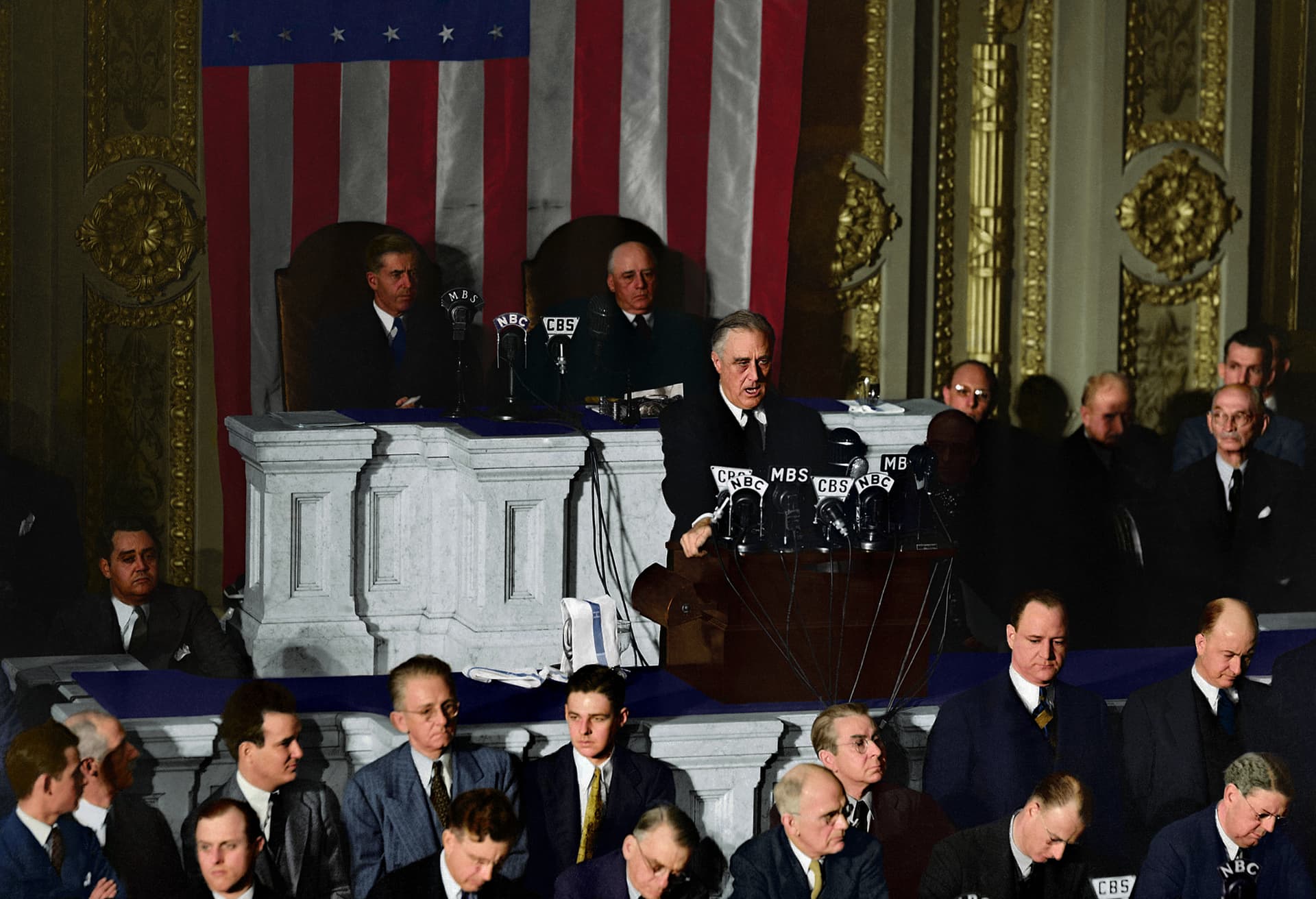
Mr. Vice President, Mr. Speaker, members of the Senate and the House of Representatives:
Yesterday, December 7, 1941 – a date which will live in infamy – the United States of America was suddenly and deliberately attacked by naval and air forces of the Empire of Japan.
The United States was at peace with that nation, and, at the solicitation of Japan, was still in conversation with its government and its Emperor looking toward the maintenance of peace in the Pacific. Indeed, one hour after Japanese air squadrons had commenced bombing in the American island of Oahu, the Japanese Ambassador to the United States and his colleague delivered to our Secretary of State a formal reply to a recent American message. And while this reply stated that it seemed useless to continue the existing diplomatic negotiations, it contained no threat or hint of war or of armed attack.
It will be recorded that the distance of Hawaii from Japan makes it obvious that the attack was deliberately planned many days or even weeks ago. During the intervening time the Japanese government has deliberately sought to deceive the United States by false statements and expressions of hope for continued peace.
The attack yesterday on the Hawaiian Islands has caused severe damage to American naval and military forces. I regret to tell you that very many American lives have been lost. In addition American ships have been reported torpedoed on the high seas between San Francisco and Honolulu.
Yesterday the Japanese government also launched an attack against Malaya.
Last night Japanese forces attacked Hong Kong.
Last night Japanese forces attacked Guam.
Last night Japanese forces attacked the Philippine Islands.
Last night the Japanese attacked Wake Island.
And this morning the Japanese attacked Midway Island.
Japan has, therefore, undertaken a surprise offensive extending throughout the Pacific area. The facts of yesterday and today speak for themselves. The people of the United States have already formed their opinions and well understand the implications to the very life and safety of our nation.
As commander in chief of the Army and Navy, I have directed that all measures be taken for our defense.
But always will our whole nation remember the character of the onslaught against us. No matter how long it may take us to overcome this premeditated invasion, the American people in their righteous might will win through to absolute victory.
I believe that I interpret the will of the Congress and of the people when I assert that we will not only defend ourselves to the uttermost but will make it very certain that this form of treachery shall never again endanger us.
Hostilities exist. There is no blinking at the fact that our people, our territory and our interests are in grave danger.
With confidence in our armed forces – with the unbounding determination of our people – we will gain the inevitable triumph – so help us God.
I ask that the Congress declare that since the unprovoked and dastardly attack by Japan on Sunday, December 7, 1941, a state of war has existed between the United States and the Japanese Empire.
FREE FRANCE DECLARES WAR ON JAPAN BRAZIL INDICATES SOLIDARITY WITH THE UNITED STATES
FIGHTING NORTH OF SINGAPORE CONTINUES
SENATE VOTES WAR DECLARATION, 82-0
News & Between the Bookends with Ted Malone (NBCB), 1 p.m. EST:
Let’s Sing and Swing (NBCB), 1:15 pm EST:
REP. RANKIN VOTES ‘NO’ ON WAR RESOLUTION IN HOUSE VOTE
HOUSE PASSES WAR DECLARATION, 388-1
Religion and the New World (NBCB), 1:30 p.m. EST:
News (NBCB), 1:45 p.m. EST:
Vincent Lopez and His Orchestra (NBCB), 2 p.m. EST:
News (NBCB), 2:21 p.m. EST:
In Care of Aggie Horn (NBCB), 2:45 p.m. EST:
News (NBCB), 3 p.m. EST:
John’s Other Wife (NBCB), 3:30 p.m. EST:
Youngstown Vindicator (December 8, 1941)
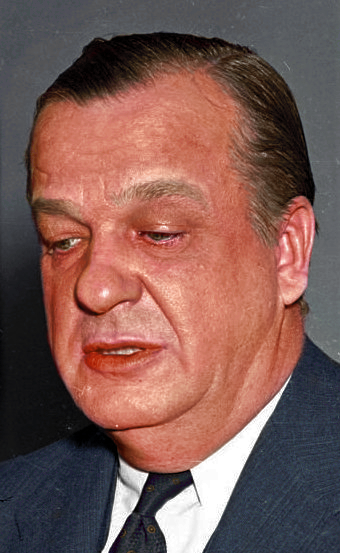
Eliot: Raid on Hawaii aimed to delay American fleet
Calls attack coverup move for action in South China Sea
By Maj. George Fielding Eliot
The war became a world war in grim earnest when Japan struck savagely at the United States.
The Japanese air attack on the American naval base at Pearl Harbor was apparently launched from aircraft carriers. The number and type of planes reported (fighters, light bombers, heavy bombers) could have come only from carriers, as Japan possesses no land bases near enough to permit such an operation by such types of aircraft.
The first attacks were made on the Naval Air Station on Ford Island, base of the Navy’s big patrol bombers, and on the Army base at Hickam Field, home of the long-range bombardment squadrons of the Army Air Corps. This was of course to impede attacks by these long-range aircraft on the Japanese carriers, so as to allow the latter to receive back their planes for rearming and refueling to carry out further attacks against other objectives.
Parachutists may be bailing out
Reports that the governor has proclaimed a state of emergency, that policemen and firemen have been called to Army stations and that the Japanese are using parachute troops suggest the possibility of a planned rising on the part of the Japanese population of the islands. However, such a contingency has long been expected and provided against by defense plans, and is thought to have little chance of success. The report of parachute troops being used may refer only to pilots and other flying personnel “bailing out” of damaged aircraft; it seems hardly likely that parachute troops could be used from carriers in sufficient force to accomplish anything on the heavily garrisoned island of Oahu, which is very far from being another Crete.
As to the purpose of the Japanese attack, it seems likely on the basis of information now available to be one of delaying the westward movement of the U.S. fleet, which is dependent almost entirely on the naval base at Pearl Harbor. Probably the Japanese desire to cover operations in the South China Sea by which they might hope to establish Japanese dominance in that area before the U.S. fleet could arrive to interfere. Supporting this is the Japanese attack against the island of Luzon.
This theory is also borne out by the reported presence of Japanese submarines on the San Francisco-Honolulu line. The Japanese have about 25 submarines capable of crossing the Pacific and returning without refueling, and their operations will tend to impede communications with Hawaii and the mainland. Also, they can be expected to inflict damage on American warships.
Japs take grave risk
The Japanese have taken a grave risk in sending aircraft carriers to attack Pearl Harbor. The island of Oahu is one of the strongest and most formidable maritime fortresses in the world. Its striking power is enormous. The Japanese carriers attacked in the early morning hours, indicating a high-speed approach during the night; they may have commenced their approach from any point within eight hours’ steaming of Oahu, or a matter of 200-250 miles.
The probabilities are that the Japanese will lose one or more of the carriers, which have launched the attack, if not all of them, and this fact indicates the desperate nature of the whole enterprise.
There is no present suggestion of Japanese troopships or battleships supporting the air attack. However, the air attack would come first in any case, and slower-moving vessels such as troopships and a naval fleet in support may later put in an appearance.
The Japanese might attempt to effect a lodgment on some of the other islands of the Hawaiian group with a view of setting up a base for land aircraft; even though this might not last very long, it would procure further delay, and delay is what the Japanese are playing for.
On the whole, it may be expected that the really decisive moves by the Japanese will be in the South China Sea area, covered by the operations in Hawaii in order to give the Japanese time for gaining their Far Eastern objectives. It is not very likely that the Japanese will succeed in doing enough damage at Oahu to procure any great delay in American fleet movements, nor that they will be able quickly to overwhelm either Manila, Hong Kong or objectives farther south.
The whole Japanese program is one of pure desperation, so far as can now be judged, and the reaction by American, British and other forces will soon take place – so that no snap judgment should be formed on the basis of early accounts of Japanese attacks.