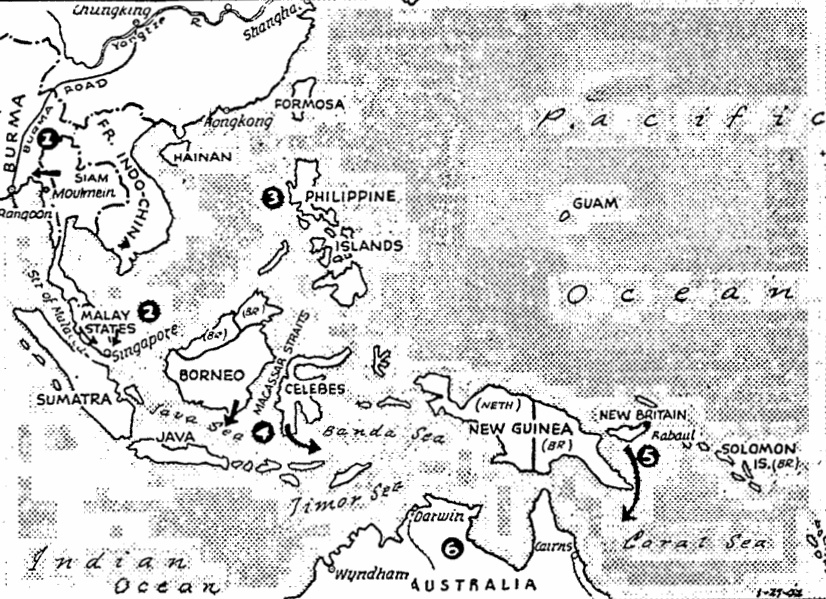
The battlefronts of the Far East
1. Allies hold Japs in Burma as foe aims at Rangoon and Burma Road.
2. RAF blasts convoy as Japs get to within 50 miles of Singapore.
3. U.S. mosquito boats and planes sink transport, down dive bombers.
4. Japs lose 25,000 men, more ships in Makassar Strait; Dutch fight in Borneo, Celebes.
5. Australian airmen blast Jap fleet at Rabaul; land battle rages there.
6. Australia gets promise of aid from Allies.

Rambling Reporter
By Ernie Pyle
SEATTLE – If you are an old resident of Seattle, you will have been seeing the by-line of “J. Willis Sayre” in the newspapers for over 40 years.
In fact, you will have been seeing it so long that you probably will have forgotten what J. Willis Sayre is really famous for.
Mr. Sayre, in his day, was the fastest man alive. He traveled clear around the world on a vacation whim, circumnavigating the globe by regularly established means of transportation in 54 days. The year was 1903. He broke the previous record by six days.
Even the boys on The Post-Intelligencer, where Mr. Sayre is now drama editor, had forgotten about it until Howard Hughes made his spectacular world flight a few years ago. They got to looking up around-the-world records in the World Almanac and here, lo and behold, was their own J. Willis Sayre, sitting back in his cubbyhole office typing out movie reviews.
So I dropped in to see Mr. Sayre, and he told me about his trip.
He was then on The Seattle Times, and just past 21. He doesn’t know what put it into his head, but he decided he’d go around the world on his vacation. He had $500 saved up. He carried the entire sum in $20 gold pieces.
He hopped a freighter on June 26, 1903, for Yokohama. It took him three weeks to cross the Pacific. He got in a little sightseeing in Tokyo, and went across Japan by train to Nagasaki. Then he took a boat to Dalny, Manchuria. He hadn’t been seasick crossing the Pacific, but he got plenty sick on this short trip.
Crosses Asia and Europe
From Dalny he took the Trans-Siberian Railway clear to Moscow. It was the first week the Trans-Siberian was in operation. The trip took three sold weeks. He says it was a wonderful train, with luxurious cars and fine food.
On the train he ran onto a Jewish merchant who had lived 18 years in Nagasaki. This man spoke eight languages, including Russian and Japanese, so Mr. Sayre clung to his coattails. When they got to Moscow this fellow was a little sore, for he said he’d been nothing but an interpreter and a lackey for Mr. Sayre all the way across.
From Moscow he took a train for Warsaw. Or rather he thought he did. When they were 18 miles out he discovered he was on the wrong train – headed for St. Petersburg.
So he got off, hired a horse and cart by sign language, and was driven 10 miles across country to the right station. It cost him 50 cents. Finally he got on the right train.
He stayed all night in Berlin, took another train to Flushing, Holland, caught a cross-channel steamer to England, a train to Liverpool, and hopped the Campagna to New York. He tarried only a few hours in New York, then headed west by train.
He turns down special train
He wasn’t aware that his home paper was making any fuss about his trip. After all, it was just his own personal trip, paid for by himself. But when he got to St. Paul, he discovered a special train – engine and two cars – waiting for him. The paper had arranged it for his final dash to Seattle.
But Mr. Sayre refused to get on the train. He had made all the trip that far on regular service – the kind where anybody could walk up and buy a ticket, and he wasn’t going to spoil it on the last lap. He came home on a regular train.
There was quite a to-do in Seattle when he got back. He made some speeches, and sold an article to The Saturday Evening Post about his trip. And that was the last of it.
Other people have claimed to have gone around faster by regular lines of transportation since then, but Mr. Sayre doesn’t believe it. And as for all those time-smashing flights around the world in the ‘30s, Mr. Sayre says they didn’t go around the world at all – they just went around part of it, up where the world is little.
Mr. Sayre was born in Washington, D.C. His father was a captain in the Union Army. When he was just a kid Mr. Sayre joined the Army and served a year in the Philippines, in ‘98.
He has had one other big trip. In 1928 he took his family and went all over Europe.
He has worked on all the Seattle papers. He has been bugs about the theater since he was a child. He says also that he’s a collector at heart. At his home he has 16,000 theatrical photographs – the biggest collection in the West, he believes. He had to build a special room for them.
He has also made a collection of all the theatrical programs in Seattle, extending clear back to 1863. He has given this to the Seattle library. He used to have a big coin collection, but it got too expensive, so he sold it.
He isn’t thinking about any more world trips soon.
Fair Enough
By Westbrook Pegler
NEW YORK – All right, you Southern-tier Senators and Representatives, you Hoosiers and Hawkeyes and you boys from Illinois and New England and the West Coast! What excuse are you going to give them back home, come election time, for permitting the Communists and fellow-travelers to filter into the National Government in Washington and in jobs out through the country in the first place and to come crowding in in force now, in time of war?
How many Communists have you got in your home country? Did the Communists send you to Washington or was it the Americans who elected you to represent them?
Don’t tell me, don’t try to tell your home folks, that you were unaware of this infiltration in the earlier years or of the present descent in force. You boys are pretty smart. You get around in Washington and you know that, even though Martin Dies has made a few mistakes, those mistakes have been exploited and exaggerated and that the bulk of his findings are true.
Afraid of being called Red-baiters
The fact that Russia is our ally is no excuse. We are Russia’s ally, too, and before this thing is over we figure to do as much for Russia’s incidental benefit as Russia has been doing incidentally for ours. But you don’t hear of any true believers in the U.S. Constitution and the republican form of Government boring into the Russian government.
You know what Stalin would do to any true believers in Americanism who tried that. Just Ivan-call-the-guard and rooty-toot-toot and shovel them under and get on with the war. They don’t let anyone mess with their form of government or their established system of economy, but you boys can’t look your people in the eye and say you have been honestly diligent to prevent the Communists and travelers from messing with ours. You boys have ducked this question for fear of being called Red-baiters – sat by and let it happen.
How does a fellow identify a Communist if the Communist denies it?
I will answer that by asking another.
How do the New Deal bureaucrats who are always so broadminded to fellow-travelers identify Hitlerites and Fascists, Quislings and appeasers?
You know the answer. Anyone, according to these bureaucrats, who ever ran with the Bund or America First is either an unforgivable Hitlerite, Fascist, Quisling or appeaser, himself, or so deeply suspected of traitorous sentiments that he might as well be guilty. They recognize no shades or distinctions on that side of the question in Washington, but a man or woman who ran with the Communists, played with them, spoke their language, did their work and advocated the total abolition of private property, gets a big break. He, or she, and there are plenty of females of the species holding Government jobs now, is tagged as just a liberal and a believer in something called true democracy which adds up to Communism.
Call poet for $8000 Government job
The worst of it is, boys, that you have only one real Communist in your entire membership and that one masquerading as a Republican, and almost all the rest of you are there as old-line Americans, elected by old-line Americans who would have snowed you under if you had expressed the slightest tolerance for Communism when you were asking for their votes. But you just haven’t had the initiative, nerve and force to throw back these Trojan horsemen as they came and you have left Martin Dies take all the punishment in a fight that should have been as much yours as his.
Recently they brought in a guy they call a poet and gave him an $8000 job in the so-called Office of Facts and Figures, although he once served on a committee which worked for the election of William Z. Foster, the Communist candidate for President.
He says he isn’t a Communist and you just take his word for that; but if someone had worked with Fritz Kuhn, of the anti-American Bund, would you take his word that he wasn’t a Nazi? Are you telling the people that in all the United States it was impossible to find a man for this job, which, of course, is an artificial job, anyway, whose record on Communism was absolutely clean?
Well, do it your way, but if this country does get captured from within and your people back home and everywhere come under the terror that Communism inflicted on Russia, you will be the guilty ones who had the right, the power and the duty to bar the door but, for the sake of some cheap patronage and for lack of patriotism, didn’t.

Clapper: Sloppy set-up
By Raymond Clapper
WASHINGTON – As I read the Roberts report on Pearl Harbor, I kept thinking that would be a hell of a way to run a newspaper.
I don’t know anything about military affairs. But I have been around newspaper offices all my life. A newspaper office is organized to be ready for the unexpected. But I never saw a news room that was as slack and sloppy as the Roberts report shows the Army and Navy at Hawaii to have been.
Go through any well-run newspaper office and you will find galleys of type, with headlines and art, all ready to be thrown into the paper at an instant’s notice. Let a flash come through about the sudden death of any prominent figure and the paper will be ready to roll within a few minutes.
A newspaper office always goes on the assumption that the worst is about to happen the next minute. An incredible amount of planning, labor and watchfulness goes into this side of a newspaper – much of it in vain. But it is necessary if you are not to be caught asleep when a big story breaks.
Newspapers are set for unexpected
I remember when Carl Groat, now editor of The Cincinnati Post, was manager of the United Press bureau at Washington, After the Shenandoah dirigible disaster, he sent a reporter to camp on a death watch at the Navy Department whenever a dirigible made a flight. The man-hours which reporters spend on death watches and on chasing down tips which do not materialize, the newsless days they put in hovering around prominent figures just so they will be on hand in case something happens are all part of the routine of being prepared for the unexpected.
Around Scripps-Howard newspaper offices is the old story of the Oklahoma City hanging years ago. The sheriff was all ready. Most of the reporters in town were on hand. But one city editor sent a reporter out to watch the governor, who was opposed to capital punishment. Ten minutes begore the hanging was to take place, the governor commuted the sentence. The newspaper which was on the job had its newspaperboys selling papers to the crowd waiting in the jailyard to see the hanging that had been called off.
Newspapers are prepared always for the unexpected. Hawaii seems to have operated on the conviction that the unexpected couldn’t happen.
Neither checked with the other
More than that, the Roberts report shows appalling lack of coordination between the Army and Navy. The Army thought the Navy was patrolling. The Navy thought the Army had its detection service operating. Neither bothered to check with the other – or maybe they were not on speaking terms.
In any newspaper office, the first business of the managing editor is to see that his city editor and his telegraph editor clear with each other on space. If the city editor went on his own and the telegraph editor sent wire copy to the composing room to his heart’s desire, you would have enough type set to fill three newspapers. If a big local story breaks, the telegraph editor’s space is reduced. If a big telegraph story breaks, the city editor takes a cut in space. The two subordinate executives must work together. Such coordination is necessary in any factory. In fact, you seem to find it everywhere, except that there wasn’t a trace of it between the Army and the Navy at Hawaii.
I always have thought that civilians should be extremely sparing in their advice about military affairs, which seem so simple and yet are so intricate. But the Roberts report shows two glaring situations which come down, in civilian language, to sloppy operations. First the Army and Navy acted on the assumption that the unexpected would not happen, when they should have assumed the opposite. Second, the two services were totally uncoordinated, and neither knew what the other was doing – or, in this case, not doing. And the air force, so supremely important in the new warfare, apparently was regarded by both as a minor auxiliary.

Maj. Williams: Vindication
By Maj. Al Williams
“Japan must be bombed to defeat.”
In that human process known as the climbing of the world to greater heights, progress, mistakes and errors are just as valuable reference points as successes. In fact, in the sad but thoroughly human fashion of having to learn the hard way, it appears as if all sorts of mistakes and errors must inevitably precede successes.
The moral of these hard-headed observations is that since we must make mistakes, the logical effort must be to keep the mistakes small. And to keep them small we must be ever alert to catch them before they become big. The application of this moral to the management of our war to a victorious conclusion necessarily means quick, alert and fearless appreciation of mistakes made to date and the patriotic courage to correct them. And when I say “patriotic courage,” I mean a selfish burning determination to let no man’s nose alignment or political or career interests deviate us from making the corrections stick.
American airmen have steadfastly warned the country and its leaders against the folly of building aircraft by the thousands without the guidance of at least a sketch plan of blueprint of what must someday be known as American airpower. We fliers warned that airpower was going to crack the old system of warfare until we got sick and tired of shouting.
America was warned
In 1938, I brought back to this country word of what the Germans had earned and sweated and paid for in preparation for setting up their airpower, hoping that we could and would take up where they had left off. As an ordinary person who had earned a little position in business, I thought this was my duty and that the country should be given this information, presented in such a way that it could be readily understood.
I tried to tell the whole story of airpower, warning that airpower is not a flock of airplanes screaming and diving all over the sky. It is a gigantic, integrated machine, the timing gears of which are aeronautical research (to find out what can and should be built); mass production, and a pilot and mechanic training program to man that machinery.
We airmen stoutly and pleadingly claimed that completeness of our air effort to achieve real American airpower could and can only be achieved by concentrating the authority, responsibility and direction in one organization, a United States Air Force, comparable in administrative power and function to those of the Army and Navy.
And now, what does the Truman Senate Committee say in substance in the report recently issued to the country?
“After two years of frantic effort, we have too few planes to allow adequate flying time for our own pilots.” Again, and this is one of the Committee’s first “becauses” – “because the Services refused to consider the airplane as more than a supporting weapon…” And again, “Apparently there has never been and is not now any real planned and coordinated program for the production of aircraft, our Services merely purchased what the manufacturers had to offer instead of planning…”
Indictment is clear
In that last sentence we see a clear indictment of the deficiency of aeronautical research – “because the Services merely ordered what the manufacturers had to offer.” And that charge confirms just exactly what American airmen have been saying all these years. We airmen shouted that airpower was the weapon of this war, while the admirals and generals and politicians said it was a “supporting weapon.” The facts prove we were right and they were dead wrong.
The purpose and the pain of this writing is to invite and stimulate hard, stern, honest criticism – criticism is the alarm clock of progress. Complacently ignore its challenge, and you may invite disaster. And I tell you here and now that we are going to have a separate air force in this country before this war is concluded. It is only a matter of “when.”