The Pittsburgh Press (April 14, 1941)
JAPAN, RUSSIA IN PACT; WORLD IS BEWILDERED
….
Neutrality treaty seen as harmful to U.S.; also as blow to Axis
….
By the United Press
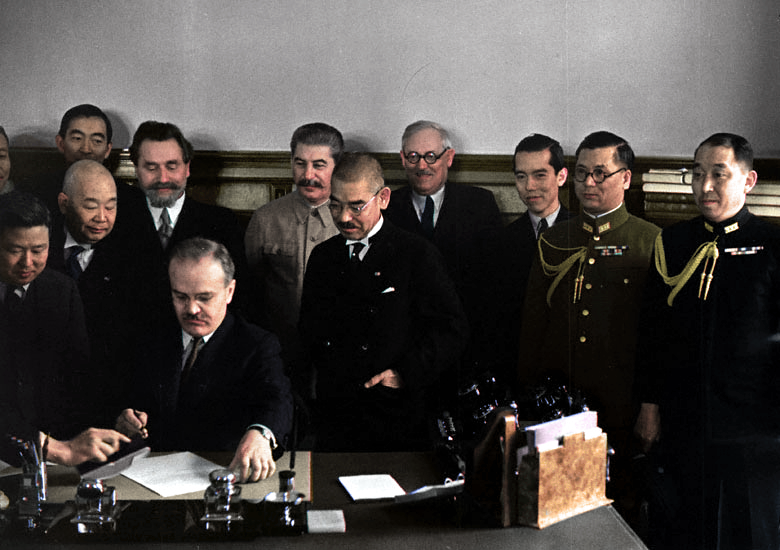
Soviet Foreign Minister Molotov signing the pact.
Statesmen in all parts of the world tried to evaluate the new “neutrality” treaty of Russia and Japan today, and seemed unable to form any definite conclusion.
Spokesmen for Japan’s Axis partners, Germany and Italy, hailed it as a great triumph for Axis diplomacy, and as a blow to the United States. But they didn’t say how or why. British and American commentators thought it might represent a defeat for Axis diplomacy, but they didn’t say how or why, either.
Neutral statesmen pointed out that Japan had wanted a non-aggression treaty with Russia, like the one Russia gave Germany in August 1939, a month before the war started. Instead she got a “neutrality” treaty in which the nations promised to remain neutral if the other was the “object” of military attack. Neither nation was pledged in the event the other is an attacker rather than the attacked.
Works both ways
They also pointed out that if it “guaranteed” Japan’s northern borders, permitting her to devote all her attention “elsewhere” (elsewhere being the Dutch East Indies, British Malaya and Oceania generally), it also “guaranteed” Russia’s far eastern borders, permitting her to devote all her attention “elsewhere” (elsewhere being the Balkans where Germany and Italy, Japan’s Axis allies, are now heavily engaged).
Semi-official reaction in Tokyo indicated that the Japanese expected great things from the treaty. They think it would aid them in bringing a quick end to their war with China, give pause to the United States in its efforts to aid Great Britain against Germany and Italy and to oppose Japanese ambitions on Oceania. Japan is now free to devote its attention “elsewhere,” was the general tenor of Japanese comment.
Text from Moscow
From Moscow came only the text of the treaty; there was not one word of comment or explanation. The reaction of various capitals follows:
Berlin
Well informed sources said:
The treaty is designed to harmonize Japanese-Soviet relations and interests, which follow the Axis policy. The treaty certainly is intended to preclude any United States-Russian rapprochement.
Rome
A victory for the Rome-Berlin-Tokyo alliance. It kills the hope of Americans and British that Russia will intervene against the Axis if the United States enters the war.
London
Official quarters saw the treaty as not necessarily unfavorable to Britain on the theory that it frees Russia to cope more actively against German aggression in Europe. But this is outweighed in many minds by the threat of greater Japanese aggressiveness in the South Pacific.
Washington
Officials anxiously studied the treaty to appraise its meaning to the United States, which opposes Japanese expansion in the South Pacific. Secretary of State Hull belittled the pact and said America’s policy in the Pacific remains unchanged.
Chungking
Informed Chinese sources said Moscow has assured China that the new pact does not affect the fundamental Soviet policy of aid to China. As a result, the pact was not regarded as substantially detrimental to China’s position.