There, on the front lines, these colored units are rarer than you might think. You see, 80 percent of all black servicemen will never leave the United States. Partly because other members of the United Nations, such as Australia, request the U.S. to not send too many people of color to not upset the white population.
So, what he said about Australia isn’t untrue. The Australian government, in December 1941, asked the United States not send Negroes. The U.S. dismissed the protests. Australia backed down, though the government established zones for Negroes to minimize contact.
“On January 25, 1942, General Barnes informed Washington that Australia no longer had any serious objection to any type of American servicemen being posted there.”
This article goes on to list several Army memos where high-ranking officers had commented about the White Australia policy (not in a good way either; they hated it).
Regarding that 80 percent number, according to the Army, they were ramping up the number of troops for the planned invasion of Japan. They had already sent the units for Europe they could, but they did not have enough numbers for Japan ready, so there was a surge right towards the end of the war. The bombings in Japan removed any need for them. The problem with figuring out exact numbers is the presence of draftees. The draft was only for 18 months of service, so, during the war, there was “cycling.” Therefore, it is safe to assume that the exact percentage is unknown.
Partly because white officers are opposed to have units of colored people in their ranks. Instead, the vast majority are converted into non-combatant units.
The non-combatant comment he makes here is both false (they fought in combat and were deployed) and also not a good understanding of the military, where the vast majority of roles were logistics and support. This is still evidently the case today.
When asked to justify this policy by a Representative to Congress in 1943, Secretary of War Henry Stimson would reply that: “Negro units have… […] …been unable to master the techniques of modern weapons.”
That’s not what he said. That was a quote from William Hastie (who was not a congressman; he was Stimson’s civilian aide) in a 1972 interview…
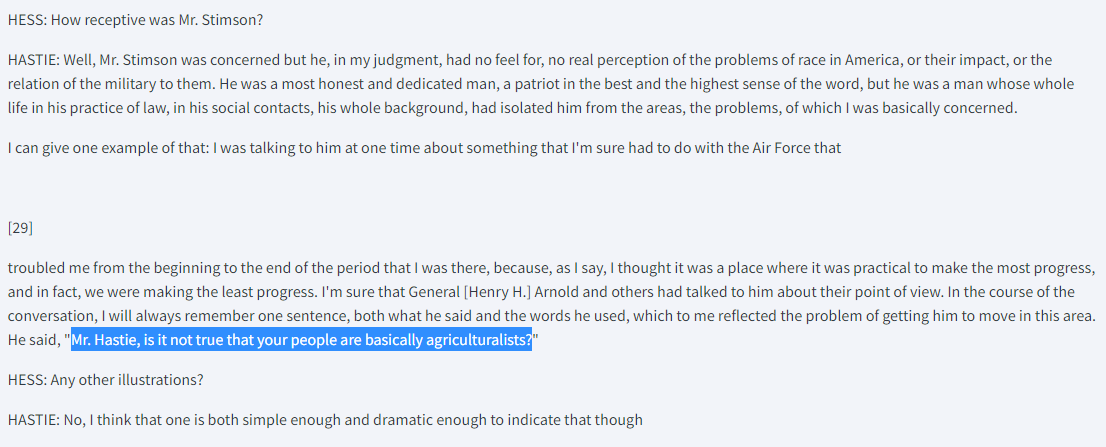

…not Stimson himself…


…that was sensationalized and twisted quite sloppily:
Wynn is another British historian and this was his only published work (outside of essays for journals).
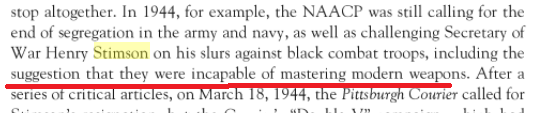
Gluckstein again:

The second part of the quote was sensationalized by the NAACP, through Hastie and Truman Gibson. Hastie stepped down as a civilian aide to Secretary Stimson because he claimed that they were planning a separate OCS for the Air Corps and he wasn’t informed. The Air Corps denied the claims, but he stated they were dishonest, and resigned. Here is an excerpt from Hastie’s resignation letter, published on The Chicago Defender:
https://cdn.discordapp.com/attachments/813068464855187467/844810942263853086/unknown.png
Now we know where the “[…]” comes from. It’s because it was two things attributed to him, but not definitively said by him that J.D. and I could find, yet.
Regarding the second comment about “not knowing how to operate modern weapons,” Hastie’s big push was never for ground combat. He wanted Negroes to be represented in artillery, mechanized divisions, and most important to him, the Air Corps. So, the soft implication of the phrase, when spoken out of context, is that “black people can’t even use machine guns,” when Stimson could have been (and this is conjecture on our part) referring to the fact they did not have the education level to handle more advanced mechanized weapons, which require training and a certain level of basic education to use.
Even then, with context of the whole discussion (and considering Stimson did sign off on multiple mechanized all-black units), Stimson could not have harbored that as a universal belief.
So, it’s easy to presume he may have been speaking about mass mobilization of all blacks, not just the higher-educated or capable ones. This does tie into racial (and regional) disparities in education.
The NAACP, following W. E. B. DuBois’ lead, really had and has a very bad habit of presuming that “anything one white man can do, all black men can do.” There’s a reality that so-called “white” militaries learned a long time ago – some people really are just bullet fodder and they are useful. You give them a rifle, you give them some training, you point them at the enemy. But that is “beneath the black man” for some.
We will never know whether Stimson himself actually said that, as he died just five years after the war ended.
Now, African-American reactions vary.
Some have a hard time mustering up the needed patriotism to fight with vigor for a nation they feel they are not welcome in.
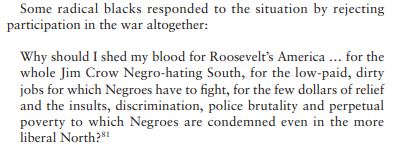
“Why should I shed my blood for Roosevelt’s America… for the whole Jim Crow Negro-hating South… for the low-paid, dirty jobs for which Negroes have to fight for the few dollars of relief and the insults, discrimination, police brutality and perpetual poverty to which Negroes are condemned even in the more liberal North?”
Quoting Gluckstein again.
Some of the photographs used do not paint the picture the video attempted to convey:
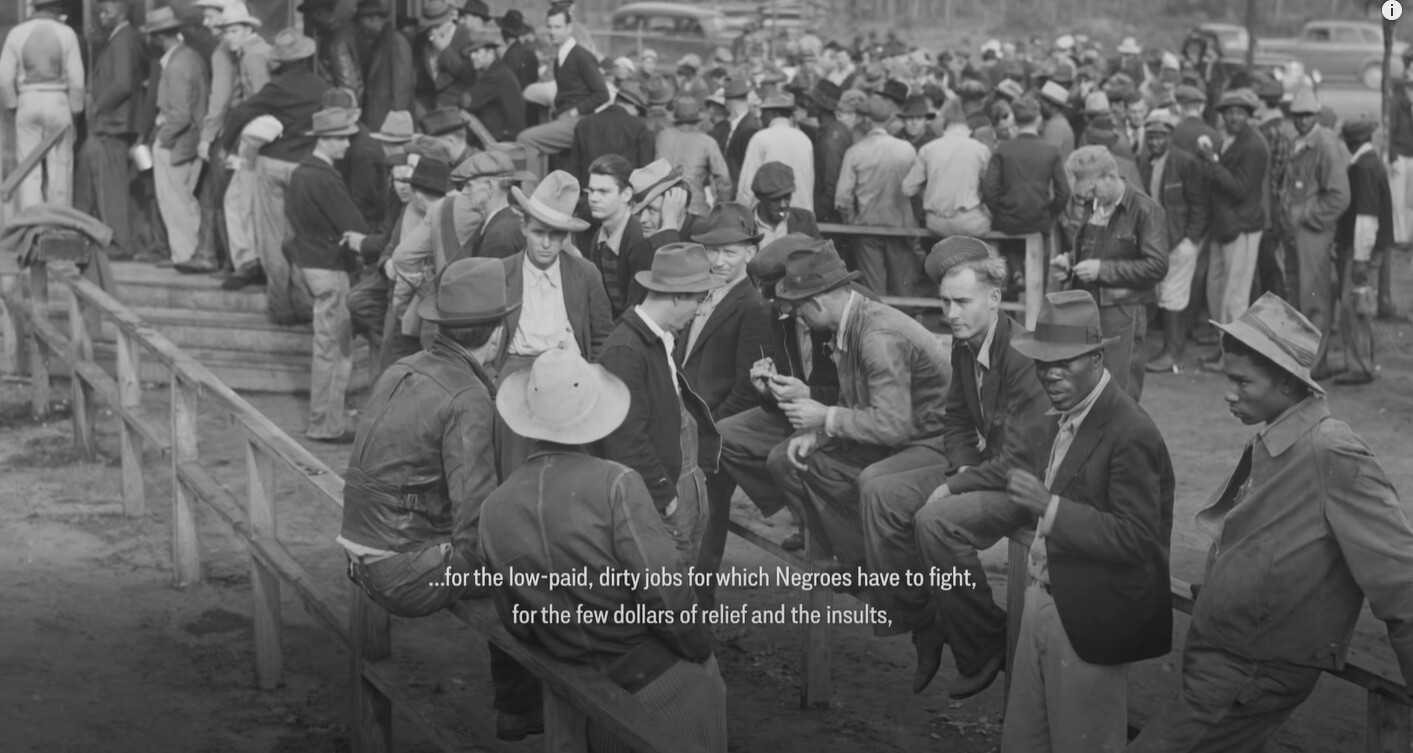
This was a Communist Party rally:
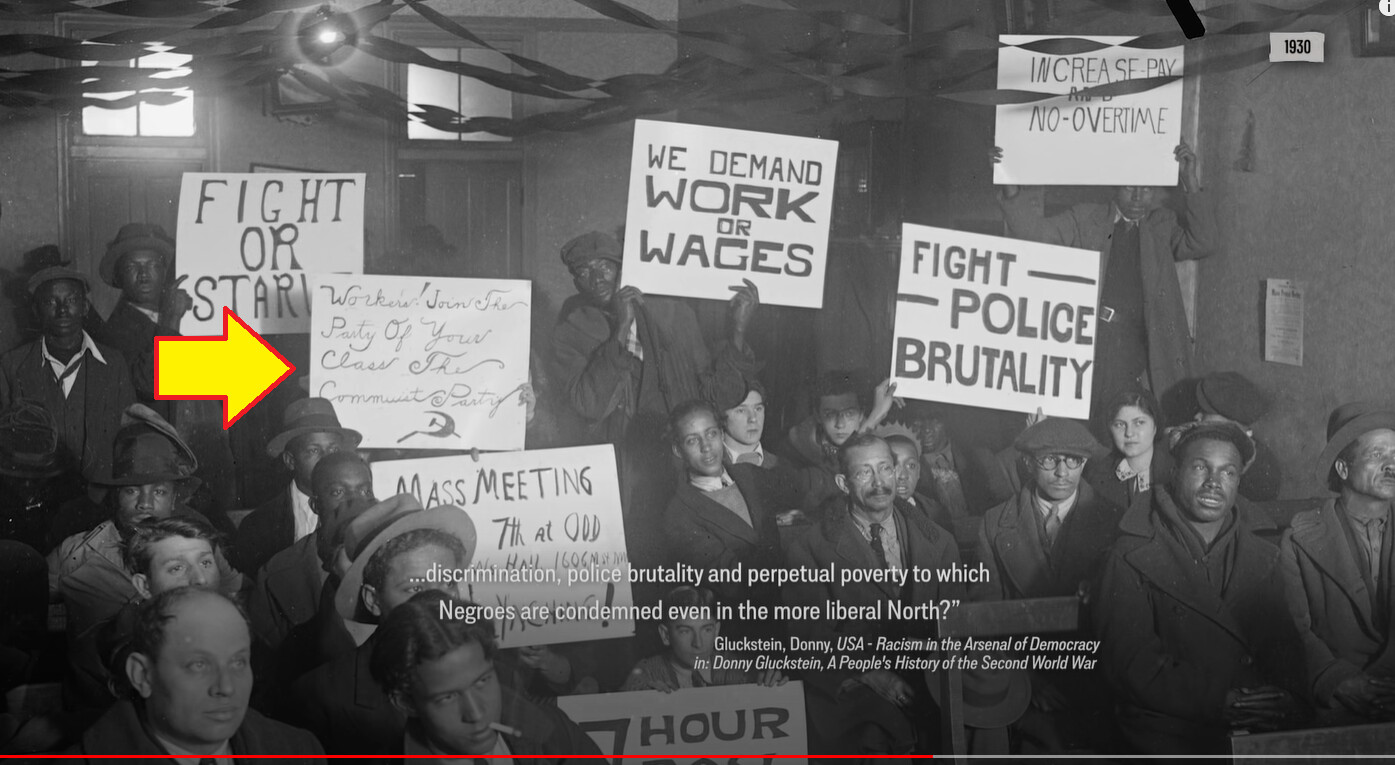
Back to the NAACP, they did make a provision for the “civilian black organizations” that were “causing pressure.” The NAACP might have stated it was a positive move, but it really wasn’t. The last thing any heading the military wanted was a troublemaker, and the NAACP was just that to the Army. They had high demands, but weren’t interested in discussing the reality of the situation or the details, so the troops were, in the end, left dissatisfied.
The segregation inside the Army has some strange side effects. Like, when one black soldier notes that a white German prisoner-of-war at his encampment has more freedom of movement than he does. And, that the prisoner is allowed to ride at the front of the bus, while he, a uniformed U.S. soldier, has to sit in the back.
What’s the source? Seriously, what is? Gluckstein again?
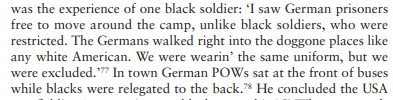
And, to be clear, these are not isolated incidents, but the rule across all stations, with, once again, the conditions in the Southern states being at the bottom of the list.
He’s implying that every post had some sort of racial strife attached, which was just not the case.
One serviceman writes to the NAACP, Camp Stewart in Georgia:
“Please for God’s sake, help us. These old southern officers over us have us quarantined like slaves come down and see… They really hate Colored. Please appeal to the War Department about our treatment at once. We are no slaves.”
Others write of unspeakable sanitary conditions and multiple fatalities due to lack of medical care and riots.
Why quote Donny Gluckstein again?
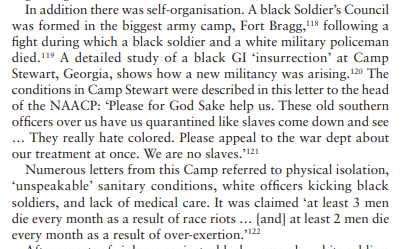
There’s far more to these claims than what was written in “A People’s History”, and, as alluded to many times in our analysis, the video pretty much quoted “A People’s History” word for word. It wasn’t just one side being “ignorant and backwards” and the other being “sweet little darlings.”
At least Gluckstein mentioned the Camp Stewart riot (albeit in an oversimplified way).
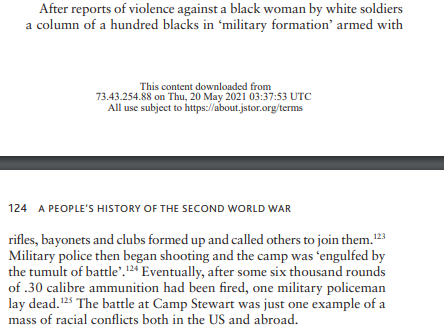
https://www.newspapers.com/clip/20361950/the-atlanta-constitution/
From the sources J.D. and I sifted through, he missed this. Here’s the summary that was given to white commanders that were to have black units in their command:
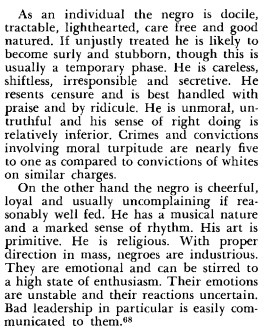
Whichever way Sparty would want to talk about it, this is the source he should have used, instead of that Marxist historian.
This summary pulled no punches, though I would say you could describe “white trash” in a similar vein.
J.D.: “The issue with the Marxist style is that they’ll find one incident and pretend it’s the rule. Or they’ll look at something that supports their underlying message of activism, and exaggerate the role played. I mean, they have to. It’s how they get funding. NAACP needs “wins,” otherwise people won’t donate to the NAACP.”
Regardless of all of these hardships and the opposition to racial integration, by the end of the war, roughly one million African-American troops will have served in the U.S. military, out of which around 125,000 will see active combat duty, and out of them, 708 men will give their lives to fight the Axis. The war proceeds, practical reality starts to overtake ideology, and the men serving side by side with their white and brown brothers will help fulfill at least some of the goals of the Double V campaign.
https://catalog.archives.gov/id/531415
That’s Lt. Gen. Joseph T. McNarney, Deputy Supreme Allied Commander, Honor Guard of MPs during his tour of the Fifth Army front at the 92nd Division Sector.
J.D.: “So, basically, they missed some really good storytelling here. This first picture is not that big a deal. It’s an honor guard. This idea that black soldiers were ‘invisible’ is proven nonsense as that’s a Lt. General and theater commander inspecting them and they were chosen to be that honor guard for his inspection.”
Interesting story with the second picture:
The third picture is of POWs taken by the Germans:
https://history.army.mil/html/topics/afam/aa-volinfreps.html
A huge missed opportunity to have not mentioned this – a massacre of black POWs by the Germans overshadowed by Malmedy:
Starting in 1942, the 332nd Fighter Group of the Tuskegee Airmen becomes the only colored airmen to see action during the war.
The 99th Squadron saw action as well, in North Africa and Italy.
By that time [when EO 9981 was signed], most of the servicemen will have been discharged to return home. To homes and cities and towns and countrysides that is still, largely, segregated. For them, personally, their service and sacrifice will largely go unrecognized.
Isn’t that revisionist lecturing about how put down and unrecognized all or at least most Negro soldiers were for years? They had the same benefits as white soldiers and those who died in service were treated with the same respect afforded to white men. The Isaac Woodard case wouldn’t have garnered national attention in 1946 if they were truly “forgotten.”

J.D.: “Gen. Patton’s not buttoning this man’s shirt here:”
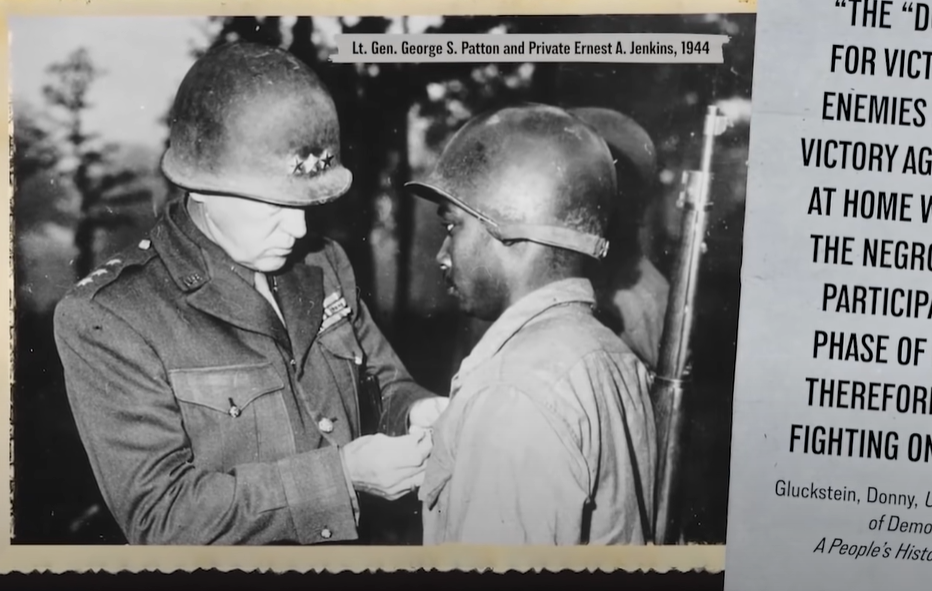
One of the truly bothersome aspects of this video is that Sparty segways from this into the Tuskegee Airmen, and then spends the rest of the video talking only about them. There’s never anything about other Negro units, even though pictures of them are shown throughout the video. He talks about the famous one that has had multiple movies, documentary specials and political attention drawn to it. Being a bit more casually aware of the contributions made, and the fact he sourced all these other pictures, just seems a bit silly and contrived.
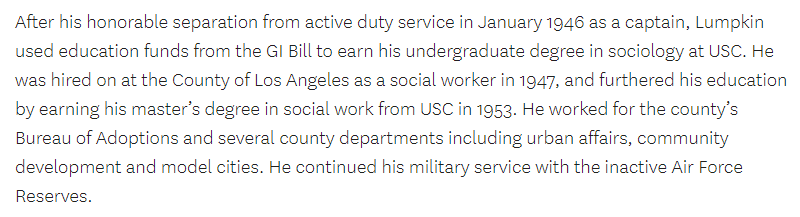
Or, as one of the Airmen, Theodore Lumpkin Jr., will say near his 100th birthday in 2019: “The Tuskegee Airmen were not recognized after the war. People didn’t believe us when we told them what we did, and our work wasn’t documented anywhere.”
This quote is used multiple places, but actually comes from Lumpkin’s 2011 interview given to the Veterans History Project of the American Folklife Center, not his 100th birthday.
Lumpkin was speaking about the importance of the organization he helped craft, the Tuskegee Airmen, Inc. (1:28 in the video).

He spoke very well of his experience after the war and in the military.

https://lite.cnn.com/en/article/h_cd4aa0295e4002e19b80923c6c1225b1
But, they will have made an impact, inspiring others to follow and take up the fight.
The video shown at this point is from a documentary on the airmen produced by the Army in 1945, narrated by Ronald Reagan. So much for the lack of documentation and recognition.

Or, as President Barack Obama, then a U.S. senator, will state in 2007: “My career in public service was made possible by the path heroes like the Tuskegee Airmen trailblazed.”*
That quote was from a written press release by his Senate office regarding the awards ceremony, which he never attended.
https://www.c-span.org/video/?197394-1/congressional-gold-medal-ceremony
This was also the same day that Obama was endorsed by Jesse Jackson, implying a political intent for his statement.
In 2007, the Tuskegee Airmen still alive will finally see their service publicly recognized with a Congressional Medal of Honor.
It wasn’t a Medal of Honor, at all. That is a military award. It was a Congressional Gold Medal.
They weren’t even allowed to keep their medal. It went to the Smithsonian and they got bronze replicas instead.
https://www.nytimes.com/2008/12/10/us/politics/10inaug.html
In 2009, Lumpkin, and several of his fellow servicemen still alive, will sit in front rows at an event that, by their own statements, they never believed would happen – the inauguration of the first African-American U.S. president.
They were invited by Dianne Feinstein, not Obama (though he signed off).
They were given access to the 30,000 seats in the terrace area. Still pretty close, but not the inspirational picture implied.
https://www.nytimes.com/2008/12/10/us/politics/10inaug.html
I’ll give Sparty this though: They were certainly inspired and pleased by Obama’s win.
However, that’s not an excuse for the video to turn fully hagiographic in the second half. That’s just something one expects from a Lifetime movie, not a history video.
J.D.: “Everyone knows of the Tuskegee Airmen and if they want to do a special on them, fine. But, I find it quietly amusing that they pick the ‘white-approved black story’ to tell. Because all people ever talk about is the Airmen when it comes to this topic.
“Again, how many movies and specials have been made about them over the decades?
“I’m more interested in the engineer battalions. No one ever talks about them.”
My suggestions:
Use better sources. Don’t just source a single British historian who is an admitted Marxist. Use sources closer to home and those sources that do not have the intent to rile up people into a frenzy (academia has a bad habit of doing that, especially in recent years).
Use more sources. The U.S. armed forces have their own historians. Their sources are excellent for a history video like this.
Post your sources in the description, always. In the video description, only the pictures are sourced. The sources for the content should also be added.
Caption the pictures correctly.
And, to quote a certain historian on YouTube, let history speak for you (very much a hypocrite himself, but that doesn’t detract from those important words).