The Free Lance-Star (June 30, 1944)
ALLIED COLUMNS CLOSING JAWS OF TRAP ON CAEN
Crack of lines admitted by Germans
Advances made by U.S. troops
Battle for Caen
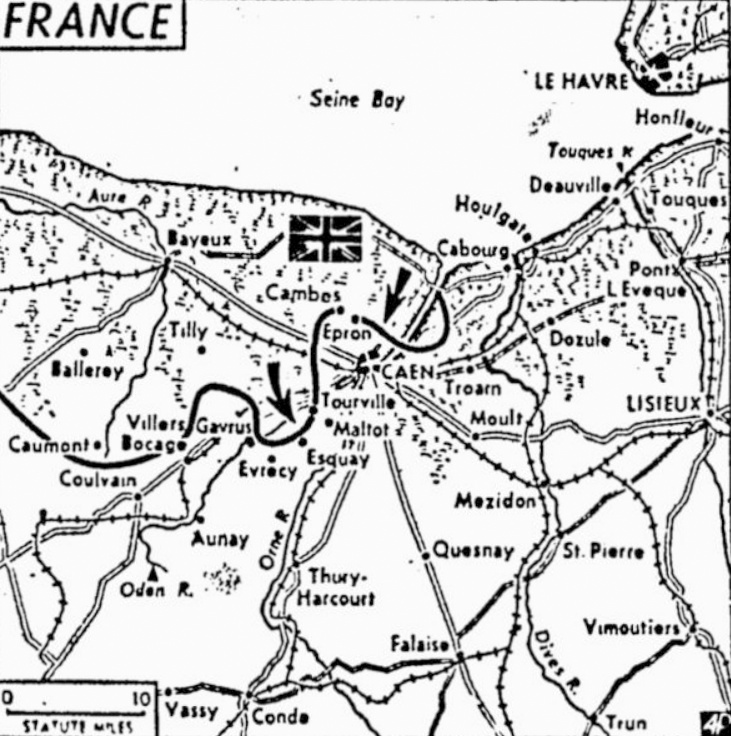
Arrows show British drives on the Allied front (black line) in the Caen sector of Normandy. British are engaged in heavy fighting in the salient they have thrust across the Odon River southwest of Caen and are reported driving at the city from the north.
SHAEF, England (AP) –
Advance elements of two British columns driving around Caen in opposite directions were within 11 miles of completely encircling the inland French port today as the Germans threw large armored forces against the Odon river bridgehead in unsuccessful flank attacks.
From newly captured Marcelet, Gen. Sir Bernard L. Montgomery’s troops struck due east toward Caen in a thrust that menaced one of the city’s main airfields. At last reports, Allied troops were only half a mile from this field.
Thus far the Allies have taken only one important airfield in the bridgehead – that at Maupertus near Cherbourg.
In the American sector of the west, Lt. Gen. Omar N. Bradley’s troops made a series of small attacks southward toward the important road junction of Saint-Lô in an effort to straighten their lines, the doughboys were also beating down dwindling resistance on the Cap de la Hague, at the northwestern tip of the Cherbourg Peninsula.
Salvage begun
The Supreme Command announced, meanwhile, that Cdre. William Sullivan, one of the foremost salvage experts in the U.S. Navy, has been put to work to bring Cherbourg’s docking facilities back into operation. He worked at Pearl Harbor, cleared Casablanca and Oran harbors and was one of the directors of the Naples operation.
In the drive to encircle Caen, forward British elements fought in the Esquay sector, southwest of the city, and in the Troarn to the east. Advances totaling 11 miles would effect a junction.
Four main roads leading to Caen flow through this bottleneck, and it was considered likely that all were under some sort of artillery fire from the Allied lines.
The Navy announced that the British assault around Esquay, on the still-widening bridgehead across the Odon River some five miles southwest of Caen, was supported by the guns of the British battleship HMS Rodney, lying off the Allied beaches to the north. HMS Rodney’s guns have a range of 33,000 yards (nearly 19 miles).
Using reserves
Marshal Erwin Rommel, who is now reported rushing strategic reserves to Normandy from both Germany and France, tried to cut off the British Odon salient with one heavy and three smaller counterattacks, but all were broken up.
Little fighting was reported directly north of Caen, where forward elements stand about miles from the city’s outskirts, but to the northeast British raiders attacked Bréville, a mile east of the Orne River and three miles south of its mouth.
The Paris radio declared in a broadcast early today that British and Canadian troops had landed on the east bank of the Orne estuary and had captured the port of Cabourg, four miles beyond, but there was no Allied report of operations that far to the eastward.
A British staff officer told Associated Press war correspondent Roger D. Greene last night that the Germans were throwing all available armor into a flank attack against the Odon River.
Alarm is seen
The Germans are rushing major reinforcements up from the south, Greene wrote, adding:
German alarm was reflected sharply by the fact that hitherto the enemy has only moved vehicles forward under cover of darkness because of Allied domination of the skies, whereas today [Thursday], for the first time, Nazi transport was on the move in broad daylight.
More than 100 of these enemy vehicles were shot up by Allied warplanes during the day.
Cherbourg forts taken
All forts along the Cherbourg breakwater are now in Allied hands. The last gave up when Marauder bombers swooped in at less than 6,000 feet and cloaked it with high explosives. The Germans began waving white flags as the smoke cleared away.
A naval announcement said destroyers and light coastal forces were keeping a close watch on the Channel Islands, where two German divisions were believed cut off. British warships are intercepting supply convoys whenever possible.
The islands have big guns capable of shooting up to 40,000 yards. They could shell the Cherbourg Peninsula but could do not great damage since there would be no way for the Germans to observe the fire.