America at war! (1941–) – Part 5

Innsbrucker Nachrichten (May 2, 1945)

Unser Führer in Berlin gefallen

Aus dem Führerhauptquartier, 1. Mai. Unser Führer Adolf Hitler ist heute nachmittags in seinem Befehlsstand in der Reichskanzlei, bis zum letzten Atemzuge gegen den Bolschewismus kämpfend, für Deutschland gefallen.

Am 30. April hat der Führer den Großadmiral Donitz zu seinem Nachfolger ernannt.

Der Großadmiral ist der Nachfolger des Führers.


Neue Konfliktstoffe unter den Alliierten

In San Franzisko erlitten die Sowjets wieder Niederlagen – Stalin antwortet Truman nicht

…


Marburger Zeitung (May 2, 1945)

Unser Führer für Deutschland gefallen

Führerhauptquartier, 1. Mai.
Aus dem Führerhauptquartier wird gemeldet, daß unser Führer Adolf Hitler heute nachmittag in seinem Befehlsstand in der Reichskanzlei, bis zum letzten Atemzuge gegen den Bolschewismus kämpfend, für Deutschland gefallen ist.

Am 30. April hat der Führer den Großadmiral Dönitz zu seinem Nachfolger ernannt.

Der Großadmiral und Nachfolger des Führers spricht zum deutschen Volk:

Deutsche Männer und Frauen!

Soldaten der deutschen Wehrmacht!

Der Führer Adolf Hitler ist gefallen. In tiefster Trauer und Ehrfurcht neigt sich das deutsche Volk. Frühzeitig hatte er die furchtbare Gefahr des Bolschewismus erkannt und diesem Ringen fein Dasein geweiht. Am Ende dieses seines Kampfes und seines unbeirrbaren geraden Lebensweges steht sein Heldentod in der Hauptstadt des Deutschen Reiches. Sein Leben war ein einziger Dienst für Deutschland. Sein Einsatz im Kampf gegen die bolschewistische Sturmflut galt darüber hinaus Europa und der gesamten Kulturwelt.

Der Führer hat mich zu seinem Nachfolger bestimmt. Im Bewußtsein der Verantwortung übernehme ich die Führung des deutschen Volkes in dieser schicksalsschweren Stunde. Meine erste Aufgabe ist es, deutsche Menschen vor der Vernichtung durch den vordrängenden bolschewistischen Feind zu retten. Nur für dieses Ziel geht der militärische Kampf weiter. Soweit und solange die Erreichung dieses Zieles durch die Briten und Amerikaner behindert wird, werden wir uns auch gegen sie weiter verteidigen und weiterkämpfen müssen. Die Anglo-Amerikaner setzen dann den Krieg nicht mehr für ihre eigenen Völker, sondern allein für die Ausbreitung des Bolschewismus in Europa fort.

Was das deutsche Volk in dem Ringen dieses Krieges kämpfend vollbrachte und in der Heimat ertragen hat, ist geschichtlich einmalig. In der kommenden Notzeit unseres Volkes werde ich bestrebt sein, unseren tapferen Frauen, Männern und Kindern, soweit dies in meiner Macht steht, erträgliche Lebensbedingungen zu schaffen. Zu all dem brauche ich Eure Hilfe. Schenkt mir Euer Vertrauen! Denn Euer Weg ist auch mein Weg. Haltet Ordnung und Disziplin in Stadt und Land aufrecht! Tue jeder an seiner Stelle seine Pflicht!

Nur so werden wir die Leiden, die die kommende Zeit jedem einzelnen von uns bringen wird, mildern und den Zusammenbruch verhindern können. Wenn wir tun, was in unseren Kräften steht, wird auch der Herrgott nach soviel Leid und Opfer uns nicht verlassen.

Tagesbefehl von Großadmiral Dönitz

Deutsche Wehrmacht! Meine Kameraden!

Der Führer ist gefallen! Getreu seiner großen Idee, die Voelker Europas vor dem Bolschewismus zu bewahren, hat er sein Leben eingesetzt und den Heldentod gefunden. Mit ihm ist einer der größten Helden deutscher Geschichte dahingegangen.

In stolzer Ehrfurcht und Trauer senken wir vor ihm die Fahnen.

Der Führer hat mich zu seinem Nachfolger als Staatsoberhaupt und als Obersten Befehlshaber der Wehrmacht bestimmt. Ich übernehme den Oberbefehl über alle Teile der deutschen Wehrmacht mit dem Willen, den Kampf gegen due Bolschewisten solange fortzusetzen, bis die kämpfende Truppe und bis die Hunderttausende von Familien des deutschen Ostraumes vor der Versklavung oder Vernichtung gerettet sind. Gegen Engländer und Amerikaner muß ich den Kampf soweit und solange fortsetzen, wie sie mich an der Durchführung den Kampfes gegen die Bolschewisten hindern.

Die Lage erfordert von Euch, die Ihr schon so große geschichtliche taten vollbracht habt und die Ihr jetzt das Ende des Krieges herbeisehnt, weiteren besingungslosen Einsatz.

Ich verlange Disziplin und Gehorsam. Nur durch vorbehaltlose Ausführung meiner Befehle wird Chaos und Untergang vermieden. Ein Feigling und Verräter ist, wer sich gerade jetzt seiner Pflicht entzieht und damit deutschen Frauen und Kindern Tod oder Versklavung bringt.

Der dem Führer von Euch geleistete Treueeid gilt nunmehr für jeden einzelnen von Euch ohne weiteres mir als dem vom Führer eingesetzten Nachfolger.

Deutsche Soldaten! Tut Eure Pflicht! Es gilt das Leben unseres Volkes!

Funkspruch des Gauleiters an Großadmiral Dönitz

Herr Großadmiral! Der Gau Steiermark steht in unbedingter Gefolgschaftstreue hinter Ihnen als dem vom Führer ernannten Nachfolger.

Heil Hitler!
Uiberreither

Tagesbefehl des Oberbefehlshabers unserer Heeresgruppe

Wir stehen zutiefst erschüttert vor der Tatsache, daß der Führer und Oberste Befehlshaber der Wehrmacht tot ist. Er fiel als Soldat im Kampf um Deutschland auf seinem Gefechtsstand. Er bestimmte zu seinem Nachfolger den Großadmiral Dönitz. Gleichzeitig befahl der Führer, daß die ihm im Fahneneid geschworene Treue auf seinen Nachfolger überzugehen habe. Er befahl weiter, daß der Kampf gegen den Bolschewismus fortzuführen und den Westgegnern der Widerstand zu leisten sei, der zur Verteidigung notwendig ist.

Ich erwarte, daß jeder Soldat der Heeresgruppe in dieser für das Schicksal des deutschen Volkes entscheidenden Stunde sich der Größe seiner Aufgabe bewußt ist. Wir müssen dem neuen Führer ermöglichen, nach der ihm vom Schicksal zugefallenen Verantwortung für Volk und Reich zu handeln.

Rendalle
Generaloberst

Die Armee hält ihre Stellungen

Unser Führer hat getreu seinem Eide in Großdeutschlands Freiheitkampf den Heldentod erlitten. Er hat Großadmiral von Dönitz zu seinem Nachfolger ernannt, auf den der von uns geleistete Eid übergeht. Die tödliche Gefahr Europas ist und bleibt der Bolschewismus, dem unser Kampf bis aufs Messer auch weiterhin gilt. Die Armee hält zum Schutz der Heimat, zum Schutz von Frau und Kind, ihre derzeitigen Stellungen. Bewahrt Disziplin und Vertrauen der militärischen Führung! Vernichtet die Banditen und Saboteure! Es lebe Deutschland!

M. de Angelis
General der Artillerie und Oberbefehlshaber unserer Armee


Der Neue Tag (May 2, 1945)

Der Führer im Kampf gefallen

Großadmiral Dönitz zum Nachfolger bestimmt
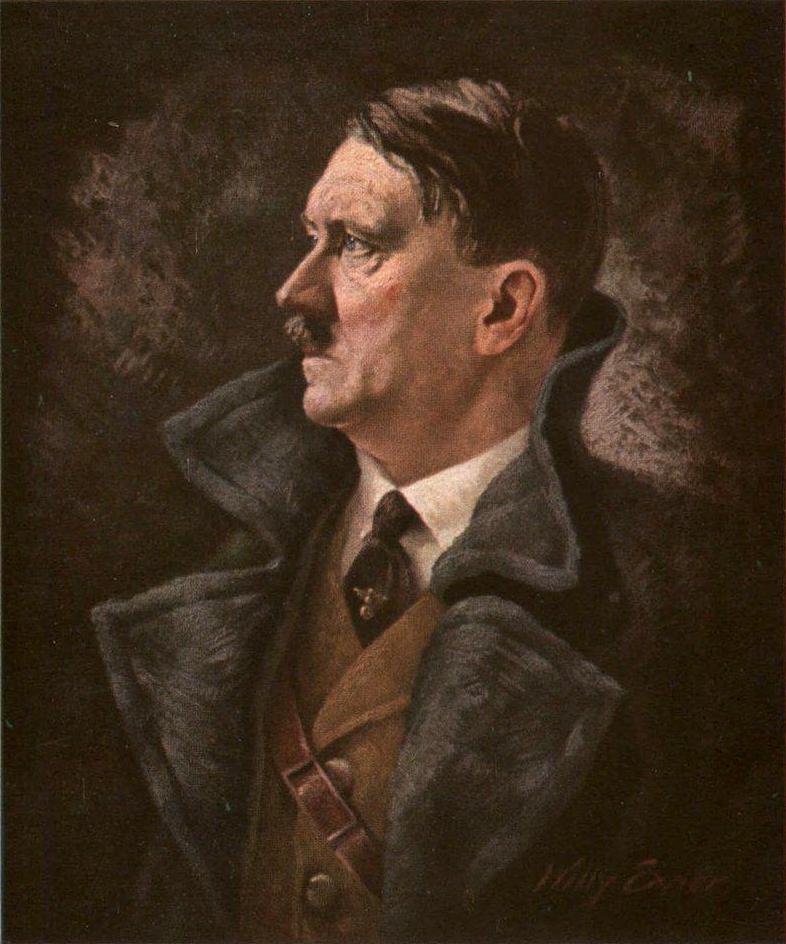
Dr. J. Prag, 1. Mai.
In tiefster Erschütterung vernimmt das deutsche Volk, Front und Heimat, die Kunde von dem heroischen Tode seines Führers Adolf Hitler. Als die Nachricht veröffentlicht wurde, daß der Führer den Oberbefehl über die Truppen übernommen hatte, die die Reichshauptstadt gegen den bolschewistischen Massenansturm verteidigen, wurde es klar, daß Adolf Hitler entschlossen war, das Werk seines Lebens durch den Einsatz seiner Person als Vorkämpfer der Idee bis zur letzten Konsequenz fortzusetzen. Seit jenem Tage waren die Blicke aller Deutschen auf das Ringen um Berlin gerichtet in dem Bewußtsein, daß sich dort, auf den Trümmerfeldern der von Bomben umgepflügten Riesenstadt, ein Vorgang von unvergleichlicher, die deutsche Seele tief aufwühlender Dramatik vollziehen würde. An der Spitze der Bataillone seiner in hundert Schlachten bewährten Ostkämpfer und seiner Volkssturmmänner, an der Spitze einer unter ihrem Führer mit leidenschaftlicher Hingabe sich einsetzenden Bevölkerung führte Adolf Hitler den Kampf persönlich. Er empfing täglich die Kampfkommandanten der einzelnen Abschnitte, er sprach mit den Männern, die sich besonders ausgezeichnet hatten, er gab die entscheidenden Anordnungen, er trotzte, ein wahrhaft guter Kamerad, zusammen mit seinen Soldaten dem Hagel der Bomben und Granaten, mit dem der zahlenmäßig vielfach überlegene Feind die Verteidiger der Reichshauptstadt seelisch zermürben zu können glaubte. Adolf Hitler war die Seele des Widerstandes im Straßenkampf, sein Führertum bewährte sich auch hier in der höchsten, leuchtenden, hinreißenden Vollendung wie am 9. November 1923 so am 1. Mai 1945, indem er in jenem Augenblick, der die letzte und höchste Anforderung an den Träger einer großen Idee stellt, selbst dem Tode ins Angesicht blickte und dem letzten Opfer nicht aus dem Wege ging, um durch das Opfer des eigenen Lebens, durch die beispielhafte Tat des heroischen, durch den Tod beendeten Waffenganges die Flamme der großen, der nationalsozialistischen Idee zu erhalten und weiterzugeben. Aus seinen Händen nimmt das ganze deutsche Volk das Vermächtnis Adolf Hitlers und gelobt, es treu und tapfer zu wahren. Es ist die Erhaltung Deutschlands gegen den Bolschewismus, der mehr als zwei Jahrzehnte rüstete, um über Deutschlands Leiche die kommunistische Weltrevolution vorwärtszutreiben nach Westeuropa und in die übrige Welt hinaus.

Für Deutschland, für Europa, für Menschheit und Menschlichkeit fiel Adolf Hitler, Sein Opfertod kann und darf nicht vergeblich sein. Seine Idee lebt und wird, trotz aller Bedrängnisse der Zeit, weiter wirken. Wenn dies nicht der Fall wäre, würde die bolschewistische Bestie die europäische Kultur verschlingen. Die Größe des Lebens Adolf Hitlers wird durch die Größe seines Heldentodes vollendet - diese Vollendung ergibt eine geistige Macht, die auch vom Sturmwinde der schwersten Prüfungen, denen das deutsche Volk noch ausgesetzt sein mag, nicht hinweggeweht zu werden vermag. Denn allem Großen in der Geschichte blieb die positive, fortzeugende Wirkung nicht versagt. Wie aus dem deutschen Kampfe des ersten Weltkrieges die Idee Adolf Hitlers entstand, so wird aus diesem Weltkriege sein unsterblicher Gedanke sieghaft in eine bessere Zukunft hinübergerettet werden. Der beispiellose Vorgang des Heldentodes des Volks- und Staatsführers ist zu gewaltig, als daß er nicht von ebenso gewaltiger, zukunftgestaltender Wirkung, bald oder später, sein würde.

Je enger der eiserne Ring um die Verteidiger der Reichshauptstadt wurde, um so mehr drängte sich dem deutschen Volke die Sorge um das Leben des Führers auf, und aus den letzten Berichten des Oberkommandos der Wehrmacht mußte sich die furchtbar schwere und bittere Frage ergeben: Wer wird, wenn Adolf Hitler fallen sollte, die Lenkung der Geschicke Deutschlands in so ernster Stunde übernehmen? Diese Sorge hat der Führer von uns genommen, indem er, als er selbst mit seinem Tode rechnete, rechtzeitig den Großadmiral Dönitz zu seinem Nachfolger bestimmte. In die ehrfürchtige Trauer um den großen Toten mischt sich der Dank Deutschlands für diese Wahl: sie fiel ‚auf einen Mann, den alle Deutschen als alten Freund des Führers kennen, als treuen Nationalsozialisten, als aufrechten, warmherzigen Menschen, als hervorragenden Soldaten, als einen Mann von weitem Blick, echt deutscher Gesinnung und schöpferischer Energie. Auch er bezeichnet als seine Aufgabe die Weiterführung des Kampfes gegen den Bolschewismus, Das deutsche Volk steht zur Bewältigung dieser Aufgabe mit der gleichen Treue und Entschlossenheit hinter. ihm, wie es hinter Adolf Hitler stand. Diese Treue gegenüber seinem Nachfolger ist es dem Toten schuldig, der auf dem Kommandoturm kämpfend bis zum letzten Atemzuge verharrte und durch diesen seinen Tod uns den ewigen Befehl hinterließ: durch Treue und Hingabe Deutschlands Ehre und Leben zu retten.

Dönitz an das deutsche Volk und an die deutsche Wehrmacht

Der Großadmiral und Nachfolger des Führers richtete über den Rundfunk folgenden. Aufruf an das deutsche Volk und an die deutsche Wehrmacht: Deutsche Männer und Frauen, Soldaten der deutschen Wehrmacht! Unser Führer Adolf Hitler ist gefallen. In tiefster Trauer und Ehrfurcht verneigt sich das deutsche Volk. Frühzeitig hatte er die furchtbare Gefahr des Bolschewismus erkannt und diesem Ringen sein Dasein geweiht. Am Ende dieses seines Kampfes und seines unbeirrbaren, geraden Lebensweges steht der Heldentod in der Hauptstadt des Deutschen Reiches. Sein Leben war ein einziger Dienst für Deutschland. Sein Einsatz im Kampf gegen die bolschewistische Sturmflut galt darüber hinaus Europa und der gesamten Kulturwelt. Der Führer hat mich zu seinem Nachfolger bestimmt. Im Bewußtsein der Verantwortung übernehme ich die Führung des deutschen Volkes in dieser schicksalsschweren Stunde. Meine erste Aufgabe ist es, deutsche Menschen vor der Vernichtung durch den vordrängenden bolschewistischen Feind zu retten. Nur für dieses Ziel geht der militärische Kampf weiter, Soweit und solange die Erreichung dieses Zieles durch die Briten und Amerikaner behindert wird, werden wir uns auch gegen sie weiter verteidigen und weiter kämpfen müssen, Die Anglo-Amerikaner setzen dann den Krieg nicht für die eigenen Völker, sondern allein für die Ausbreitung des Bolschewismus in Europa fort. Was das deutsche Volk in dem Ringen dieses Krieges kämpfend vollbracht und in der Heimat ertragen hat, ist geschichtlich einmalig. In der kommenden Notzeit unseres Volkes werde ich bestrebt sein, unseren tapferen Frauen, Männern und Kindern, soweit dies in meiner Macht steht, erträgliche Lebensbedingungen zu schaffen. Zu alledem brauche ich eure Hilfe. Schenkt mir euer Vertrauen, denn euer Weg ist auch mein Weg! Haltet Ordnung und Disziplin in Stadt und Land aufrecht! Tue jeder an seiner Stelle seine Pflicht! Nur so werden wir die Leiden, die die kommende Zeit jedem einzelnen von uns bringen wird, mildern und den Zusammenbruch verhindern können. Wenn wir tun, was in unseren Kräften steht, wird auch der Herrgott nach so viel Leiden und Opfern uns nicht verlassen.
The New York Times (May 2, 1945)

HITLER DEAD IN CHANCELLERY, NAZIS SAY
Doenitz, Successor, Orders War to Go On

Admiral in Charge; Proclaims Designation to Rule – Appeals to People and Army
Raises ‘Red Menace’; Britain to Insist Germans Show Hitler’s Body When War Ends
By SYDNEY GRUSON
By Cable to The New York Times


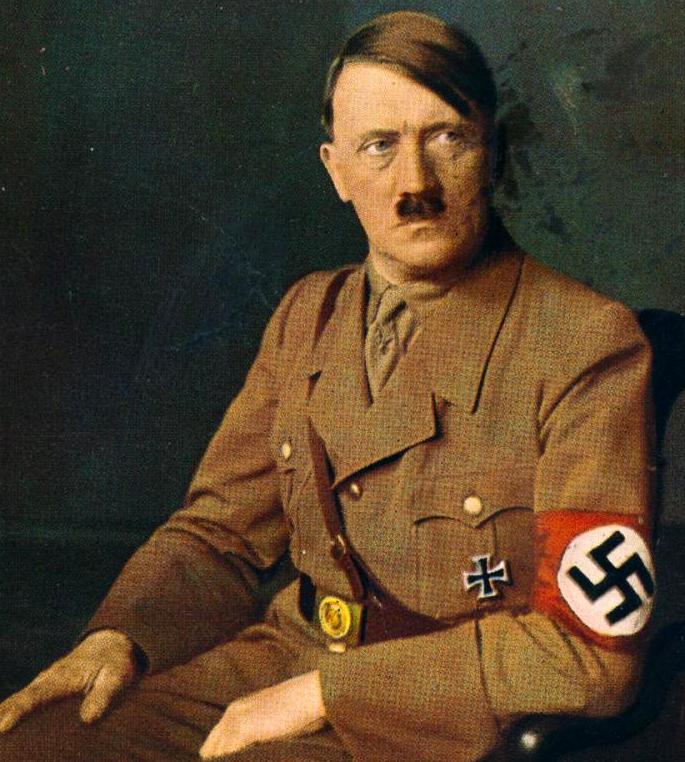
Adolf Hitler (The New York Times, 1938)

LONDON, May 1 – Adolf Hitler died this afternoon, the Hamburg radio announced tonight, and Grand Admiral Karl Doenitz, proclaiming himself the new Fuehrer by Hitler’s appointment, said that the war would continue.

Crowning days of rumors about Hitler’s health and whereabouts, the Hamburg radio said that he had fallen in the battle of Berlin at his command post in the Chancellery just three days after Benito Mussolini, the first of the dictators, had been killed by Italian Partisans. Doenitz, a 53-year-old U-boat specialist, broadcast an address to the German people and the surviving armed forces immediately after the announcer had given the news of Hitler’s death.

[The British Foreign Office said that it would demand the production of Hitler’s body after the end of hostilities, The Associated Press reported.]

First addressing the German people, Doenitz said that they would continue to fight only to save themselves from the Russians but that they would oppose the western Allies as long as they helped the Russians. In an order of the day to the German forces he repeated his thinly veiled attempt to split the Allies.

Radio Prepares Germans

Early this evening the Germans were told that an important announcement would be broadcast tonight. There was no hint of what was coming. The stand-by announcement was repeated at 9:40 P.M., followed by the playing of excerpts from Wagner’s “Goetterdaemmerung.”

A few minutes later the announcer said: “Achtung! Achtung! In a few moments you will hear a serious and important message to the German people.” Then the news was given to the Germans and the world after the playing of the slow movement from Bruckner’s Seventh Symphony, commemorating Wagner’s death.

Appeals for Cooperation

Appealing to the German people for help, order and discipline, Doenitz eulogized Hitler as the hero of a lifetime of service to the nation whose “fight against the Bolshevik storm flood concerned not only Europe but the entire civilized world… It is my first task,” Doenitz added, “to save Germany from destruction by the advancing Bolshevist enemy. For this aim alone the military struggle continues.”

Clinging to the line of all recent German propaganda, reflected in Heinrich Himmler’s reported offer to surrender to the western Allies but not to Russia, Doenitz said that the British and Americans were fighting not for their own interests but for the spreading of Bolshevism. He demanded of the armed forces the same allegiance that they had pledged to Hitler and he assured them that he took supreme command “resolved to continue the struggle against the Bolsheviks until the fighting men, until the hundreds of thousands of German families of the German east are saved from bondage and extermination.” To the armed forces he described Hitler as “one of the greatest heroes of German history,” who “gave his life and met a hero’s death.”

News tickers in the House of Commons lobby carried the news of Hitler’s death just before the House rose tonight. The reaction of members and of the general public was much the same. Some doubted the truth of the announcement altogether, while others argued that there would have been no sense of making it if it were not true, since Hitler was perhaps the last person around whom the Germans still in unconquered territory would rally.

But there was an almost complete lack of excitement here. Those who believed the report seemed to accept it as a matter of course that Hitler would die. There was no official reaction.

The last reference to Hitler before tonight’s announcement came in this afternoon’s German communiqué, which said that the Berlin garrison had “gathered around the Fuehrer and, herded together in a very narrow space, is defending itself heroically.” When Himmler offered his surrender to the Americans and British, it is reported, he told Count Folke Bernadotte, his Swedish emissary, that Hitler was dying of a cerebral hemorrhage. During the past week, Hitler was variously reported dead, dying or insane in Berlin, Salzburg or the Bavarian mountains.

Doenitz’ self-proclaimed accession was believed in some quarters here to bear out reports of a recent split in the German hierarchy between the supporters of an immediate peace gathered around Himmler and the die-hard clique clinging to Hitler and his determination to fight to the very end.

It was noted that Doenitz commanded the last arm of the German military machine that could cause the Allies major difficulties, and his ability as an expert on submarine tactics is not belittled here.

He was one of the first military men to join the Nazis and his loyalty to the party and its ideology never wavered. Known as one of the most ruthless men in Germany, he has been a bitter enemy of Britain since his imprisonment during World War I, when he was confined to a Manchester asylum as a lunatic.


Churchill Hints Peace This Week; 2-Day Celebration Is Authorized

By CLIFTON DANIEL
By Wireless to The New York Times

LONDON, May 1 – The general belief that peace with Germany will be announced this week persisted in Britain today, encouraged by Prime Minister Churchill himself and by Grand Admiral Karl Doenitz’s announcement of the death of Adolf Hitler.

The War Cabinet again held a session tonight but so far as was known did not have any concrete proposal to consider. The chances that Heinrich Himmler ultimately will deliver an acceptable peace are now held in some official quarters to be only “fifty-fifty.”

Nevertheless the buoyant Prime Minister told the House of Commons today that he might have “information of importance” to announce before Saturday.

The public’s hopes were raised still further by a long Home Office circular giving the Government’s views on how Britain should observe V-E Day, which the British, it appears, will be expected to celebrate strictly according to form.

[Stockholm reported, with the return there of Count Bernadotte, the “imminent liberation” of Denmark and Norway – already taking effect locally in Denmark – as a phase of a prospective general German capitulation that must be acceptable to the Allies’ military commands.]

The hurrahing will begin with the announcement of the cessation of hostilities by Mr. Churchill over a nation-wide radio network. The King will speak at 9 o’clock that evening. And throughout that day and the next all Britain, except for bank clerks and other essential public servants, will be on holiday – and probably a binge.

The military disintegration of Germany is proceeding now at such a pace that even the dampening news from Stockholm, Sweden, that Count Folke Bernadotte had no new offer from Himmler did not abate Britain’s peace fever.

In any case, the three major powers will make absolutely certain that Himmler can produce a genuine and total unconditional military surrender, before accepting any offer from him.

Mr. Churchill reiterated today that the political leaders would be guided by the military commanders in this matter.

He also hinted that the announcement, which he hoped to make this week, might not concern all enemy forces. Additional point was given to this remark tonight when the possibility arose that Admiral Doenitz might be acting independently of, or in competition with, Himmler, and might try to keep some German forces, including the Navy, in the fight.

Reports of the evacuation of German troops from Denmark also lent support to the supposition that the German surrender might still be a piece-meal affair.

Yet Britain had no doubt that peace was on the way. Authoritative quarters prepared the public for the inevitable delays attendant upon signing any surrender document and consultation between the three major powers to fix the time for announcing the end of hostilities.

Two-Day Celebration Sanctioned

Mr. Churchill let the House know today that he would not be surprised at an unofficial leakage of the news, but he assured the members that he would not hold up the announcement unduly and that it would not wait upon full, formal occupation of Germany.

If the end of hostilities takes the form of a three-power declaration, Britain’s V-E Day plans may be changed. But until further notice the Government wants the churches to be open and the bells rung; it also wants thanksgiving services on the Sunday following V-E Day, flood-lighting wherever available, but not full street lighting; bonfires of non-salvagable material, full programs in all places of entertainment; later hours for dancing than normal, open-air celebrations, longer hours for saloons, parades on thanksgiving Sunday, and food stores to be kept open long enough to prevent people from going hungry.


“Ghost” Interrupts Doenitz

LONDON, May 1 (AP) – When Doenitz declared on the radio that Hitler had died “a hero’s death,” a ghost voice immediately interrupted, shouting: “This is a lie!”

[The British Broadcasting Corporation subsequently reported that Hitler had actually died of a stroke, rather than in battle against the Russians, the National Broadcasting Company said.]

Hitler, who was 56 years old on April 20, was lauded by Doenitz as “one of the greatest heroes in German history.” Here the ghost voice broke in: “The greatest of all fascists!”

“With proud respect and mourning, we lower our standards,” Doenitz continued. “His death calls on us to act,” the ghost voice interrupted. “Strike now!”

Doenitz launched into a pep talk to the German people and troops, only to be interrupted again by the ghost voice, crying: “Rise against Doenitz. The struggle is not worthwhile if crime wins.”

Haw-Haw Repeats Message

After Doenitz had broadcast his message the Hamburg station played “Deutschland Ueber Alles” and the “Horst Wessel Lied.” This was followed by three minutes of silence, then by a formal order of the day from Doenitz to the military services and then by funeral music. Then Lord Haw-Haw repeated the broadcast, including Doenitz’ order of the day, in English.

The Foreign Office said that it believed that Hitler was dead, but it declined to comment on the accuracy of the Hamburg radio’s report of how he died.

London Press Voluminous

London newspapers received the announcement of Hitler’s death just as the early editions were going to press but the second editions went “all-out” on the news, with long obituaries of Hitler and biographical sketches of Doenitz, the British radio said early today, according to the Office of War Information.

The Times of London limited its comment to a five-column obituary of Hitler and another half-column of copy on Doenitz, with photographs of both. The Daily Express, on the other hand, said that it “rejoices to announce the report of Adolf Hitler’s death,” the broadcast said.

The Daily Herald commented that Hitler had “snatched power at a moment when moral conviction and mutual trust were at a low ebb among the governments of the democracies” and added: “It is up to the democracies to insure that no such moment shall occur again.” The Daily Mail declared that the Germans would continue to “worship” Hitler.


‘The Bloody Dog Is Dead’

LONDON, May 1 (U.P.) – In its first comment on the announcement of Hitler’s death, the British radio started off: “‘The day is ours, the bloody dog is dead.’ That, from the last scene of Shakespeare’s 'King Richard III,’ is as good for a first comment on Hitler’s death.”

Doenitz Held Suspect

Admiral Believed Appointed to Negotiate Peace but Any Move is Looked at Askance
By HANSON W. BALDWIN

The E. Phillips Oppenheim quality of the last days of Hitler’s Germany was heightened yesterday as strong peace rumors continued to be circulated after the German radio had announced Hitler’s death.

Grand Admiral Karl Doenitz, Commander in Chief of the German Navy and ruthless director of the U-boat war, was appointed to succeed him – and possibly to sign the surrender. Both Hitler’s announced death and Doenitz are to be suspected. The former may be true. It would fulfill the Hitlerian myth to have the Fuehrer immolate himself as a martyr to the Greater Reich. But we may never know whether it is true. Will the body be produced, and if so, how will it be identified?

Doenitz himself seems to be a figurehead, appointed perhaps because he is not a member of the General Staff or of the Junker class, not a Nazi political leader as Heinrich Himmler is; not so closely identified with Hitler as Field Marshal Gen. Wilhelm Keitel was. But both his present position as a figurehead and his past history as a Nazi condemn him. He is no more to be trusted than Himmler.

May Be There to Negotiate

Apparently he has been set up by the German armed forces for the purpose of negotiating a peace. It is interesting and perhaps symptomatic that an admiral rather than a member of the army, which is Germany’s pride, has been selected for this purpose.

The aura of mystery that has surrounded whatever exchanges with the Germans have been occurring has not, therefore, been lifted by yesterday’s events, and it is well to remember that the Allies’ troops are still being killed in Germany. But the German radio’s announcements may be prefatory to other announcements, and expectations are still high – though without official endorsement – that some early surrender with a German Government will be arranged. But exactly what German Government, how arranged, or by whom was not clear.

If, as some reports have indicated, Heinrich Himmler or other leading Nazis or Doenitz, operating behind the scenes, have tendered surrender offers, these offers must be regarded with suspicion. For Nazi fanatics would never quit unless they felt there was some quid pro quo for them – and for Nazism – in surrender. Even a cornered rat, facing certain death, fights to the end.

The ulterior motive in the original offer reported to have come from Himmler is clear enough. The offer followed the same divisive policy that has marked the enemy’s political strategy for the past four years. Surrender was tendered to the United States and Britain, but not to Russia. This offer was rejected, and it has been reported, though without any official confirmation, that the original tender has been amended to include Russia.

Offer of Desperation

If this is true, the reasoning behind such a surrender approach is not so clear. It is obviously an offer of desperation; Germany and the German Army are falling apart like a house of cards. But there are still sizable and fanatical enemy forces, with large stockpiles of ammunition, and capable of prolonging the fighting. The German policy of sabotage, espionage, terror and underground activities in areas already occupied by the Allies is functioning, though on a small scale. The longer the fighting can be protracted, the more difficult it will be for the Allied Military Government to restore some stability to war-torn Europe; the more chance there is that Europe will be plunged into the “organized chaos” that the Nazis have professed to espouse.

Why then should men like Himmler and other Nazi leaders offer to surrender unconditionally – if they have done so? There may be several answers to that question, none of them totally satisfactory:

(1) The announced removal of Hitler from the national and party helm in Germany – by death or other causes – may have caused a change, under pressure of this emergency, in the party line. The new leaders may be convinced that Germany and the Germans will be virtually eliminated unless resistance ceases soon, or they may have less fanaticism than Hitler, or they may be attempting to achieve his same ends in different ways.

(2) Some German leaders would unquestionably be willing to surrender on any terms if they could preserve their lives. But these are the cravens, and whatever else we may say of many of the German leaders, there are among them many men who have shown no lack of physical courage and to whom their own lives have been secondary to what they have considered a greater purpose. Moreover, it seems very unlikely at this late date that Himmler or any other prominent Nazi tarred with such a reputation as his could hope to escape punishment by surrendering. The Allies would surely never stoop to such a bargain.

Hess Case Recalled

But Himmler and his associates may think that they would. The strange case of Audolph Hess who parachuted into England to arrange a peace shows how different the world looks, how warped the mind is, when one has swallowed a large dose of one’s own propaganda. And the Nazis undoubtedly remember the case of the Kaiser premier war criminal twenty-seven years ago, who lived out his years in ease and peace.

Whatever the reasons that may motivate any surrender offer made or to be made, there is no doubt that the present disasters that Germany is suffering are a powerful spur to rationalization in the German mind and toward making the best of a bad bargain. Yet ulterior purposes by the enemy must and should be suspected. We may be certain that any peace that the Germans make will be accompanied by very large mental reservations, indeed, even if unexpressed or unrecorded.

Therefore, every peace offer must, and undoubtedly will, be minutely scrutinized and examined. There must be no strings attached, no conditions – actual or tacit or implied – to unconditional surrender.


Just a ‘Fascist Trick,’ Moscow Radio Asserts

LONDON, Wednesday, May 2 (AP) – The Moscow radio’s first announcement of the German report of Hitler’s death, broadcast at 3:12 A.M. to the Russian people, declared that “the German radio statement evidently represents a new Fascist trick.”

The radio announcement was prefaced by the phrase “it is asserted that,” indicating that the Russians were skeptical of the German version of Hitler’s fate. The broadcast said that Admiral Doenitz’s order to the German troops was repeating “the usual trickery and twists of Hitlerite propaganda.”

The Moscow broadcast said that, “by the dissemination of the statement on the death of Hitler, the German Fascists evidently hope to prepare for Hitler the possibility of disappearing from the scene and going to an underground position.”


Doenitz’ Accession Viewed as a Blind

Capital Lays His Designation to General Ignorance of His Allegiance to Party


Grand Admiral Karl Doenitz (Associated Press, 1939)

WASHINGTON, May 1 (AP) – If Adolf Hitler really designated Grand Admiral Karl Doenitz his successor, military men here believe, he did so for the following reasons:

  1. Doenitz is a Nazi supporter who could be counted on to keep German resistance going if possible.

  2. But he is not associated in the Allies’ minds with German atrocities and the extreme policies of the Nazi party. Therefore, Hitler probably figured that he might be able to get better treatment from the Allies when the hour of surrender came.

  3. He is immensely popular with the German people.

There was a disposition here tonight to look for continued organized resistance whose core would now be centered in the Baltic and North Sea port areas. Those places are the homes of the German Navy and especially of the U-boat fleet that Doenitz commanded from 1936 until he succeeded Grand Admiral Erich Raeder as Commander in Chief of the navy in 1943.

There may be some continued resistance in the southern pocket, but there are well placed officials who now say that there is no national redoubt area and never has been.

In proportion to the total strength of the services, there have been far more Nazi party members among German Navy officers than among Army officers. The reason appears to be this: After the First World War and the scuttling of the German Fleet at Scapa Flow, German navy men developed an inferiority complex. The rise of the Nazi party and its doctrines of world domination appealed to them even more strongly than to their brothers of the army.

The reports of Hitler’s death caused a stir in Congress. Skepticism mingled with questioning whether it would make any difference in the final mop-up of German resistance.

Senator Edwin C. Johnson, Democrat, of Colorado, acting chairman of the Military Affairs Committee, said: “I hope it’s so, but I would kind of like to have a look at the body before I believe it.” Whether it makes any difference, Mr. Johnson said, depends not only on what attitude Doenitz takes but on what control he can exercise. “I doubt if it makes any difference,” he added.

Senator Robert A. Taft, Republican, of Ohio, declared that it was “significant and interesting that Hitler’s death, if the report is true, should come with the complete collapse of his philosophy. Incidentally, it will save the Allies a lot of worry about dealing with a captured Fuehrer.”

Nazi Ruse is Seen in Hitler ‘Death’

Writer Suggests the Report Is an Effort to Hide the Whereabouts of Leader
By LOUIS P. LOCHNER
Chief of the Former Associated Press Bureau in Berlin

WITH THE UNITED STATES SEVENTH ARMY, May 1 (AP) – I have just listened to the shortwave broadcast of Admiral Karl Doenitz’ speech as the new Fuehrer of Germany, but I still find it difficult to believe that Hitler is really dead or that he remained in Berlin during the Russian assault.

The whole melodramatic buildup, beginning with Propaganda Minister Joseph Goebbels’ announcement days ago that Hitler was personally conducting the defense of the capital, now reaching its climax in the claim that he met death in the Chancellery, of all places, looks like an effort to make good the Fuehrer’s oft-repeated assertion: “I will never capitulate.” Hitler could not afford to accept unconditional surrender, so what may prove to be the legend of his meeting a hero’s death had to be staged.

Hitler may or may not be dead. If he is dead, it seems extremely unlikely that he died as the German radio says that he did. Having spent the past days in the very section of the country where Hitler rose to power, wrote “Mein Kampf” and conducted affairs of intrigue with the whole world from Munich, I still cannot escape the feeling that Hitler is some place where nobody expects him to be. From time to time people will claim to have seen him.

Doenitz’ announcement by no means ends our troubles with Hitler. They may have only begun. There may be a state funeral for him, and photographers may have the opportunity to produce pictures of a dead man labeled Hitler. Then, some day much later, a “resurrected” Hitler may again stir the world.

The appointment of Doenitz as Hitler’s successor indicates that the German leadership desires someone as chief of state who can possibly negotiate with the Allies. Doenitz had no experience in government and had no real hold on the affections of the German people. His appointment was obviously a political maneuver.

The course of the war is unlikely to be affected by his appointment.


Milestones in Hitler’s Career Marked by Memorable Dates in His Rise and Fall

By the United Press

Significant dates in Adolf Hitler’s life:

April 20, 1889 – Born in Braunau, Austria.
Nov. 8-9, 1923 – Attempted to seize dictatorship of Bavaria through “beer-hall” Putsch in Munich; failed.
Jan. 30, 1933 – Appointed Chancellor by President von Hindenburg.
March 23, 1933 – Made dictator of Germany by powers voted by Reichstag.
Oct. 14, 1933 – Announced Germany’s withdrawal from League of Nations and disarmament conference.
March 7, 1936 – Denounced Treaty of Locarno, sent German troops into demilitarized Rhineland area.
March 12, 1938 – Sent German troops into Austria; proclaimed union of Austria and Germany the next day.
Sept. 28, 1938 – Munich conference at which Britain, France and Italy agreed to partition of Czechoslovakia.
March 14-15, 1939 – Occupied the remainder of Czechoslovakia.
March 22, 1939 – Seized Memelland from Lithuania.
April 28, 1939 – Denounced 1935 naval agreement with Britain and non-aggression pact with Poland.
Aug. 23, 1939 – Entered non-aggression pact with Russia.
Sept. 1, 1939 – Invaded Poland.
April 9, 1940 – Invaded Norway and Denmark.
May 10, 1940 – Invaded France and the Low Countries.
June 22, 1941 – Invaded Russia.
Dec. 11, 1941 – Declared war on the United States.
Nov. 9, 1943 – Said that Germany “will never capitulate.”
May 1, 1945 – Reported dead by Hamburg radio.


‘Deep Satisfaction’ Is Felt by U.S. Troops At Death

American soldiers in the field received reports of Adolf Hitler’s death not with joy but with deep satisfaction, Richard Hottelet, CBS war correspondent, reported from the First Army in Germany yesterday.

“We will fight as long as the German soldiers shoot at us,” was the chief reaction, he said.

“We don’t know any details of Hitler’s death except that the German radio says he was killed in action,” he added. “The news is just beginning to spread around to the soldiers here in the First United States Army.

“Hitler has become hated among the soldiers of our Army, hated personally and violently, as the man who kept fighting a senseless fight, kept the slaughter going for absolutely no reason. There’s a feeling here that justice has been done, and certainly a determination that none of the lesser Nazis shall escape.”


Hitler’s Credo of Force and Bloodshed Expounded in ‘Mein Kampf,’ Nazi Bible

Hitler’s credo – in so far as it could be considered a credo, for it was a mass of political and social contradictions – was expressed in his famous book “Mein Kampf,” and in his speeches.

“Mein Kampf,” begun while Hitler was a prisoner, following his beer-cellar putsch in 1923, became the bible for many millions of Germans and one of the greatest “best sellers” in history. By the spring of 1939 it had been translated into eleven languages, and more than 5,200,000 copies had been sold. No figures of the book’s sale during the war are available, although it is probable that several more million copies have been disposed of. It went through more than 425 German editions before the war, when it was estimated that the book had netted Hitler about $3,000,000. His royalties from foreign sales by 1933 amounted to $150,000.

On May 1, 1936, the German Ministry of the Interior decreed that the “community” provide every married couple with a copy. This added greatly to the sale of the book. In Germany the book became a party and national catechism. It was a gift book for boys and girls celebrating their birthdays and for old folks on their anniversaries.

It was a historical criticism of German policy, a manual of faith, a confession, a political testament. Hitler never altered it. For this added reason it remained a maze of contradictions, although some of its ideas were carried to realization, with grave consequences for Germany and the rest of the world.

Discussing Germany’s need for “Lebensraum,” Hitler frankly declared in “Mein Kampf” that Germany intended to take what she could by force of arms.

“The frontiers of states are made by men,” he wrote, maintaining that war was a nobler state than peace. “One must realize that often a steel-hard, healthy national body has grown out of the bloodiest civil war, while more than once decay has stunk to heaven from an artificially cultivated state of peace.

“No one can doubt that this world will one day again be exposed to the deadliest struggles for the existence of mankind. Nothing can be finally victorious but the passion for self-preservation. So-called humanitarianism, the expression of a mixture of stupidity, cowardice and conceited priggishness melts before it like snow in the March sunshine. Humanity grew great in eternal strife – in eternal peace it perishes.”


City Takes Report of Death in Stride

Many New Yorkers Skeptical, Others Are Unemotional – Service Men Pleased
By MEYER BERGER

Reports of Adolf Hitler’s death, like the weather yesterday, left New Yorkers cold. They stopped only briefly in the chill rain of the evening rush hour to glance at headlines, to shrug in disbelief, before they dived like moles into the subway.

Skepticism was by far the dominant reaction. There was no cheering, only subdued gloating. The comparative few who discussed the reports aloud seemed to find profane speech most fitting. Eight of ten persons took the attitude: “It’s another Nazi fake,” or, “They’re trying to palm off a Hitler double.”

Though the reports broke here a little before 5 P.M., they filtered as slowly as winter molasses through rain-swept Times Square. A police sergeant from Traffic J moved from Forty-second Street to the Times Tower’s bulletin board at Forty-third Street to verify oral rumor.

Beaded rain dripped from his cap as he stared at the poster: “Hitler Is Dead.” He shook off the rain. He said: “So the bum’s dead, eh?” and, as if answering his own question, he said dully: “What difference does it make now?”

French Sailors Bitter

Two French sailors read the sign. One turned to sodden civilians grouped near him. He said: “It is the end of the pig. He will roast in hell.” The civilians looked bewildered. They remained silent.

A bobby-socks blonde turned to a friend and repeated the legend on the bulletin board. Her friend tugged at her sleeve to hurry her on. She said: “Too bad he’s dead. He should have been tortured.”

A tall Italian told them: “Do not believe what it says. Believe it when you see a picture of Hitler as you saw Mussolini’s picture yesterday.” The girls moved off without reply.

Skepticism took some amusing turns. A sharp-featured woman told a friend sharing her umbrella: “Don’t believe what bulletins tell you. This morning the bulletin said: ‘light showers today.’”

The appearance of newspaper extras started a sudden flurry. Hoarse cries of “Hitler dies – get that uxtray!” brought surging groups to newsstands and the hucksters’ cries added to the traffic din, but only for a while. Within an hour, extras found few buyers.

Leo Kaplan of 32-15 Forty-first Street, Astoria, Queens, a soldier hit by machine-gun bullets in the Philippines, hobbled across the Square through the downpour. He stopped to say: “If it’s true, it’s the greatest thing I ever heard.”

A mounted policeman, huddled glumly under his rubber cape, waited until the soldier was beyond earshot. He said: “It would have been good news twenty years ago. Late now.” He stared gloomily eastward down Forty-second Street.

The East Side gave no more outward evidence of gloating or belief in the report than did Yorkville, traditional German quarter. The same was general true in all the city’s Jewish districts.

Service men were outspoken. Lieut. Arthur McIntyre of Kansas City, Mo., an air corps man, said in Times Square when he saw the bulletin: “Good riddance.” Sgt. John Eliopoulos of Haverhill, Mass., an Army engineer, remarked bitterly in Pennsylvania Station: “We’d likt to spit on his grave, the—.” He spoke for a group of five.

Joe Ente, who owns a monument yard at 89 Ludlow Street, discussed the report in terms of his trade. He said: “His headstone should be a skunk. But he shouldn’t be buried. He will contaminate the good earth.”

Chinatown Skeptical

Chinatown took the news gravely, but skeptically, like the rest of the city. Shavey Lee, its mayor, said fervently: “Here’s hoping we can sing the death of Hirohito.”

Commuters bound home through the murky twilight read the scant details of Hitler’s reported end and stared moodily but silently at drear landscape. Out in the Brownsville district of Brooklyn, Joe Sisselman, who works in Hoffman’s Cafeteria at Saratoga and Pitkin Avenues, looked up from a mound of dishes when he heard the report. “Maybe,” he said, “it will save the lives of some of our American kids. For me it comes late.”

His son, Leonard Sisselman, was reported dead in Germany ten days ago. He had been with the Ninetieth Division of the Third Army.

Rabbi Henry A. Schorr of 1100 Grand Concourse, the Bronx, said: “He leaves behind him a ruined and agonized world, the monument to his madness. God save humanity from the seeds of his tyranny and terror.”

Mayor La Guardia was returning from Brooklyn where he had helped to open a city health center, when he was informed of Hitler’s reported death. “That’s the best news I’ve heard,” he shouted into the two-way police radio in his car. “Look for anything to happen now.”


Editorial: The End of Hitler

The German radio announces that Adolf Hitler fell yesterday afternoon in his command post at the Reich Chancellery in flaming Berlin, “fighting to his last breath against bolshevism.” The announcement adds that Admiral Karl Doenitz, commander of the German fleet, has been named as Hitler’s successor, which presumably means as head of the German state and Reich Chancellor.

The Nazis have made lies so much a part of their politics, and the reports about Hitler’s alleged doubles have been so widely spread, that these announcements are bound to leave in many minds the suspicion that the master liar is attempting to perpetrate one last great hoax on the world in an effort to save himself, and perhaps prepare the way for his return at a later and more auspicious time. Yet, whether true or not, the announcement does mark the end of Hitler and the regime that plunged the world into this war and formed the core of the fanatical German resistance which has cost so much Allied blood and effort.

All things considered, there seems to be no good reason to doubt that Hitler is dead, or that he died as the announcement says he did. Logically, he had to die that way, and had he tried to evade his fate, it is difficult to believe that even his most devoted followers would have permitted him to do so. There was always a good deal of opéra bouffe in Italian fascism, and despite its ghastly results for Italy and Mussolini’s own grim fate, both Italy’s wars and the “Sawdust Caesar’s” end were in keeping with fascism’s fundamental character. But the serious-minded, cold-blooded and wholly humorless Germans had exalted Nazism into a religion which proclaimed Hitler not only the Fuehrer of all Germans but also their god, and Hitler loved to refer to himself as the instrument of Providence. He could not have been permitted to die like Mussolini, to be kicked about and strung up by his heels by the same populace which once had cheered him to the skies. He had to die with the cause he lost, and he had to die that way for two reasons. He had to save it from ridicule inherent in the ludicrous contrast between his megalomaniacal pretensions and his catastrophic failure. And he had to perform one last service for that cause by helping to perpetuate the legend which formed the core of Nazi propaganda and by which he rose to power – the legend that he and the Nazis were shining knights in armor fighting for European civilization against bolshevism – “to their last breath.”

And so it seems probable that Hitler fell as he was supposed to fall – in the roar and terror of battle, amid the crumbling walls of his capital, in the Chancellery which he had built as the seat of his world dominion, and at a moment when the conquering Russian armies were planting their victory banners on the scenes of his former triumphs. If so, history will add one particularly sardonic touch in the fate which made Hitler die on May Day – the day on which he used to display his greatest power over the German masses, the very day, in fact, on which his great adversary, Joseph Stalin, was staging a victory parade in Moscow, which Hitler once thought within his grasp.

But equally important is the announcement that Hitler’s successor is to be, not Goering, who was once designated as such, or Himmler, who was supposed to have concentrated all power in his hands and recently made a “surrender offer” to the United States and Great Britain, but Admiral Doenitz, the head of the German Navy. Doenitz is a stanch Nazi, but not politically exposed. He is also the first navy man to become a head of the German Government.

The inference seems obvious. Himmler’s attempt to save himself and the Nazi regime, and even to split the Allies by a surrender offer which Stalin denounces as a “trick,” has failed, and therewith the role of Himmler is finished. That is also attested by the fact that Count Bernadotte, the Swedish intermediary, returned from a new conference with Himmler’s representatives without a new message for the Allies, and by a statement of an American authority in Stockholm that if the Germans want to surrender they must surrender to the Allied commanders in the field – as Marshal Graziani did in Italy. But it is also evident that Germany is finished, and that only the method of surrender remains to be determined. That job now appears to have been turned over to the German Navy, which, in German eyes at least, might appear to be more respectable than the defeated and disintegrated army, whose most noted leaders have been either purged or discredited.

Doenitz himself declares that he will continue the fight against Russia, and there is the possibility that he may attempt to hole up with his U-boats in Norway in an attempt to blackmail the Allies into more favorable terms. But it seems incredible that any German Government would attempt to continue under the leadership of a virtually nonexistent navy a war which the army has already lost. The next few days, perhaps hours, should tell the story.


Hitler’s Birthplace Taken As Germans Tell of Death

PARIS, Wednesday, May 2 (AP) – Braunau, the little Austrian town where Adolf Hitler was born fifty-six years ago, was captured last night by the American Third Army just as the German radio was telling the world that Hitler was dead. The Thirteenth Armored Division took Braunau on the Inn River after having stormed across the Isar River and driven twenty-five miles.


The Stars and Stripes, Germany (May 2, 1945)

HITLER DEAD

Adolf Hitler, for 12 years the master of Germany and the man who set out to conquer the world, died yesterday afternoon, the German radio at Hamburg announced last night.

Declaring that Grand Adm. Karl Doenitz, commander-in-chief of the German Navy, was Hitler’s successor, the radio stated:

“It is reported from Der Fuehrer’s headquarters that Der Fuehrer, Adolf Hitler, has fallen this afternoon at his command post in the Reich Chancellery, fighting to the last breath against Bolshevism and for Germany.”

Death is not explained

The announcement did not explain how Hitler, who was 56 years old 12 days ago, had “fallen.” Russian forces in recent days have been battling toward the massive Chancellery that Hitler built in the Wilhelmstrasse, in the center of Berlin.

The broadcast reported that on April 13, Hitler named Doenitz as his successor. Then Doenitz came on the program with a fiery promise to keep up what he termed “the struggle against Bolshevism.” He said the German would fight American and British forces to the extent that they hindered his fight against Russia.

There was no indication as to the whereabouts of Heinrich Himmler, Gestapo chief and leader of the German home defense forces, who has been reported offering to surrender. Neither was there any word of Propaganda Minister Paul Joseph Goebbels or other Hitler henchmen.

The announcement of Hitler’s death was preceded by the playing of solemn Wagnerian music, including “Twilight of the Gods.” The southern German radio kept up a program of light music all through the program from the north, indicating that communication is broken down between the two German pockets.

Doenitz came on the air immediately after the brief announcement of Hitler’s death, saying:

“German men and women, soldiers of the German Wehrmacht:

“Our Fuehrer, Adolf Hitler, has fallen. The German people bow in deepest mourning and veneration.

“My first task is to save the German people from destruction by Bolshevism. If only for this task, the struggle will continue.

“Adolf Hitler recognized beforehand the terrible danger of Bolshevism and devoted his life to fighting it. At the end of this, his battle, he stands as a hero in the battle of the capital of the Reich.

‘We shall fight’

“The Fuehrer has appointed me as his successor. Fully conscious of the responsibility, I take over the leadership of the German people at this fateful hour.

“It is my first task to save the German people from destruction by Bolshevists, and it is only to achieve this that the fight continues.

“As long as the British and the Americans hamper us from reaching this end, we shall fight to defend ourselves against them as well. The British and Americans are not fighting for their own interests, but for the spreading of Bolshevism.”

Doenitz, whose appointment came as a surprise, called on the German people to help him to the utmost and urged them to keep order and discipline. Only by complete fulfillment of every German’s duty, he said, could the country avoid collapse.

Issues order to troops

Doenitz also issued an order of the day to the Reich’s armed forces in which he repeated the same determination to “save” the Germans from Bolshevism. Assuming supreme command of all the armed forces, he said Germany would continue the fight to save “hundreds of thousands of German families from slavery and destruction.”

“The situation,” he added, “demands from you who have already accomplished such momentous deeds – and who are now wishing for the end of the war – unconditional exertions.” The latter was an obvious answer to the Allied demand for unconditional surrender.

“Only by executing my orders without reserve,” he told his decimated Wehrmacht, Luftwaffe and navy, “can chaos and annihilation be avoided. The coward and traitor is he who just now shirks his duty – and who thus brings death or slavery upon German women and children.

“The oath of allegiance which you have given the Fuehrer is now for every one of you immediately due to me as the successor whom the Fuehrer appointed.

“German soldiers, do your duty! The very lives of our people are at stake!”

The 50-year-old Doenitz, regarded as the Nazis’ top man in the navy, has always been held high in Hitler’s esteem and has been classified as a fervent party man from the outset of the Nazi movement. He led the Atlantic submarine wolfpacks before he became navy chief two years ago. He was confined in an insane asylum in Manchester, England, during the first World War.

U.S. Navy Department (May 2, 1945)

Communique No. 594

FAR EASTERN WATERS – U.S. submarines have reported the sinking of 21 enemy vessels, including two combatant ships – a destroyer and an escort vessel – in operations against the enemy in these waters, as follows:

  • 1 destroyer
  • 1 escort vessel
  • 1 destroyer transport
  • 2 medium cargo transports
  • 2 small cargo vessels
  • 12 medium cargo vessels
  • 1 large tanker
  • 1 medium tanker

These actions have not been announced in any previous Navy Department communique.

The Pittsburgh Press (May 2, 1945)

NAZIS QUIT IN ITALY

Almost million troops affected by surrender; West Austria included
By Herbert G. King, United Press staff writer


SURRENDER IN ITALY by the German forces collapsed the southern side of the Nazi redoubt. Surrender also affected German troops in Western Austria. Meanwhile, the U.S. Third and Seventh Armies were smashing into Austria from the north, and were reported within 40 miles of Berchtesgaden. Far to the north, the British Second Army drove to the Baltic Sea at Wismar, near a juncture with Red Army troops reported near Rostock.

ROYAL PALACE AT CASERTA, Near Naples, Italy (UP) – The German Armies of Northern Italy and Western Austria formally surrendered unconditionally to the Allies today, effective at 8 a.m. ET.

The surrender affects between 600,000 and 900,000 men commanded by Col. Gen. Heinrich von Vietinghoff and Gen. Karl Wolff, chief of police and security for Northern Italy and Western Austria.

Lt. Gen. W. D. Morgan of the British Army, who negotiated on behalf of Field Marshal Sir Harold R. L. G. Alexander, supreme commander in the Mediterranean Theater, said the terms “in effect are complete and unconditional surrender.”

The documents were signed in the Royal Palace here on Sunday by Gen. Morgan and two German officers, one of whom represented von Vietinghoff and the other Wolff.

The surrender will permit the Allies to make an unhindered advance to within 10 miles of Adolf Hitler’s former country home at Berchtesgaden. It also uncovers the flank of Col. Gen. von Lehr, commanding enemy troops in the Trieste area.

The surrender documents were signed in the presence of a group of Allied officers which included Russians. Secret negotiations for the surrender have been going on for several days.

The terms are the immediate immobilization and disarmament of enemy ground, sea and air forces.

Near Brenner Pass

The surrender imposes upon the German commander-in-chief the obligation to carry out any further orders issued by Marshal Alexander.

Von Vietinghoff’s command includes all of Northern Italy to the Isonzo River and the Austrian provinces of Vorarlberg, Tyrol, Salzburg and parts of Carinthia and Styria.

As the surrender was announced, the positions of the Allied troops in Italy were as follows:

The U.S. Fifth Army north of Lake Garda was within 35 miles of the Austrian border and 83 miles of the Brenner Pass. Farther east, the Fifth Army captured Feltre, 52 miles from the Austrian border. To the southeast, the British Eighth Army captured Udine, 38 miles west of Yugoslavia.

Near French frontier

Fifth Army units on the west were within 35 miles of the French frontier.

Yugoslav Marshal Tito, meanwhile, announced that his forces had captured the Italian port of Trieste. Tito’s forces made a juncture with British troops west of Trieste.

Two thousand troops of the Fascist Italian Ligurian Army’s Lombardy Corps surrendered in response to the capitulation order issued by Marshal Rodolfo Graziani.

Truman: ‘Part of general triumph’

WASHINGTON (UP) – President Truman declared today that the unconditional surrender of German forces in Italy was “but a part of the general triumph we are expectantly awaiting on the whole continent of Europe.”

At the same time, he called upon Japan as well as Germany to “understand the meaning of these events.”

Mr. Truman said “only folly and chaos can now delay the general capitulation of the everywhere defeated German armies.”

And the Japanese, too, he added, “must recognize the meaning of the increasing, swifter-moving power now ready for the capitulation or the destruction of the so-recently arrogant enemies of mankind.”

First announcement

The president’s was the first announcement in this country or abroad of the German surrender in Italy.

Acting Secretary of State Joseph C. Grew said the German surrender in Italy would greatly reduce “the possibility of prolonged resistance” in Southern Germany and Austria.

The president immediately sent messages to Field Marshal Sir Harold Alexander and Gen. Mark Clark, congratulating them for the “complete defeat of the Germans in Italy.”

Thanks generals

In breaking the news of the complete victory over German forces in Italy, the president said “the Allied armies in Italy have won the unconditional surrender of German forces on the first European soil to which, from the west, we carried our arms and our determination.”

In his messages to Marshal Alexander and Gen. Clark, he congratulated them on their persistent, difficult campaign. He said no praise was adequate to tell of “the heroic achievements and magnificent courage of every individual” under their command “during this long and trying campaign.”

The president told this country that the Allied and American officers who led the victorious forces in Italy “deserve our praise for the victory – we have the right to be proud of the success of our armies.”

Brain stroke killed Hitler, Eisenhower’s evidence indicates

Highlights on Hitler’s ‘death’

  • Gen. Eisenhower doubts Nazi version that Hitler died in battle; reveals authentic Himmler report that Hitler suffered stroke and was dying eight days ago.

  • Surrender of Germany regarded as hastened by elevation of Adm. Doenitz and his ousting of Foreign Minister Ribbentrop.

  • Doubt cast on report of death by Moscow. Washington skeptical. British believe Hitler is dead; doubt Nazi version.

  • Goebbels’ death in Berlin regarded as highly probable by well-informed quarters in London.

LONDON (UP) – Gen. Dwight. D. Eisenhower said today there was some evidence that Adolf Hitler had died of a brain hemorrhage instead of a hero’s death in battle as the Nazis claimed.

The statement by Gen. Eisenhower was the first from any Allied official to shed light on the mystery of Hitler’s reported death.

Gen. Eisenhower said the enemy claim that Hitler died fighting the Russians in Berlin was “in contradiction of facts” given by Heinrich Himmler at a conference with Count Folke Bernadotte of Sweden at Luebeck eight days ago.

Himmler and a Gen. Schellenberg, who accompanied him to the conference, said Hitler had a brain hemorrhage and could not live 48 hours and even then might be dead, Gen. Eisenhower said in a statement issued through Supreme Headquarters in France.

Through neutral source

Even though this version of Hitler’s death was based on Nazi information, it had the merit of coming to Gen. Eisenhower through Count Bernadotte, a neutral. Observers were inclined to put more credence in the Himmler version than in the melodramatic account broadcast by the Hamburg radio yesterday.

A high British source at the San Francisco conference told the United Press Saturday that Hitler had suffered a stroke and could not live more than 24 hours. That raised the possibility that Hitler’s death might have been covered up for two or three days to give time to build up a legend of a hero’s death.

Germany finished

Himmler admitted that Germany was finished, Gen. Eisenhower said in the official confirmation of the Luebeck conference. Bernadotte said in Stockholm yesterday that he could make no disclosure of his activity as the reported intermediary in Nazi-Allied negotiations.

Gen. Eisenhower said the radio statement by Adm. Karl Doenitz, announcing Hitler’s death and proclaiming himself as his successor, represented an attempt to drive a wedge between the Russians and Anglo-Americans.

The attempt “will be as completely ineffective as many previous efforts which have been made,” Gen. Eisenhower said. “Nothing which either Doenitz or Himmler may say or do can change in any way the agreed operations of the Allied Armies.”

Doenitz was reported already to have ousted Joachim von Ribbentrop as foreign minister in what may be the first move toward trying to save Germany from further battering.

London circles with excellent sources circulated a report that Propaganda Minister Paul Joseph Goebbels probably had died in Berlin with Hitler.

Radio Hamburg, voice of the new Doenitz government, said the admiral had appointed British-educated Count Ludwig (also known as Lutz) Schwerin von Krosigk, 58-year-old nephew of the late Kaiser Wilhelm, as foreign minister.

Allied and neutral sources predicted that the death – real or fictional – of Hitler, and elevation of Adm. Doenitz to Fuehrer will hasten Germany’s collapse.

Belief persisted in London that victory in Europe will come this week. Prime Minister Winston Churchill conferred with his cabinet until early this morning on the swift sequence of events.

No Churchill statement

In the House of Commons, the question period passed today without any statement by the Prime Minister on the war situation or Hitler’s reported death.

German preparations to quit Denmark and possibly even Norway continued in what Stockholm suggested was the first step toward Germany’s full capitulation.

The first meeting of top-ranking Allied and German officials on the Western Front was disclosed by Supreme Allied Headquarters. It resulted in an agreement to ship food by air, sea and highway into German-occupied Holland, and a dispatch from headquarters added:

“The implications of a face-to-face meeting of high SHAEF and German officers at this time are obvious.”

Lt. Gen. W. Bedell Smith, chief of staff to Gen. Dwight D. Eisenhower, headed the Allied delegation and Arthur Seyss-Inquart, governor of German-occupied Holland, the German group.

Rhodes scholar

New German Foreign Minister Schwerin von Krosigk, a former Rhodes scholar at Oxford, speaks fluent English and it was suggested that Doenitz may have called upon him as a man capable of negotiating with the Allies.

He was minister of finance in Adolf Hitler’s government, but had been active in German politics long before Hitler’s advent. He became head of the German budget department in 1929 and served in the von Papen and Schleicher cabinets before Hitler came into power.

Like all members of the Hitler government, Schwerin von Krosigk was made a member of the Nazi Party. But he was regarded the least Nazi of those in the cabinet.

Radio Hamburg made no mention of Ribbentrop. He was last reported in Southern Germany two weeks ago.

Goebbels last in Berlin

London sources which reported that Goebbels may have died with Hitler in Berlin pointed out that he had not been mentioned by the German radio for more than a week, though as Nazi leader of the capital he then was directing its defense.

Thus, within six days, four of the top Nazi leaders of Germany have disappeared from the scene – Hitler, Goebbels, Ribbentrop and Reichsmarshal Hermann Goering. The German radio announced last Friday that Goering had resigned as commander of the Luftwaffe because of poor health.

Whereabout and status of the other top Nazi, Gestapo Chief and Interior Minister Himmler, were not known. Doenitz did not signify immediately whether he considered Himmler part of his regime.

The surrender of German forces in Denmark already may be under way. A Stockholm dispatch to the London Evening News said that German naval forces in Denmark had begun to surrender.

Norway reports conflict

Conflicting reports were received from Norway. Some said the Germans were determined to fight to the death there, but others asserted the surrender of those forces also was likely.

One source said Doenitz had discharged Adm. Otto Ciliax, German naval commander in Norway, because he desired to capitulate. Adm. Theodor Kranke, formerly assistant to Gen. Fritz Boehme, German Army commander in Norway, was named to succeed Ciliax, it was said.

The announcement of Hitler’s death met a mixed reception in Allied capitals.

A British Foreign Office commentator said there appeared little doubt that Hitler was dead. Far from dying a “hero’s death,” however, the spokesman said all reliable reports indicated the Fuehrer died of a stroke.

Moscow sees trick

Moscow, on the other hand, inclined to the belief that the death report was a blind to enable Hitler and his henchmen to go underground.

Allied officials expressed surprise at Doenitz’s announcement that Hitler had designated him rather than Gestapo Chief Himmler as his successor.

They theorized, however, that Himmler must have approved the appointment since he still controlled the dreaded, all-powerful SS and Gestapo, without whose support no German official could remain in office.

Himmler may have decided that Doenitz as a non-war criminal might better be able to deal with the Allies.

Allied authorities were far from convinced that Hitler actually was dead.

One British official said he would have to see Hitler’s body before he would believe the Nazi leader was dead. Measurements of Hitler’s head taken by doctors before the war might clinch final identification.

Fight on, Doenitz says

Announcing Hitler’s death over the Hamburg radio last night, Doenitz called on the German Army to continue the struggle against Bolshevism “until the fighting troops and hundreds of thousands of families of the German eastern territories are rescued from enslavement or extermination.”

“Against the British and the Americans,” he said, “I shall continue the struggle in as far and so long as they will hinder me in carrying out the fight against Bolshevism.”

Observers pointed out that Doenitz’s anti-Bolshevist pronouncements followed the pattern laid down by Himmler who within the past fortnight offered to surrender Germany unconditionally to the United States and Britain.

The Western Allies replied that surrender could only be accepted if addressed to Russia as well. A British spokesman reiterated last night that Doenitz’s emergence as Fuehrer would have no effect on the Allies’ demand for Germany’s unconditional surrender to all of the “big three.”

British reach Baltic, cut off Hamburg, Kiel

2 U.S. armies near Berchtesgaden

BULLETIN

PARIS – Surrender of German forces in Western Austria today dissolved the U.S. Seventh Army’s front. It opened the way to within 10 miles of Berchtesgaden.

Gen. Patton’s forces to the north advanced up to 20 miles, reaching the Inn River at five places, capturing one bridge over the river and spearing within 16 miles of Linz.

PARIS (UP) – British Second Army troops were reported to have slashed to the Baltic at Wismar today.

The drive isolated the great ports of Hamburg and Kiel and reached within some 30 miles of a junction with Russian forces sweeping westward along the coast.

Lightning advances by both British and Russian troops appeared to have undermined the entire position of the Nazis in Northern Germany where Adm. Karl Doenitz, the new self-proclaimed Fuehrer, and the German High Command were believed holed up.

Ordered to retreat

A United Press dispatch from the Canadian First Army front quoted a German prisoner as saying Doenitz had ordered the German forces to cease fighting the Western Allies and “withdraw eastward.”

The apparent collapse of the German pocket in the north coincided with the onrush of two U.S. armies wedging deep into the Bavarian sac and racing over the last 30-mile stretch before Berchtesgaden against only spasmodic resistance.

The British Second Army thrust a spearhead to the Baltic in a lightning spurt of 30-odd miles, sealing off Denmark and the Schleswig-Holstein finger of Germany, a British correspondent reported.

Flee to Denmark

The 6th Airborne Division sprinted to Wismar in a few hours, the front report said. There they were 58 miles northeast of Hamburg and about 30 miles from Rostock.

Gen. George S. Patton’s American Third Army reached the Inn River barrier on a broad front east and west of Hitler’s native city of Braunau, 43 miles north of Berchtesgaden.

London reports said the Yanks crossed the Inn, captured Braunau and struck southward into the mountain passes before Berchtesgaden.

On the left flank, Third Army troops were within 30 miles northwest of Linz, driving toward a junction with the Red Army.

Far to the west, the American Seventh Army drew abreast of Patton’s men in the race for the Bavarian stronghold, driving 33 miles southeast of Munich to reach the Inn River at a point 42 miles west of Berchtesgaden.

Another Seventh Army column advanced more than five miles through a narrow Alpine road into Seefeld, nine miles northwest of Innsbruck, northern gateway to the Brenner Pass, threatening momentarily to seal off that last escape road for the defeated German forces in Italy.

Resistance dwindles

On the Seventh Army’s westernmost flank, the Americans advanced southward into Fern Pass within 20 miles of the Italian frontier.

Front dispatches said the Germans were putting up virtually no resistance in the path of the Third and Seventh Armies. Tank spearheads of the two American forces overran scores of undefended road blocks and the principal obstacles to their advance appeared to be demolitions and scattered mines sown by the fleeing enemy.

United Press dispatches from the Swiss-German frontiers said Rundstedt’s successor, Field Marshal Albert Kesselring, was reported to have taken personal command of the wilting Nazi armies in the south, establishing his headquarters in the Bregenzer Forest southeast of Lake Constance.

Canadian First Army forces broke the enemy defenses before Wilhelmshaven and Emden with twin drives that captured Bad Zwischenahn, seven miles west of Oldenburg, and carried within two miles of the latter stronghold in Northern Germany.

The Canadians also pushed out seven miles beyond captured Leer to outflank Emden from the northeast and eliminated a stubborn German pocket at Delfzyl, on the west side of the Ems River estuary opposite Emden.

Yanks capture Von Rundstedt

Ex-Nazi commander seized at dinner


Marshal von Rundstedt
Health treatment ends.

WITH U.S. SEVENTH ARMY IN GERMANY (UP) – An American tank crew surprised Field Marshal Karl von Rundstedt at his dinner table and captured the man who had battled the Allies from Normandy to the Rhine, it was announced today.

Von Rundstedt, twice commander of the German armies in the west since the Allied invasion, was taken at 10 p.m. last night at Bad Tolz, a resort town south of Munich.

He was having dinner with his wife and son, Hans Gerd, when a tank commanded by Lt. Joseph Burke rumbled into the hospital grounds at Bad Tolz. Von Rundstedt, who was taking a health treatment, was living in a house attached to the hospital.

Yanks come early

Von Rundstedt said he had not expected the Americans until the next morning. He told his captors he last saw Hitler on March 12.

Pvt. Herman Jobe of Warrensburg, Ind., who drove von Rundstedt and his family to the prisoner of war cage, said “He seemed ready to surrender.”

Yesterday the Seventh Army captured two other German field marshals, Wilhelm Ritter von Leeb and Wilhelm List, as well as the former Regent of Hungary, Adm. Nicholas Horthy. They also took two lieutenant generals and three major generals.

Ousted twice

Von Rundstedt was relieved of his command for the second time since the western invasion in March after the American First Army won the Remagen bridgehead across the Rhine. He was replaced by Field Marshal Albert Kesselring.

In December of last year von Rundstedt launched the German counter-offensive in the Ardennes, which came dangerously near to taking Liege and cutting across the Meuse River. The attack was the worst setback the Allied armies suffered in the entire Western European campaign.

Von Rundstedt commanded the German armies in the west at the time of the Normandy invasion, replacing Field Marshal Erwin Rommel. He in turn was relieved by Field Marshal Guenther von Kluge in July, after the attempt on Hitler’s life.

However, von Rundstedt again was given the western command last fall, squashing rumors that he had been connected with the plot against Hitler.

In the Polish campaign, which began the war, von Rundstedt captured Krakow and Warsaw. Then, in 1940, he smashed through the French defenses to the Meuse – as he tried to do last year – and reached the English Channel. In 1941 he defeated Marshal Semyon Budenny in the Northern Ukraine.

Thin-lipped, cold-eyed von Rundstedt is the typical German general. He is 69 years old.

Second Borneo landing reported

Isle off east coast invaded, Tokyo says

MANILA (UP) – Tokyo radio reported today that about 5,000 Allied troops had landed on Tarakan Island off the east coast of Borneo in what may be the second invasion of that area.

The enemy broadcast said the troops landed at Lingkas on Tarakan early Tuesday, about 12 hours after Allied assault forces were said to have invaded Borneo itself.

Gen. Douglas MacArthur did not confirm either of the reported landings although an official Australian announcement yesterday said that Australian troops had taken part in a landing on the east coast of Borneo, world’s third largest island.

Tokyo said the troops went ashore on Tarakan, an important oil center, at 6:30 a.m. yesterday after three cruisers and 13 destroyers had bombarded the island consistently since last Friday.

The broadcast claimed the Jap forces on the island were “holding secure to their positions, obstructing the enemy’s advance.” There was no further Jap comment, however, on the reported landing on Borneo in the Tarakan area.

Close in on Davao

Allied headquarters here reported only that Dutch pilots, flying B-24 Liberator bombers, joined the neutralization campaign against Borneo’s airfields in attacks Saturday and Sunday. Among the targets hit was the island of Tarakan.

On Mindanao, in the Southeastern Philippines, the 24th Division continued its rapid drive northward along Davao Gulf and reached within six miles of Davao city.

In Northern Luzon, the Japs were reported withdrawing major units from the Balete Pass area in the Caraballo mountains under pressure of the American troops and aerial forces.

The Japs, however, left considerably strong forces at the main points on the approaches to Balete Pass gateway to the Cagayan Valley.

Other American troops continued to fan out from Baguio, to the northwest.

Australians ask more publicity

CANBERRA (UP) – Treasurer J. B. Chifley said today that Prime Minister John Curtin had asked Gen. Douglas MacArthur that activities of Australian forces in the Southwest Pacific be fully and adequately published in communiques, consistent with security.

Mr. Chifley’s statement was issued in connection with his announcement yesterday that Australian forces were participating in a landing on Borneo.

The invasion of Borneo, which also was reported by Tokyo, still has not been confirmed by Gen. MacArthur’s headquarters at Manila.

Truman spurned Nazi peace bid

Grew announces reply to Himmler

WASHINGTON (UP) – Acting Secretary of State Joseph C. Grew today unveiled the hour-to-hour story of Heinrich Himmler’s unsuccessful attempt to surrender Germany to the United States and Great Britain.

Grew revealed that Himmler was told yesterday in Stockholm by Swedish Count Folke Bernadotte that President Truman would accept Germany’s unconditional surrender only if it were made “to the three Allied governments on all fronts” rather than just to the two Western Allies.

The American Legation in Stockholm said Bernadotte reported yesterday that he had delivered the president’s message “but had received no reply” from the Germans.

Trucks of food enter Holland

Agreement reached with Germans

…

End of Civilian Defense June 30 ordered by Truman

President withdraws $369,000 budget, cites need for state, local units

…

I DARE SAY —
Some letters

By Florence Fisher Parry

…

Some U.S. troops face ration cut

…

At San Francisco –
Allies study U.S. proposal to keep islands

Britons and Russians await orders

…

Reds refuse news on missing Poles

14 leaders disappear in March

…

Full surrender may be delayed

By Paul Ghali

BERN, Switzerland – The disappearance of Adolf Hitler from the political scene at this juncture – no matter by what means – is taken generally here as indication of the failure of any attempt at general German capitulation, thought it may precipitate local surrenders on the part of German Army generals.

The end of the war is no longer estimated in terms of hours, as did the more optimistically-minded over the weekend, but rather in days.

Some of Switzerland’s less pessimistic souls today voice undisguised joy at the latest report of Hitler’s demise. But the general belief that this most malevolent figure of modern history still lives despite the German radio’s efforts to convince the world otherwise seems at long last to be the boomerang of Nazi propaganda, which for so many years has outdone itself in building the Hitler legend.

Members of the German legation and consulates here now openly admit that the war’s end approaches. All employees of the Nazi foreign service in Switzerland yesterday received three months’ salary in lieu of notice. Many are already job-hunting.

Hitler death news results in skepticism

If true, it may have little effect

WASHINGTON (UP) – This capital calmly awaited the unfolding of events today to show whether the German radio report of Adolf Hitler’s death is true and how the alleged succession of Adm. Karl Doenitz will affect the supposed surrender negotiations.

Though there has been no official comment as yet, the general opinion is that German disintegration is now so nearly complete that even if the Nazis are telling the truth, it will make little difference at this stage of the war.

Consequently, there is little tendency to rejoice over the news of Hitler’s death, just a general feeling of relief that the world is well rid of him – if he is really dead.

Voices skepticism

The general skepticism felt throughout the Allied world was expressed here by Sen. Edwin C. Johnson (D-Colorado), a member of the Senate Military Affairs Committee.

“I’d suspect the report and would like to see the body,” Mr. Johnson said. “I don’t believe those darn hounds at all. They might pull anything.”

Important questions arise if Doenitz really has taken command of the German nation. One is whether he will attempt to make new contacts with the Allies. Another is the question of how serious he can be about continuing the fight in view of the rapid overrunning of the Reich by Allied Armies.

Where is Himmler?

A third question is what has happened to Gestapo Chief Heinrich Himmler, who was reported to be conducting surrender negotiations with the Allies.

The possibility was not overlooked that Himmler, if he is in control in Germany, might have staged the whole show in keeping with his purported promise to deliver Hitler’s body as a token of good faith. Doenitz could be a figurehead set up to carry out the actual capitulation.

There were divergent views expressed on Doenitz himself. Military observers believed he might have been chosen because he was the strongest possible leader and that he might continue to lead a last-ditch stand in Denmark, Norway and the German ports.

Strong party man

These observers pointed out that Doenitz was recognized as a strong Nazi Party man. At the same time, they said, he was the only German commander who had not been thoroughly whipped. His U-boats were reported increasingly active after the first of this year.

However, it was felt at the State Department that despite Doenitz’s rise to top rank through his espousal of Nazism he still thinks like old-line German High Command military men. This would make him a possible choice to lead a peace move in keeping with the High Command’s suspected desire to save what it can from the ruins.

One theory advanced at the State Department to explain Doenitz’s getting control rather than Himmler is that Doenitz “just happened to be there” at the right time and decided to take over.

May be hoax

This could portend a scrap between Doenitz and the men behind him with Himmler and his Nazi adherents, presumably including what remains of the Gestapo and other Nazi groups.

The possibility is also seen, however, that the whole affair is a hoax designed to cover Hitler’s whereabouts and plans and confuse the Allies on the question of ending hostilities.


Trick by Nazis, Russians charge

Reds scoff at report of Hitler’s death

MOSCOW (UP) – Reports of Adolf Hitler’s death were described by the official TASS news agency today as a Nazi trick.

It appeared the Russians were not likely to accept the German radio announcement without independent supporting evidence.

The TASS dispatch said the Nazis, by disseminating news of Hitler’s death, “obviously hope to enable Hitler to vanish from the scene and assume an illegal underground position.”

Called usual propaganda

It charged that the appeal by Adm. Karl Doenitz was the “usual fabrication of German propaganda calculated to provoke discord among members of the anti-Hitlerite coalition.”

It can be assumed reasonably that until the Russians actually see Hitler’s body, they will not be convinced he is dead.

Other recent events also caused considerable skepticism here over the authenticity of the report. Some sources pointed out that the report was made even more suspicious by the fact that not only Hitler, but Reichsmarshal Hermann Goering, Propaganda Minister Paul Joseph Goebbels and Gestapo Chief Heinrich Himmler allegedly vanished from the scene when Doenitz was elevated to Fuehrer.

Disguise hinted

Only two days ago, in commenting on Goering’s rumored execution, Leonid Leonov wrote in the newspaper Izvestia that plastic surgeons probably were working hard on Hitler, Goebbels and other Nazis to change their physical appearance so they could escape.

The general feeling here was that, regardless of the truth of the report, Hitler’s death would not materially affect the duration of the war. The Russians believe the German Army has been crushed decisively and its days of continued resistance numbered.


Jubilant but dubious – that’s reaction of British

U.S. soldiers in London howl with joy until they realize war’s not over yet

LONDON (UP) – Morning newspapers today generally “greeted” the reported death of Adolf Hitler and bannered the news in the largest type used since President Roosevelt’s death.

The Daily Express, however, went a step further with a three-column box headed “Obituary.” It said:

“The Daily Express rejoices to announce the report of Adolf Hitler’s death. It prints today every line of information regarding the manner of his death.

Deeds well known

“It wastes no inch of space on his career. The evil of his deeds are all too well known. It gives no picture of the world’s most hated face. It records that Hitler was born Schickelgruber at Braunau, Austria, April 20, 1889, and his days upon the earth he sought to conquer were too long.”

The British people were jubilant over the report, although a number still were skeptical that Hitler had died. When a group of Cockney youths was asked what they thought, one replied: “I don’t believe it.” Another insisted that “He’s halfway to Stockholm by now;” while a third said “It’s a pity a British housewife couldn’t have given it to him – that would have been a real show.”

Howl with joy

American soldiers howled with joy when the report was announced at the Rainbow Corner Red Cross Club. Cpl. Charles Cummings of Omaha, Neb., was the first to hear the news.

“I grabbed the mike,” he said, “and shouted: ‘Hitler’s kicked the bucket. Adm. Donuts has taken over.’

“I don’t think they heard that last part. They really howled. In about 15 minutes they subsided – I guess they realized the war wasn’t over yet and they wouldn’t be catching no boats tomorrow.”


Hitler’s death not worth an extra in Rome

ROME (UP) – The German announcement of Adolf Hitler’s death caused remarkably little excitement in Italy, once a co-partner in the Axis.

Newspapers were not printing because of the May Day holiday and publishers told the United Press that “Hitler’s death is not worth an extra or publication on an off-day.”

“We are waiting for the German surrender, nothing else,” one publisher said.

American diplomatic quarters were skeptical of the report.

$7 billion cut in war spending requested by Truman

Shipbuilding curtailment, end of OCD, slashing of budgets recommended

…