Marines take Palau Airfield, kill 1,400 Japs
Enemy evacuating civilians from Davao
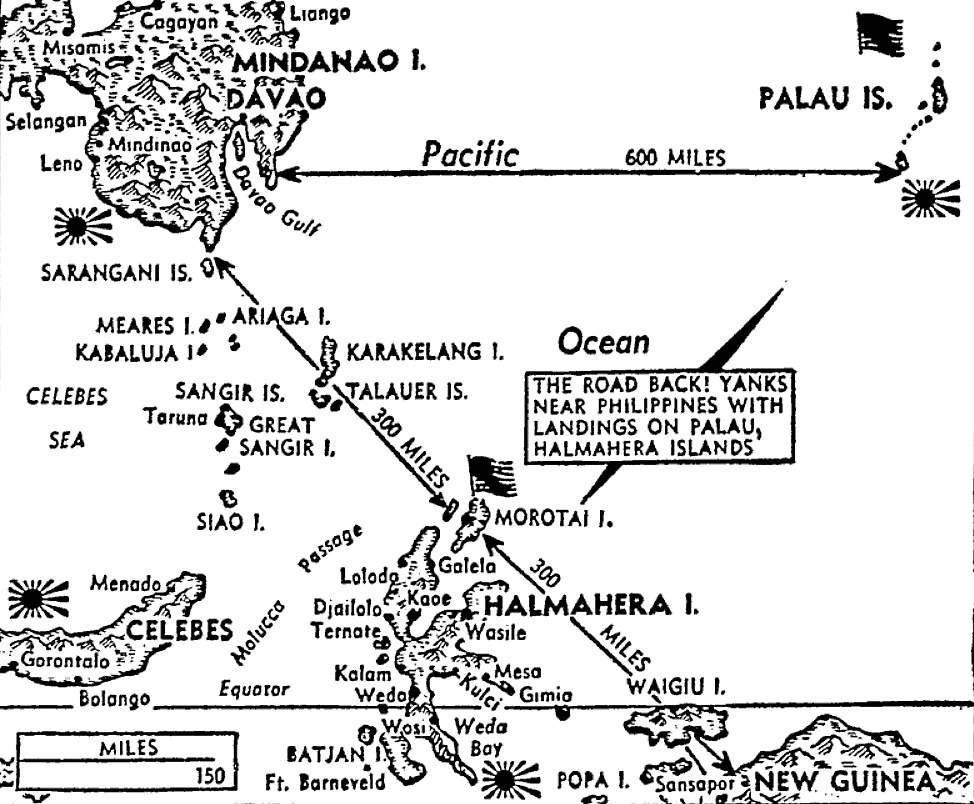
Early invasion of the Philippines was predicted by Tokyo today from the new springboards invaded by U.S. forces. The Yanks, meanwhile, had surrounded the airfield on Peleliu, southernmost of the Palau Islands, and were mopping up on Morotai Island, northernmost of the Halmaheras. The Tokyo radio reported evacuation of civilians from Davao on southern Mindanao in preparation for the anticipated next American attack.
Pearl Harbor, Hawaii – (Sept. 16)
U.S. Marine veterans of Guadalcanal have captured the 4,200-foot Peleliu Airdrome in advances of 1,500 yards against stubborn resistance, beating off several strong counterattacks and taking a toll of more than 1,400 Jap dead, Adm. Chester W. Nimitz announced tonight.
The excellent figure-four shape airfield fell in bitter fighting Friday (West Longitude Time) after the Leathernecks clamped a three-way pincer on the airdrome in a drive aided by the blazing guns of field artillery, tanks, warships and carrier aircraft.
U.S. troops have extended their beachhead to two and one quarter miles and occupy the entire southern end of the island with the exception of two small bulges on the extreme tip. The biggest penetration was 2,000 yards, while gains along the entire front, ranged from 200 to 1,000 yards in the 24-hour period covered in the communiqué, indicating the tough resistance being encountered.
The capture of the airdrome was announced as the Tokyo radio said the city of Davao was being evacuated in anticipation of an American drive into the Southern Philippines from new invasion, springboards less than 300 miles away.
As capture of the airfield approached, front dispatches from United Press writers Lisle Shoemaker and Richard W. Johnston revealed that a battle of annihilation was in progress on the southern tip of the island.
Mr. Shoemaker reported that Jap snipers emerged from caves, infiltrated the left flank of the beachhead and pinned the Marines down through the night. Today, however, the Marines attacked and field artillery barrages pinpointed enemy troop concentrations ahead as assault troops pushed forward.
The densely wooded hills of Peleliu were the scene of bloody fighting, with the Marines fighting for every yard while warships and carrier aircraft stood by prepared to blast any Jap attempt to bring in reinforcements from other islands in the Palau group.
The 1st Division Marines apparently were taking a heavy toll of enemy lives as the seventh invasion in 10 months in the Central Pacific unfolded as part of a coordinated offensive toward the Philippines.
Some 500 miles to the southwest, Gen. Douglas MacArthur’s Army troops, fashioning the southern claw of a pincer aimed at the big Philippine island of Mindanao, began whipping into shape the newly-captured Morotai Airfield, less than 300 miles below Mindanao and 375 miles from Davao.
Gen. MacArthur reported that work on the airfield and consolidation of U.S. positions were being rushed without enemy opposition, while heavy bombers blasted nearby Halmahera with 125 tons Friday and neutralized the Lolobata and Hatetabak airdromes. The airfields are only 12 miles from Morotai Island.
Six vessels blasted
Other bombers continued to hit East Indies island airdromes and shipping routes, sinking or damaging six vessels and nine barges.
Reflecting growing alarm at the twin American thrust to the threshold of the Philippines, Tokyo said civilians were being evacuated from Davao, a stronghold of Nipponese fifth columnists before the war, and that “preparations for a United States invasion of the Philippines are being pushed rapidly.”
Jap Premier Gen. Kuniaki Koiso, attempting to boost home front morale, said that Japan was preparing to “launch a great offensive in the near future to crush Britain and the United States,” and Tokyo revealed another shakeup in the Japanese Naval High Command. Adm. Naokuni Nomura, former Navy Minister, was installed in a “certain important post” and was succeeded as chief of the great Yokosuka Naval Station by VAdm. Nishizō Tsukahara.
Fierce Peleliu fighting
A Jap communiqué admitted the U.S. landings at both Peleliu and Morotai and claimed fierce fighting raged in both areas. The Japanese Dōmei News Agency said, “We are on the eve of a decisive battle” and said American strategy was to cut off the southern regions from Japan, seize bases from which continuous bombings of Japan could be launched and accelerate preparations for direct assaults – presumably amphibious – against Japan itself.
The U.S. landings left some 300,000 Japs bypassed in various Central and Southwest Pacific bases strung far behind our expanding invasion line.