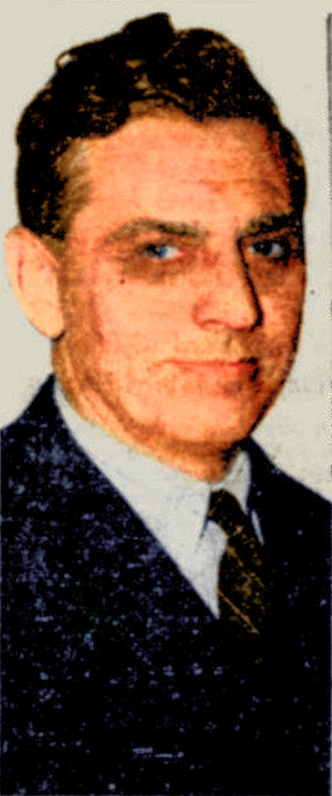
Clapper: More
By Raymond Clapper
This is Raymond Clapper’s last column. It was written aboard the carrier from which he flew to his death in the battle of the Marshall Islands. The column was only about two-thirds completed; the second page of manuscript carried the slug “more.”
Frank Mason, special assistant to the Secretary of the Navy, delivered the copy from the carrier to Pearl Harbor, and it was wirelessed from there to the States.
Before leaving for the Pacific, Mr. Clapper wrote that “some people in Washington feel there is no sufficient awareness at home of how much our men are doing and in what a living hell they must sometimes do it.” He went to the Pacific to help increase that awareness. Some 14 columns written by Mr. Clapper in the days before his death have been printed posthumously, in the belief that he would have wished us to help him carry out that self-appointed mission.
With the Pacific Fleet, in the Marshall Islands – (by wireless)
Contrary to many predictions that I heard in Washington and in the Southwest Pacific, the invasion of the Marshalls did not prove to be another Tarawa. All concerned had one thought in mind in planning the Marshalls campaign – that there must be no repetition of Tarawa.
Nobody will admit officially that Tarawa fell short of what it should have been. But there were some faults in the plan of operations. For the Marshalls campaign, changes in planning were made to ensure that no matter how much delay the troops might encounter upon reaching shore, their cover would stay with them and hold the Japs in their holes.
Furthermore, the approach to the main objectives was planned on an entirely different basis for the Marshalls campaign. We not only made sure that the Japanese airpower was knocked out before our landings began, but the landings themselves were planned differently.
We slipped around to one of the rear atolls where we were not expected. On the first day we occupied small undefended islands near the larger ones of Roi and Kwajalein. The purpose in occupying those was to set up artillery for heavy bombardment of our main targets.
Enormous concentration
And above all there was an enormous concentration of the Pacific Fleet, with sufficient strength to have taken on any defense Japan wanted to attempt, including the use of her fleet.
The night before the battle began, the captain of the happy carrier which I was aboard during the air attack talked to his entire ship about the battle that was about to begin. He said the Marshalls battle was well-planned and carefully thought out, and that we started out with “a powerhouse of strength.” He said this was the biggest task group ever assembled in the Pacific.
The men aboard all had complete confidence. There were no jitters. There was almost a holiday air, because they knew that what the captain said was true. For days we had traveled in the midst of a large number of battleships, cruisers and other carriers. You could not look around the horizon without seeing the flattops of carriers and the peaked-pagoda effect of the low-water silhouettes of our newest battleships.
East Lynne at Eniwetok
After the first days of hammering at Kwajalein, as we swung out for our “strike” the next morning before dawn at Eniwetok, which is within bomber range of the great Jap base at Truk, one of our Navy fighter pilots, Lt. Robert A. Ogden, an Ohio State law graduate from Portsmouth, Ohio, reflected the spirit on board when he announced:
Tomorrow night, “East Lynne” at Eniwetok.
We are not bothering to clean out all the Japs from the Marshall Islands. It is more economical, and just as effective, to cut them off and let them “die on the vine,” as the method is referred to out here. That is what Gen. MacArthur is doing in New Guinea. It is a form of piecemeal blockade.
[MORE]
NOTE: Here the dispatch ended.