The Pittsburgh Press (August 21, 1943)
Kiska is captured by Yanks, Canadians
Japs give up last base in Aleutians without firing a shot
By Merriman Smith, United Press staff writer
Québec, Canada –
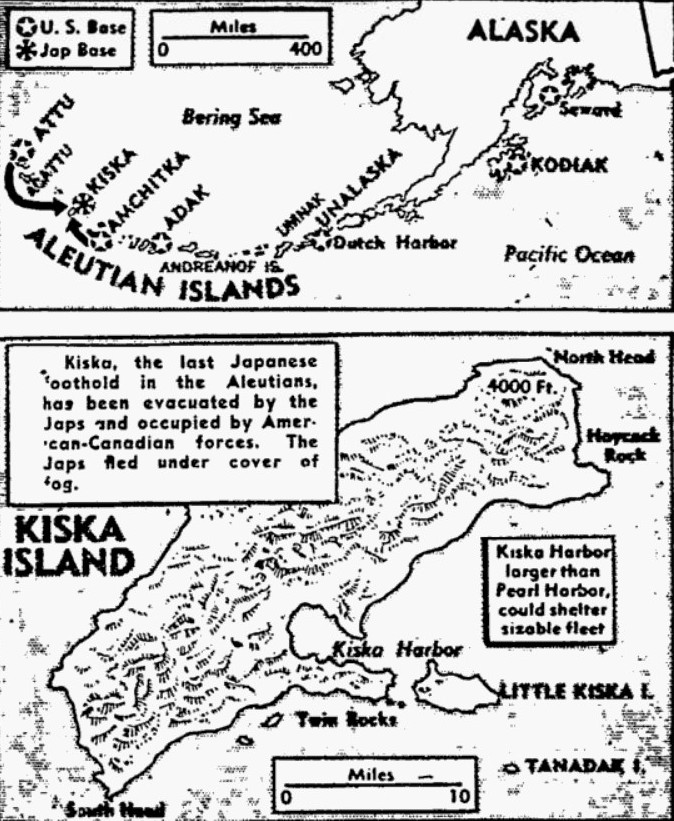
U.S. and Canadian troops have occupied Kiska in the Aleutian Islands without firing a shot, freeing “the last vestige of North American territory of Japanese forces,” President Roosevelt and Prime Minister W. L. Mackenzie King announced today.
The Japanese, estimated at 10,000 by the U.S. Navy, apparently escaped under the cover of fog sometime in the night of Aug. 13-14. They fired on U.S. aircraft on the 13th, but on the 14th, there was no reply to either air or surface raids. The Allied forces began landing on Aug. 15, the Navy said in Washington.
The dramatic announcement by the President and the Canadian Prime Minister was made as the war-plan conference between Mr. Roosevelt and British Prime Minister Winston Churchill neared its close. Reportedly, the President and the Prime Minister had reached agreements to push the Pacific offensive with the Jap fleet as the main objective.
Cleaning out the Aleutians meant that the eastern end of the road to Tokyo was open and that probably Paramushiru, the big Jap naval base in the Kuril Islands, was next on the list for heavy attacks.
Conscript Canadian troops were used in the occupation, their first combat duty. Under Canadian law, they cannot be used outside the Western Hemisphere.
White House Secretary Stephen T. Early, who made the announcement for Mr. Roosevelt and Mr. King, said that the President was “particularly happy” that he was in Canada when such good news could be given to the world.
Text of the joint statement:
A strong force of U.S. and Canadian troops supported by surface vessels have occupied the island of Kiska in the Aleutians. The landing began on Aug. 15; no Japanese were found, and it is our belief that the enemy evacuation was made under cover of heavy fog.
It is evident that the position of the Jap troops became untenable because of the occupation of Attu, the harassment of enemy supply lines and the recent bombings and bombardments of Kiska by air and surface craft.
For security reasons, this announcement has been withheld pending the unloading of transports.
The present occupation of Kiska frees the last vestige of North American territory of Jap forces.
FRANKLIN D. ROOSEVELT
W. L. MACKENZIE KING
A naval communiqué issued simultaneously in Québec City and Washington said:
A task force of the Pacific Fleet has landed a force of U.S. and Canadian troops on Kiska beginning on Aug. 15. No Japanese have been found. There were indications of recent hasty evacuation of the Japanese garrison.
Presumably the heavy bombardments by our ships and planes that have been carried on for some time and the danger to their supply lines by our capture of Attu made the enemy positions on Kiska untenable. It is not known how the Japanese got away, but it is possible that enemy surface ships were able to reach Kiska under cover of the heavy fog that has been prevalent.
Since the air and surface bombardments in the latter part of July had apparently destroyed Japanese radio equipment on Kiska, the assumption was that they were not in communication with the mainland. Consequently, no release of Allied operations against Kiska has been made since July 31 as it would have conveyed information to the enemy which he otherwise would not have had.
This particularly applied to the period during which transports were in areas exposed to enemy submarine attacks and while they were unloading.
Earlier reports from the conference between Mr. Roosevelt and Prime Minister Churchill had indicated that some action on the Jap front could be expected. Heavy naval and air action in the Pacific against the Jap fleet was believed to be one of the major military decisions reached at the conference.
This did not mean there would be any relaxation of the Anglo-American effort in Europe, but it was becoming increasingly evident that the Pacific was near, if not at the top, of the agenda at the Citadel where the President and Mr. Churchill are meeting.
Russian demands to the contrary, the conferees were believed to have decided that the situation in the Pacific is such that it will not permit an all-out concentration against the Germans in Europe to the entire exclusion of Japan.
The Allies were expected to hit twice – in Western Europe and, at about the same time, in the Pacific. The fall campaign in Burma was decided at the Roosevelt-Churchill conference in Washington last May. Coincident with the Québec Conference was information that a section of the British Navy is moving into the Pacific and there were some sources which foresaw a major naval battle with the Japs in the very near future.
Sir Alexander Cadogan, British Permanent Under-Secretary of State for Foreign Affairs, was one of the key figures in the Pacific planning here. He came over with British Foreign Secretary Anthony Eden and is one of the high-ranking Far Eastern experts of the British Empire. Naturally, he is not a master of military logistics, but his counsel is being received by the two top figures in the conferences along with that of Mr. Eden and Secretary of State Cordell Hull.
There was a widely circulated but unconfirmed report that Lt. Gen. Joseph W. Stilwell, commander of U.S. forces in China, India and Burma, had joined the discussions. Gen. Stilwell, along with Maj. Gen. Claire L. Chennault, commanding the U.S. Air Force in China, and Field Marshal Sir Archibald Wavell, new Viceroy of India, were key figures in the May conferences with the President and the Prime Minister.
If the reports about Gen. Stilwell are true, they mean one thing: The plans for Burma have been given a final touch and a new pattern of Allied combat against the Jap is being born.
Attack by fall
Meanwhile, from the Citadel, there came no information but many indications. Among highly unofficial reports were:
-
The Allies move against Germany by autumn, this operation timed with a body blow against the Japs in Burma.
-
The race for Berlin is on, with Anglo-American forces poised to beat the Russians who have made far more tangible progress in this direction.
-
Great Britain and the United States would much prefer to accomplish the “ruthless” destruction of Japan without the benefit of Russian bases in order to give them a better advantage at the peace table. Such bases, however, would be accepted in exchange for a costly push against Germany.
To talk in Ottawa
Mr. Roosevelt speaks in Ottawa from the steps of the Parliament Building Wednesday at noon. This means he leaves Québec Tuesday, and this, in turn, means that the Roosevelt-Churchill conferences will end then.
Mr. Roosevelt goes to Ottawa really as the guest of Prime Minister W. L. Mackenzie King, but formally as the guest of the Earl of Athlone, Governor General of Canada. The President speaks to members of Parliament, not reconvened but invited to reassemble to hear him.
In the area stretching in front of the Parliament steps from where the President will speak, there is space to accommodate 20,000 persons.
Go fishing
According to White House Press Secretary Early, the conferences are going along well to the point that Messrs. Roosevelt and Churchill were so “caught up” in their work they spent yesterday picnicking and fishing with members of their staffs at a lake north of Québec.
The “caught up” phrase used by Mr. Early did not mean the truly important and final decisions had been reached. According to Mr. Early, the import of this statement was that Messrs. Roosevelt and Churchill had cleaned up a batch of paperwork laid down by their generals and admirals and gone out to fish while the staff chiefs got together more material for them to pass on.