The Pittsburgh Press (June 22, 1943)
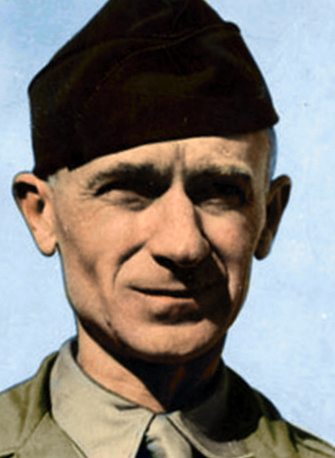
Roving Reporter
By Ernie Pyle
Somewhere in Africa –
Brazzaville is the capital of French Equatorial Africa. It is also the original headquarters of the entire Free French movement throughout the world.
You’d have to search a long time for a more remote spot in which to center a world movement, but at the time France went under, there weren’t many French territories left to harbor a renewal of the war against the Germans.
Brazzaville has been mostly just an executive war capital, fighting only with the radio, with plans, with decisions. Gen. de Gaulle has been there a number of times, but no actual movement or concentration of war goods has ever occurred there. It’s just too far away from anywhere.
Brazzaville is on the opposite bank of the Congo River from Leopoldville. The river there is about a mile and a half wide. You cross in a motor launch, which runs every half hour. Natives sit in the front part, and whites in the rear.
Brazzaville is to Leo what West Memphis, Arkansas, is to Memphis, Tennessee. It is small in comparison and everybody goes to Leo for his better shopping and entertainment. Brazzaville has a few paved streets, a few nice homes, but mostly it is a native village.
There is one thing you do go to Brazzaville for, however, and that’s to buy ivory. It is one of the best places in Africa for ivory carvings. I wanted to get some to ship home, so I collected a friend and we went across the river.
This friend was Capt. Phil Ross (now a major), formerly an independent oil operator in San Antonio, Texas. Buying ivory is one of his hobbies. He knows the values down to a centime, and he has a way of haggling with the natives – a boisterous pretense of being insulted and angry at the prices they ask – that tickles them to death.
When we got off the launch, about a hundred black boys came charging down as though we were a citadel and they were storming us. They were all rickshaw pullers.
Knowing how this thing works in other countries, I quickly picked out one boy on the theory that he would save me from the rest. But it doesn’t work that way in Brazzaville. The others continued to yell, grab, push and haul at my defenseless person until we were a hundred yards down the road. Real chamber-of-commerce go-getters, those Brazzaville boys.
A Brazzaville rickshaw is something new under the sun. It has only one wheel. This wheel is nicely rubber-tired, and about the size of a motorcycle wheel. It sits in the center right beneath your seat. A framework of shafts extends fore and aft, and it takes two boys to balance and pull the thing.
Brazzaville is full of rickshaws, but for some strange reason there are none at all in Leo, 10 minutes away.
We went into the heart of the native section and finally pulled up before a mud house. An ivory dealer lived there. He got out his supply from a wooden truck, spread it out on the bare ground of the hallway, then ran along the front of his house, and we began bargaining.
The grapevine carried the word rapidly over town, and pretty soon other dealers began to arrive with their ivory tied up in white rags. They would sit and watch the proceedings for a while and then slowly untie their stuff and very gradually, enter the bargaining.
They were all Negroes, dressed mostly in loosely flowing white gowns. About a dozen finally came. These were not ivory carvers, but merely traders.
They looked like plain jungle Negroes, yet they were acute businessmen. When the American troops first arrived, ivory prices skyrocketed, but when we were there, most of the troops had gone and prices had consequently nosedived again.
Some of the Negroes spoke a few words of English, and Capt. Ross knew a few words of French. Between them we bargained, laughed and haggled there on the ground for three solid hours. We bought bracelets, Negro busts, solid ivory elephants, beautiful Madonnas, knife-and-fork salad sets, dainty pairs of antelopes, turtles, necklaces.
It was more like an auction than a private transaction. I kept books on the thing – whenever Capt. Ross would finally strike a deal for something he would lay it aside and I would put down a description of the article and its cost, on the back of an envelope. When we were finally finished, we had more than 50 separate pieces and they ran into thousands of francs.
I added up the figures, Capt. Ross added them up, and two of the Negroes added them up. I didn’t think they could add, but they said the total was correct. Anyhow we paid a lump sum to one man and left it up to them to thresh out the division among themselves.
How they ever got it straightened out, I didn’t know, for it was a complicated mess, but everybody seemed happy, including us.