The Pittsburgh Press (May 12, 1943)
ROOSEVELT, CHURCHILL MAP BLOW AT JAPS
High Far East war leaders arrive in U.S.
President, Prime Minister to review strategy on all fronts
By Merriman Smith, United Press staff writer
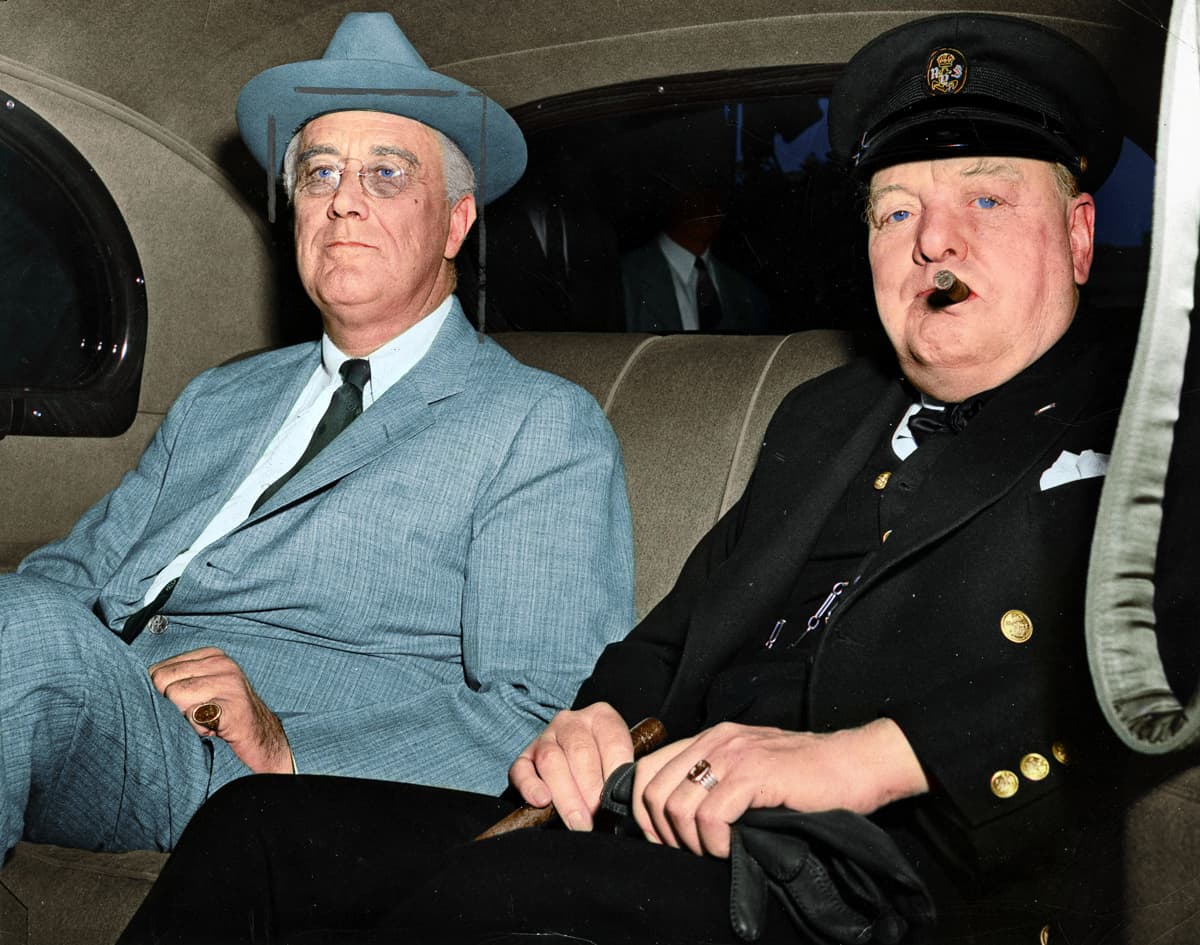
Third visit to Washington finds Prime Minister Winston Churchill riding to the White House with President Roosevelt after his arrival in the United States yesterday. The meeting of the two war leaders is their fifth.
Washington –
New Allied blows against Japan were believed to be foreshadowed by disclosure today that British Prime Minister Winston Churchill brought to Washington his top military and naval officers in India.
There was no doubt that Mr. Churchill and President Roosevelt, master strategists of Allied arms, will review plans for all fronts, including the invasion of Europe. They also face several knotty political problems such as the Polish-Russian relations and the Giraud-de Gaulle friction.
But the apparent emphasis on the war against Japan in this fifth Roosevelt-Churchill conference tended to confirm belief of many observers here that the plans for direct blows against the European continent have been pretty well perfected before this.
Wavell in party
Membership of the Churchill party was disclosed by the White House today.
With the Prime Minister were Field Marshal Sir Archibald P. Wavell (Commander-in-Chief of British forces in India and former commander of their army in the Middle East), Adm. Sir James Somerville (Commander-in-Chief of the Eastern Fleet), and Air Mshl. Sir Richard Peirse (commanding British air officer in India).
Other members of Mr. Churchill’s party included Gen. Sir Alan Brooke (Chief of the Imperial General Staff), Adm. of the Fleet Sir Dudley Pound (First Sea Lord), Air Chf. Mshl. Sir Charles Portal (Chief of the British Air Staff).
Also Lord Leathers (Minister of War Transportation), Lord Cherwell (the Prime Minister’s statistical officer), Lt. Gen. Sir Hastings L. Ismay (chief staff officer to the Minister of Defense), and Brig. E. I. C. Jacob (Assistant Secretary [Military] of the British War Cabinet).
It was noted in London that no African or U.S. commanders in Britain accompanied Mr. Churchill.
White House Press Secretary Stephen T. Early said the war experts who accompanied the Prime Minister would meet with the American staff chiefs, while Mr. Roosevelt and Mr. Churchill hold a series of intensive conferences.
Heavy blows pledged
From time to time, Mr. Roosevelt and Mr. Churchill will probably participate in the Joint Staff meetings.
The presence of Marshal Wavell, Adm. Somerville and Marshal Peirse was taken as a strong indication that considerable emphasis in the talks between the President and the Prime Minister will be on the Far East and the South Pacific. Mr. Roosevelt has promised that heavy blows will be struck this year against the Jap homeland.
Obviously, however, they will also review Allied strategy all over the world, particularly in the light of the Allied cleanup in Tunisia.
Lt. Gen. Joseph W. Stilwell, U.S. Commander-in-Chief in China, Burma and India, has been in Washington recently and is believed still in this country. He may join the war planning sessions.
Maj. Gen. Claire L. Chennault, chief of the U.S. 14th U.S. Army Air Force in China, has also been in Washington.
Mr. Roosevelt and the Prime Minister conferred at great length last night after dinner, and resumed their talks again today.
To dine at Embassy
Tonight, the Prime Minister will go to the British Embassy to have dinner with his Ambassador, Lord Halifax, while the President is entertaining President Edvard Beneš of Czechoslovakia, who will arrive at the White House at 4:30 p.m. today to be an overnight guest.
Mr. Roosevelt and the top leaders of the U.S. government will greet President Beneš upon arrival and later attend a stag state dinner for him at the White House tonight.
Only the brief announcement of Mr. Churchill’s arrival was made last night, but observers here believe that in addition to European military plans they are giving keen attention to these matters:
-
Plans to reemphasize their “unconditional surrender” decision reached at Casablanca last January and to reassert their lack of interest in peace offensives, except on that condition, whether emanating from the Axis directly or through such agents as Gen. Francisco Franco of Spain.
-
Incessant demands of the Australian and Chinese leaders that more material, especially planes, be thrown into the war against Japan. some sources suggested that the comparative case of the Allied victory in Tunisia might possibly permit an increase in the Pacific allotments determined at the Casablanca Conference.
-
The Soviet Union’s relations with the rest of the United Nations, which have been clouded by Soviet-Polish friction. A Roosevelt-Churchill-Stalin meeting might be in the cards later, but was not considered probable in the immediate future.
-
Post-war plans. In this connection, it was noted that the international food conference, first big meeting that will bear on post-war matters, will begin next week at Hot Springs, Virginia.
Two schools of thought
Washington generally had not expected another Roosevelt-Churchill meeting until mid-summer. Two conflicting schools of thought developed as to basic purposes of the meeting at this time:
One said:
He has come to map out with the President the new offensive in Europe, now that German resistance in Tunisia is out of the way.
The other said:
The next move was decided when Mr. Roosevelt and Mr. Churchill met at Casablanca. This time they are meeting to take up what goes on after the invasion of European continent gets underway.
In any event, it seemed certain that the improved military situation resulting from the Axis rout in Tunisia was bound to figure in the new calculations here.
Meanwhile, reports from London predicted that the present White House parleys would lead to a Churchill-Roosevelt meeting with Premier Joseph V. Stalin of the Soviet Union, such reports obviously based on the “second mission to Moscow” of former U.S. Ambassador Joseph E. Davies who is bearing a highly-secret message from Mr. Roosevelt to Mr. Stalin.