The Pittsburgh Press (March 21, 1942)
Rambling Reporter
By Ernie Pyle
LONG BEACH, Calif. – Among the many things about the conduct of the war which aren’t clear to me, is whether city people should try to grow their own food.
I’ve read pieces coming from Washington telling of the formation of a national Garden-for-Victory movement, or some such similar title, and urging people to get right out in their back yards and hoe against Hitler.
I’ve also read pieces coming from Washington urging amateurs not to put in back yard gardens, on the theory that their inexperience would squander valuable seed and fertilizer and insecticides that could be used better in more professional hands.
So what are we to do? Certainly I don’t know. But I do know that in England everybody and his brother has a little war garden; that clerks and bookkeepers and bus drivers are farming “allotments” in city parks; that even on top of Anderson shelters you’ll frequently see a few vegetables growing.
So I’ve gone to the foremost war-garden expert in this Los Angeles area, to see what he thinks about it. Naturally he’s for war gardens; like anybody all wrapped up in a certain line of work, he sees the war being won by a great devotion to his especial hobby.
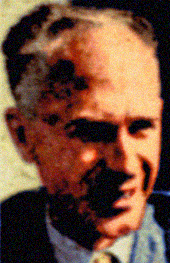
This man is Maj. Harry L. Bateson, who has been a horticulturist all his life. He is a Canadian by birth, but an American citizen now. He is a sort of local Burbank. He has been gardening and flowering and breeding and preaching around here for 12 years.
What attracted me to him is that he runs actual classes for adults, teaching them how to become their own private gardeners. He says he can take the dumbest guy that ever lived and make a self-sufficient gardener out of him in six weeks. And the funny part about it is that he doesn’t charge his students anything.
Bateson says that the average back yard will keep a family of four in vegetables. In Southern California you could have a different kind of vegetable coming in every week of the year; in colder regions it would have to be confined to summertime.
Maj. Bateson is quite a fellow. He has been all over the world. He is middle-aged with bushy hair; wears a lumberjack shirt with red handkerchief tied around his neck; and on his finger a fascinating gold ring given him by Sun Yat Sen.
He was raised in the cold North, 300 miles above Edmonton, Alberta. He says he was at work when he was 7, making his own living at 9, and in foreign countries at 14.
He studied and worked in England as a youth. So England was not new to him when he arrived there as a Canadian soldier in November, 1914. He was with the famous Princess Pat regiment. They were in the trenches by Christmas.
Bateson fought and was gassed and wounded. But as he recuperated, he pounded on his hobby of gardening. He says he was the father of England’s war gardens in the last war. He’d get a soapbox, plant it in front of a cathedral, and preach gardening as the people came out.
After the war Bateson spent long years in veterans’ hospitals, both in Canada and the United States. In the late ‘20s he wasn’t expected to live a week. But finally he began to regain his health at El Paso. And then in 1930 he came to California and started working in the open. Today he’s twice as hale three times as hearty as I am.
He expounds his gardening in classes, by example and over the air. He has been on the radio in this region every day for the past 12 years. He gets about 40,000 letters a year asking questions about gardening, and has to have a staff of secretaries to answer.
In 1932 he talked the leading citizens of Long Beach into establishing what was known as “Thrift Gardens.” It was at the depth of the depression, and people were desperate.
So real estate operators donated land, the city collected money for seeds. Maj. Bateson furnished the direction, and pretty soon they had 3200 families at work gardening. The thing is actually still in existence, although the gardeners are down to 75 now. These are otherwise unemployable; all the rest have jobs.
Bateson is as interested in handicapped and unfortunate people as he is in vegetables. Several very old people called while I was there, looking for work or wondering if they could still swing a hoe, and Bateson gave them all a nice life-begins-at-80 pep talk and I’m sure sent them away much happier than when they came.
And, in addition, he has classes of boys working in his gardens, all of them handicapped physically, some of them mentally. They stay anywhere from three months to a year and a half. The sun and exercise and friendliness do wonders for them. The School Board helps keep them.
Bateson says in the entire Los Angeles area, including suburbs, there are now about 100,000 gardens. He thinks there should be many times that number.