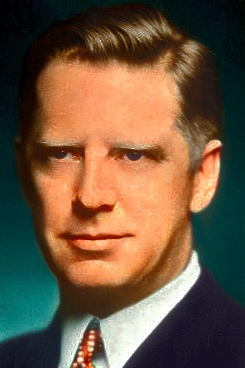
Rubber saving must continue, Jeffers warns
Nation has to get along on present stocks until 1944, he says
…
Nation has to get along on present stocks until 1944, he says
…
What happens if i don’t give them da money?
Nothing much; so far, donations are all voluntary. However, where taxes are concerned (Victory tax), if you don’t pay it, you’re in for some legal trouble.
Swampy Quantico ‘blitz’ course laid out where Battles of Bull Run were fought
By Ned Brooks, Scripps-Howard staff writer
…
Washington –
The Senate passed and returned to the House for slight amendment a bill authorizing creation of a woman’s auxiliary of the Coast Guard – similar to the Army’s WAACs and Navy’s WAVES. It will be known as the WARCOGS.
By Westbrook Pegler
New York –
Concerning democracy in the treatment of the sexes, as he put it, Henry Wallace, the Vice President, said in his speech to the Congress of American-Soviet Friendship, whatever that was, last Sunday, that it had taken the war experience of Russia to demonstrate the completeness of our own failure.
He said:
The average woman [of Russia] does about as much work as the average men and is paid as much. Thousands of Russian women are in uniform, either actively fighting or standing guard.
We in the United States have not yet, in the same way as the Russians, called on the tremendous reserve power which is in our women, but before this war is over, we may be forced to give the women the opportunity to demonstrate that with proper training they are equal to man in most kinds of work.
That is Mr. Wallace’s idea of one of the meanings of democracy. It means that women become soldiers or factory hands and have the privilege of performing most of the kinds of work that men do. It is true that in the United States, women are the victims of a wage differential in most lines of work.
System is not to blame
That, however, can be adjusted by raising their pay without any alteration of the American form of government or change in the relations of the government to the governed. It represents only faulty operation of the American system, not a fault of the system itself.
Otherwise, women in the United States do enjoy equality with men. They vote and, except in a few states which cling to old laws, without the conscious knowledge of their people, their property rights are fully respected and protected.
Indeed, they enjoy special legal protection as the homemakers and the mothers of children, and American thought has always imposed on the husbands and fathers a duty to provide homes and the necessities of life for their families. It would seem that in Mr. Wallace’s concept of democracy, woman is degraded by this legal recognition of her dependency, but the American people will be slow to emancipate her in this respect.
The enfranchisement of women in the United States, regrettably, has caused no perceptible improvement in the political hygiene of the country. It is only coincidence, to be sure, and the women are not to blame, but our political life was never more sordid than it has been under the administration of which Mr. Wallace has been one of the leading spirits since 1932.
One woman Senator was elected by the intercession of the most brutal and dangerous politician in all our history, Huey Long, who was a dictator of Hitlerian stripe. The lady’s career has been otherwise undistinguished, one way or another.
Another woman was sent to Congress by the Frank Hague machine of Jersey City which has been denounced, in season, by Mr. Wallace’s party as a horribly corrupt and utterly anti-democratic monstrosity, but out of season has enjoyed the most agreeable and profitable recognition from his party. A third lady has been serving as a Cabinet officer of Mr. Wallace’s administration since 1932 and has been a negative figure at best.
There is disagreement as to the quality of Mrs. Roosevelt’s contribution to American political and social life. But contrary to Mr. Wallace’s theme, Mrs. Roosevelt has been amazingly active, whereas the wife of the dictator of Soviet Russia has no public existence at all.
Women enjoy much freedom
American women frequent our saloons, they go about unattended, they have educational opportunities equal to those of men and in the matter of employment are hampered only out of consideration for their physical delicacy. Some of the restrictions may be unreasonable, but it is hardly an argument for democracy or freedom to insist women be hired for hard physical work.
And it should be noted that Russia is an invaded country, right under the guns, in which every pair of hands and every muscle counts. If the enemy, striking the Atlantic Coast, had swept our people to a stand west of the Mississippi, no doubt American women would be, as Mr. Wallace says of the Russian women, “in uniform, either actively fighting the tremendous reserve power which is in our women,” to an even greater extent than Russia has on hers.
A troubling thought occurs in connection with the purpose to extend the four freedoms everywhere in the world. American troops landing in Africa were solemnly warned that deadly consequences might ensue if they addressed so much as a word to a Moslem woman.
The Moslems are numerous and hosts to some very cranky prejudices. They would be certain to regard this phase of Mr. Wallace’s concept of democracy as an affront and this freedom would have to be imposed on all Islam by force of arms.
By Editorial Research Reports
In 1831, the United States signed a treaty with France for settlement of claims by American citizens for French depredations on American shipping from 1800 to 1817. Ratifications were exchanged on February 2, 1832. France was to pay 25 million francs in six annual instalments beginning on February 2, 1833. The United States was to pay for counterclaims 1,500,000 francs in six annual instalments.
The arrangement was unpopular in France. The first two instalments became due without any step for an appropriation by the French Chamber of Deputies. Then a bill authorizing the payment of the money was rejected. The King of France sent his regrets, coupled with assurances that the payments would be made. Nevertheless, in July 1834, he discontinued the French Parliament until the following December. Thereupon President Jackson laid the matter before Congress in his annual message of December 1834.

Jackson declared that the United States could not honorably allow the treaty to be repudiated without taking action. French interests could be injured by laying heavy duties upon imports from France and by denying French vessels access to American ports. However, Jackson declared that these steps would at the same time injure American trade. The better way was to seize property belonging to the French government or its citizens. Such procedure, according to Jackson, was in conformity with international law and had recently been followed by France herself against Portugal.
The U.S. Senate unanimously agreed that action was “for the moment” inexpedience, but the House of Representatives passed resolutions upholding the treaty of 1831 and calling for preparations to meet any “emergency thereby created.” France objected violently to Jackson’s message, recalled its minister to Washington, notified the American minister at Paris that his passports were ready for him.
The Chamber of Deputies did pass a bill making appropriations for the first three annuities under the treaty of 1831. However, the Chamber added to its bill a proviso withholding payment until the United States should declare in writing that it regretted the misunderstanding which had arisen, and that it had never intended to question the good faith of France nor to take “a menacing attitude” toward France.
Jackson, in his annual message of December 1835, declared that he would not apologize, and that he stood by his guns. At the same time, he disavowed any intention of wounding French pride or insulting the French government. In a special message of January 15, 1836, he finally recommended that an embargo be laid on all French imports and that all American ports be closed to French ships. However, France took the position that the language of the president’s annual message of 1835 was satisfactory to her and allowed her in honor to pay the instalments due. Thereupon the incident was closed.