More enemy boats sunk –
Pacific admirals shifted; Navy raids Japanese isles
Halsey replaces Ghormley as commander in Solomons area as U.S. fleet units attack foe in Gilberts and Ellices and blast 4 ships
By Sandor S. Klein, United Press staff writer
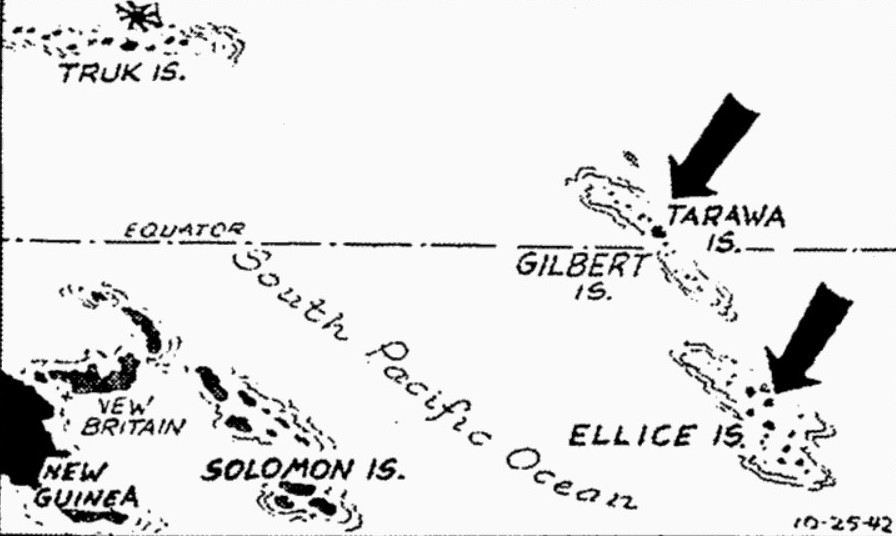
Navy raids Jap bases east of Solomons, sinking two patrol ships and damaging a destroyer and merchant vessel at Tarawa in the Gilbert Islands. The Ellice Islands were also raided. Tarawa is 1,500 miles east of the Japs’ main South Pacific base at Truk. Tarawa is about 1,100 miles from Guadalcanal in the Solomons.
Washington – (Oct. 24)
The Navy announced today that Vice Adm. William F. Halsey Jr. has been made Commander-in-Chief of the South Pacific Area in a shakeup coincident with steadily increasing activity by powerful Japanese forces bent upon recapturing vital Guadalcanal in the Solomons.
The new commander replaces 59-year-old Vice Adm. Robert Lee Ghormley who launched the American attack on the Solomons Aug. 7 and has directed it since.
A few hours after the announcement of the shakeup, the Navy disclosed that U.S. warships had resumed far-ranging raiding operations in the South Pacific similar to earlier raids which Adm. Halsey himself has led against the Japanese-held Gilbert, Marshal, Wake and Marcus Islands.
No news of Solomons
The new raids, the communiqué said, were carried out in the Gilbert and Ellice Islands, approximately 1,000 miles from the beleaguered Solomons, and resulting in the sinking of two small enemy patrol vessels by gunfire. A Japanese destroyer and one merchant ship were damaged.
Meanwhile, the Navy said:
There has been no report of any new action in the Solomon Islands area.
Adm. Halsey, 59-year-old holder of the Distinguished Service Medal for his leadership of brilliant actions against the enemy in the early months of the war, takes over the South Pacific command at a time when mounting American losses are causing some criticism in Congress of the conduct of the Solomons campaign.
Invasion fleet massed
Just a week ago, Rep. John M. Costello (D-CA), member of the House Military Affairs Committee, told the House he feared the Navy had attempted a “grandstand play” in the Solomons by failure to seek Army cooperation. Other Congressional leaders have voiced similar fears privately.
Meanwhile, the Japanese have been able to concentrate a powerful invasion fleet in the Solomons and have already pushed out “feeler” thrusts against the American garrison on Guadalcanal, presumably preliminary to an all-out assault.
Ship losses heavy
Thus far, U.S. losses in the Solomons have included at least 12 ships – three heavy cruisers, five destroyers, three auxiliary transports and one transport – plus unannounced numbers of ships damaged, aircraft destroyed and men killed or wounded. In addition, the Australian cruiser Canberra was sunk early in the campaign.
The most alarming development announced was recently the occupation by enemy forces – disclosed yesterday – of the strategically situated Russell Island, only 30 miles northwest of Guadalcanal. Possession of this island gives the Japanese a valuable supply base for their ground forces on Guadalcanal.
Jap forces regrouped
The enemy’s ability – repeatedly established since Oct. 14 – to land forces and heavy equipment, to push home night warship bombardments of the vital American-held Guadalcanal airfield, and to carry out increasingly-heavy air attacks on the field was regarded as evidence of the extent to which the Japanese have regrouped their forces since their defeat in the battles of Midway and the Coral Sea.
Adm. Halsey, who won the Navy Cross as a destroyer squadron commander in World War I, commanded the Pacific task force which raided the Japanese-held Marshall and Gilbert Islands last January. For this “brilliant and audacious” attack, President Roosevelt awarded him the Distinguished Service Medal.
Led raid on Wake
Adm. Halsey is a naval aviator – the son of a naval captain – and has commanded aircraft carriers. Since 1934, he has been identified with the Naval Air Service. In the Marshall and Gilbert Islands raid, his task force destroyed 16 enemy ships, including a converted 17,000-ton aircraft carrier, and 41 planes. He also led the successful raids on Wake Island, Feb. 24, and Marcus Island, March 4.
In replacing Adm. Ghormley, the Navy did not say what his new duties would be. The retiring commander, whose home is in Moscow, Idaho, is not rugged physically.
Other changes in the South Pacific Command announced at the same time included the designation of Vice Adm. Herbert F. Leary, heretofore Commander of United Nations Naval Forces in the Southwest Pacific under Gen. Douglas MacArthur, as a Pacific task force commander. He will be succeeded by Rear Adm. Arthur S. Carpender who was his second-in-command.
Enemy suffers reverses
Adm. Leary succeeds Vice Adm. William S. Pye, who moves from the task force leadership to the presidency of the Naval War College in Newport, Rhode Island.
Heavy as U.S. losses have been in the Solomons, the Japanese have suffered reverses too. Enemy losses thus far announced include 10 ships sunk, three probably sunk and 46 damaged. Navy communiqués have announced destruction of 353 enemy planes.
Congressional criticism of the Solomons campaign has stressed fear that the Army and Navy High Commands are still not cooperating effectively.
Congress may act
Secretary of War Henry L. Stimson recently attempted to allay such criticism with the disclosure that Army troops and airmen had been dispatched to the Solomons. Mr. Stimson added the assertion that Gen. MacArthur, United Nations Commander-in-Chief in the Southwest Pacific – Australia and islands to the north – was cooperating closely with the Navy.
Some Congressional leaders have said privately that unless the situation, as they saw it, was corrected soon, they would bring it to a head after the November elections.