Reading Eagle (August 18, 1942)
ALLIED ROUT REICH PLANES OFF FRANCE
Yank fliers renew raids upon coast
Spitfires destroy big patrol craft, blast 2nd in clash
…
Reading Eagle (August 18, 1942)
Spitfires destroy big patrol craft, blast 2nd in clash
…
Face bitter Jap fight against expansion of Solomons footholds
…
Seattle, Washington (UP) –
Boeing Aircraft Co., makers of the Flying Fortress, plans to segregate women workers because the men are always looking at them, thus slowing production.
H. Oliver West, executive vice president of the company, said:
Women do rather well in war production, but they cause a disturbance. Many are here for other than a serious purpose.
West said Boeing hopes to solve the “disturbance” by segregating women in sub-assembly work, where woman’s dexterity is superior to man’s and where they will be free of “all but working interest.”
West said women also create a safety problem, because of their long hair and jewelry. The company discourages both, he said.
Three months ago, Boeing employed no women on the production lines or in the shops. Today, 26% of the company’s employees are women.
Miami Beach, Florida (UP) –
Clark Gable, without his mustache and considerable hair, jumped out of his bunk at 5:15 a.m. today and began the grind of classes, drill and study that will make him an Army officer and probably a gunner in the bombing plane.
As an officer candidate, he is making $66 a month. As one of Hollywood’s greatest stars, he was believed to have made $3,500 a week.
Gable was accepted as an officer candidate in the Miami Beach Army Air Force school without fanfare.
Bombers make successful attack on convoy and hammer Matruh
…
Tentative 3-point plan would control flow of livestock to packers
…
Official press gives prominence to clamor for second front
…
…
The Pittsburgh Press (August 18, 1942)
By Ernie Pyle
SOMEWHERE IN NORTHERN IRELAND (By Wireless) – The sky of Northern Ireland is not like the sky around, say, San Antonio. The sky of Northern Ireland is usually full of water.
As a result, getting each new batch of American pilots checked out in Spitfires is a rather slow process. You fly when the weather permits, and you never can tell 10 minutes ahead of time whether it will permit.
The fliers over here have a saying which goes, “If you can see the hills it’s going to rain. If you can’t see the hills it’s raining.”
The American fighter pilots who are over here training under the RAF fly practically around the clock – between showers. They are divided into three groups. One group starts flying at 5 a.m. The third group stops late at night.
Their flying-field headquarters, living quarters, lounging and eating quarters are all at different places. That’s the way everything is over here – dispersed, so a raid can’t get everything at once.
Consequently they have to travel around a lot during the day. Each American squadron leader has been given an RAF sedan for his own use, and every one of the pilots has been issued a brand-new bicycle.
The training program goes on one side of a big field, while on the other side a full force of active and experienced RAF fighters sits in readiness to protect them, just in case.

When American pilots are on flying duty they do their loafing in a brick building alongside the field, called a dispersal hut. It has a concrete floor, a coal stove, deep easy chairs along the wall, and a wooden table in the center with long benches on each side. The pilots sit at the table and play cards, or lounge in the chairs and read, until it’s their turn to fly.
On warm days they stand in groups outside to watch fellow pilots getting their first thrills in a Spitfire.
I happened to be at the dispersal hut the first day mail arrived from home. They were like a bunch of 5-year-olds on Christmas morning. Within 30 seconds there wasn’t a sound in the room. Everybody was deep in his letters.
One young lieutenant, when he was finished, took all four of his letters and put them in the stove with a disgusted look. His girl back home had found somebody else.
All the pilots in these new fighter groups are second lieutenants. They look older than they really are. Most of them have been flying about a year. They come from all over America. Some of them are already veterans of bad training crackups back home, and have brought scars with them.
They say they had a fine trip over. There wasn’t a ripple on the ocean. They spent practically all the time shooting craps.
The main thing they’re running into over here is the lack of excitement in their spare time. It’s several miles to the nearest town, and after they get there they find life very dull. They all crave female companionship, as they say, but that commodity is scarce.
I don’t know whether it’s true or not, but they say that because of the movies or something people here have got the idea that American fliers are wild men. So the minute the mothers of nice Irish girls see American wings in town they haul in the girls and lock the doors. At least so the boys say.
The pilots and ground officers of the new fighter force are quartered in buildings formerly occupied by WAAFs who have now moved to another field. Most of the pilots are in small single rooms, a few in double rooms. They have good beds and comfortable furniture. Already each pilot has made his room a miniature home by putting up pictures of his girl or parents and throwing college stuff around.
There is an RAF batman for each five pilots. That is something new to Americans, and they like it. The batman is an RAF enlisted man. His job is to keep his officers’ rooms clean, get hot water, keep their uniforms pressed and shoes shined, and run their errands.
The enlisted men of the fighter group – mechanics and other technicians – live nearby in Nissen huts. They live better than most enlisted men in the Army. Their huts are light and clean and uncrowded. They, too, like and admire the RAF pilots.
They knew they would be working with the RAF when they got here, so on the way over they had lots of fun mimicking the British. They’d go around pretending to balance teacups and talking in a British accent. But you should have seen them a week after landing. They can hardly wait now for teatime, and they think the custom is wonderful.
The RAF has tea twice a day at 11 and 4:30, and about half an hour ahead of time the American pilots start looking at their watches and getting ready to leap into the trucks that take them from the airdrome to the officers’ club.
There they are served tea and cakes from a long table by RAF mess attendants. They take their teacups and sit four and six in a group around card tables all over the big lounge hall, drinking their tea, chatting and laughing. The blue uniforms of the RAF are intermingled with the brown of America.
They’re nearing the great adventure, and they’re anxious to get to the front.
These men of the air are a high-class lot, but war is no respector of class. I couldn’t help wondering as they sat there in that big room, drinking tea and laughing and talking, what they would be like a year from now – how many scarred faces, how many meals dangling from chests, how many empty chairs.
Völkischer Beobachter (August 19, 1942)
Der Augenblick konnte kaum dramatischer sein
vb. Wien, 18. August
Zu Churchills Kanossagang nach Moskau ist der OKW-Bericht vom Dienstag ein eindrucksvoller Hintergrund: Der feindliche Schiffsraum ist nach den Meldungen der letzten 24 Stunden wieder um 84.000 BRT zur Ader gelassen worden. Der Vormarsch im Süden der Ostfront geht weiter und die mit stärksten Kräften vorgetragenen wütenden Angriffe der Bolschewisten in der Mitte sind wiederum am heldenmutigen Widerstand unserer Truppen zerschellt, die in knapp drei Wochen allein bei Rschew über 1000 feindliche Panzer vernichtet haben — eine Zahl, die einen Begriff von der Wucht dieses unablässigen Ansturms und von der Größe deutschen Soldatentums gibt, vor der sich unser Volk in Ehrfurcht neigt.
Daß Churchills Besuch bei den bolschewistischen Gewalthabern wie alle Auslandsreisen Churchills wieder ein Vorbote einer kommenden Katastrophe ist, wird nun auch englischerseits zugegeben. So sagte der Kommentator des Londoner Nachrichtendienstes für den Pazifik, Tahoe Hoal, am Dienstagvormittag:
„Der Augenblick, der von Churchill für den Besuch gewählt wurde, konnte kaum dramatischer sein, da das Bild von der Lage an der Ostfront im südlichen Abschnitt dunkel und düster ist und die Deutschen im Kaukasus rasch vordringen.“
Damit gesteht der englische Sprecher ein, daß derselbe Churchill, der im April des Jahres 1919 den Bolschewismus als die „schlimmste, die zerstörende und am meisten degradierende Tyrannei von allen Tyranneien der Geschichte“ verurteilt hat, nunmehr vor dem. Exponenten desselben Bolschewismus, Stalin, einen Kniefall tat, da er fürchtet, das bolschewistische Kanonenfutter zu verlieren.
Die Moskauer Neuntagekonferenz hat, sich also in einer Lage abgespielt, in der der deutsche Soldat dem Gegner unverändert das Gesetz des Handelns diktiert. Angstbeflügelt kam Churchill nach Moskau und die Meldungen über den Empfang des britischen Besuchs lassen sehr wohl erkennen, daß man diesem nicht gerade Triumphbogen errichtet hat. Stalin ließ Churchill zu sich kommen. Die Begrüßung auf dem Flugplatz übernahm Molotow, da Stalin selbst „im Kreml beschäftigt“ sei. Er hatte Wichtigeres zu tun, als dem Vertreter Englands Reverenzen zu erweisen, der mit gezogenem Hut und ergebenem Bückling zur Audienz antrat. Unter den Klängen der Internationale schritt Churchill die Front der Ehrenkompanie ab und die Hofberichte vergessen nicht zu erwähnen, daß er sich das bolschewistische Kanonenfutter mit besonderer Aufmerksamkeit gemustert habe. Churchill hatte aber wohl mit einer persönlichen, Begrüßung durch Stalin schon bei seiner Landung gerechnet, denn er war sehr verdutzt, was in seinen Äußerungen beim Betreten sowjetischen Bodens zum Ausdruck kommt. Er pries die Sowjetarmee und die Schönheit des russischen Landes, das er überflogen habe, und meinte geistreich, „die Moskauer Häuser sähen von oben sehr schmal aus“.
Gegenseitige „Aufrichtigkeit“
Es folgten die Besprechungen mit Stalin in Gegenwart des Roosevelt-Agenten Harriman und zeitweise des Empirestabchefs Sir A. Brooke und General Wavells, dem als Oberkommandierenden in Indien auch die britischen Truppen im Iran unterstellt sind. Die amtliche Verlautbarung über diesen Besuch ergeht sich in Gemeinplätzen, die besagt, man habe „eine Anzahl von Beschlüssen“ über die Kriegführung in Europa gefaßt und wolle den Krieg bis zur vollständigen Vernichtung des Gegners weiterführen. Die Beratungen hätten „in einer Atmosphäre der Herzlichkeit und vollkommenen Aufrichtigkeit“ stattgefunden und „in voller Übereinstimmung mit den bestehenden Beziehungen“.
Es ist bemerkenswert, daß dies besonders betont wurde, denn schließlich sind seit dem Abschluß des Vertrages Churchill-Molotow, der diese Beziehungen festlegte, noch keine drei Monate verflossen. Damals wurde allerdings auch von der zweiten Front in großen Tönen geredet. Sie ist diesmal amtlich nicht erwähnt worden, und in London läßt man durchblicken, Churchill habe Stalin klargemacht, daß man in diesem Jahr mit solchen Anstrengungen nicht rechnen dürfe.
In seinem Abschiedsgruß an Stalin hat Churchill betont: „Es war meine Pflicht, mich auszusprechen“ und es habe sich daraus ein „nützlicher Kontakt“ ergeben. Worauf es Churchill ankam, als er nun auch in Moskau der Welt das Schauspiel gab, wie Englands Premierminister dauernd als Hausierer über die Hintertreppe zu seinem Verbündeten schleicht, faßt der „Daily Express“ in folgende Worte: „Wie groß ist die wirkliche Stärke Rußlands in moralischer Hinsicht und in bezug auf Kriegsmaterial? Wie ist die russische Armee verteilt? Es ist wichtig, daß Churchill davon unterrichtet wird. Hat Rußland irgendwelche Schwächen? Dann ist es notwendig, daß Churchill davon weiß, daß er unterrichtet ist, wo Rußland sich selbst helfen kann, und wo ihm um jeden Preis Erleichterung geschaffen werden muß. Wir verlassen uns hinsichtlich des Sieges auf die Russen. Es lohnte sich für Stalin, seine Geheimnisse zu wahren. Vielleicht will er auch weiterhin Hitler täuschen und um dies zu tun, muß er uns in Unkenntnis halten. Sicherlich hat Stalin Churchill viele Angelegenheiten, die wir selbst gern wissen möchten, mitgeteilt.“
Nach 14 Monaten gemeinsamer Kriegführung tappte also Churchill noch im dunkeln, obwohl er seinem Parlament die rosigsten Schilderungen von der Lage der Bolschewisten gab. Hat er nun von Stalin erfahren, was er wissen wollte? Der Londoner Nachrichtendienst behauptet das zwar, aber Churchill hat ja keine Möglichkeit, nachzuprüfen, was ihm Stalin zu sagen für richtig hielt. Seine Offiziere dürfen die Sowjetfront nicht besuchen und seinen Wirtschaftssachverständigen wird kein Einblick in das Geheimgetriebe der Sowjetproduktion gewährt. Zutreffen dürfte es freilich, daß Stalin angesichts der Versorgungsschwierigkeiten nach dem Verlust der fruchtbarsten Gebiete um Getreidesendungen ersucht hat.
In der Rolle eines Großinquisitors konnte Churchill im Kreml keinesfalls auftreten. Er hatte nichts zu bieten, was Stalin hätte gesprächig machen können. Vielmehr trat er selbst als Bittsteller auf. Die 25 Trinksprüche, die bei dem feuchtfröhlichen Bankett zum besten gegeben wurden, waren zweifellos von geringerem Gehalt als die hochprozentigen Getränke, mit denen sie ausgebracht wurden und die für den Hartsäufer Churchill vermutlich die angenehmste Erinnerung an sein Moskauer Gastspiel bleiben werden.
Daß die Moskauer Berichte über den Inhalt der Besprechungen nichts sagen, beweist genug. Dieses geheimnisvolle Schweigen bestätigt erneut, daß die verzweifelte Gesamtlage Britanniens und der Sowjetunion, die beiderseitige Hilflosigkeit und die Sorge um die weitere Entwicklung der Kriegslage für diese beiden „Alliierten“ das Thema waren. Daß nicht alles so glatt gegangen ist, zeigt auch die Meldung, daß Wavell mitgeredet habe. Ferner ist.in diesem Zusammenhang zu erwähnen, daß Churchill auf seinem Flug nach Moskau in Kairo ein Zusammentreffen mit dem südafrikanischen Ministerpräsidenten Smuts hatte.
Man werde den Kampf „gemeinsam als Brüder und Kameraden fortsetzen, bis die letzten Fetzen des Hitler-Regimes in Staub verwandelt sind“, so versicherte Churchill über den Moskauer Rundfunk. Bisher werde dieser Kampf im wesentlichen neidlos den Sowjets überlassen, und der Erfolg zeigte, daß dabei lediglich die bolschewistischen Fetzen geflogen sind.
Im übrigen zeigen diese Erklärungen Churchills erneut, wie tief das englische Prestige gesunken ist. Früher sprach das stolze Albion verächtlich von dem bolschewistischen Pöbel, und heute verbrüdert sich sein leitender „Staatsmann“, der einst die Bolschewisten als vertragsunfähig erklärte, mit eben diesem „Pöbel“.
Zu erwähnen ist schließlich, daß sich die Beurteilung der Moskauer Gespräche in Washington von der Londoner Vorlage in einigen Punkten unterscheidet, wenigstens was die Behandlung der Presse angeht, während die amtlichen Stellen sich erst dann äußern wollen, wenn Harrimans Bericht an Roosevelt vorliegt. In Washington wird nämlich noch hauptsächlich von der zweiten Front gesprochen unter Bezugnahme auf die Zusagen, die man vor drei Monaten Molotow gemacht hat, und man bezieht sich dabei auf beschwörende Vorstellungen seitens der bolschewistischen Vertreter in den USA. Demgegenüber will man in London wissen, Churchill habe Stalin gebeten, seinen Botschaftern in England und in den USA Zurückhaltung bei der Behandlung dieses Themas zu empfehlen, da ihre Agitation für die zweite Front mittels bestimmter Organisationen in beiden Ländern die Stellung der leitenden Persönlichkeiten zu erschüttern geeignet sei. In Washington hat sich dies offenbar noch nicht ausgewirkt, soweit Stalin überhaupt eine solche Zusage gegeben haben sollte.
dnb. Stockholm, 18. August
Nach einer Meldung des „Aftonbladet“ aus London erklärte Churchill bei seiner Abreise aus Moskau voller Resignation, er kehre diesmal nicht mit sichtlichen Erfolgen von der Reise zurück, er müsse sich vielmehr damit begnügen, wenn er mit seinen Gesichtspunkten im Kreml wenigstens Verständnis fände.
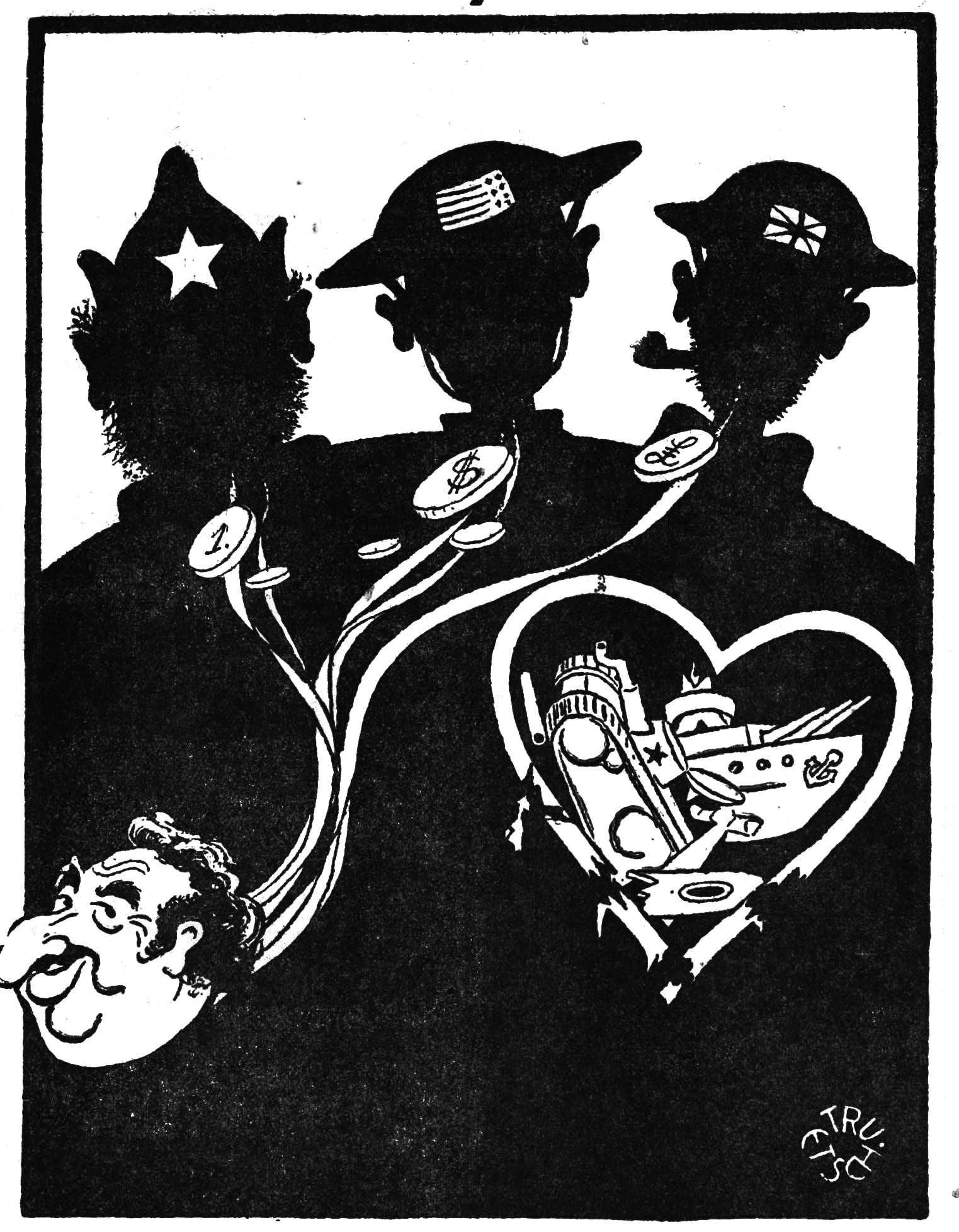
Moskau—Neuyork—London
Ein Herz und eine Seele
(Zeichnung: Kurt G. Truetsch)
Stockholm, 18. August
Nachdem das Hauptquartier MacArthurs, wie aus Melbourne gemeldet wird, eingestehen mußte, daß die japanischen Truppen nach der Einnahme von Kokoda, in ständigen Kämpfen vorrückend, die letzte Sperre vor Port Moresby erreicht haben, überschattet die Angst um diesen dem australischen Festland gegenüberliegenden letzten Inselstützpunkt, der sich noch im Besitz der „Vereinigten Nationen“ befindet, die Trauer um die „enormen Verluste“, die als Ergebnis der Kämpfe auf den Salomoninseln bereits eingestanden worden sind.
Wird Japan jetzt zum Angriff auf Port Moresby übergehen? Nach Auffassung australischer Kreise könne es nicht mehr lange dauern, ehe die erste wirkliche Schlacht zwischen den Bodenstreitkräften auf Neuguinea beginne. Auf jeden Fall räumt man schon jetzt ein, daß man nur wenig gegen die Japaner ausrichten könne, da die Wirksamkeit der Flugzeuge durch den Umstand sehr behindert sei, daß die Operationen im Dschungeldickicht vor sich gehen.
Über die amerikanischen Operationen im Raume der Salomoninseln wird bekannt, daß sie völlig ins Stocken geraten sind. Auf den beiden kleinen Inseln Tulagi und Guadalcanar wird noch erbittert gekämpft, wobei die dort an Land gesetzten amerikanischen Marinefüsiliere hohe Verluste erleiden. Die japanische Marineluftwaffe hat das umliegende Seegebiet von feindlichen Schiffen gesäubert und verhindert jede Annäherung von amerikanischen Transportschiffen, die den ausgesetzten Landetruppen Nachschub heranbringen sollen. Die verzweifelte Lage der auf den beiden Inseln kämpfenden amerikanischen Truppen ähnelt stark den seinerzeitigen Kämpfen auf der Bataanhalbinsel, die bekanntlich mit der Kapitulation der US-Amerikaner endeten.
Aber auch die weiträumigen Operationen der japanischen U-Boote nagen empfindlich an den Nerven der australischen und USA-Strategen. Die wachsende Versenkungsziffer feindlichen Schiffsraums durch japanische U-Boote im Pazifik und im Indischen Ozean sind vernichtende Schläge für die Lebensadern des englischen Empire und der USA.
Wie aus amerikanischer Quelle verlautet, sollen überdies japanische U-Boote in geschlossenen Verbänden konzentrierte Angriffe auf die amerikanischen Seestreitkräfte bei den Alëuten unternommen haben. In Washingtoner Kreisen sei man sogar der Ansicht, daß diese Angriffe noch bedeutend zunehmen werden. Falls es den Japanern gelingen sollte, so wird hinzugefügt, Kiska als U-Boot-Stützpunkt zu benützen, so würde die Entfernung für die japanischen U-Boote um 2000 Meilen verringert werden.
dnb. Stockholm, 18. August
In einem amtlichen Bericht des USA-Marineministeriums über die Schlacht bei den Salomoninseln heißt es, „über den Umfang der amerikanischen Verluste kann gegenwärtig noch keine Erklärung abgegeben werden, weil solche Informationen für unsere Feinde von unschätzbarem Wert wären“. Reuter hat dagegen seinen Engländern schon etwas weitergehende Geständnisse gemacht und — wie wir gestern berichteten — mit unmißverständlichen Andeutungen auf die Prügel hingewiesen, die in erster Linie die amerikanischen Verbündeten erhalten haben.
Roosevelt hat sich also wiederum das sattsam bekannte Notrezept Churchills zu eigen gemacht, mit dem auch dieser seine Niederlagen seit langem bemäntelt. Der Sprecher des nordamerikanischen Marineministeriums bequemte sich allerdings vor Washingtoner Pressevertretern, die sich wahrscheinlich nicht nur mit Phrasen abspeisen lassen wollten, bereits zu dem Eingeständnis, daß die USA-Flotte in der Nacht zum 9. und 10. August „Verluste, und möglicherweise schwere Verluste“, erlitten habe. Wie „möglich“ diese Verluste sind, weiß die übrige Welt längst durch die stolzen Siegesmeldungen unseres japanischen Verbündeten.
Von Wolfgang Waubke
In einem Zeitpunkt, da Tschiangkaischeks China angeblich 10 Prozent jener an sich unzulänglichen Unterstützung erhält, die ihm früher über die Burmastraße zugegangen war, da Indien sich der Umwandlung in ein „Arsenal des Ostens“ widersetzt hat, da die UdSSR der für eine offensive Kriegführung wichtigsten Rohstoffe, Industriegebiete und Verkehrsadern beraubt wird, haben die Herren Stalin, Harriman und Churchill in Moskau über das abgegriffene Thema der gegenseitigen Hilfe konferiert. England und die USA vermögen an der Schwelle des vierten Kriegsjahres ihre eigenen Positionen an den Peripherien ihrer Reiche kaum zu halten. Sie sehen die Hunderte von Millionen Chinesen immobilisiert, die Hunderte von Millionen Inder in feindseliger Resistenz. die hundert Millionen der UdSSR in von Tag zu Tag hoffnungslosere Lage gedrängt, sie sehen sich kurz gesagt jenes ungeheuren Menschenarsenals beraubt, aus dem sie das Blut für ihren Sieg schöpfen wollten. Was konnten in einem solchen Zeitpunkt und in einer solchen Lage Churchill und Harriman Stalin bieten, was konnte Stalin von der Durchführbarkeit neuer Hilfszusagen überzeugen?
Die Verhandlungen in Moskau sind mit einem kurzen und wenig sagenden Kommuniqué abgeschlossen worden. Den Grad der Intimität zwischen Stalin, dem Milliardär Harriman und dem Herzogsproß und Millionär Churchill kann man vielleicht nicht daran ermessen, daß Stalin sich der Entgegennahme einer persönlichen Botschaft Roosevelts mehr als acht Tage entzogen und daß er den britischen Premier bei seiner Ankunft in Moskau nicht persönlich empfangen hat, sondern eher an der uns bekannten Wärme jener Beziehungen, die gegenwärtig zwischen Großbritannien und den USA bestehen. Denn wenn die beiden „westlichen Demokratien“ nach drei Jahren eines gemeinsam geplanten und geführten Krieges der vertrauensvollen und kameradschaftlichen Übereinstimmung ermangeln, wenn von ihnen materiell leicht mögliche Einigungen in wichtigen Fragen nicht erzielt werden können, wie schwer wird es den drei ungleichen Partnern in Moskau erst geworden sein, eine Konkordienformel selbst für Probleme zu finden, die wenigstens die Möglichkeit einer Lösung erkennen ließen, also bei für die gemeinsame Kriegführung sekundären Fragen?
Trotz aller britischen Beschwörungen an die Adresse der Yankees ist bis heute eine Poolung aller Hilfsquellen der beiden „westlichen Demokratien“ nicht durchgeführt worden und am 7. August reitet das führende Londoner Finanzblatt, die „Financial News“, neuerlich eine Attacke gegen die harthörigen Herren in Washington. Eine der durch den Krieg bewirkten grundsätzlichen Wandlungen sei die weitverbreitete Erkenntnis von der verhältnismäßig geringen Bedeutung des finanziellen im Vergleich mit dem wirtschaftlichen Faktor. Finanziell arme Länder wie Deutschland und Japan hätten finanziell reiche Länder in ihren kriegswirtschaftlichen Anstrengungen, weil überflügelt. In gewissen Kreisen werde die Auffassung vertreten, daß die Begrenzung der finanziellen Mittel die Ausdehnung der Erzeugung nicht behindern müsse. daß sie im Innern eines Landes praktisch nicht bestehe. Nun seien Bestrebungen zu bemerken, die Anwendung dieses Grundsatzes der „Neuen Wirtschaftslehre“ auch auf die internationalen Beziehungen auszudehnen. In der Praxis manifestiere sich die „Neue Wirtschaftslehre“ bereits in der Lend und Lease-Bill und in den verschiedenen Poolungsvereinbarungen. Und als Ergebnis dieser Abkommen sei die Theorie aufgestellt worden, daß unter dem Regime der „Neuen Wirtschaftslehre“ die Bedeutung des finanziellen Faktors sowohl in der nationalen wie in der internationalen Sphäre abgenommen habe. Die internationale wirtschaftliche Tätigkeit sei durch den finanziellen Faktor ebensowenig behindert wie die nationalwirtschaftliche Aktivität.
Die „Financial News“ bemerken ironisch, daß die radikalen Propheten der „Neuen Wirtschaftslehre“ mit Mitleid und Verachtung auf die rückständigen Leute herabsähen, die mit Sorge die Unzulänglichkeit der britischen Dollarquellen betrachteten. Die „progressive Schule“ beschuldige jene, die sich um die Auffüllung der erschöpften Gold- und Devisenreserven Englands bemühten, der äußersten Unkenntnis der Weltentwicklung. Auf solche Leute würde in der gleichen Weise herabgesehen wie auf jene falschen Propheten, die geglaubt hatten, Deutschlands Wiederaufrüstung sei mangels Gold und Devisen zum Scheitern verurteilt.
Es gebe jedoch einen fundamentalen Unterschied zwischen der nationalen und internationalen Anwendung der „Neuen Wirtschaftslehre“. Jedes Land könne „aus dem Blauen“ zusätzliche Finanzquellen zur Deckung innerer Bedürfnisse schaffen. Kein Land sei jedoch fähig, aus dem Blauen Devisen zu produzieren. England sei in der Lage, Milliarden Pfund Sterling zu schaffen. Die USA könnten Milliarden Dollars produzieren, was sie ja auch ausgiebig tun. Aber England sei nicht in der Lage, Dollars zusätzlich zu dem Ertrag aus den elend geschmolzenen Exporten zu erhalten, wenn die USA ihm nicht diese Dollar gäben. Und die tun das nicht. Es sei daher äußerst trügerisch, anzunehmen, daß die Doktrinen der „Neuen Wirtschaftslehre“ gleichermaßen auf die Binnen- wie die Außenwirtschaften angewendet werden könnten, meinen die „Financial News“. „Das wäre der Fall, wenn die alliierten Regierungen der Poolung ihrer Hilfsquellen ohne Reserve zugestimmt hätten. Während des frühesten Stadiums des Krieges machte die Zusammenarbeit zwischen diesem Land und Frankreich in Richtung auf dies Ziel gute Fortschritte. Unglücklicherweise hat sich die Zusammenarbeit zwischen England und den USA noch nicht jenem Stand genähert, den die britisch-französische wirtschaftliche und finanzielle Zusammenarbeit im Frühjahr 1940 erreicht hatte. Trotz der wiederholten allgemeinen Feststellungen über Poolung und Zusammenarbeit dauert das hartnäckige Handeln an.“
Trotzdem also die Briten den Yankees immer wieder versichern‚ daß ihr Mangel an Dollareinnahmen ihre Kriegsanstrengung behindere, daß eine Poolung auch der finanziellen Hilfsquellen dringend notwendig sei, um England außerhalb des Lend and Lease-Gesetzes die Finanzierung kriegsnotwendiger Ankäufe ungehemmt zu ermöglichen, trotzdem die Unterhändler der „Alliierten“ die gleiche Sprache sprechen, am gleichen Tau ziehen und der gleichen hochkapitalistischen Welt und auch der gleichen gesellschaftlichen Klasse angehören, können sie zu keiner Verständigung gelangen. Das „hartnäckige Handeln“ dauert an, teilen uns die „Financial News“ mit. Wie mag das erst in Moskau gewesen sein, wo auch über Lend and Lease und die Finanzierung der Lieferungen an die UdSSR. Gesprochen worden ist? Gar nicht auszudenken ist der Hitzegrad der freundschaftlichen Vertrauensseligkeit zwischen Harriman und Stalin, zwischen Churchill und Molotow.
U.S. Navy Department (August 19, 1942)
NORTH PACIFIC AREA – A U.S. submarine has reported the sinking of a Japanese cruiser or destroyer in the western Aleutian area. Conditions made impossible an exact identification of the type of ship.
This sinking has not been announced in any previous Navy Department communique.
The Evening Star (August 19, 1942)
Nazi battery and ammunition dump destroyed; London denies second-front aim
Commandos strike at Dieppe
British Commandos (black arrow) stormed the German-occupied French coast at Dieppe early today and the attack apparently was continuing. Germans, who said their forces (white arrow) were applying countermeasures “according to plan,” reported Commandos were using tanks and air units. (AP Wirephoto)
LONDON (AP) – United States troops landed in France early today with tanks and heavy weapons, and more than nine hours later they and their Canadian, British and Fighting French Allies still were waging ferocious battle with the Germans around Dieppe in the greatest Commando assault of the war.
Overhead the United States Army Air Forces, the RAF and the Royal Canadian Air Force maintained a constant thick umbrella of bombing and fighting planes against bitter German aerial opposition. Indications were that more than 1,000 Allied planes were participating.
Escorted by British and Canadian fighters, two squadrons of the United States Army Air Force’s big Flying Fortresses smashed at one base of Nazi aerial resistance in a high-level bombing of a German fighter station at Abbeville, 38 miles northeast of Dieppe, setting buildings afire and smashing runways.
From dawn on through late afternoon the constant shuddering roar of heavy explosions denoting the battle’s continuance shook buildings on the English side of the Channel.
Although the British repeatedly asserted the action was a Commando raid and not an invasion, the strength and continuing nature of the assault suggested that it was developing into a major operation with unpredictable possibilities.
Even as the battle thundered on, first units of the Commando force who had speedily accomplished their mission, returned to a British port in gay spirits.
Force is mostly Canadian
Canadians made up the majority of the strong forces that drove across the Channel to Dieppe, 50-odd miles from Beachy Head, the nearest point in England, and 100 miles from Paris.
Announcements from the United States Army and Allied combined operations headquarters disclosed that the Americans, British special service troops and the Fighting French all were in action.
The Americans, specially chosen from a host of volunteers as the first American fighting men to set foot on the continent of an embattled Europe since 1917, proudly wore the title “Rangers” – after the famous Rogers’ Rangers whose bold exploits made history in the French and Indian War of American Colonial days 180 years ago.
Nazi battery destroyed
First-announced fruits of the raid were destruction of a six-gun German battery and an ammunition dump by troops who landed on the right flank, accomplished their mission and were re-embarked by the British Navy, which ferried all the forces across to France.
On the left flank the Canadians first were repulsed by strong German opposition, but bounded back to carry the beach by assault while their comrades were pushing tanks ashore in the center for the main thrust, which a noon announcement said still was continuing.
The landings were accomplished at every point selected in advance in a carefully-planned, closely secret operation that American officers of all services helped to arrange.
Second front ardor cools
Eagerness to call this a second front, a real invasion, was cooled by repeated BBC broadcasts stressing the “limited and temporary” character of the action and declaring “it had nothing to do with military decisions which have been taken in Moscow recently.”
The Germans, however, made no attempt to belittle the scope of the assault, and claimed they had thrown even their naval forces into the bitter conflict.
For the Canadians, thirsting for a fight for months or years, it was the first real action against the enemy.
For the Fighting French, whose Commando organization was disclosed only on Bastille Day last July 14, it was the first time they have set foot on the soil of their native land since the German conquest of 1940.
Observers on the British shore said there were more aircraft than ever before seen and heard over the Channel, as bombers and fighters shuttled across to assault or reload. Indicating the size of the present operation, it was recalled on at least one previous occasion 1,000 fighters participated in a sweep across the Channel.
The raid, first announced at 6:45 a.m. (1:45 a.m. EWT), was still continuing at noon when issued.
After that, as the mists burned away and a fine, fair day developed, persons on the British shore still could hear the heartening sounds of offensive battle.
Informed quarters captioned, however, that for all the broad participation of troops, tanks, naval guns and planes, the raiding forces would be withdrawn when they had achieved their objectives. This was not a second front.
Their objectives obviously were extensive, since it was the first time landing parties have used tanks.
The objectives appeared to be these: To test the enemy’s defense organization and to test the Allied plans for landing and the RAF ability to cover a big landing force.
Additionally, it was bound to disclose disposition of German troops and equipment in the cross-channel area that once was a vacation resort but now is a nest of Nazi fortifications.
The British radio urgently warned the French public that the raid – strongest of the numerous Commando smashes up and down the coasts of Nazi-ruled Europe since March, 1941 – was not an invasion.
The French were cautioned not to rise in support of the Allies until they should be given the word, lest there be a repetition of the tragic St. Nazaire battle, in which French patriots battled the Nazis for days after British Commandos had withdrawn and drew stern reprisals from the Germans.
Reuters reported that the Paris radio had been off the air since 8:12 a.m., which it said was extremely unusual.
United States officers, it was announced, are “serving as planners and advisers alongside officers of the British Navy, Army and Royal Air Force” on the staff of Lord Louis Mountbatten, supreme chief of the Commandos.
These American officers include:
Brig. Gen. L. K. Truscott Jr., Army, of Charlottesville, Va.; Cmdr. E. B. Strauss, Navy, of Washington, D.C.; Lt. Col. H. D. Campbell, Marines, of Vermont; Lt. Col. Loren B. Hillsinger, Army Air Forces; Maj. T. J. Conway, Army, of San Francisco; Maj. P. M. Hamilton, Army Air Forces, of New York; Maj. J. D. Lawrence, Army, of Los Angeles; Capt. G. W. Embury, Army, of Milwaukee, and Lt. Douglas Fairbanks, Navy, of Los Angeles.
Within fighter range
Dieppe is regarded by British observers as one of the points along the 700 miles of German-occupied coastline from Holland to Brest where a landing might be attempted in the opening of a second front.
It is within easy range of fighter aircraft based in Great Britain, but its small harbor has unloading facilities only for small ships and these facilities are not considered adequate for a swift landing of vast quantities of weapons and supplies such as would be required for a big base for a land offensive.
Dieppe was busy with Channel passenger and freight traffic in peacetime, cross-Channel boats running to Newhaven, England, 80 miles away.
The Germans have set up long-range coastal batteries there to harass Channel shipping. The city is only 33 miles from Rouen, where U.S. Flying Fortresses attacked the railway yards Monday.
Gives Nazis jittery morning
Following closely on the visit of Prime Minister Churchill to Moscow, the raid undoubtedly gave the German forces in occupied territory a jittery morning of invasion fears.
The BBC warning to the French could not be accepted at face value by the Germans and, whatever the raid’s outcome, observers here felt the Nazis might consider it at least a prelude to the opening of a second
front.
Today’s raid was the first announced by the British since the landing in the Boulogne-Le Touquet area June 4 to test the German defenses there. The Commandos completed their work in an hour on that occasion.
Several transports sunk or fired in Channel, Berlin declares
BERLIN (From German Broadcasts) (AP) – British Commando forces launched an attack on a broad front with tanks and heavy air support in the region of Dieppe on the French Channel early today and hundreds of the attacking Commandos already have been killed, DNB said.
The attack was “on a larger scale than previous landings and exceeds the usual proportions of so-called British Commando operations,” the Germans said.
DNB reported that several transport ships were sunk or set afire before they reached the coast.
At 5:30 p.m. (11:30 a.m. EWT), DNB broadcast this dispatch:
“The German counterattack against the British troops which landed at Dieppe is taking a successful course. Advancing German troops repelled the enemy and hourly increased the British losses in men and material. A number of prisoners already have fallen into German hands.”
The British attack was aimed at the town and harbor of Dieppe and developed on both sides of the town, it reported.
The broadcast several hours after the start of the raid said “whether there are still British troops in the town or harbor of Dieppe or whether they now are only on both sides of the town along the coast could not be ascertained here at this moment.”
It added that “in previous cases German reports never mentioned that British armored fighting vehicles had been landed.”
German artillery destroyed several of the British tanks, the German news agency said.
Nazi countermeasures were “being applied according to plan,” it added.
Casualties heavy on both sides in 9-hour battle
LONDON (AP) – Allied Commandos with tanks stormed through the German defenses of Dieppe on the shores of Northern France today in the first major attack on the continent by American, Canadian, British and Fighting French, and re-embarked this evening after nine hours of the fiercest sort of fighting.
The Allies were understood to have achieved all the principal objectives of the assault with clock-like precision.
Losses on both sides probably were heavy, a communique said tonight, but the attacking forces destroyed German shore artillery and anti-aircraft batteries, a radio location station and an ammunition dump, among other objectives.
Eighty-two German planes were destroyed and more than 100 probably destroyed or damaged as approximately 1,000 Allied planes, forming probably the greatest protective aerial canopy ever used, fought off the German air force. A total of 95 Allied planes were lost.
Some tanks lost ashore
Some Allied tanks, landed for the first time from new British tank-landing vessels, were lost ashore; others were, apparently, brought back home.
The German news agency DNB asserted that the landing attempt had ended in a debacle and that since this afternoon there was “not a single armed British, American or Canadian left on the European continent.”
DNB asserted that more than 1,000 prisoners had been taken and that Allied losses in men and material were “very high.” This is a standard Nazi claim.
DNB also said German coastal artillery participated in the Dieppe fighting and sank numerous British landing boats and that several transports turned back to sea without having accomplished their tasks.
Despite the unprecedented scope of the attack, the British repeatedly announced during the day the action was not an invasion intended to create a front in Western Europe but was only a raid.
Test suggested
The constant procession of hundreds of planes from British frontline airdromes to the battle zone suggested that, at the least, the great assault might be a test to determine whether such an aerial “big-top” could positively protect a true invasion force all day long.
The planes shuttled to the attack and back for reloading and refueling so quickly that the scene at British airdromes recalled the Battle of Britain in the fall of 1940.
Starting at dawn, there never was a break in the procession.
Despite the great concentration of planes, it was reported reliably that no parachutists were used.
The Americans, carefully chosen volunteers called the Rangers, were the first American fighting men to set foot on German-controlled soil in this war and the first to go into action in Europe since 1918.
Text of communique
The text of tonight’s communique:
“Despite the clear statement in our first communique at 6 o’clock this morning and broadcast to the French at 6:15 about the raid on Dieppe, German propaganda, unable to make other capital out of the turn the operation has taken, is claiming the raid was an invasion attempt which they have frustrated.
“In point of fact, re-embarkation of the main forces engaged was begun six minutes after the time scheduled and has been completed nine hours after the initial landing, as planned.
“Some tanks have been lost during action ashore, and reports show that fighting has been very fierce and casualties are likely to have been heavy on both sides.
“A full report will not be available until our forces are back in England.
“In addition to destruction of a six-gun battery and ammunition dump reported in our earlier communique, a radio location station and a flak (anti-aircraft) battery, were destroyed.
Vital experience gained
“Apart from losses inflicted on the enemy, vital experience has been gained in the employment of substantial numbers of troops in an assault and in transportation, and use of heavy equipment during combined operations.
“Our new tank landing craft were in action today for the first time.
“There was intense activity by aircraft of all operational commands of the RAF in support of the landing of our troops against heavy enemy defenses, and air fighting on a most intense scale also developed.
“From reports so far received 82 enemy aircraft are Known to have been destroyed in addition to a number shot down by naval vessels. More than 100 enemy aircraft also were probably destroyed or damaged.
“Ninety-five of our aircraft of all commands are missing, but 21 fighter pilots are known to be safe, and it is hoped that others will prove to have been rescued.”
VICHY (AP) – A source in close touch with Vichy government opinion urged tonight that the French remain “vigilant and cool-headed” in their attitude toward the British and American landing in the Dieppe region.
The Commando raid was described as a “setback” for the British and Americans.
“The British undertaking – obviously improvised in haste – has been translated into severe losses and has resulted in a setback,” this source said. It was asserted that the landing was “an indication that the position of the Soviets is desperate and that Stalin had demanded immediate action.”
Country at ‘gates of war,’ Rio official says
RIO DE JANEIRO (AP) – A U.S. pilot bombed and sank one of the Axis submarines lurking off the Brazilian coast after the sinking of five Brazilian ships brought this biggest South American republic to the “gates of war,” an official announced today.
All Brazilian soldiers on leave were recalled urgently to duty and the navy forbade furloughs for regular reserves.
First official word of the Axis sub sinking came from Cmdr. Ernani A. A. Amaral Peixoto, federal liaison officer of the State of Rio de Janeiro, who told a crowd gathered before the presidential palace that one of the undersea raiders had been destroyed.
Government press department and other accounts in Brazilian newspapers gave this version of the attack:
The submarine was sighted 50 miles off Brazil’s coast by a U.S. plane piloted by Capt. Jack Lacey. The plane dived, machine-gunning the submarine and forcing it to the surface with bombs when it attempted to submerge.
Bomb hit finishes craft
The Diario Carioca, quoting authorized sources, said the submarine apparently was damaged in this first attack. The U.S. plane dived again, this time finishing the submarine with direct bomb hits.
At me same time, radio reports purportedly from British Guiana were heard here saying RAF planes, based on that British South American territory, attacked a second submarine off the Northeast Coast of South America yesterday, and sighted a third.
These developments came as renewed anti-Axis demonstrations flared in the streets of principal cities throughout the country. Brazil’s course could not yet be foretold.
Meanwhile, a naval spokesman said an Axis surface raider prowling the South Atlantic had been sighted near the Brazilian island of Trindade, 1,000 miles off the coast, several days ago. (Presence of a surface raider in the South Atlantic was confirmed by the U.S. Navy today.)
Call for revenge
Throughout the country, in fervent demonstrations, Brazilians called on the government to avenge the affront to Brazil’s honor and the apparent loss of several hundred lives, including those of women and children, in the recent wave of ship losses.
Lt. Col. Joao Pinto Pacca, speaking for War Minister Gen. Eurico Gaspar Dutra, told one crowd here that the country was at the “gates of war” and the army was “ready to obey the order of the chiefs who direct this nation.”
Demonstrations against the Axis mounted so dangerously that the police here ordered all bars and cafes closed at 9 p.m. daily and advised residents to be in their homes by 10 p.m.
Official announcements showed only 185 persons known to be saved of the 836 listed as being aboard the five vessels which were sunk. There was a report, however, that several lifeboats with survivors had landed on an isolated beach.
Both President Getulio Vargas and Foreign Minister Oswaldo Aranha violently denounced Axis “piracy” and gave hints that strong measures would be adopted.
“I can assure Brazilians that, forced by the brutality of aggression, we will offer a reaction which will serve as an example to peoples who seek to destroy contemporary civilization,” Aranha said.
Newspapers unanimously echoed the popular cry for revenge. Radio stations scrapped light programs for martial music and almost continuous news announcements. Rio de Janeiro’s three gay casinos closed last night in memory of the dead.
Army men, angered by the loss of a number of the 153 soldiers on one of the ships, participated in many of the demonstrations. In the city of Juiz de Fora about 100 alleged Axis sympathizers were arrested.
The German and Italian ambassadors and some other Axis diplomats still were in the city, two days after their exchange ship had been scheduled to sail. The sailing was canceled, apparently because of the U-boat attacks.
The new Chilean ambassador to Brazil told a crowd that “Chile stands in solidarity with Brazil and condemns the barbarous aggression Brazil has suffered.”
15 of crew killed, 20 more taken prisoner; British craft sunk
By the Associated Press
First confirmation of reports that a German surface raider was loose in the South Atlantic came today when the Navy released the stories of survivors of a medium-sized U.S. merchant vessel.
Sinking of a small British ship off the northern coast of South America by a submarine identified by survivors as Italian also was announced by the Navy today.
Survivors of the American ship said at an Atlantic port that the German raider, obscured by the darkness, appeared to be a five-hatch cargo ship.
Maritime men in New York said this was the average number of hatches, or deck openings to the cargo hold, for about a 7,000-ton gross ship.
The second officer of the American ship, who said at least 15 of his crewmates were killed by shells or machine-gun fire, said about 20 other men were made prisoner. He said the ship was probably steam-powered and left the scene at about 20 knots.
The captain, who like the second officer is a naturalized German-American, said he believed that the raider had at least six guns and that some of her armament was of eight-inch caliber. He estimated the ship at 8,000 to 9,000 tons and suggested that it launched motor torpedo boats equipped with machine guns to make a simultaneous attack on the freighter from three points.
Survivors said that in addition to 10 salvos from the raider’s guns, their ship also took three and possibly four torpedoes before it went down.
The attack took place in mid-July off the West Coast of Africa.
Sinking of the small British merchant vessel off South America, brought the Associated Press tabulation of announced sinkings in the Western Atlantic to 436. The ship sunk by the raider was not included in the tabulation since the attack took place In the Eastern Atlantic.
HILO, Hawaii (AP) – The case against Sanji Abe, territorial senator charged with illegal possession of a Japanese flag, was dismissed yesterday on grounds that the alleged offense had not been defined at the time of his arrest August 2. General military orders under which possession of an enemy flag is unlawful were issued August 8.
Abe, of Japanese ancestry, was elected to the Hawaiian Senate in 1940 and gave up his dual citizenship the same month. Born in the Hawaiian Islands in 1895, he had served two years with the Hilo police.
Abe said the flag was found among some stage property at a theater of which he was part owner.
London, England (UP) –
American Flying Fortresses today carried out a successful precision bombing attack on the key Nazi air base on Northern France at Abbeville in an air maneuver designed to support the Commandos fighting at Dieppe.
Two squadrons of the huge high-altitude American planes roared over the Abbeville airdrome which is known to American Eagle and RAF pilots as a “hornet’s nest” of crack Nazi planes and pilots.
In good visibility, the Americans employed their famed bombsights to lay numerous hits on runways, buildings and aircraft dispersal areas. Protecting the U.S. planes were British and Canadian fighter squadrons.
All the attacking bombers returned safely.
Abbeville is abut 35 miles from Dieppe and is known to be a key point in the entire Nazi defense system for France and the Low Countries.
RAF men regarded it as one of the most dangerous Luftwaffe bases which they have to deal with.
Chungking, China (UP) –
Chinese forces have recaptured the walled city and port of Wenchow on China’s east coast, only 600 airline miles from Japan, a Chinese communiqué said today.
The communiqué said the city of about 100,000 people was taken by storm last Saturday.
Wenchow lies 250 miles south of Shanghai and about 600 miles southeast of Japan’s home islands.
Stimson to take over, run Boston company violating WLB edict
…
Torpedo boats aid in the South Atlantic – wounded Boro men among survivors
…