Publicity spotlight turned on gas cards
…
50,000 artillerymen trained at Fort Bragg in year to take their places in combat forces
By Marshall McNeil
…
They will be called upon to drain dregs from cup of bitterness
By William Philip Simms, Scripps-Howard foreign editor
…
Americans were giving it away, upsetting market before they found out they could sell it
By George Weller
…
Production this year to meet only fraction of America’s needs
By Allen Haden
…
Allied aviators continue enemy base raids
By Don Caswell, United Press staff writer
…
By Ralph Heinzen, United Press staff writer
…
Abandoned trees retapped while millions of new plants are being set out
…
Anyway, opinion is that Sal’s some gal
By Paul Harrison
…
By Florence Fisher Parry
Katharine Hepburn, our last week’s visitor (and the most provocative one we have had in many moons!) has probably had more bad habits to get over than any actress we have ever seen. I am not referring to the bad habits of her private life. Private lives are not my business or concern when I go to the theater to pronounce upon an actor’s acting. (Except, of course, as his private life affects, discernibly, his acting). So long as no harmful evidence of it is to be observed upon the stage, it is a negligible thing, not to be considered.
The likelihood is, however, that some traces of one’s private temperament and conduct CAN be discovered in a stage performance. No artist can possess an art greater than his own potentialities AS A PERSON. The flaw is bound to show up.
This being so, it is reasonable for us to assume that Katharine Hepburn is a most extraordinarily interesting PERSON, given to the same sudden gusts of charm and faultiness as are noted in her versatile performances on the stage.
It is generally conceded that she provides the best “copy” for her publicity staff that can be found in the Private Lives of all our Thespians. And it is reasonable to suspect that, knowing this, the young lady has obliged. All the vagaries of her perverse behavior off stage have been turned into SPACE, in newspaper and magazine.
Even her snubbing of her Home Town Folks on a recent engagement in Hartford, Connecticut, got for her a full page in a current issue of “Life.” If ever it paid to be snooty, it has paid our Katharine; and Shakespeare himself might have been tempted to take a few tips from her, in his delineation of Petruchio’s woman.

Personally, I like her. I don’t know the girl, and in this respect share the impoverishment of most other women; for there are few who rate her confidence, even her recognition. But there is a thoroughbred quality about her, even though she were to behave like a fishwife, that sets her apart.
She does everything, and by everything I mean Everything, with a fine Patrician scorn of the consequences that would do credit to our most historic ladies. In this Free Soul attitude (yes I dare say it IS an attitude; actresses can’t help it) she reminds me of Tallulah Bankhead. They are entirely different creatures, heaven knows; Katie’s meat would be Talluo’s poison; but neither of these gals has compromised with Mother Grundy or Main Street. Take me or leave me, preferably leave me, is their attitude toward their fellow sisters. They both are smart enough and gifted enough to make the grade alone without benefit of… shall I say, clergy?
There is another basis for this similarity. In each of these women there resides a deep core of integrity toward themselves, their art and their OWN FOLKS. They’re true to some personal code which they have set up, which others might have trouble in deciphering, but which to them is as inexorable as Moses’ commandments.
And I believe that upon comparison of these two secret codes, they would be found to be strangely identical. Both girls bear toward the theater an almost religious devotion. They may treat life with a certain loose scorn, but when it comes to their WORK, it gets their all!
Like all true sensitives, both girls fall easily into regrettable habits which need only a sharp word from a trusted one to cure.
I’ll never forget the terrible exhibition she gave here a couple of years ago when she appeared in “Jane Eyre.” She behaved like nothing human, both on and off the stage. She was completely off the track; her acting was a caricature of all the mannerisms ever affected by a spoiled star. That was when she was going through the phase of willing autograph-giving and Publicity Seeking. She was Sweetness and Light to the world,
Happily, she recovered. Now she has matured to the point where it is more important for her to give a good performance in Hartford, Conn., than to win the love of her neighbors there.
As for the play in which Miss Hepburn displayed her willful gifts, Philip Barry may have written far defter and more important comedies, but never one so easy to take. “Without Love” has grace and easy humor; its characters, never quite believable, speak dialogue never quite believable but nevertheless far more fetching than real discourse ever is.
Perhaps never did a playwright hang the gossamer of his fancy upon so frail a peg as the structural “plot” of a young couple attempting marriage without benefit of bed. But partly due to the adroit casting, skillful acting and artful setting, “Without Love” seemed far more substantial than indeed it was.
I liked young Nugent in the role of Katy’s husband. His careful technique of understatement never has been so suitably employed. And I for one do pray that he wail not be replaced, as has been bruited noisily, by that persistent lover of the screen, Spencer Tracy.
Now I am fond of Mr. Tracy as a movie actor of certain physical persuasions; but I must confess to a growing ennui over his persistent assumption of Lover Roles. Mr. Tracy has taken on weight and years, an inevitable penalty which overtakes the Lotus Eaters, whether they be in Hollywood or Washington. His ROMANTIC assets are diminishing. Other sterling actors from Lewis Stone on down through John Barrymore and Warmer Baxter have had to relinquish the pleasant role of playing lover to some slender Diana years their junior.
Besides, Mr. Tracy is the type of male who could not be credited with taking on a marriage-in-name-only!
No, on careful thought, Mr. Tracy should be restrained from pairing with Katie in “Without Love.” With Love, yes. But not WITHOUT.
In the interest of public credulity I hold out for Mr. Nugent. He is a man who looks as though he could be trusted to Bide His Time.
By Maxine Garrison
Eve Woodburn, who writes confession stories for the magazines which specialize in the “why girls leave home” stuff, has made a confession on her own part.
Says she finds much of her material in bars. Four good drinks and the average gal in a bar will tell all, according to Miss Woodburn. Better than research, as a matter of fact.
Let that be a warning to any young woman who, while reminiscing over a swizzle stick in her favorite bistro, feels the urge to tell the story of her life.
That sympathetic ear may belong to a soap opera dramatist in need of a good sobby scene, to a confessions scribbler with a deadline two days away, to almost anybody but a sympathetic person.
The funny thing is that said young woman will tell her story to a perfect stranger when she wouldn’t dream of mentioning it to her best friend, certainly not to her family.
Protective deafness
Bartenders should make the best novelists and psychologists in the world. They hear the stuff of life, the bare facts, the honest truth all the time they’re on duty. The reason they don’t become novelists and psychologists is probably that they develop a protective deafness.
The same tendency to confide in strangers holds for love-lorn columnists, psychoanalysts, fortune-tellers, “counselors” of all sorts – almost anyone who is willing to listen.
A girl won’t ask her mother for help with a boy problem – but she’ll write the whole story to the advice-giver on the woman’s page.
A man wouldn’t tell his closest pal that he’s been fighting a feeling of guilt ever since he robbed a penny bank when he was 12, but he’ll tell the psychologist across the desk.
A woman won’t tell her dearest friend that the cause of her continued distractedness is a secret yen for a guy who isn’t her husband, but she’ll tell the sloe-eyed “gypst” who’s reading her teacup.
Aired in public
A husband and wife may never tell each other their real reasons for quarreling unless they are corralled in the chambers of an organizations such as the Los Angeles Institute of Family Relations. There, before perfect strangers, the whole truth comes out for the first time, and the chances are that a reconciliation may be effected.
Perhaps the tendency is all to the good. When you confide in a stranger, he can, and usually does, let the story pass in one ear and out the other. He may or may not be able to help you. But he doesn’t lose any sleep over it.
Secrets told to someone close to you may relieve your mind only to burden his with extra worries. Verbal honesty may not be the best policy when used merely to ease one mind and torture another.
Unbossed, unregimented pal of former Vice President John Garner opens fire on New Deal
By Harry Hansen
If a Democrat picks up “The Autography of a Durable Sinner” and it explodes in his hands, he will know that the author is a Texan, a drinking pal of John Garner of Uvalde, and as unbossed, unregimented and unreconstructed as the former vice president.
His name is Owen P. White, and if he isn’t writing articles these days for a certain national weekly it is because he couldn’t make a truce with “an administration that was dragging the United States head-on to ruin.”
Born in El Paso in 1878, White had the good luck to run into enough gunmen and card sharpers in his youth to stock his mind with stories that he turned to good account in 20 years of magazine writing. What with hold-up men, diamond thieves and train robbers operating all around, he caught the spirit of Texas independence and remained “exactly like a 12-year-old outlaw horse on the range,” unfit for saddle or harness.
He challenged hypocrisy, says the publisher (Putnam), but he never lost “his high-spirited enthusiasm for sin.” Sin makes good reading when properly chaperoned.
The book also has a certain political interest. When John Garner said, “Come on, let’s go back to the kitchen and take a drink,” he had unfolded to White the full story of his controversy with President Roosevelt and the New Deal.
It’s a footnote to history that Garner didn’t turn against his chief until the President threatened to purge the senators who objected to the court packing plan. Then Garner and his associates went to town. And what they accomplished is on the record.
Book in two parts
Thus there are two parts to this book: the first is western, dealing with the free Iife of Texas before it was cleaned up, and with Mexico while the Madero revolution was in the making; the second is New York journalism, with White getting hotter at the abuse of the American way of life by the New Deal, seeing in the supporters of the administration only voters eager to continue the receipt of handouts.
The American way, says White, is the way of hard work and economy, and its objectives are individual opportunity along with freedom from dictation and regimentation. He thinks many Americans, including time-serving politicians, have forgotten that.
The first part of this confession, describing a remarkable Texan boyhood and youth, ought to make every native of Brooklyn and the Bronx envious of White’s good fortune. At 13 he was working in an El Paso jewelry store, where women bought huge diamond bracelets and male sinners furtively picked out be-jeweled garters for their women friends. Shick gamblers alternated between diamond stealing and blackmail, and robbers blew open the safe. From this beginning White graduated to a bank. That gave him more light on how people made their money.
Then he had a Mexican experience and got wind of the Madero revolution. Here lovely women swam into his ken, and “the most beautiful woman in the republic and the most accomplished” became his particular friend.
Lest this be misunderstood, let me add that this was one of those idealistic friendships that glow in retrospect. The lady was married, but insisted on moving with her menage to an apartment in White’s house. They had one of those friendships that men often describe but never get anybody to believe.
Wrote for magazines
When White tells how he began writing for New York magazines he draws some vivid portraits of the young, energetic editors that many will recognize. William Chenery agreed to print his first stories about western gunmen, and Charles Colebaugh hurried to get his name on the dotted line to shut out competitors.
Colebaugh reminds him “of Shakespeare’s school boy, with his satchel and his shining morning face, but there the resemblance ceases, rapidly.” Chenery is “capable, courageous and energetic” on one page and “dignified, cautious and intellectual” on another.
White now joins that fairly large family of outspoken journalists who have turned on their old employers and told all. Of recent memory is James W. Barrett’s blast at the Pulitzers, Emile Gauvreau’s repudiation of the tabloid system that he
He wrote an article about San Antonio’s political mess just in time for a city election, with the result that he was indicted for criminal libel by the Grand Jury of Bexar County, Texas.
His editorial associates were “chuckling inwardly”; he had mixed with his fellow Longhorns and would take an awful beating. The lawyers said they couldn’t do a thing. White called on Vice President Garner, who berated him for coming to him for a favor. But a few weeks later the indictment was dismissed. It pays to have a friend deep in the heart of Texas.
‘Underground Europe’ tells about conquered people
“Underground Europe” (Dial Press) by Curt Riess seems to be one of the most exciting of the recent books on conditions in Europe. This may be because of wishful thinking, but it is undeniable that everyone in America is interested in what plans are being put into action against the Nazi heel in the conquered countries.
This book tells all possible about sabotage by the little people. Each country is discussed in turn: Czechoslovakia, France, Holland, Belgium, Norway, Yugoslavia – and even Italy and Germany.
The Chetniks in the Yugoslavic mountains, who were famous in World War I, and the Czechoslovakian underground that functioned during occupation by other countries, are very much in action now, when men’s souls count more than their bodies. For every man who is tortured and killed for sabotage there are other natives who are willing and anxious to carry on the work.
Kept in touch with their own government through the British Broadcasting System, they know what is going on in the war and they are doing their best to undermine the production that keeps war going. Each individual country has its own story, and each country has worked out its underground system to suit its own people and terrain.
Mr. Riess has carried the story up to December 1941 – it is to be hoped that infinitely more has been done since then. According to his book, an excellent start had been made.
The Pittsburgh Press (May 18, 1942)
Retailers post ‘ceilings’ on virtually all commodities
…
New London, Connecticut –
Eight months ahead of schedule, the submarine Gunnel was launched yesterday at the Electric Boat Company shipyard in Groton.
Stowe travels Lend-Lease route from Persia to southern Russia and finds Reds ‘nurse’ trucks as they rush supplies to troops
By Leland Stowe
Moscow, USSR –
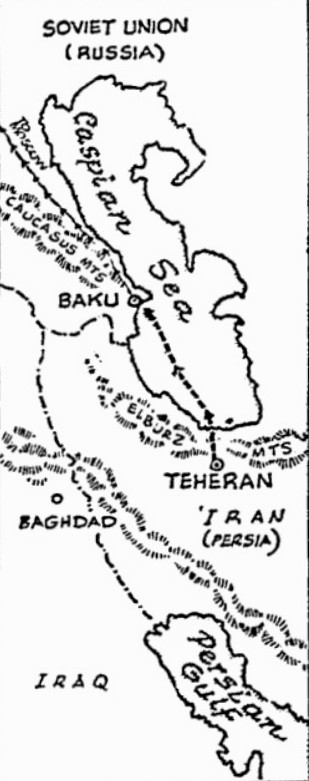
From Tehran, Iran, we traveled the Lend-Lease road by auto through the lofty passes of the Elburz Mountains down to the Caspian Sea, then by cargo boat to Baku.
All the way we journeyed with American war materials which were on the last leg of a long voyage to the Soviet Union’s mighty army. So, we saw our Lend-Lease tide rolling on, on and safely home.
Across Iran’s northern plateau, it is fairly fast going over the main dirt-road highway. The big trucks rumble up the tortuous passes between snow-capped giants of granite. Then they serpentine down through magnificent gorges whose rivers, swollen by spring floods, are torrents of boiling chocolate. We took the longer route through the lower passes because avalanches still make the sky-top route too dangerous.
Far better than Chinese
It is remarkable, though, how these Red Army drivers keep their convoys moving hour after hour regardless of backbreaking terrain and neck-twisting series of hairpin curves.
In places, this highway is as tough as China’s Burma Road, but Russian chauffeurs never waste a minute. They are driving against time.
Wonderfully efficient drivers, these Russians are. What records they could have hung up on the Burma Road! Unlike Chinese chauffeurs, they treat their motors with great respect. They pause frequently to water their radiators. Their cars are well-greased. As we passed one long convoy after another, I noticed how a dozen lorries held a single unbroken pace. I also observed that every Russian was his own machinic.
Never see wrecked truck
These people really know what maintenance means – no monkey business, no wasting of time or energy… We motored all day along with scores and scores of Russian-driven Lend-Lease trucks but we never encountered a single wrecked lorry, even on the meanest hairpins. There was not one stalled truck temporarily out of commission. Regardless of tough mountain gorges, everything keeps rolling.
Yes, these Russians mean business all right and they are as sweet a lot of smooth drivers as you ever saw. Those Boeing Boston planes, in their huge crates, are going to get where they are supposed to get, there is no doubt about that.
We are descending toward the Caspian now in late afternoon, and scores of UKCC camions are climbing back empty. They belong to the United Kingdom Commercial Corporation and the UKCC is the transit agency for Britain’s aid to Russia. Along with Soviet trucks, they are coming and going incessantly from one end of Iran to the other.
Picks four-leaf clovers
We round another curve and come out suddenly upon the shoulder of a great bluff. A mile below us, the river valley opens broadly between spruce-covered hills and it looks for all the world like a serene majestic vista in Oregon or Washington. We can see one Russian caravan and then another, miles ahead of us and below, winding steadily downward, ever downward. The Caspian and its ports are now almost within sight.
I step out upon a patch of clover. A good place for four-leaf clovers – the thought pops into my head. So, I walk over to a second patch and pick three four-leaf clovers as fast as my fingers can take them. I say:
Good luck for Russia.
So, the trucks roll on and on and the Lend-Lease road comes down to the sea. There is not one lorry smashed anywhere along the way. The Russian drivers have seen to that.
But there is more than luck about these Red Army drivers. They are doing a job, and the job is being done right. Unusual luck rides with those who earn it. A fine workmanlike job, bothers. Proud to know you! And that is why you enter Soviet Russia feeling that things are going right and that things are going to be all right