
Rambling Reporter
By Ernie Pyle
SCOTIA, Cal. – In these past few years of traveling and reporting, I have gone through factories, foundries, mills, canneries, shops, abattoirs, assembly plants and mines until I feel like a walking edition of the American Review of Industry. I’ve become so adept at looking without seeing that I can now spend three hours in a plant and not know whether I’ve been in a shrimp cannery or a steel mill.
And yet, being thus thoroughly satiated with factory-touring, I have just spent a whole day inside a mill and actually enjoyed it. This was the mill of the Pacific Lumber Co. – the biggest redwood lumber mill in the world, I believe.
It was only by special dispensation that I got through.
In previous years the mill was wide open to tourists. As many as 20,000 would flock through in a season, following route lines painted throughout the mill. And whenever a lumber man or a foreign visitor came through, he was given a special guide.
One of the officials who took me around said it made him as mad as a hornet to think what saps they’d been. “Just typical bighearted Americans,” he said. What he was referring to was the Nazi visitors they’d had on several occasions. They posed as lumber buyers from Hamburg, and were given the run of the place. They never did buy any lumber but they took lots of pictures and measurements.
So now, visitors are forbidden. That is, all except well-known spies like me.
One mill covers 500 acres
A lumber mill is really just an amplification of a backwoods sawmill, but what an amplification! The resemblance between the old sawmill and a modern lumber mill is about the same as that between a peg-legged man and Fred Astaire. They both can stand up.
This mill here, with all its auxiliary sheds and kilns and drying lots, covers around 500 acres. They’re building one new storage shed that takes a whole trainload of lumber just for its construction. More than 1000 men work in the mill, and 600 more out in the woods cutting down timber for it.
Redwood is the only timber in the world that has to be barked before it is sawed. The bark is so thick and pulpy that it just “cotton-mouths” in the saws. They have known bark on a big redwood tree to be 18 inches thick.
Until a few years ago, redwood logs were barked in the woods where they fell. It is done by men with sharp-pointed steel rods, who jab the rod deep into the bark, they pry down and peel it off. It is a hard, tedious and expensive process.
But now the logs are hauled in with the bark on, and they are barked (still by the hand method) right in the mill. The barking is much faster and cheaper, due to machinery for holding and turning the logs.
They find a use for bark
But the main point is that they now utilize the bark. They grind it into fine chaff and make insulating material out of it. You know the old slaughter-house gag about utilizing every bit of a pig, even the squeal. Well here they utilize every bit of a log, even the bark. (Be a better joke though if they were sawing up dogs).
And take the sawdust. That’s all used now too. They mold it into round logs about a foot long for use in fireplaces. They are called Prestologs. They’ve been doing it for several years, but I never heard of them till I came to California this time.
Other lumber companies do this too, with other kinds of wood. All my friends in San Francisco use Prestologs for their fireplaces. But they don’t use redwood, because you can’t buy them that far away. They can’t even make enough here to supply the demand a few score miles up and down the coast.
The machines that grind up the bark and all the waste pieces from the saws are called “hogs.” They are ghastly brutal machines. I’ve seen a tough green plank five feet long and a couple of inches thick slide into the mouth of one of these “hogs,” and you’d hear a heavy, vicious “bzzt” lasting only a fraction of a second, and the whole thing would be mere sawdust.
It has never happened here, but there have been cases of workmen falling into the hopper of a “hog.” That was the last ever seen of them. And there have been cases of men jumping into them to commit suicide.
Since we have supplied Japan with so much metal in the past, I suggest we now send over a few of these “hogs,” accompanied by written instructions on how and where to jump.
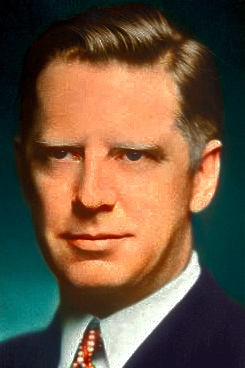
Fair Enough
By Westbrook Pegler
WASHINGTON – Now that the income tax has become a democratic institution, affecting some seven million new subjects in income brackets as low as $800 a year, the Treasury seriously hopes to banish from the public mind the concept of the taxpayer created by the cartoonists who picture him as a scrawny little man wearing nothing but a barrel and always in a hot fury over the waste of his tax money by public officers.
Our friends at the Treasury believe the new members of the lodge will be cager to pay their bit not only to buy the tools of war but to stand off inflation. This is the first time the Treasury has seemed to care what the income taxpayer thought about anything.
Always hitherto he was treated as a rich man who probably had stolen or inherited his money and the bureaucrats of the New Deal laughed at his futile complaints.
I remember an encounter with an ex-newspaperman who had been drafted into the long and extravagant war on poverty as an aid to Jim Farley for duties mostly political who said rather mockingly: “Why don’t you pay your income tax and quit squawking?”
I had paid my come tax and I was squawking because $6000 a year of the taxes paid by me and others was being paid to a relative of a prominent idealist for decorating embassies abroad; $6000 a year had been paid to Theodore (the Man) Bilbo, a stranded Mississippi politician, to clip and paste newspaper items in scrapbooks, and to keep him off the neck of Pat Harrison; $10,000 was being paid to Jimmy Roosevelt to act as one of his father’s secretaries and keep out of mischief.
Your phone book can prove it
And countless other high salaries were being paid to other personal and political friends and relatives of high personages as a sort of deluxe dole or handout or, not to fumble for a word, gravy. Everyone in Washington has personal knowledge of many such ill-disguised gifts of large salaries to individuals whose duties are only theoretical, nominal or unnecessary and the same generosity has now spread out over the country.
Look in the local phone book of any fairly large city under the heading “U.S. Government” and observe the growth of Government, part of which has been legitimate and natural but much of which represents nothing but political generosity and waste at the expense of the income taxpayer and those who had paid other taxes all along. A salary of $6000 or $10,000 a year is no mere nickel. It is thick money.
But, under the old scale of brackets, the income tax was a class tax and those who paid it were deemed lucky to have that much income and poor sports to ask what was done with the money. And anyone who asked too insistently and clamorously could expect a call from one of the detective-accountants of the internal revenue who would go over all his personal items and even demand an explanation of his spendings which were none of the Treasury’s business, as well as of his earnings.
They’ll be sensitive to graft
This is literal truth. The income taxpayers were a small and politically friendless minority and the Government itself created the figure in the barrel whom it is now desired to retire from the scene lest the new and much larger group of taxpayers come to regard the tax as a burden.
The Treasury people are correct in their belief that the new income taxpayers will be quite willing to pay the tax for war purposes. The old group has the same spirit and, with very few exceptions, has been willing all along to pay legitimate costs of Government including the expense of new departments honestly intended to ease the nation over the long panic.
But neither group will be happy to continue to support innumerable political press agents on better salaries than they ever were worth in private industry merely because they are politically right.
Neither group will willingly contribute money out of earnings and go through the vexation of making out returns so that useless, extravagant and ornate Government reports may be turned out in the form of bound books singing the praises of this or that Cabinet member.
And nobody will be more sensitive to waste or graft than those new taxpayers, hitherto exempt, who gladly shower down, say $25, with the understanding that they are paying for a war and then read that a Malcolm Cowley, identified as a poet and long identified with the Communist front, has suddenly been deemed indispensable to the war effort as an “analyst of defense information” at $8000 a year which represents the entire income taxes of 320 of those $25-a-year-taxpayers.
The angry little guy in the barrel should not typify the income taxpayer but it is up to the Government to show him that his money is being spent for legitimate purposes.

Clapper: OPM to blame
By Raymond Clapper
WASHINGTON – Bungling and delays in production, described in the report of the Truman Senate Committee, are glaring enough to justify Donald Nelson in the severest kind of shakeup action.
While it is customary here to single out the Army and Navy procurement agencies as slow and time-wasting, the Truman committee shows that OPM isn’t too fast on its fact either. This Truman report is an encyclopedia of what is wrong around Washington. You can dip into it at almost any page and be shocked.
Just m the matter of slow starting the record is appalling.
Watch this slow-motion action in aluminum. Last April the Truman committee asked OPM how much aluminum would be needed. In May, OPM replied that we would be short 600,000,000 pounds a year. June 26 the Truman committee let out a blasting report on the aluminum shortage.
The next day OPM announced it had submitted plans to the Undersecretary of War for eight aluminum plants with a capacity of 600 million pounds. But when the Truman committee took a look, the
“plans” consisted of a hst of eight localities m
which the necessary electric power could be found.
The companies to produce the aluminum were not designated, the plant locations were not designated, and there was not a suggestion as to the terms on which contracts should be let. July 15 OPM designated the companies to produce the aluminum. The first contract was signed August 19 – April to August. And that was in 1941.
Copper production bungled
In the summer of 1940, after France fell, the foreign market for copper fell off and it was a drug on the market. In November, 1940, a large producer of foreign copper attempted to sell a large quantity to us at a price between nine and 10 cents a pound, as compared with the present price of 12 cents.
American copper interests opposed the importation and the defense agency turned it down. OPM did not move to increase copper production until July 9, 1941, when producers were asked about it.
Not until October 1 was Government aid given to increase production. That was a project which had been submitted to OPM in July, and approved by it September 22. The increase is expected to be available in January – of next year.
U.S. planes still inferior
The Truman committee, after wading through pages of that sort of thing, reports that actual production of lead, copper and zinc has been most disappointing.
Incidentally some months ago Donald Nelson, as executive officer of SPAB, decided to expedite copper production. But OPM Director Knudsen claimed jurisdiction and Mr. Nelson was elbowed out of the picture. Some of his friends urged him then to carry the fight to the public but he declined to do so, feeling that it would only produce dissension. Now he has complete power over such matters and is not compelled to get out of anybody’s way.
Our boasted efficiency and enterprise seem to catch the sleeping sickness at Washington.
Aviation is our special dish. Our commercial aviation is without equal anywhere. Yet the Truman committee exposes the fact that we are still clinging to that particular fighter plane that the British couldn’t use over France because it had neither the ceiling, the speed nor the firepower.
The British gave them to Russia and used them in the Middle East where the enemy had only second-rate equipment. But most of our fighter production in 1942 will be that type of plane. We put in leak-proof gas tanks for the British shipments but used the old-style tanks for our own planes.
At the start of the war in 1939 the British were using armored planes. Many of ours still have no armor, the Truman committee says.
Such are the dismal samples of our production story that fill this long report. Mr. Nelson will need support and our patience while he is clearing his jungle.

Maj. Williams: British error
By Maj. Al Williams
The British have lost about 15 major airdromes in the Malayan Campaign to date. The loss of the strategically located British airdrome at Kuantan, of great strategic value on the East Coast of Malaya touched off a flood of questions.
Discussion of the situation presented in this news release from England in a recriminatory vein would be far from salutory and in good taste at this time. But, when the British or any other nation make mistakes in this war, we had better take heed and make every effort to understand the significance of the mistake lest we pay again for an error marked “paid in blood, money and prestige!”
The posing of questions by members of Parliament as to why the British forces in Malaya have lost so many air bases is the worst exhibition of buck-passing that has come to public attention in a long time. Those air bases have been lost and there are more to be added to the total. This is directly attributable to the fact that the Japs control the air in and over that entire zone of combat. One reason for this is that the Japs, with their short-spaced line of air bases from Japan proper right down to the combat zone, are able to keep a steady fine of replacement air forces flying toward Singapore. The British need to transport their planes by cargo vessels thousands of miles from England and America. This is a modern sample of the vital part played by the length of lines of communication in swinging the combat balance.
Why all the questions?
What are the Members of Parliament asking questions about, anyway? They were all there in Parliament during the past five and six years. It is they who had the power to act upon the insistent pleadings and warnings issued by British airmen who begged for airpower development comparable and even exceeding that planned for the British Army and Navy. Even Edward VIII, during the short time he occupied the throne, told England, the Empire and the world, that the Royal Air Force was the Empire’s first line of defense.
In times of danger there is no room for oratory. This war was more than a year old before Parliament could be convinced that the British air defense plan was nothing more or less than an air defense plan of England proper rather than an air defense plan of the British Empire. Vital aircraft and engine factories were built up all over England proper, all well within the range of ordinary bombing planes. The airmen of England had tried to sell the sound idea of building enormous aircraft factories and the establishment of pilot training programs in the dominions and colonies. But it was no-go. The factories were built where the Nazis could hammer them to pieces.
Airmen insisted that in the event of war in the Far East with Japan, with Malaya and the East Indies as the goal of the Japs, major aircraft factories must be built in Australia. But the first mistake of concentrating the development of mass production facilities for airpower machinery in England proper, following to the letter England’s old plan for obtaining the raw materials in her dominions and manufacturing at home, led to the second mistake of failing to utilize Australia as one of the Empire’s major mass production centers. This mistake is now being paid for by the British inability to match the Jap airpower in Malaya and in the East Indies.
This is our lesson
This is our lesson. For years American airmen have been preaching against building our major aircraft and engine factories and expanding the established plant on the Atlantic and Pacific Coasts. Placing these vital facilities on our coasts is like leaving your jewels on the front porch and turning in for the night in the hope that they will be unmolested.
The President warned us against this recently and he is right. Not another dollar should be spent for building new aircraft factories or expanding those already built within 1,000 miles of either American coastline. Axis strategists don’t need to take photographs of our best and biggest aircraft factories now. They’ve undoubtedly got all dope and had it long before this war began. Anyone could have had it by corresponding with any of the involved Chambers of Commerce publicity bureaus.
All of America’s major aircraft production facilities should be well inland, behind the Alleghenies and the Rockies. And unless we put them there we stand a good chance of seeing them damaged just as soon as the super, long-range bombers get to work. This seems like good, hard sense to American airmen and should be acted upon immediately.
Australia accepts ‘token’ refugees
SINGAPORE – That Australia’s acceptance of Chinese refugees from the Singapore area will be upon token rather than full-scale pattern is evident from advices reaching the Australian consulate general here.
Only 50 women, children and men, of non-military age, are authorized to take refuge in Australia. Each refugee must deposit a fee sufficient for two years’ upkeep.
Pat Hurley nominated as brigadier general
WASHINGTON (UP) – President Roosevelt today nominated Patrick J. Hurley, Secretary of War under Herbert Hoover, to be a brigadier general in the Army.
White House Secretary Stephen T. Early said he could not disclose “for a while” what Mr. Hurley’s specific job will be.