
Rambling Reporter
By Ernie Pyle
SCOTIA, Cal. – People from the east who drive up the Redwood Highway for the first time almost invariably wax enthusiastic over the monstrous trees.
I’ve heard scores of people speak of their sensations at driving among the giant redwoods, and invariably they say the same thing – how insignificant they feel before the majesty of nature.
Well, I’ve driven through the redwoods many times. I don’t remember what I thought the first time, but my main feeling now is a desire to get out of them, because it’s like driving in a tunnel. You are surrounded, enveloped, closed down upon, and I get a form of claustrophobia from being among them.
So, like all people who eat too much cake, my day of sensitive appreciation of the redwood forests is gone. When I come into them now I don’t say, “Ernest, you are insignificant.” No, I just say, “Ernest, here are those damn big trees again.”
I do, however, enjoy looking at redwood lumber. I’m sort of crazy about wood anyway, I’ve always wanted to be a cabinetmaker. And wooden sculpture is about the only form of art I appreciate. I love to feel of wood, love to look at it. Even finished lumber gives me a warm sensation.
If I ever get rich, I think I’ll build a shed about the size of a barn, fill it full of lumber, and just go around each day admiring it, as other people might stroll through their private art galleries.
Redwood lumber is beautiful. It seems to come in all shades of red – some so pale you can hardly tell it is redwood; some so violently red that it resembles the “purple heart” wood of Guiana jungles in South America.
Largest trees preserved
For years I have been laboring under two delusions about redwood – (1) that it was a crime to be cutting down those big trees, and (2) that the lumber wasn’t much good anyhow.
As usual, I was wrong. There is no danger of the redwood becoming extinct. The most spectacular of the big trees have been safely preserved in parks and groves, the better for posterity to see.
Nor are the lumber forests on the verge of demolition. There is right now enough redwood standing to last for 80 or 100 years, and new growths are coming in all the time.
As for the lumber, it’s fine. We don’t see it used so much in houses, because it is expensive. But when you do build a house of redwood, it is there practically forever. That is its chief virtue – it just doesn’t wear out.
At the lumber mill here they showed me some eave-troughs made of redwood, to use instead of metal gutters. “How long would those last?” I asked. “Four or five years?”
The man looked at me as though I were a moron. “Fifty or 60 years,” he said.
Redwood will burn, but it’s about the most fire-resistant of woods. You don’t see many stark and ghostly fire-paths in the redwood forests. They protect themselves well.
And when a redwood tree goes down, it will lie there for ages without rotting. They recently hauled in and sawed up a log that had been on the ground 500 years – and it made good lumber. They could tell how long it had been down, because a new tree had grown on top of it, and that tree was 500 years old by ring count.
One specimen 2300 years old
We’re always hearing about the great age of these redwood trees. The Pacific Lumber Co. has cut one tree that was 2300 years old. But that is practically freakish. They say the ideal cutting age is about 75 years. So you see the forest can renew itself in one person’s lifetime.
Since this country at war will have to have lots of wood, I assumed that outfits like the Pacific Lumber Co. would be swamped for the duration with government orders, and would get high priorities for new milling machinery and what not, I mentioned this.
They said, “No, not at all. It’s true the government will have to have lots of lumber, but it doesn’t have to have redwood. It’s too expensive. We won’t be getting much priority.”
Redwood costs about twice as much as ordinary lumber. Not because there isn’t plenty of it, but because there’s so much waste in getting it into lumber.
For one thing, the trees are so big they go down with an awful smash, and there’s often considerable damage. For another, the older trees are “overripe,” and there is wastage in the center. For another the bark is so thick, and it’s expensive to get off.
As a result of this high cost, a good portion of the redwood produced goes into specialty uses, rather than for straight building construction. It is used for cigar boxes, and oil tanks in Texas, and for caskets, and grave vaults, and for foundations in termite country. I want a redwood oil tank for Christmas next year.
Fair Enough
By Westbrook Pegler
WASHINGTON – The seven million who will become income-tax payers on March 16, as well as the veterans who have enjoyed this delight of citizenship before, surely will be pleased and startled to learn that Sen. Joe Guffey of Pennsylvania, for many years a deadhead passenger on the ship of state and often a guest at the skipper’s own table, finally has picked up a tab for a little matter of $4000 that rested on the dead-hook at the Bureau of Internal Revenue since many fighters in the present war were just toddling little boys.
Yes, friends, that sterling statesman finally remembered to pay off at Pittsburgh, after many reminders from certain less admirable elements of newspaperdom including your correspondent, and from ordinary taxpayers and political opponents in his home town. He stood it off for nigh onto 20 years, and, by a quirk of the law or the regulations which the common citizen might not understand, this honest debt of $4000 had been outlawed.
Always lived rather sumptuously
But Sen. Guffey recently had an attack of patriotism, conscience or political judgment and threw his owings into the pot, but without interest. How this august Senator and great and altruistic New Dealer could get a pass in the matter of the interest on his old debt is something else that had better not be explained, lest other citizens who fall in arrears demand the same favor.
Interest runs up fast at the rate of 6 percent, compound, and the naked interest alone would have been about $4800 by the time the Senator remembered to take his name off the board.
Your correspondent’s actuary is a strict union man on a five-day week and isn’t on hand at this writing to compute the compound interest, but, of course, it would have been much more and, moreover, back in the early days of this long stand-off, interest ran at the rate of 1 percent a month compound.
So, the interest, if Sen. Guffey had not been excused the interest, would have been a very tasty contribution to the cost of the guns and other gear of war for which the common man is now assessed an income tax on earnings as little as $800 a year. But the Treasury never expected to get the $4000, so let us not be nasty.
During all this time, the Senator always said, when reminded, that he would pay off when he could. As Senator, of course, he has received $10,000 a year salary, plus the little pickings, such as mileage, which the members of the New York legislature call their Lulus, but, somehow, he never could lay up a cent until lately.
Ten thousand a year is around $200 a week and you would have thought that a good manager would have been able to put aside $4000 in three or four years, but you just don’t know. Sen. Guffey always has lived rather sumptuously, but during most of this time he was technically a very poor man with nothing in his own name, and signed all his checks as “Joseph F. Guffey, agent.”
Guffey threatened to make a speech
The Senator often got cross when reminded of his debt to the people, denouncing these reminders as destructive criticism, and once, in a greater anger over some mention in these dispatches, he called in Mr. Fred Perkins, the Washington correspondent of The Pittsburgh Press, and warned him that if this ever happened again he would make a speech on the Senate floor against your correspondent’s cherished employer. That put your correspondent on a spot, as he did not wish to bring down the Senator’s personal revenge on his cherished employer in the guise of official business of the United States Senate.
But one day your correspondent decided that his cherished employer would have to take it as a human sacrifice to journalistic integrity and gave Sen. Guffey a good poke with the needle and, sure enough, he spraddled all over our helpless employer who had nothing to do, with the needling.
The Senator couldn’t intimidate us. You didn’t imagine a Senator would do that to take the heat off a criticism of himself for dead-beating Uncle Sam, did you? Well, you live and learn. They get all kinds there.
In the last campaign in Pittsburgh, the opposition put out some little contribution boxes labeled “Guffey income tax collection: Drop donations here.” And in the collector’s office, say, “All right, here’s mine; now go and get Guffey’s.” These manifestations may have stimulated the Senator’s patriotism, because he may be running for governor this year and, with all the low-bracket people paying income tax now, that old matter of $4000 owed by a man who lives so high and gets upward of $10,000 a year, might have been a serious embarrassment.
It might, even so, although another check for, say, $8000 more, to take care of the compound interest, might take off some of the heat.

Clapper: Nelson’s power
By Raymond Clapper
WASHINGTON – No basis existed for fears that President Roosevelt would not go through with his promise to give Donald Nelson complete power over war production.
The executive order is out now in black and white. It goes all the way. Confidentially, the order was drafted by Mr. Nelson and one of his lawyers. They put into it everything they could think of. All of it stayed in. Steve Early said Mr. Nelson was told to write his own ticket. This is it.
The fact that the Nelson War Production Board is established within the Office for Emergency Management means nothing. Forget it. The fact that OPM is not abolished and that the two heads of it are on the War Production Board means nothing. The War Production Board has only the power to give “advice and assistance” to the chairman, who is Mr. Nelson.
The powers given Mr. Nelson are, so far as I can recall, the largest ever invested in one man aside from the President himself.
Can order procurement methods
Mr. Nelson is told to exercise general direction over the war procurement and production program. That is a generality. But note the next section. He is to determine the policies, plans, procedures and methods of all Federal departments and agencies in respect to war procurement and production. This is made specific by mention of purchasing, contracting, specifications, construction, conversion, requisitioning, plant expansion and financing thereof. Furthermore he is to issue such directives in those matters as he may deem necessary or appropriate.
Practically the whole war government is packed into that brief section. It means that Mr. Nelson can prescribe the methods to be used in Army and Navy procurement. Those services will remain where they are but the directing hand is Mr. Nelson’s. His power extends even over specifications. This goes to the heart of much of the trouble with war production – the slow, tangled, old-style procurement methods of the services.
Next Mr. Nelson is given authority to supervise OFM and to direct such changes in its organization as he may deem necessary. That language seems to make him the boss.
He is instructed to report directly to the President. There has been talk that Mr. Nelson ought to have Cabinet rank. This order gives him a special pass to operate anywhere in the Government. To make him a Cabinet officer would be stepping him down from a higher perch.
One other matter. Mr. Roosevelt in the executive order puts the rest of the Government at Mr. Nelson’s disposal. The order specifies that Federal departments and agencies shall comply with policies, plans, methods and procedures in respect to war production and procurement as determined by Mr. Nelson. Furthermore – and this is vital – they shall furnish to him such information relating to war procurement and production as he may deem necessary.
May expand joint munitions board
You wouldn’t know it unless you worked around here but one of the hardest jobs of a Government official is to find out what he needs to know from another branch. OPM has had trouble finding out what the Army and Navy were up to. If the Navy ordered a quantity of aluminum, it didn’t have to tell OPM why. OPM might find that steel would do just as well. It has been difficult to find out what was coming up so as to start laying out the materials that would be needed.
Incidentally the Army and Navy Munitions Board must now report through Mr. Nelson instead of direct to the President. Possibly Mr. Nelson intends to expand the joint munitions board and transfer much of the work now down by OPM into one basket. That might be a smart way – build up the existing procurement machinery instead of trying to rip it apart and set up a new civilian procurement and supply agency as some have suggested. The President’s decision to put William S. Knudsen in the War Department as a lieutenant general seems to fit into such a design.
Lastly, there is this line in the executive order about Mr. Nelson: “His decisions shall be final.”
There it is – at last, after a year and a half.

Maj. Williams: Reactionarism
By Maj. Al Williams
“Japan must be bombed to defeat.”
The saddest, most pitiful monument to reactionarism in this war is represented by giant guns mounted in concrete against warship attack. Cool and helpless, they point toward the horizon, and cool they remain as the air bombers streak and lay their deadly loads.
It is well to remember that all too often a monument erected in honor of some victory for one commander is also a monument commemorating the reactionarism of his defeated opponent. On a highway near Pittsburgh there is a monument to Gen. Braddock. Gallant he was, but Braddock died on the site of that monument, and to my way of thinking, that is a monument to reactionarism – to a soldier who insisted upon using status-quo methods for fighting in a new land.
Braddock had been told and warned that European methods of marching into battle in solid-line formations, with troops dressed in easily distinguishable uniforms, would not fit frontier warfare as developed in America. He had been told to crawl on his belly from rock to tree to bush. But Braddock was determined to fight the war this way. He did and lost – and paid with his life for his “status-quo-ism.” History teems with similar instances. We must always bear this in mind in this newest and most revolutionary of wars.
We were shortsighted
When I say newest of wars, isn’t it apparent that this age was caught flat-footed by airpower? Everybody knew that winged weapons existed. They knew that infant air forces had wreaked havoc in World War I. Historical records clearly explain the plight of German cities in and about the Ruhr section and the panic created by the steady air bombardment by the Allied air forces during the latter part of World War I. The inhabitants of those cities suffered so badly that they petitioned the Kaiser’s high command for protection against this dread menace from the sky.
Did it require more than half good sense and logic to realize that such damage created by inconsequential numbers of bombers – bombers of inferior performance at that – could be immeasurably and terribly increased as the performance and numbers of bombers were increased? The “experts” were caught far off first base, flat-footed and baffled, by the new use of known weapons. Possibly the only other comparable instance might have been when gunpowder was first used on battlefields.
Up to that time, the knight-boss of a county or a couple of counties, and the richest and most powerful man. was clothed in armor and mounted on an armored horse. Such equipment was far beyond the means of his henchmen, except perhaps the next richest subordinates – his retainers. The iron-clad knight was supreme. He galloped and hacked his way through the ranks of peasantry soldiers who were clad for the most part in leather jerkins and armed with bows and arrows and knives and clubs. Of course he was supreme and vulnerable only at the joints of his armor and the openings in the visor of his helmet.
Guns topple knights
Then came the day when a comparatively unarmored soldier stood behind a bell-mouthed tube that had been stuffed with black grams of gunpowder and stone. A lighted torch of fatwood was applied to the near end of the tube. An explosion – matched only by thunder – a blast of flame and smoke, and the heaviest armored knight was toppled off his horse. That day ushered in the new weapons which depended upon explosives and new methods of warfare.
And to complete this curious story, do you know that the reactionaries of that period were just as hard to sell on gunpowder warfare as the old guard has been to sell on airpower? It’s true. Every failure of the really crude gunpowder weapons, every time the attempt was made to fire them in or after heavy rain or when the wind was too high to keep a torch alight, the old armor-plated lads cried to high heaven against the folly of such nonsensical weapons.
Did you know that in the official records there is a report of an admiral who had been assigned one of the early steam-driven warships and his recorded complaint of these “silly steam kettle warships” was about as follows: “I had to uncouple the main engines from the screw to operate the ash hoist and heave the ashes overboard. To do this in battle, the loss of headway would undeniably result in defeat.” Such was the official report of a sailing ship expert.
Prior to World War I, Foch, later the brilliant Generalissimo of the Allied Forces, remarked of the airplanes he was watching at an air meet that these contrivances were “expensive military toys.” In or about 1921, however, the same Foch, clearly and forcefully predicted that airpower would play a tremendously important part in any modern war.
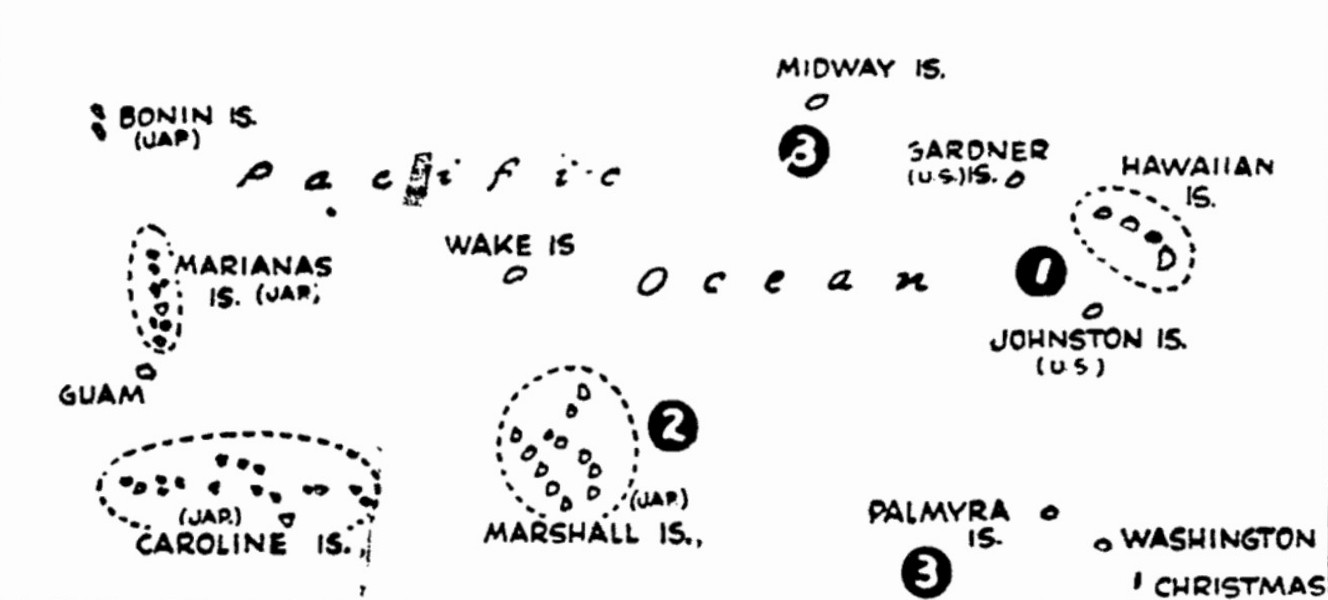
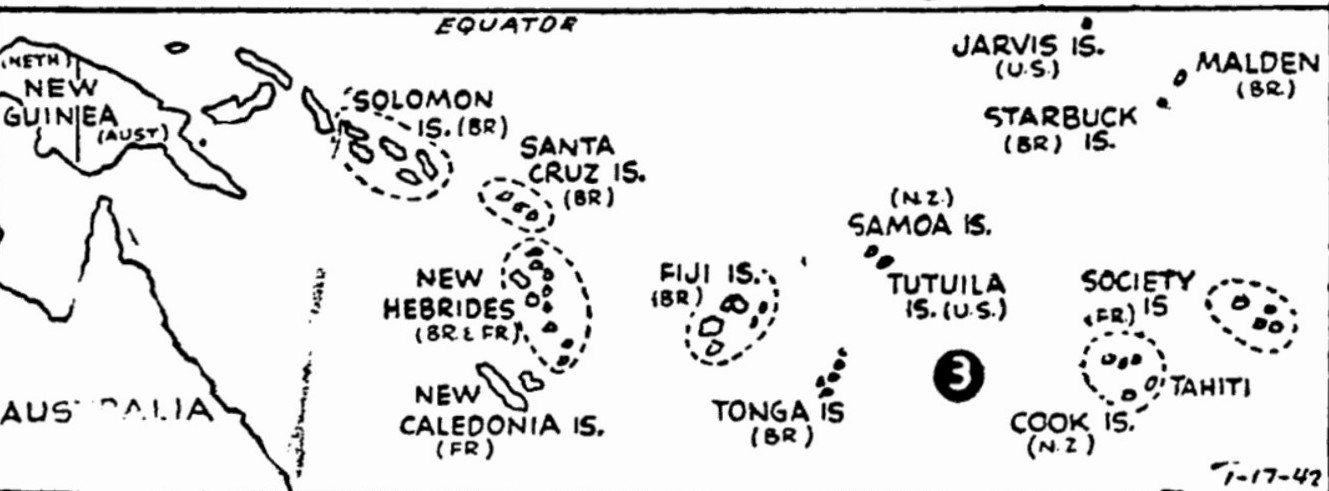
U.S. Fleet protects Pacific sea lanes
(1) Hawaiian Islands, main base for America’s Pacific Fleet.
(2) Jap naval forces reported massed near Marshall Islands.
(3) “Stepping-Stone” islands for U.S. defense of Hawaii.
U.S. fleet in action…
Many Jap subs sunk
Reporter with American warships in Pacific gives picture of men at battle stations
By Frank Tremaine, United Press staff writer
The first dispatch from correspondents with the United States warship forces operating in the Pacific follows. It is the first direct word from naval forces since the war started.
ABOARD A U.S. WARSHIP IN PACIFIC WAR ZONE – The United States Fleet is in action in the Pacific war zone and has sunk a number of Jap submarines.
It is impossible to disclose the number because such a disclosure would be of value to Japan.
But it was made known today that the operations of the Pacific Fleet had been sufficiently successful to provide ample proof of the Navy’s statement that it was not idle.
Protect ‘stepping stones’
It is impossible also, for naval reasons, to disclose the details of action taken by the force of which this vessel is a part, and by similar forces.
It can be said nevertheless that the American Navy is constantly on the alert in the Pacific war zone to intercept any Jap attempt to seize such American “stepping stones” as Midway, Johnston and Palmyra Islands, which lie northwestward (1,320 miles), southwestward (675 miles) and southward (900 miles) of the Hawaiian Islands, America’s mid-Pacific outpost.
United States naval forces are operating far from their bases, patrolling wide areas of the Pacific.
Fear mid-ocean trap
The fleet is refusing to risk the possibility of a mid-ocean trap in which the Japanese might, learning of the presence of an individual force of ships, concentrate a fleet in strength.
As Navy Secretary Frank Knox recently said, the Navy is waiting and will carry the fight to the enemy when it is ready to do so.
It is necessarily a secret business. American policy is based on the idea that it is best to keep the enemy guessing and waiting, for instance, for overdue submarines to return. That is one reason why it cannot be said how many Jap submarines have been sent to the bottom.
Expect surprise move
The Japanese will not be aided, however, by the news that the destroyer force, working closely with patrol planes of the fleet, has accounted for its share of Jap submarines since the sneak attack on Hawaii December 7.
Vigilance in the fleet could hardly be intensified, but it was made known today that Allied forces throughout the world, including the mid-Pacific area, were taking extra precautions against a possible surprise Axis move, timed to coincide with the current Pan-American conference at Rio de Janeiro.
In connection with these precautions, foreign broadcasts heard here reported Jap concentrations in the Marshall Islands, 2,400 miles south of Hawaii.
Could strike at Tahiti
Belief was that if the Axis made any move at the moment, it would be intended to lower American prestige in the Rio de Janeiro meeting, and that simultaneous Jap and German thrusts might be made.
From the Marshall Islands, the Japanese could strike at Midway, Johnston or Palmyra Islands or at Samoa, south of Palmyra and nearly 3,000 miles south of Hawaii. They might strike at Free French Tahiti in the Society Islands 1,430 miles east of Samoa, which is in the Panama Canal route to the Far Pacific.
Johnston and Palmyra have naval and air stations. Midway is the key to the defense of Hawaii.
Maintain constant watch
Japan has strong bases in the Marshalls and in the Carolines to the west. It is believed that planes based in the Marshalls attacked Wake Island. The Japanese have established themselves in the British-mandated Gilbert Islands, 500 miles south of the Marshalls, and are believed to have seized bases in the Ellice Islands, 250 miles south of the Gilberts.
Silent always, and by night, ghostly, the United States Fleet with its thousands of American men, pursues its steady zig-zagging course, maintaining a constant watch on the approaches far outside Hawaii and to the Pacific Coast of the homeland.
This ship in which I am writing is part of the force assigned to patrol a certain sector of the Pacific.
To port and starboard, ahead, astern, other vessels of the force steam quietly, all on their course in a formation set by the force commander, the rear admiral aboard the flagship.
No light shows anywhere on any of the ships we know are near as we watch from the sky control platform high on the mast.
Here’s action after alarm
Seconds after an alarm sounded, this ship and the accompanying force would be throwing steel and lead at an enemy on a rapid-fire order from both heavy and light batteries, while the “general quarters” call sounded and the entire ship’s company ran to battle stations in a matter of minutes.
As we steam along, the gunnery officer orders another drill to put the gun crews through the routine they would follow if an enemy force were sighted.
It would go like this:
“Enemy vessel three five oh!” the control officer shouts, relaying a shout from the lookout.
‘Enemy vessel 3-5-0’
“Enemy vessel three five oh!” the talker repeats into the mouthpiece of the telephone suspended from his neck, thus passing the word to the bridge and the gun crews that an enemy craft has been sighted 350 degrees from the ship, taking the ship as the center of the 360-degree circle.
“Range four six hundred!” the sky control officer announces, relaying from his observer. The enemy ship is not quite 3¼ miles away, or 4,600 yards.
While the sky control officer has been announcing and relaying information, and the news passed to the guns and the bridge, the big turrets of the main battery already have been swung to port and the secondary battery on that side of the ship has been trained forward off the port bow.
‘Commence firing!’
It is assumed to be night, and the big searchlights have been brought to bear on the point. Everything is ready.
“Strike arcs!” the bridge telephones the searchlight crew.
They turn on their power but no light appears.
“Open shutters! Commence firing!” the bridge orders.
As the searchlight beams hit the enemy, the guns open fire almost simultaneously and the main and secondary batteries start throwing their hail of shells.
“Cease fire!” comes the order and it is over.
Deadly earnest this time
Later, the other half of the crew relieve those who have been on duty.
A lookout shouts: “Lights zero six oh!”
This time, the guns swing out in deadly earnest. It is not drill. But a search of the horizon fails to reveal a light. It might have been a shooting star, but no chances are taken in these waters, prowled by enemy vessels, and all unusual lights and other objects are reported, and guns are trained until identification is made.
In daytime, it might be a whale on or near the surface, seen or picked up by the exceedingly delicate detector apparatus. Many whales have been victims of depth charges or airplane bombs.
Stricter tire curb in store
Henderson warns output for civilians may end
WASHINGTON – Price Administrator Leon Henderson warned last night that “we are almost done with manufacturing tires on a civilian basis,” and that the impact of tire and tube rationing “has scarcely been felt yet.”
Opposing a bill before the House district committee which would permit Washington taxi drivers to buy new equipment, he said the “mailbags are full” of requests that the rationing restrictions be relaxed for “special groups.”
Must last long time
“The answer is simply that there are not enough tires to go around,” he said. “We must allocate our stocks over a long period – and that period extends until our military arms are successful.”
Barring unforeseen developments, he said, a stockpile of nine million tires should be available “for the duration” to civilian consumers who normally buy 35 million annually. If restrictions were lifted, he added, the number on hand would “disappear in a bare three months.”
Urges approval of bill
Rep. William T. Schulte, D-Indiana, pleaded for approval of the bill, arguing that local transportation is vital to defense and that “the Burma Road is a pleasure in comparison to Washington’s most damnable, abominable transportation system.”
Mr. Henderson announced later that the tire rationing order has been amended to permit “eligible” light truck operators to buy six and eight-ply tires as well as those of four-ply.
Fleet to get rubber
The Navy, meanwhile, announced that synthetic rubber and plastic substitutes developed by research men during the past three years would meet almost all of the fleet’s requirements and that present production facilities would be adequate if the Navy were given their entire output.
Sen. Sheridan Downey, D-California, introduced a resolution to create a special five-man committee to investigate rubber supplies and the development of substitutes. He said that despite “reassuring” reports of Federal Loan Administrator Jesse Jones and others, there is only an 18-month supply on hand and that synthetic production should be increased to 400,000 pounds annually.
Editorial: Bands, songs and cheers
One trouble with this war so far is – no bands. Anyway, not enough bands.
During the period between the World War and the present one, such things as martial music and flag-waving fell into disfavor. It was felt that they tended to excite interest in war, and no one wanted to do that.
Now that we are at war, however, we can make good use of the emotional “shot in the arm” that is provided by band music, parades, cheers, songs and, yes, flag-waving. Singing nations have always fought better than dour ones.
It would seem that bands, parades and patriotic rallies might well be used to help raise money for the Red Cross, to promote the sale of defense bonds and stamps, to stimulate registrations for civilian defense activities or volunteers for the Armed Forces.
Why not have an occasional band concert in or near defense plants at lunch periods? If we know anything about the effect of patriotic airs upon the average American, the workers would go back to their all-important tasks with greater enthusiasm and determination.
Above all, draftees and volunteers should be sent away, whenever possible, with music and cheers. There has been all too little of that. Most of our soldiers-to-be have gone to their trains with nothing to distinguish them from commuters, traveling salesmen or young men going to visit relatives in Hoboken.
As for the rest of us, it is possible that we are being a little too grim about this war. It is serious, of course; extremely serious. But our morale would be better, and we would make greater contributions to the cause, if we went on an emotional spree every once in a while.
All this is not to say, of course, that we should go hysterical. Quite the contrary. But there are still a lot of people who haven’t taken the war to heart. A little pep might stiffen them up.
Strike up the bands.