Jap hospital ship sunk by sub in South China Sea
Tokyo blames American submersible for torpedoing vessel – six members of crew reported drowned
TOKYO (Broadcast Recorded in U.S. by The United Press) – Japanese headquarters said today that an enemy submarine sank the Jap hospital ship Harbin Maru in the South China Sea January 8.
Some of the Harbin Maru’s personnel was said to have been saved.
Radio Berlin was heard by United Press in London broadcasting a dispatch from “Tokyo headquarters” that the Harbin Maru was sunk last Saturday by an American submarine, and all but six members of the crew and the wounded were rescued.
A dispatch from Malaya said a tank unit, the vanguard of the Jap forces, crossed the frontier of Negeri Sembilan State last night and was pursuing the British, who were in hasty retreat toward Malacca, 120 miles northwest of Singapore.
Because of the difficult terrain in the interior, the Japanese are advancing close to the coast on the west aside of the peninsula, a Radio Berlin broadcast, recorded by United Press in London, said.
Official sources claimed that Japanese bombers had sunk seven Allied ships in the Malacca Straits. Nationality of the ships was not reported.
40,000 British fighting
Forty thousand British troops were estimated to be fighting in Negeri Sembilan.
“Their construction of trenches, destruction of roads and laying of mines shows that their technique is far superior to the technique the British possessed when the Malayan offensive began,” it was said.
Despite bad weather, formations of Jap planes raided Singapore yesterday afternoon, it was asserted, doing important damage to military installations. All the Jap planes were said to have returned.
Land on Celebes Island
A communique said special naval units had landed on the east coast of Celebes, an island of the Netherlands East Indies, south of the Philippines, and occupied the town of Kema, in the extreme northeast.
Jap airmen were said to have shot down seven enemy planes during this operation. Other Jap units were reported to have taken Tondano, in the north of Celebes Island, and it was “supposed that Jap troops advancing from the west and east coasts of the Celebes Island will join each other in the center of the island.”
Two enemy bombers were said to have been shot down around Tarakan, Borneo.
Japs cite size of foe’s army
A naval spokesman said yesterday that losses in landings on Celebes and Mindanao Islands were “negligible.” He said the regular East Indies army was composed of 35,000 men, plus 70,000 added in general mobilization, but a high percentage of the Dutch forces are natives “and for this reason such an army is no match for Japanese forces.”
The Tokyo newspaper Asahi estimated Netherlands East Indies military strength as follows:
About 72,000 regular troops and 25,000 volunteers, 100 pursuit planes, 80 bombers, 90 scout planes, 100 hydroplanes, six cruisers, 10 destroyers, 15 submarines, five mine layers, eight mine sweepers, seven torpedo boats, one gunboat and smaller craft.
Claim Americans reinforced
A special correspondent of Asahi said in a dispatch from the Philippines that the Japanese were continuing encirclement operations against enemy forces – mostly Americans – in the Bataan Peninsula. The Americans have been reinforced by coastal artillery and some tanks and have counterattacked, but without result, he said.
The German official news agency said fighting in the Philippines was going on in the mountains of Bataan Peninsula, 40 miles from Olongapo. The agency’s dispatch, recorded by United Press in London, said American and Filipino forces were doing their utmost to defend the eastern part of the peninsula “their last center of resistance.”
The Germans quoted the Jap newspaper, Nichi Nichi, that an “estimated” 30,000 Americans and Filipinos were fighting and suffering from a food shortage.
The Germans added that several transports had been observed near the fortress of Corregidor at the mouth of Manila Bay and that they were probably there to evacuate “encircled American forces.”
The Rangoon radio was quoted as saying that Robert Seal, U.S. consul at Singapore, had been transferred to the American consulate at Rangoon.
“This action of the State Department in Washington is being interpreted as a preliminary to the withdrawal of all diplomatic officers in the imminent collapse of the Singapore defenses,” the Tokyo radio said.

Rambling Reporter
By Ernie Pyle
SCOTIA, California – This little town in the great redwood country of northern California is wholly owned by the Pacific Lumber Co.
I have just spent two nights here, as the guest of two lumber men.
One night was at the cottage home of a cousin of mine from Indiana. He works for the lumber company, driving a bulldozer to gouge out logging trails in the mountains.
The other night was at the luxurious mountain lodge of Stan Murph, who is president of the huge company my cousin works for. My cousin has never met Mr. Murphy.
My cousin’s name is Paul Saxton. His father is my Uncle Oat back near Dana, the coon-dog man with the laugh that peals and rings. I saw Uncle Oat just a few weeks ago, but Paul has not seen him for 12 years.
Paul Saxton was born in a log house in Indiana two miles from where I was born. We used to play together as kids. But we have seen each other only once before in 20 years.
Paul left the farm when he was 21, worked a couple of years in the shops of Detroit, and then came west with some boys in a Model-T. He has never been back.
Always worked in woods
He has always worked mm the woods out here. At first he was a “high-climber,” which is the precarious job of climbing to the tops of these towering redwoods and preparing them for the fall. That is dangerous and dramatic work, but my cousin liked it. He changed only because he could make more money driving a caterpillar.
I got to my cousin’s house before he got home. I never had met his wife, yet she knew me before I introduced myself. It was strange, too, because as far as she knows she had never even seen a picture of me.
They hadn’t known I was anywhere near this part of the country, so she decided to play a joke on my cousin.
She saw him pull up, and went out and told him there was a Government man inside to find out why he hadn’t sent in the papers about his car. “He’s good and sore, too,” she told my cousin. “Aw, to hell with him,” my cousin said.
Then he came in the house. He looked hard at me and I could see he was puzzled. “Why didn’t you send in those papers like you were supposed to?” I said, trying to sound tough. Obviously he heard me, but he looked startled and said “What?”
I said, “You’re gonna get in trouble for not sending in those papers.” He looked pretty grave and was fishing for an answer. It might have gone on for quite a while except his wife giggled, and then it was off. He took one good look and knew who I was.
Bought his own home
My cousin went only part of one year to high school, and he says that has deprived him of many better jobs. But he has saved his money and bought his own home – one of the few among his crowd who have.
They have nice clothes and a bath and a big radio and an electric washer and a Dodge sedan in addition to the old Ford. They are by no means badly off.
My cousin likes it out here. He loves the woods and the outdoors and the rain. He wouldn’t leave here on a bet. But his wife doesn’t like it, because there are occasional earthquake shocks, and they frighten her. One quake last summer knocked down both their chimneys.
My cousin has a scar on his lower lip. I said to him, “Have you had an accident since we saw each other last?”
And he said, “Why, no. Don’t you remember? I got this when I fell out of the eucalyptus tree when I was little. You ought to remember. You were up in the tree too.”
Funny that a boy who falls out of trees and gets a life scar should wind up working in the tallest trees known to man. He says he’s never fallen out of a tree since. And neither have I, for I’ve never been up in a tree since. And never intend to be.
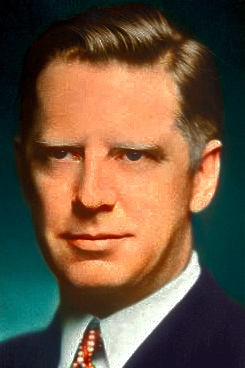
Fair Enough
By Westbrook Pegler
WASHINGTON – You ought to know that our young friend, Mr. Sam Ballard of Houma, La., received a very fair and courteous hearing from the august statesmen of the subcommittee of the Judiciary Committee of the Senate when he went back Monday to renew his protest against the appointment of Herbert Christenberry, a veteran member of the unspeakable Huey Long mob, to the position of U.S. district attorney in New Orleans.
On Saturday, the three statesmen of the subcommittee had roughed up our young friend as though he were a mildewed bum and more than slightly colored and they were city detectives in the backroom of police headquarters in Memphis, Tenn., or Miami, Fla.
Mr. Ballard, who soon will enter the U.S. Navy to fight for democracy, believed that as a citizen he had a right, indeed a civic duty, to present to Congress reasons why he believed the confirmation of Mr. Christenberry would constitute a blow at the honor of the Federal courts, which are a pillar of democracy, and that the statesmen had a civic duty and official duty to hear and even elicit information bearing on the inappropriateness of the nominee.
Appeared to be inviting sucker
Being in his hither 20s, and flustered by his own conspicuousness, he appeared to be an inviting sucker for the traditional treat-‘em-rough tactics of Senators. Most ordinary citizens feel like a little boy trying to give a speaking of the Wreck of the Hesperus and are likely to go up in their lines when they face this ordeal and even without heckling are likely to do rather badly.
And it was so with young Mr. Ballard, too, except that when Senators O’Mahoney of Wyoming, McFarland of Arizona and Austin of New Hampshire began to bounce im around with sharp questions, loud and impatient comments and senatorial finger-shakes, he reacted unexpectedly. Mr. Ballard held his temper, but with a politeness that might with advantage be adopted by Senators themselves in their dealings with citizens, and, with a dogged zeal for his rights, which might well be imitated by others, he insisted on pursuing his case.
On Monday when the case resumed, somehow, there was considerable press present to observe the treatment of young Mr. Ballard and whether he would be permitted to offer his witnesses and his facts. And, somehow, the three august Senators, who had been so impatient and sharp when it seemed that nobody was looking, were now as nice as pie and most helpful and legal and kind. The turnout of reporters and photographers could have had nothing to do with this, because it is well known that the press is without influence, so the change in demeanor might be explained by the fact that they had a good rest over Sunday.
Anyway, it was “Mister Ballard” this and “Mister Ballard” that and Sen. Austin, particularly, who had been distinctly on the grumpy side on Saturday, went out of his way to help Mr. Ballard develop what might be called the people’s side.
The principal witness was John Rogge, late of the Department of Justice, who ran the prosecutions of the ribald thieves in the odoriferous double-dip case in New Orleans in which numerous close personal and political associates of Mr. Christenberry and of his sponsoring Senators, Ellender and Overton, of Louisiana, were sent to prison, and he said he distinctly felt that the nominee’s loyalty was given first to his political faction as against the D. of J.
Said his motives were honorable
Mr. Christenberry, you understand, was an assistant USDA in New Orleans at that time, and Mr. Rogge said he felt that someone on the local staff was tipping off grand jury matter to defendants and felt, moreover, “that it might have been Mr. Christenberry,” whose brother, Earl, had been Huey Long’s secretary and hand-in-glove with Senators Ellender and Overton in Louisiana gang politics. Herbert, himself, was hand-in-glove with them, too, and Mr. Rogge said that, believing Herbert “would place his political faction ahead of his duty to the Government,” he could not recommend him for the post of USDA.
There was other testimony tending to show that Herbert had acted as a “dummy candidate,” a political device which Sen. Tom Connally of Texas, in a previous inquiry, had denounced as “damnable” and vicious and corrupt, and that he had served Huey as eavesdropper against citizens by use of a Dictaphone.
After the hearing, Sen. O’Mahoney sought out Mr. Ballard to say that he was a United States Senator and that his motives had been honorable, to which Mr. Ballard, looking him calmly in the eye, replied that he was a United States citizen whose motives were no less honorable.
Sen. Connally came in to jollify the occasion which had started on a sour note, but his unhappy part was written years ago by the moving finger which, having writ, moves on. Discovering fraud in the election by which Overton reached the Senate, Mr. Connally, nevertheless, suggested that this wise but naïve man had had no knowledge of the fraud, and that is in the record, nor all his piety nor wit shall lure it back.

Clapper: Job to be done
By Raymond Clapper
WASHINGTON – The pity about Secretary of Agriculture Wickard’s fight to get control of farm price fixing is that it inflames the appetite of one of the most greedy and overbearing of all pressure groups – the farm bloc.
Its twin is the labor bloc.
They feed each other. Unless President Roosevelt is successful in his courageous effort now to break up that game, the country is apt to be whipsawed into vicious inflation, with wages and farm prices climbing up on each other’s back.
Usually my trouble is that I can see there are two sides to most of the questions that come up here. I can see but one side to this one – Mr. Roosevelt’s.
The details of the controversy are covered in news dispatches. Briefly, Secretary Wickard led a demand that the price-control bill be changed to give him control over farm prices. Mr. Roosevelt insisted on centralized control of all prices in a single administrator – Leon Henderson. The Senate farm bloc fell in behind Secretary Wickard, and shoved through the Bankhead amendment to take farm prices out of Mr. Henderson’s control and give it to Secretary Wickard. The technique was to hand him the veto power over Mr. Henderson.
*Henderson’s statement rings true
In addition, Sen. O’Mahoney put through an amendment which would tie farm prices to wages. Mr. Roosevelt denounced this. He said it would bring disastrous inflation on the country more quickly than anything that has yet been suggested.
In price legislation, Mr. Roosevelt Is hewing to the principle of centralized responsibility which he finally applied in the field of production and procurement last night, when he announced that Donald Nelson was 16 be made, in effect, an American counterpart of Lord Beaverbrook, the British minister of supply. The President ought to have, in price control as well as in production, the fullest support of everyone who has criticized the loose and divided authority which he has heretofore tolerated in the war production agencies.
Secretary Wickard’s main argument is that he must control prices in order to encourage production of farm products. He says Leon Henderson has not consulted him in fixing some farm prices. Mr. Henderson gives the names of Secretary Wickard’s experts who have been consulted, and details as to instances in which he has followed the recommendations of Department of Agriculture officials. Mr. Henderson’s statement on this rings true.
Argument doesn’t make sense
Furthermore, the argument doesn’t make sense, anyway. Mr. Henderson must fix prices on many commodities and thus affect their production. He must consider in fixing copper prices, for instance, the necessity of encouraging more production. Under Secretary Wickard’s argument, copper prices should be fixed by the metals division of OPM.
You would have price fixing scattered all over the government, under the Wickard theory. We must assume that Mr. Henderson, if he is competent to hold his job – and it is pretty well agreed around Washington that he is – will take into account the need of increased production and will obtain the best technical advice as to where the price must be placed to get it.
Secretary Wickard’s fight for the farm bloc has put many Senators and Representatives in a hole. You may find it hard to believe. but some Senators and Representatives are trying to rise above local politics and do what seems to be necessary for the country. For instance Sen. Lucas of Illinois voted with the President, even though Illinois is a big corn state. He can get away with that until is corn growers discover that Secretary Wickard, a member of the cabinet, thinks Sen. Lucas is voting against the farmer.
Thus such an affair as this feeds the pressure groups and weakens the resistance of Congress to them, and the resistance isn’t too strong to begin with.

Maj. Williams: Place your bets!
By Maj. Al Williams
“Japan must be bombed to defeat.”
I was sorry to note Fiorello LaGuardia’s slur of un-Americanism on those who disagree with his mismanagement of the Civilian Defense Program. Any man who accepts appointment to lead our combat, industrial or home defense forces must be ready to account to his fellow Americans. We are all in this war. We are a really united people today.
An alert citizenry determined upon winning should rise on its hind legs and raise hell if and when any other American’s true patriotic purpose is indicated or slurred without proof. Judge not lest ye be judged.
We don’t need any Hollywoodian melodramatics to win this war.
I have kept a file on almost all the literature within recent months having to do with minimizing the war efficiency of Japan. The stuff and nonsense, unthinking wishfulness and inaccurate blather is almost unbelievable. The natural result has been to incline public opinion toward underestimating this Asiatic enemy. This is always dangerous.
It is always safe to overestimate the power, capacity and resourcefulness of an enemy, be that enemy a man or a nation.
Other nonsense!
We had a flood of similar misleading nonsense about the “starving, ersatz-equipped, short-of-oil” Nazis. Remember that deluge about the impregnability of the Maginot Line? Remember the fanciful stuff about the naval blockade England would establish around the waters of Europe to starve Germany to her knees? Deadly complacency and overconfidence are fatal in wartime.
The mass of printed matter is too voluminous for the average reader, so he reads and tries mentally to digest everything and anything. In this production age of printed matter, one can easily set up a screen by familiarizing one’s self with the opinion trend of authors. Left Wingers and Right Wingers are readily recognized. There’s your solution for protecting your mental digestion. Weigh the source, and be guided accordingly.
Now, the moral of all this. Let’s quit daydreaming and enter the lists of world combat as we were taught to enter a baseball or football game: “The enemy is tough, courageous, and resourceful, and licking him will take all we’ve got.” This is a real formula for winning this war.
Corregidor defenses
Corregidor is a veritable Gibraltar. It is a mightily fortified island at the entrance to Manila Bay. Jap troops and tanks cannot march and roll across the waterways leading to its bastions. It is unbelievable to presume that the Japs will be fools enough to launch a warship attack against this rock fortress. It is obvious then that their only alternative will be the continual employment of massed air attack.
Lacking air protection, it therefore becomes a question as to whether or not the anti-aircraft guns of Corregidor will be able to smother or turn aside the Jap Air Force. I don’t know how many anti-aircraft guns are available on Corregidor, but I hope there’s a thousand to blast those yellow apes into smithereens.
Corregidor, like Gibraltar, was built years ago to withstand warship attack and equipped with giant mortars and long-range guns. It’s a tough nut to crack. But you can bet your last dollar that whatever happens to Corregidor will shape the tactics of resistance and the form of attack to be launched against Gibraltar. In either case, it is paradoxical to reflect that the great long muzzles of anti-seapower guns will be cool and helpless while the little barkers (anti-aircraft guns) will test the intestinal fortitude of the Japs.
U.S. State Department (January 14, 1942)