Air star’s love goes on stage
Lady gets her man named Lou into nasty plot
By Si Steinhauser
It wasn’t the “shooting of Dan McGrew” and the lady wasn’t known as Lou. But her husband was. Now go on and read about the wonders of love and how it got a good guy mixed up in a nasty story.
Adelaide Klein, star of radio’s “Meet Mr. Meek,” is the lead in the Broadway play, “Brooklyn, U.S.A.”, a Murder, Inc., story. In the play she is supposed to be in love with a bad guy named “Max” and in rehearsal always called him “Lou.” Authors John Bright and Asa Borges screamed, “Listen, Addie, the guy’s name is Max. M-A-X. What is this Lou stuff?”
She promised to “reform” but, when the play was premiered called him “Lou.” Backstage after the opening the authors rushed into her room to add a new victim to “Murder, Inc.” and there found Miss Klein who smiled sweetly and said, “Boys, this is my husband, Lou Weddels.” So now “Max” doesn’t live there anymore. The guy Lou she’s in love with “rubbed him out” and she ain’t foolin’ about her love as Bing Crosby would say in his best Thursday night English.

One of our fellow radio scribes originated “Me, Incorporated,” and once in a while speaks his personal likes and dislikes about radio and its personalities under that heading. We borrow “Me, Inc.” for today to talk about so-called news commentators.
For one thing, Mr. Cal Tinney – in our one man opinion – is making an unsuccessful effort to replace Will Rogers in the minds and affection of American listeners. Assuming the role of a super-patriot, he is more likely to hinder than help loyal causes by some of his inferences. We don’t favor gagging free speech but we feel that the Mutual Network should tell Mr. Tinney to pull his ears in before listeners pull theirs in and give him the air.
A favorite news broadcaster of ours is Gabriel Heatter. We admire him greatly because he is a humanitarian. It’s a grand thing to hear a national figure take time out to remind listeners to feed birds and animals deprived of their source of food by winter snows.
But if Mr. Heatter were just a little less optimistic with the news we think his services to listeners would be perfect. We realize that he has a boy in the service and that, he, like millions of other parents, wants to look hopefully and cheerfully into the future.
But why try to make good news out of bad? Americans can take it.
To those newscasters who really give the news, applause, and to those who editorialize to make it sound good – how do you spell “the bird”?
We could go on and gripe about songs with double meaning, offensive people on the air and the hike, but we’ll take Will Rogers’ (not Cal Tinney’s) tip and just twist the dial and not listen to them.
The Pittsburgh Chapter of the Institute of Radio Engineers will meet at Mellon Institute tonight, with James B. Rock, general manager, and Dwight Myer, chief engineer of KDKA, as speakers.
Isabel Randolph, “Mrs. Abigail Uppington” of the Fibber McGee Show, is celebrating her fifth year with Fibber and Molly this week.
Charles Boyer ought to do a good job as “Lafayette” on tonight’s Cavalcade of America.
Charley Correll (Andy of Amos ‘n’ Andy) and the rest of the radio-screen aviation enthusiasts have hung up their private planes now that Uncle Sam has decreed no private flights within 150 miles of the Pacific coast. Correll was radio’s pioneer private plane owner and pilot.
Pittsburgh’s Margaret Daum is scheduled as guest soloist of “For America We Sing” one week from tonight with Frank Black conducting. Kenny Baker was listed for tonight but will be replaced by Kenneth Schon. The program is a Treasury Department affair.
Did you know that Margo the actress who sings on Cugat’s program is the maestro’s niece?
Ronald Colman, our favorite radio voice, will star in Charlies Dickens’ “Tale of Two Cities” on tonight’s Radio Theater.
Janet Gaynor will be Herbert Marshall’s guest on KQV at 7 o’clock.
Betty Denning, a Texas beauty, has succeeded Dorothy Lamour as Mrs. Herbie Kay. The maestro and his new mate are in Cleveland during a hotel engagement there.
Fredric March will clown with Eddie Cantor on Wednesday night.
And Lou Holtz with Kate Smith on Friday.
Public jitters may put sugar on ration basis
Huge supply available, but hoarding makes pinch for some buyers
By John W. Love, Scripps-Howard staff writer
WASHINGTON – Growing nervousness among consumers, and the trouble dealers are having in their own informal rationing of sugar, may lead to unexpectedly broad government measures for conserving essential commodities.
Although enough sugar is in sight to supply the country almost indefinitely, grocers are putting their customers on two-pound and five-pound allowances. Some retailers of soft drinks in Washington, Pittsburgh and elsewhere find themselves unable to buy all they can sell.
One business forecasting service has told its clients that rationing of sugar is on the way. Officials of the Agriculture Department say the possibility of a shortage is remote.
Different from 1918
No authority here believes a scarcity of sugar could possibly approach in severity the squeeze of 1918 to 1920. At that time, France and Italy were big buyers, the American sugar industry was far smaller, and we began war without a surplus.
Consumer overbuying of sugar is more than a year old and has been increasing since Pearl Harbor, evidently due to the public’s knowledge that about 30 percent of it ordinarily comes from the Hawaiian and Philippine Islands.
The “scare” buying is like that which spread through many commodities spectacularly in silk stockings and for a few days in tires, but now continuously in a wide range of products. The general movement is being watched carefully here but no definite plans seem to be afoot to check it.
Shopper raids noted
Sporadic raids by shoppers have been noted in pineapple juice. The hoarding of canned goods in general is almost as old as that of sugar.
Within a week, Leon Henderson of OPA has had to allay fears for storage battery supplies and spark plugs and to issue a statement that private autos would not be sequestered for their tires.
U.S. wives thought blitz at Hawaii was ‘air show’
Evacuee and son hid under mattress two hours in Jap attack
By June Greene
Special to the Pittsburgh Press
NEWPORT NEWS, Virginia – For two hours Mrs. Wilson F. Moul and six-year-old Gail had been lying under the mattress.
Window glass still was flying about as Japanese planes zoomed over Hickam Field, Honolulu, and raked the place with machine guns. The thud of explosions echoed and re-echoed.
Finally an eerie quiet settled over the field and the officers’ quarters.
Little Gail fidgeted beneath the mattress which had been laid across two chairs as a canopy and glanced at his mother.
Watched ‘air show’
“Will there be Sunday school today?” he asked seriously.
“I don’t know, dear,” his mother replied. “I don’t know.”
It was just about 8 a.m. on December 7 when the Japs struck at Pearl Harbor and surrounding airfields, Mrs. Moul explained here today.
“Like many of the Army wives, I was washing Sunday breakfast dishes,” she said. “My husband asked if I had ever seen the Navy on maneuvers drop bombs. I joined several women to watch the show. I could see clouds of smoke and heard someone say he thought there was an earthquake.”
Saw ‘rising sun’
But a moment later, Mrs. Moul said, all conjecture about whether it was an earthquake or the Navy on maneuvers ended. For on the side of one of the planes, someone had spotted the rising-sun insignia of Japan.
Mrs. Moul’s husband reported to his station immediately, while she and her son lay under the improvised mattress shelter.
“I had started to pray,” she said, “but then I got so angry I felt like swearing at them.”
Evacuation order
When the lull in bombing came, all women and children were evacuated to the hills, Mrs. Moul said.
“We had been told to take only a few possessions. All I could think of was Gail and of course, worry about my husband at the field. Jewelry, money, house furnishings meant nothing.”
For a week they stayed in the hills or in civilian homes, always on the alert and ready to flee.
For three days Mrs. Moul was unable to get word to or from her husband. Meanwhile, he was searching for her.
Husband promoted
“He visited churches, schools and public buildings where people were being housed and finally, we found each other,” she said. “I had been numb with worry and fear for him.”
Today, Mrs. Moul and her son are at her parents’ home, Newport News, Virginia. Her husband remained at Hickam Field, where they had lived for two years. She has learned that he has been promoted in rank from master sergeant to a second lieutenant.

Rambling Reporter
By Ernie Pyle
ALBUQUERQUE – What, pray tell me, have I wrought now? Lord have pity on my poor sinful soul; I must have been thinking about something else at the time.
For I have bought a Great Dane!
The whole thing is still a little vague to me, it all happened so suddenly. But as far as I can remember, it went like this.
That Girl was delighted and agog over the toy shepherd I brought from Washington. But I still had in mind getting her a Great Dane some day.
We talked casually about it, and she said yes she’d like a Great Dane, too, but perhaps two dogs all of a sudden would be too much for her, so she’d rather wait a while for the Dane.
But since I’m going to be gone a long time, I thought it would be smart to look at a Dane and sort of get things lined up, in case she wanted it while I was away.
So we drove out to a kennel here in Albuquerque. When we stopped the car, a monstrous beast stuck its gigantic head in the car window and almost scared us to death. It was just one of several colossal animals running around the place – all Danes. They set up such a fiendish baying that it sounded as though the Hound of the Baskervilles were entertaining at a murder party.
Well, we plugged our ears and looked around. We were rather struck by a seven-months-old puppy which was already waist-high and weighed 100 pounds. It was brindle-colored and striped like a tiger. Its face was a million years old and you couldn’t help but laugh when he looked at you. And the damn dog kept leaning against me all the time.
Good theory doesn’t work
I suppose it was that leaning as much as anything else that caused mv destruction. All of a sudden I knew the jig was up. I looked at That Girl and saw that her jig was up, too. So I just turned my head to the sky, bayed loud and long, and whipped out the old checkbook.
We did keep our heads enough, however, to make the purchase on the basis that the kennel people would keep the dog for two more months, and during that time they would housebreak it and train it.
The theory was excellent. I still think it was a fine arrangement. There was nothing at all wrong with the plan. Except that we didn’t keep it.
For the following day was warm and sunshiny and we had nothing especial to do, so we said, “Let’s get the Dane and bring him out for just an hour or two.”
The kennel people said that would be all right, so we brought him out to the house. We turned him loose in the big south lot with the picket fence around it. The little toy shepherd was there, too. A furious sniffing took place between Mr. Big and Miss Little. And all of a sudden they became friends. And also all of a sudden we knew we weren’t going to take the big dog back to the kennel – ever.
Miss Little leads Mr. Big
So now we have two dogs. The little one is named Cheetah. The big one Piper. The little one can walk right under the big one, with six inches to spare. Yet already she leads him around by the nose.
The two dogs are wonderful for each other. They walk everywhere side by side, like two soldiers. When we came out the door they were standing there at attention with their ears cocked, one so ghastly big, one so dollishly tiny.
Now Mr. Big has condescended to play and leap a little with Cheetah. He is so immense that he leaps exactly like an elephant. He is so immense that he leaps exactly like an elephant. I am in deadly fear for his safety every time he gets two of his feet off the ground. He is pathetically awkward.
When we were talking across the mesa he stubbed one foot, got those horsey legs mixed up, and fell clear down flat like a box that had collapsed. It was so funny I had to sit down and laugh. When he lies down in the house, it sounds as though a cow had suddenly fainted in the living room.
Piper loves to be petted, and likes to be in the house better than outside. I am sure he is a lapdog at heart. If he turns out to be thus afflicted, we’ll just have to invite in a few dozen neighbors every time he wants to sit down.
That Girl is horrified and riotously delighted with her strange new team. Already she is starting to get sore at people who see our dogs for the first time and don’t go into ecstasies over them.
There is a lot of jealousy floating around our house. Each dog is jealous of the other one; That Girl is jealous of me because the dogs follow me; and I’m jealous of her because the dogs are hers.
And right now I’m facing a choice between two awful alternatives. I can’t bear to leave these creatures; and yet I don’t dare stay. For the brutes between the eat six pounds a day, so I’ve got to get back on the road in order to support them.
Wish we’d bought white mice instead.
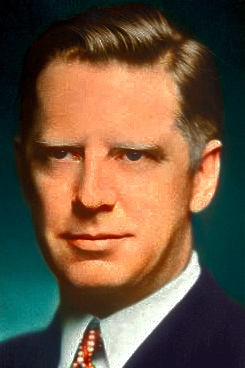
Fair Enough
By Westbrook Pegler
WASHINGTON – Something is cooking in the Senate Judiciary Committee and, judged by the smell, is it something that ain’t quite fresh.
Senators Ellender and Overton of Louisiana are trying to put over as Federal district attorney in New Orleans another member of their low political mob. He is Herbert Christenberry and, if confirmed, he would be in a position to ease up or bear down on still other members of the old Huey Long gang in the prosecution of indictments pending and the investigation and punishment of much other unfinished crooked business.
Overton was elected by a fraud perpetrated by the mob but insists that he was so dumb that he didn’t know the fraud was operating. Ellender was Huey Long’s yes-man when he served as speaker of the lower house of the legislature.
They are typical Long politicians and it would be a tweedle-dum judgment to say that either is worse than the other. Nevertheless, as senators, they have the right to select the sort of politicians they inevitably would select, meaning their own kind, to sit on the Federal bench and handle grand juries and prosecutions.
Christenberry’s nomination was sent to a subcommittee of the Senate Judiciary Committee and a delegation of young Louisiana Citizens came up to present objections to his confirmation.
Senators bulldoze objectors
In an earlier case, Ellender and Overton put in Gaston Porterie, Long’s old attorney-general in the foul dictatorship, for Federal judge and a subcommittee quietly okayed him and the Senate confirmed him in the dark of the moon, stealthy trick on the people but over and done with before anyone knew about it.
Saturday. Sam Ballard. a young man from Ellender’s home town of Houma, La.; James L. Morrison, a law instructor from Tulane University, New Orleans, and James Domengeaux, pronounced Chumley, a young French Cajan congressman from Lafayette, La., appeared before this subcommittee of the judiciary and got such a robust tossing around that you might have thought they were the defendants in a case of murder by criminal assault.
The subcommittee was composed of Senators O’Mahoney of Wyoming and McFarland of Arizona, Democrats, and Austin of Vermont, Republican. They heckled young Ballard, nagged him for short answers which would have placed him in a false position or discredited his case, shook fingers at him, raised their voices and. just generally, carried on in the traditional bulldozing county-attorney manner which senators affect when they think they have a sucker at their mercy and nobody is looking.
They didn’t try to draw out what could be termed the people’s side of the case but rather counter-attacked the petitioning citizens to the benefit of the notorious Louisiana mob so many of whose bosses, all political associates of Ellender, Overton and Christenberry, were caught in spectacular looting.
A Federal employee who would be fired if identified confided to young Ballard after the morning session that never in his long experience has he seen a petitioning citizen so set upon by a congressional body.
The reason is no mystery
By afternoon, however, word seemed to have got around that the hearing was being watched and you should have seen the change. The august statesmen of the subcommittee were almost half-civil by the time the show closed for the day and they may be on a spot themselves Monday.
For, the inquiry is generating heat and the protesting group, respectfully but doggedly are asking that Justice Frank Murphy of the Supreme Court be invited to tell what he learned about Christenberry which, of course, is plenty, when he was attorney general succeeding Homer Cummings, who held the job at the time of the second Louisiana purchase.
And why shouldn’t Murphy tell what he knows? Who has a greater duty to guard the sanctity and purity of the court system? He hasn’t become a god, has he?
Christenberry has a brother, Earl, who was Huey’s secretary and secretary-treasurer of the notorious win or lose company, a racket which Huey authorized to sell oil out of a state preserve for the private profit of a few select members of the gang.
Indictments now pending arise from this company’s affairs and the Department of Justice has ruled, in advance, that even if Herbert is confirmed he will not be allowed to prosecute the most important of these cases against Jim Noe, another old member of the mob.
The reason for the heckling is no mystery. If senators permit citizens to block selections of brother senators, the brother senators can get dirty and retaliate in turn.
Nor is there any guarantee that the official record will show the bulldozing, for senators have a right to strike out matter revealing their prejudice and no notes could record the harassing voice or the intimidating shake of the senatorial finger.

Clapper: Latin showdown
By Raymond Clapper
WASHINGTON – Is South America going to be with us or not?
That is the real question which hangs over the Pan-American Conference that begins at Rio Thursday. The question won’t come up in such bald form. But it will be the reality behind the diplomatic language.
It is not a matter of whether South American nations declare war on the Axis. One could even think up some reasons why that might not be an unmixed gain for our side. The question is whether they will give whole-hearted help to our side as the United States helped the anti-Axis powers long before we went to war, or whether some of the South American nations will hold themselves in readiness to play the Axis game if they are crowded a little.
The time may come in this war when the Axis will attempt to work through South America to encircle us and isolate us north of Panama. It is one way they might strike at the heart of the United Nations supply base, which is America and our industry. Certainly it is a possibility that must be considered.
In that case much would depend on whether South American countries, particularly Argentina, Brazil and Chile, were ready to assist us or whether they would be passive pushovers for the Axis. The answer to that must come largely out of the heart, long before the event.
It is the difference between France and England. France lacked the heart and gave up to the Axis. Britain carried on the fight alone, through a dark and lonely hour when her chances seemed no better than France’s had been.
A matter of where your heart is
It is a matter of where your heart is, first of all. And that’s what I’d like to know about South American countries now.
Most of the small Central American republics have declared war on the Axis. But none of the important South American countries has even broken relations. None has joined the United Nations. The Argentine foreign minister only a few days ago publicly opposed going to war with the Axis and rebuked Central American republics which had done so.
The cabinet of Uruguay, however, has instructed its delegate to the Rio conference to propose that all South American nations break relations with the Axis. Argentina has given no public indication of its position on this, but the Argentine foreign minister has been caucusing with the foreign ministers of Chile, Peru and Paraguay hoping to obtain a united front.
That he was having trouble was indicated in a luncheon speech made in Buenos Aires by the foreign minister of Chile, who said America is one and that there are no blocs or artificial distinctions between north, center and south. “America,” he said, “is one and must remain one.”
Welles knows way around
That is the outward picture of the situation with which Undersecretary of State Sumner Welles, the American delegate to Rio, must deal. Mr. Welles is an old hand in Latin American affairs. He knows his way around and is on good personal terms with most of the personalities involved.
There are good reasons why some of the South American governments have to walk a tightrope in respect to public commitments. They are, in some cases, caught in the same kind of internal division that President Roosevelt had to deal with before Pearl Harbor.
But Mr. Roosevelt knew which side he was on and threw the breaks that way. In that sense, the important fact out of the Rio Conference will be where the hearts of the Latin governments are, and not necessarily what formal resolutions are adopted.
One strong fact in favor of our side is that with European markets cut off, all Latin America depends on us as the main customer, just as we now depend increasingly on South America for strategic war materials.
But that doesn’t mean too much unless the heart is in the right place. We were Japan’s best customer and she depended on us for many materials essential to her war machine. But that all melted quick as a snowball in hell when Japan wanted to hit us at Pearl Harbor.

Maj. Williams: The challenge
By Maj. Al Williams
“Japan must be bombed to defeat.”
When everything is said and done, the one greatest factor in making the United States the greatest nation the world ever saw is the strong, rugged individualism of the typical American. … From infancy we Americans are taught to stand on our own feet and do our own thinking. The essence of the Constitution, every precept of the Bill of Rights, founded and fostered this individualism – this basic difference between a real American and all the other peoples of the world.
We’ll think our thoughts and speak our thoughts and reach forward with our hands to do the nation’s job. And when we think that anyone delegated to boss any part of that job is not capable of bossing it efficiently, we’ll promptly say so and demand a man who can. This is the self-determination of Americans. It’s in our blood, our bones, and in our every breath. And it is this spirit, this undying spirit of self-determination which will win the war for the United States.
This is a new, a revolutionary type of warfare. No one appears to know more than a few of the answers. We are all in it. Not only the men who do the fighting, but those who are behind the lines, the men who pay the plans. Understanding full well the vital factor represented by combat efficiency in the field, on the sea, and in the air, it is well for us all to remember that this war can be won or lost in the laboratories and strategic councils thousands of miles away from any combat front. Any reverses we suffer can be directly attributed to having failed to realistically plan to fight the war that is being waged against us. That’s water over the dam, and we are only interested from here on in to the victorious finish in the rapid readjustments and ingenuity effected in out-smarting, out-thinking, and out-producing our enemies with weapons and war tools more efficient and numerous than theirs.
Old rules won’t work
To plan our strategy for out-daring our enemies and for seeing farther into the future of warfare, we must revise and scrap our old rule books of war. This calls for personal courage far greater than ever demanded from Americans since the dark days of our Civil War. It’s not the job of planning and building new weapons that worries me, but rather the Herculean task of discarding, scrapping, and ditching the old ideas and the old ways of warfare that don’t and won’t work in modern warfare.
That is the real crux, the pivotal point upon which American victory balances. Look at it, inspect it carefully, walk around and be sure you know its every shape and shade. No man’s pride, no organization’s traditions – nothing must be allowed to sway or influence us from striving and demanding to clean our defense house and build it anew, brighter. more efficient, and more terribly effective than all the Axis powers best efforts combined. To beat those outlaws, we will have to build 10,000 and more planes per month. We’ll have to train commensurate flying and ground manpower to man and service those planes – those fleets of airpower.
We can’t afford to model our plans or our organization upon any scheme that has satisfied our enemies to date. American airpower – full American airpower – free and unhampered, must be inspired and built to reach any continent, to bridge any ocean, to strike any enemy nation at the heart – at home. Show me some other weapon besides airpower that holds such promise of military effectiveness and victory and I’ll fold up and follow you. The men of England pleaded at the Namsos disaster, “For God’s sake, tell them to give us planes.” Ditto the French and English in the Battle of France and at Dunkirk. Ditto the defenders of Crete. Ditto the British High Seas Fleet. Ditto the fighting men all over the world whose own air forces were weaker than those of the enemy.
Proof is complete
The Dutch general in the East Indies pleads with us today, “We’ll do the job if you’ll send us the planes.” The gallant MacArthur, stalwart soldier, pleads not. But airpower could save him and his command. These are the lessons of destiny standing nakedly before us. What further evidence or proof could you ask for?
Read them. Study them. No matter what airpower has accomplished to date, only the surface has been scratched in the use of airpower for the purpose of warfare. Even the German Air Force was not up to the strength and unbelievable might planned for it. Why, therefore, should we Americans – who have led the world – timidly and faintheartedly plan to equal the airpower or any other plans of Germany, Italy, and Japan? Why not take the bull by the horns and interpreting the signs courageously, move our full might into the atmospheric ocean that covers the world. If we slowed down on everything else right now and built airpower – gigantic air fleets – we would be taking the first step to subduing our enemies. We are not going to land any expeditionary force in any foreign land until our planes dominate the air over those debarkation points. Why not be the Americans we boast we are and accept the challenge of destiny.
Let’s quit thinking of air service as auxiliary to any type of land or sea machinery. The nation that rules the air will rule the world, just as England ruled it with seapower for centuries. Let’s rub the cellophane scales of tradition from our eyes and get on with the full-time job of ruling the world from the air – the only way it can be ruled, and it needs ruling.
Freedom of speech safeguards pledged
WASHINGTON (UP) – Assistant Attorney General Wendell Berge said last night the Justice Department is prepared to preserve freedom of speech and to prevent the “veritable chamber of horrors” that resulted from the prosecution of critics of the first World War effort.
Mr. Berge said in a radio address the department had entrenched itself “against those pressures and influences, which cry for the prosecution of those people who are merely exercising their right of free speech guaranteed by the First Amendment of the Constitution, and whose utterances are not in themselves seditious and cannot be shown to constitute any direct interference with the conduct of the war.”
He referred to the latter part of the first World War when the government “embarked upon a course of prosecutions on the theory that words in themselves had a ‘tendency’ to encourage resistance to law and interference with the conduct of war.”
U.S. State Department (January 12, 1942)