Background of news –
Travel industry fades
By Editorial Research Reports
The business of catering to the wants and needs of auto tourists – described as “the nation’s third largest industry” – faces virtual suspension for the duration of the war. In recent years, auto travelers have spent an average of about five billion dollars annually away from home on purchases and payments at filling stations, garages, hotels, tourist homes and cabins, restaurants, retail stores, and amusement and recreation places. The grand total in 1941, it is estimated by the American Automobile Association, was 5½ billion dollars, only 14 percent of which was spent on business trips.
The war, increased taxes and living costs, tire rationing and auto curtailment, have now knocked the bottom out of the tourist business. The pinch has already been felt in Florida and the sunlands of the Southwest; next summer, it will be felt in the vacationlands of the Northwest, in Maine, at seaside resorts on the Atlantic and Pacific coasts, and at inland lake and mountain resorts. Canada has undertaken to restrict travel and expenditure by her citizens in the United States, to preserve all available exchange for war purposes, and Canadian resorts will suffer from a sharply reduced volume of American tourist expenditure.

Using 1938 as an average year for measuring the tourist business, the U.S. Travel Bureau found that the largest crops of travel dollars were harvested in New York State and California. New York collected more than $584 million from tourists and California more than $439 million. Much of the Empire State’s share went to New York City, which is not likely to suffer any considerable drop in this tirade during 1942, when many vacationists, deprived of their autos, will use the regular transportation lines to visit the metropolis. In California, much of the drop in tourist trade has already been offset by the tremendous expansion of defense plants, particularly in the aircraft industry.
More likely to feel restrictions on motor traffic are such states as Michigan, where tourists spent $207 million in 1938 (and, according to the Michigan State Travel Bureau, $300 million the following year); Texas, with tourist revenue in 1938 of $255 million; Minnesota, $133 million; Wisconsin, $118 million; Iowa, $113 million; Washington, $102 million; Oregon, $62 million; Maine, $41 million; North and South Dakota, $33 million and $37 million, respectively; Idaho, $27 million and Utah, $26 million.
Last year, it was estimated that 52½ million people traveled around the country in 15 million cars. They were served by an estimated 20,000 hotels, many of which depend almost wholly on tourist trade; nearly 20,000 tourist camps and courts, at least 200,000 tourist homes, 400,000 service stations, and an inestimable number of roadside hot dog and pop stands.
In recognition of the tremendous value of tourist business, nearly every state, in recent years, has allocated a separate fund for advertising purposes. Last year, about $6 million was spent by the states for this purpose; $90 million more was spent on local authorities and private agencies. Washington alone appropriated $250,000 for that purpose and Oregon about $100,000. Because of existing conditions, both of these appropriations have been suspended. Many other states are expected to shift their tourist advertising allocations to more vital civil defense needs and leave individual resort owners to do the best they can to attract patrons.
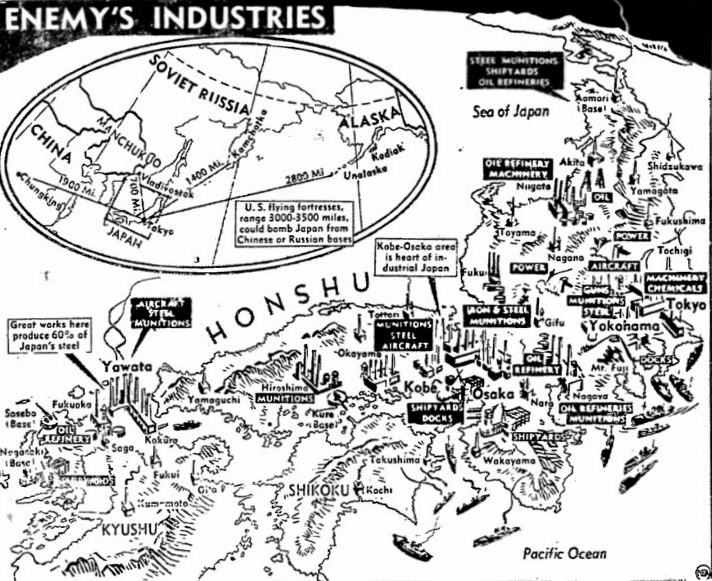
Concentrated into an area little larger than New England are most of the war industries of Japan. They are hard for Allied bombers to reach, but once hit they would be highly vulnerable to mass destruction.
Rambling Reporter
By Ernie Pyle
ALBUQUERQUE – We have a dog. A brand-new dog.
The whole thing was sort of fantastic. That Girl said one evening last fall that she’d like a Great Dane. She said that if she ever had a dog it had to be a big one. She said the only trouble with a Great Dane was that it wasn’t big enough. She said what she’d really like to have was a dog as big as a horse.
So we talked a while along that line, and then she said that if she couldn’t have a dog as big as a horse she’d like a “toy” dog so little you could hardly see it. She is a woman of terrific extremes. She said she’d read in a magazine that they now have toy shepherds so tiny you can put one in a shoe. She said one of these would serve the purpose.
So when I went to Washington recently I inquired around about toy shepherds. Finally we tracked our desire down to its lair. and over near Falls Church, Va., we found a whole kennelful of toy shepherds.
Well, it turned out they weren’t little enough to put in a shoe. They weren’t little enough to put in a rubber boot, or even in two rubber boots. But they were pretty little. And they were mighty sweet. So I said okay, wrap one up. I’ll take it.
I left by plane the next day. The dog was delivered to me at the airport by the kennel people. They had it in a nice lightweight wooden box. I said “Hello dog,” and we both got on the airplane and flew away.
A dog has to go in the baggage compartment, so I couldn’t see her on the way. But the captain came back two or three times and told me she was doing fine and didn’t seem scared. He said that as a matter of fact dogs are good fliers, but that cats and monkeys are terrible. They get airsick.
Due to various stopovers, we were a week getting out here. The dog and I lived in hotels and the homes of friends; we traveled on trains and in autos; we were stacked by big dogs and frightened by strange people; we had weird experiences by the score and digestive disturbances by the thousand.
Probably no dog has ever flown so far and seen so many people in her first week away from home. Our eastward journey was an epic and a torture, but I’ll have to tell you all that some evening sitting before a fireplace.
When we finally got here the poor thing didn’t know whether she was a dog or a flywheel, and she had the shakes and the shivers something terrible. But she had nothing on me. I was shaking, too, with anxiety that That Girl might not like her. For after all, she was neither as big as a horse nor as little as a shoe.
Dog turns family into idiots
But I needn’t have worried. For the new owner took to the dog in such colossal fashion that I’m in a jealous rage. I don’t get any attention at all.
The dog has by now wrought an outstanding change in our lives. Why is it that two purportedly sane people, suddenly confronted with dog ownership, actually turn into simpering idiots, and drool and burble and talk baby-talk until they have to sit and laugh at themselves in their clearer moments?
We get practically sick at our stomachs when the dog’s nose gets hot, for we are sure she is dying. Her refusal to drink milk with an egg in it causes long and serious conferences. If she runs around sniffing at things, we know she is to have a fit. If she lies down quietly and goes to sleep we are positive she is just about to have a stroke.
We try to force water down her when she doesn’t want to drink. If she gets a burr in her foot we whine and carry on more than she does. If she doesn’t want to come in the house from her play, we figure that she hates us, and we sit in self-reproach.
Twice I have corrected her in the most apologetic fashion, yet I slunk around for hours afterward as though I’d been caught pulling the wings off flies.
‘Didums hurtems footsy-wootsy’
And buy things? Why, there wasn’t a day for the first two weeks that I didn’t spend at least two hours downtown haunting the stores looking for dog things. I’ve bought rubber rats, rubber bones, plastic bones, rubber balls, cloth balls, wire combs, rubber combs, leather leashes, chain leashes, flea powder, dog-bath soap, three dog books, dog biscuits, dog mattresses, canned dog food, hamburger, two dog magazines, and have clipped a coupon in one of them and sent away for two more dog books and a sack of cedar dog-bedding.
And the damn dog won’t play with her rubber rats and won’t lie on her dog-mattress and won’t eat her dog biscuits. All she wants to do is either sit on our laps or else get out in the big south lot and scamper and play all day and half the night.
Actually the other night That Girl, who should have been snug in her convalescent bed, was out there in the yard in the cold moonlight of 2 a.m. playing catch-the-ball with this beast, just because it woke up and seemed restless in the house.
Yes, it’s wonderful to own a dog. I’m glad I’m on mv way again. If I stayed here another month I bet I wouldn’t have an ounce of sense left.
For when a grown man finally winds up sitting in a chair saying “Ohh didums hurtems poor little footsy-wootsy oh me oh my blub blub blibber,” then it’s time he’s getting out.
So goodbye, dog, I’m going before it’s too late. That’s the way I’m solving my dog-idiocy problem. That Girl will just have to rassle hers out in her own fashion.
Fair Enough
By Westbrook Pegler
NEW YORK – Within the past three weeks, Adolf Hitler and Joseph Goebbels have ordered the German people to surrender all their heavy clothing and blankets for the army in Russia. In a cheery Christmas message to the civilians which the Fuehrer delivered through Goebbels, it was remembered that last year there had been an “appeal” for the delivery of all heavy apparel which they could spare. This time Hitler did not appeal. He commanded.
All overcoats, all shoes with warm linings, all heavy underwear and furs were to be given up and the Brown Shirts would start their house-to-house collections of such apparel and blankets on December 27.
In Germany, this means, of course, that from now on, this winter and in winters to come, the civilians will not be allowed to have warm clothing, although Hitler, himself, and the higher party celebrities, such as Marshal Goering, of the many spectacular uniforms, will be excepted. Anyone who conceals or neglects to give up the requisitioned clothing and blankets will be subject to the usual penalties for sabotage and neighbor will spy on neighbor to enlarge the yield.
Sales listed freely in U.S. papers
This was not the “extra” stuff that Goebbels demanded. That was turned in a year ago, as he said in his address, so the meaning of this new demand plainly is that any man who wears an overcoat suitable for conversion into a military coat, anyone whose ration record shows purchases of heavy underwear or blankets or heavy shoes and who fails to surrender the same, now will risk those punishments which the Germans under their liberator know so well.
Not only that, but the people were asked to turn in woolen bathing trunks for conversion into helmets for the troops and the strange German mentality has even called on the people of Belgium to make similar sacrifices for the comfort of those who pounced on them without warning and kicked their country to death.
Americans and Britons are constantly warned, and wisely, not to deceive themselves with undue optimism, but certainly this development in Germany may be contrasted with conditions in the United States without danger. The current American papers offer freely for sale, no ration cards being required, huge piles of warm blankets, overcoats, suits, ski suits, fur coats, fur-trimmed coats, heavy socks, shoes of all kinds, underwear of all weights desired in any of our climates, gloves, mittens, leather jackets with heavy linings, canvas jackets lined with sheepskin with the fleece on.
Germany, on the other hand, has not only been on rations for a long time but has not been able to fill the meager allowances and is now calling in everything for those millions of German young men who were sent on a wild mission of quick conquest which failed horribly and left them exposed to a winter for which the leader had made no preparations. If that had happened here, the people undoubtedly would peel off their coats and heavies, strip their beds and rummage all old and spare material out of all the attics and storerooms, but they certainly would not forbear the mention that someone had been guilty of a terrible blunder.
Germany may be running out of time
A year ago Hitler robbed the Norwegians in their cold homeland of much of their warm clothing and all the blankets he could steal and it stands to reason that he has left no such treasures to the civilians of France, Holland, Denmark, Poland or any of the conquered Balkan countries. In other words, having stripped most of the people of Europe to clothe his armies and civilians, he is now forced to strip his own people on the home front to remedy his blunder and with no prospect that he will be able to clothe these millions for next winter or the next.
It may be culpable optimism to think so, but this is bound to suggest that Germany is beginning to run out of time, because a whole continent cannot go on indefinitely without winter clothing and there is no apparent source of a new supply this side of complete victory for the Fuehrer which he has failed to predict for 1942. This is a state of affairs which should not be expected until a nation has been at war and blockaded for a long time and it shows on its face that the superman did not provide against the setback to his arms in Russia.
Attempting no military interpretation of the case, one may still look at the ads of the American stores in the daily papers and ask whether the American people would be unaware of a dangerous situation, if, today, President Roosevelt were forced to issue a similar call backed only by public opinion rather than the Brown Shirts.

Clapper: Reuther’s plan
By Raymond Clapper
WASHINGTON – For a whole year, the Reuther plan to put the auto industry 100 percent to war work lay dormant on the shelf. Walter Reuther’s proposal provided for a joint board of Government, management and labor to direct the full use of auto facilities for war work.
It was that feature of the Reuther plan which aroused the most suspicion last winter. William Knudsen, co-head of OPM, is an auto production man first of all and he, as well as the industry executives, not only questioned whether the machinery of the plants could be converted to any large degree but they were suspicious of this as a scheme by which labor hoped to muscle in on management of industry. They regarded it as a design for transfer of management to the hands of labor. If it were accepted for the auto industry, then a series of drives would be made on other basic industries.
Public trusted auto executives
The public reaction in general was to trust the auto executives and their former colleagues in OPM to do the job There was confidence in their knowhow. The auto industry stood above all others in public confidence with regard to efficiency, inventiveness, ability to obtain large production quickly. The public instinct was to protect such an industry and allow no outside intrusion. That is why the Reuther plan gathered very little public support a year ago.
But a whole year went by, and at the end the checkup caused a good deal of public dismay. Whether industry or the Government or both were to blame is not the most important question. The one big fact is that despite the frantic need for planes and tanks, the auto industry turned out an almost record-breaking number of passenger cars. A vast amount of labor and scarce materials went into semi-luxury output while the needed war equipment went unbuilt.
As this realization dawned, the shutting off of rubber forced the issue to a head and production of cars was ordered suspended. Here Walter Reuther came back into the picture, with his plan which had been laid on the shelf a year ago. OPM called a conference a few days ago of management and labor leaders to discuss the method of putting the auto industry to work on war goods.
Supreme test for private industry
Reuther proposed that his previously discarded plan be tried out now. Some Government officials were inclined to be sympathetic. Industry executives objected to sharing responsibility for direction. For two days the battle went on. All agreed that some general planning and central direction was necessary. Labor wanted a three-way board to do it, with full authority to pool machines, materials and labor of auto companies without regard to corporation lines. Industry fought this as involving a surrender of part of its control over its properties, and proposed that the board be strictly advisory. Finally a “compromise” was achieved. A joint committee will “assist” OPM in developing the best methods.
Thus for the second time, the drive of labor to get in on the management of the auto industry was beaten off. It was a narrow escape this time because of the poor 1941 showing in conversion to war production. Many who formerly were skeptical now took the attitude that Reuther had been so nearly night he deserved respectful attention, as the conservative New York Herald Tribune put it.
Adding it all up, it looks as if this is a supreme test for private large-scale industry. Its best hope of turning back this threat for a third time lies in doing a job now that will completely vindicate it and wipe out growing doubts. If industry fails, its right to exclusive control of management policies is bound to come into serious question. America is the last stand of independent capitalism. In a sense, the test is in the hands of the auto industry because the issue happens to have crystallized around it. Fortunately no other industry is so alert and inventive and so inherently capable of meeting the test as the auto industry.
Maj. Williams: Admiral King
By Maj. Al Williams
“Japan must be bombed to defeat.”
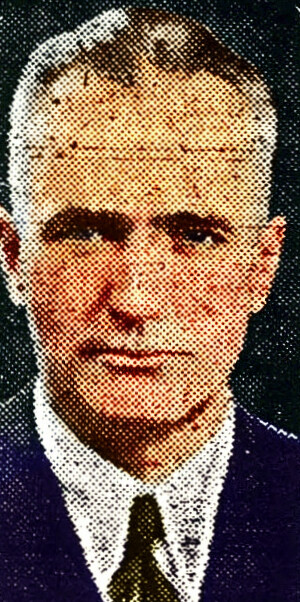
The recent Presidential appointment of Adm. Ernest J. King as full Commander-in-Chief of the United States Navy creates a precedent. Heretofore, it was the Chief of Naval Operations who was the boss of the Navy proper, reporting to the Secretary of the Navy.
In passing, it must always be borne in und that it is the admirals who actually run the Navy, with the Secretary of the Navy doing the reporting to the President. Under Adm. King’s appointment, he reports directly to the President. This expedient, which temporarily sets aside the Constitutional provision for a civilian boss of the Army and Navy to represent citizenry interests, is deemed, or rather estimated, to fit the President’s apparent need for more direct action in the handling of this war.
I served under Adm. King and know his temperament and characteristics. He is hard-boiled, but not in the usual sense of the ranking officer who knows that he is beyond criticism or contradiction. We had many a battle about the true function of aviation – military, naval, and otherwise – and just how far they extend. This gives me an opportunity to explain that Adm. King welcomes alertness and aggressiveness in junior officers and that he respects a man who stands up and lies for his opinions and beliefs.
Of course, such forthright, aggressive characteristics must balance with a certain inclination to treat war games and general service as operations to be held to rule books whenever possible, yet also be prepared to get a job done irrespective of all the rule books ever written. This calls for a lot of personal courage and daring because such a man is constantly gambling his future and professional career.
King is capable
But Adm. King took all these chances in his stride and when the Old Guard had just about reckoned him ready for a next-to-retirement berth, in some semi-honorary capacity, he met the President’s demand for a go-getting Admiral who would start and finish a war job. King’s handling of the annual war games was always marked by originality in strategy and daring tactics. A little too strong a dose for peacetime, make-believe naval warfare, he is just the man for the job utilizing the U.S. Navy to its fullest efficiency and the best interests of the country. He is the right man in the right job. And no man can hope for a better endorsement from those who serve with and under his command. Just the two-fisted type of fighting man who knows his Navy inside out.
Freeing Adm. King from red tape is the best move the President has made yet toward winning this war on and over the sea. Modern sea warfare is not covered by any war college book on strategy and tactics. The answers for victory are to be found in the resourcefulness of a trained, courageous leader – and Adm. Ernest J. King has just what it takes.
Thinking of personalities brings to mind certain quirks of fate which place men in circumstances in which they as expert observers have viewed other men. I recall that in World War I, Winston Churchill commented that Adm. Jellicoe (Commander of the British High Seas Fleet) was the only man who could lose the war in a few hours. As we well know, Churchill himself occupied and still occupies a comparable position in this war.
Dispatch proves claims
One of Gen. Douglas MacArthur’s recent dispatches from the Philippines, where he is conducting a brilliant and masterful fight against overwhelming enemy forces, says, "Enemy dive bombers control roads.” The capacity of the air force controlling the air over a combat zone to dominate or destroy enemy communications (roads, highways, railroads, and other supply routes) is one of the main claims stressed and proven by every airpower apostle. The effort throughout the history of warfare has been to lengthen the striking power of men and weapons to increase the striking range and increase the speed of the striking.
The big guns of shore batteries was the limit of shore guns over sea areas. Afloat, these big guns were mounted on what came to be known as battleships. Basically, the battleship is a lengthening of the range of shore batteries, as the bomber is the lengthening of range of the Army’s big land artillery pieces. The tank is the lengthening of range of the land pill box or fort, the paratrooper the lengthening of striking range of the infantry, and the ground-strafing airplane the lengthening of the range of the machine gun.
The total purpose of long-range artillery has been, and still is, to control or destroy the enemy supply lines especially in his back areas behind the fighting front. And no weapon has the effective striking range of the modern air force.