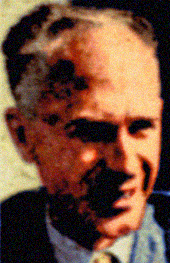
Rambling Reporter
By Ernie Pyle
ALBUQUERQUE – During these recent three months of vegetating I did manage to get in a couple of trips.
In September, on a whim, I flew with some friends out to Los Angeles, stayed four days, saw the “Ice Follies,” spent all my money, and had a wonderful time.
Then in November I took a flying trip to Washington to arrange for the winter’s Orient trip which never came off. Washington was hectic, and almost killed me.
On the way back west I stopped off in Indiana to see my Dad and Aunt Mary. My Aunt Mary cried and said she was so glad I came; she said she’d had a feeling that now since my mother was gone I would never come home again. I don’t know what made her think that.
My father is well, but he had a bitter year. His two remaining brothers died within a month of each other. It seems to him that he had more than his share in 1941. He feels the loneliness that comes of being the only one left.
But he is going on about his days, and he grieves only to himself.
Furthermore he has gained eight pounds. He now weighs 124, which is some 15 pounds more than his strapping son weighs.
My father kept putting off his big trip all summer, but he didn’t give it up. We discussed it at great length when I was home, and finally got it all arranged.
Dad’s, aunt’s trips planned
The plan was that in January (just about now) he would get on that airplane he’s wanted to ride on for so long, fly out here to Albuquerque, and then on to California. He thought he’d stay on the coast most of the winter, if he didn’t get too homesick.
We discussed Aunt Mary’s trip too. She sort of leaned toward staying at home this winter and taking her big trip next summer.
But then after I came on west she suddenly decided she’d go to Dallas, Tex., to send the winter with some friends. Aunt Mary has the air bug too, so she planned to fly from Chicago to Dallas.
I sent them air-line schedules, and everything was all set. They were already beginning to pack their things a month ahead of time, and then – came Pearl Harbor.
And before you could blink an eye the word came that they’d both called off their trips on account of the war, and were just going to stay at home. I’m damned if I don’t think they were both relieved.
There was great perturbation in our farm community when I was home, which was before we got into the war. It seems that some civic go-getters had got from the government a decision to build an immense $33,000,000 powder plant there on our arms.
When I was home, the government had not decided whether the plant should go north of Dana or south of Dana. That left everybody in a stew. People couldn’t talk about anything else. Rumors were thick and wild. Our neighbors said some of the older people were actually going crazy worrying about it.
Simple community seen doomed
For a great defense plant anywhere near us means the end of the close-knit, kindly, simple, honest community that I and my father and my grandfather knew in those fields and woods and houses of the Dana area.
It means that people like my father will have to sell and move off the land they have trod a lifetime; suddenly they will take up their things and go forth to they know not where; they will become refugees, bewildered and sad.
The government has now decided to build the plant north of Dana, which means that our own farm has escaped. But the community has not escaped. The whole country will be changed for miles around. Little Dana will suddenly become a boom town, roaring, crowded, strange, with a face and a manner that ill befits a Dana.
Strangers will open juke-joints; prices will skyrocket; elderly women in their cars will be afraid to venture into the thick new traffic; farmers for the first time in their lives will have to lock their houses against the 3000 “foreigners” who will swoop in and devour our community.
Our farm home, in the nearly 40 years of my memory, has never had a lock of any kind on it. I know of no house in our neighborhood that has a lock. But now the farmers will put locks on their houses and their cribs.
To me that one little gesture is the symbol of a tragedy – the planned and necessary execution of an old community.
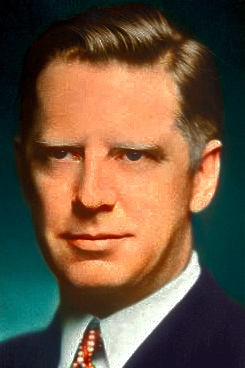
Fair Enough
By Westbrook Pegler
NEW YORK – This will be an account of a notable contribution to the cause of unity by Mrs. Eleanor Roosevelt.
Tuesday night Mrs. Roosevelt and two friends, one of them beg her protege, that veteran and inveterate professional youth, Joe Lash, late of the Communist front, approached the Mansfield Theater with tickets for a play called “In Time to Come,” which is a story of President Wilson’s war administration. Observing two pickets from Local 802 of the American Federation of Musicians blockading the place, Mrs. Roosevelt refused to enter and got her money back.
Otto Preminger, the producer of the play, reports that Mrs. Roosevelt said, “I can’t cross a picket line – fair or unfair,” and Local 802 states that The New York Times account of the incident in which she was so quoted is “substantially correct.”
Mrs. Roosevelt gives her own version of the incident in her column, “My Day.”
‘Pancake turner’ is high-salaried
“In Time to Come” is an all-union show, employing 66 persons, including a pancake turner, which is a man who plays a phonograph record. Any child can play a phonograph record, but under unionism this is a high salaried trade. Preminger says the pancake in question is played less than two minutes. The union claims it is played longer, but will not say how long. Incidentally, the record was made by union musicians in a union factory.
The union demanded that Preminger hire four musicians to do nothing. at $337.50 a week. He said his box office couldn’t bear that overload, but said he would accept one first musician at $112.50 a week to do nothing and when that offer was refused he proposed to post $337.50 a week in escrow and submit the dispute to any public agency having jurisdiction. This was rejected also and the pickets showed up 10 minutes before Mrs. Roosevelt appeared with her idea of a model for American youth and one other.
Aside from the unmistakably Hitlerian attitude toward the art of the drama, which is revealed in this conduct, Mrs. Roosevelt here gave support to a plain, undisguised racket. There is no dispute here between an employer and any worker. Preminger employs no musicians whatever and has no use for any and the union is simply trying to shake down a businessman at the rate of $337.50 a week as the price of forbearance. No employees are on strike and the same union itself crossed a picket line some months ago when a teamsters’ outfit tried to make a musician pay a teamster to convey to a theater a piccolo about the size of a pencil which he carried in his pocket.
The international president of the union is Jimmy Petrillo of Chicago, who is also president of the Chicago local and draws combined salaries, expenses, perquisites and allowances of about $80,000 a year.
The president of Local 802 is Jacob Rosenberg, who was himself charged some time ago with patronizing with his family a summer resort at which a non-union orchestra was employed, but beat the rap. Petrillo says, “There was nothing to it,” the scandal was silenced.
Constitution ‘at mercy’ of Petrillo
Rosenberg is an East Sider with an old Tammany background, and unlimited power to persecute individuals and a vast power of patronage derived from the treasury composed of dues, fees, assessments and other contributions, including undisguised income taxes, on a membership whose economic condition is desperate.
Rosenberg also tums out a union publication at the expense of the members in which he heaps praise on himself and last fall, when he ran for the New York city council, he used this journal to ballyhoo his ambition and had the gall to announce that he would “look forward eagerly to the support of our members,” most of whom undoubtedly took rapturous joy in slitting his throat at the public polls. Two pages of that issue were devoted to his candidacy and Rosenberg tried to hitch his wagon to Fiorello LaGuardia’s, describing himself as a candidate on “the LaGuardia American-Labor Party ticket.” He was slaughtered on Election Day, but he had gamed a little personal advertising and herewith gets some more.
Incidentally, Lash, whose nerve equals and resembles Rosenbergs put in for a commission as lieutenant, J.G., in the Naval intelligence some time back, but an informant reports that not even Mrs. Roosevelt’s influence could put that one over.
And, finally, the constitution of this union, whose picket line Mrs. Roosevelt respects, “fair or unfair,” as her contribution to unity, contains an absolute provision that Petrillo may suspend any part or all of it at will and substitute his own as the government of the economic lives of thousands of American workers.
Clapper: Figure fantasy
By Raymond Clapper
WASHINGTON – Even though this is the biggest war budget of any nation any time, I’m not going to try to write anything about it, because it is just too big for my finite grasp.
I don’t know how you are making out trying to digest these gigantic chunks of news that are coming out of Washington, but I’m dizzy. It is like trying to figure an understandable pattern out of a convulsion. And this is a convulsion we are going through. Far from being able to understand it, we shall be lucky indeed if we can only keep our balance as it whips us around with its demoniacal force.
For two hours the other day I sat with other Washington correspondents in President Roosevelt’s office while he explained the war budget. More important to me than anything he said was the fact that he was holding the conference, or seminar as he calls it.
President explains budget for public
He had just been engaged lor two weeks in the wearing conferences with Churchill and the strain of the loss of Manila. That very morning Mr. Roosevelt had gone to Congress and delivered his message calling for the unprecedented program of war production. He returned to the White House about 1 o’clock.
After lunch he undertook to explain the war budget in order to assist the Washington reporters who would be writing their dispatches about this complicated array of figures. For two hours he tried to reduce the matter to simple terms for us. He patently answered questions. some intelligent, some not, and some only repetitious. Though he must have been unbelievably tired and pressed with critical business, he never showed impatience and he stayed with it until all questions were exhausted.
I left thinking not much about the budget but a lot about whether a man who could go through the performance with such patience and good will had very much of the dictator stuff in him after all. If he were of the dictator stripe, he surely would not have used precious hours just so the public might better understand what the Government was trying to do. Dictators don’t explain. They tell you.
I had a feeling, too, that Mr. Roosevelt was coping with astronomical figures with the same sense of being unable to grasp them that we all experience.
Hitler didn’t think in terms of money
Dollars are now only symbols on the books. A budget of 59 billion dollars is not anything you or I or President Roosevelt can comprehend literally. It is hardly more than a way of saving that we must have a whole lot of weapons. It is a way of trying to say that about half of the effort of the American people must be put into the war. You might as well say we are going to use up 59 billion ergs on the war.
The question, “where is the money coming from?” doesn’t make much sense either. People asked that question when Hitler was building his war machine. They said he couldn’t find the money to pay for it. Hitler didn’t think in terms of money. If he had, he never could have done it because by thinking in terms of money he would have put himself into a straitjacket. He figured how many planes he needed, how many tanks. He set out to round up the material. He built the factories and aid the work. He thought only in goods and men at work.
In America we have to figure that aside from a bare living, practically everything else goes into the war. The war will take it one way or another. It will take a clever man to escape.
Our earnings, after a modest living, will go into war bonds and taxes. In spite of price control, we probably will have considerable inflation to take away part of our earnings. Luxuries and semi-luxuries just won’t be made. or if they are made they will be taxed heavily, to try to keep us from buying them.
And in spite of it, we’ll find, as the people of England have found under hardship, that life still is worth living.
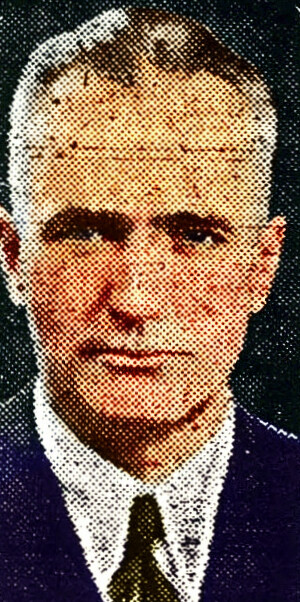
Maj. Williams: Pacific weather
By Maj. Al Williams
“Japan must be bombed to defeat.”
True to form, and it’s a thoroughly human trait, we grandstand strategists still are wondering how the Japs managed to drive their air attack home against Hawaii without being detected. Cogitation and guesswork on this angle seem safe – it can’t be aid or comfort to the enemy. In the first place, the strategy the Japs used, well, the Japs certainly know and knew about it because they planned it that way. And if it isn’t correct, then the facts themselves prove that they used some other method, or they wouldn’t have succeeded.
In the first place, we have the statement of Col. Muehlenberg, commander at Hickam Field, Hawaii, for which he was confined to his quarters. He said that there weren’t enough American patrol planes available to maintain a full 24-hour scouting patrol over the seas around Hawaii. If anybody knows anything about the planes available, Muehlenburg was certainly in a position to speak authoritatively.
Question unanswered!
We have been told at various times just prior to the outbreak of war between the U.S. and Japan that we have been building many hundreds of planes each month, and despite this an adequate number of planes was not on hand at Hawaii and in the Philippines when the Japs struck.
How did the Japs get close enough to Hawaii with their carriers to launch a mass air attack without being detected in time? Adequacy of planes or patrols or whatnot, I can think of only one way the Japs could have brought their aircraft carriers near enough without being spotted. Now let’s turn our imaginations loose.
Weather plays a vital part in modern air war.
When we were first told about the inevitability of war with Japan, I undertook to study and read up all there was to be found concerning the peculiarities and characteristics of weather in the Far East and Middle Pacific. Each corner of the world has its own brand of weather. A low ceiling in England of 700 feet may continue without change for weeks at a time. A ceiling of 700 feet in the U.S. means one of two things: either it will lift or lower – soon. It seems to be a quirk of bad weather spots, technically called “low pressure areas” or “lows,” to move with rain and fog from West to East across the Pacific. Due to the fact that the Japs possess a great number of land observation points, it is most likely they had stationed weather observers pretty freely.
One possible theory
Furthermore, in this movement from West to East, the Japs were originally in a good spot to note the “lows” and estimate the extent. Some tunes these Pacific “lows” are a hundred miles or more in diameter. Now wouldn’t one of these “lows” in which the visibility would be limited to little more than zero-zero, moving 10 to 15 miles an hour West to East (thus approaching Hawaii), be a dandy place for a couple of aircraft carriers to play around in? Unseen by scouting patrol planes (which would, of course, be compelled to skirt such messy weather), the carriers could fool around just inside the edges of such a low until they had worked their way close enough to any objective to be within the range of their roosting planes for a surprise raid.
In addition to the weather forecasters on the Jap-controlled islands, and those on the aircraft carriers, a few submarines poking out ahead could very easily do a little look-see weather scouting on their own, with a minimum chance of being detected. This sort of actual observation could readily substantiate all the theoretical calculating of the weather and one look is worth a bale of guesses.
This may be all haywire, but at the same time, it’s the only way I can find to explain how the Jap carriers got within working range of Hawaii. Such strategy could have been used by the Japs. At any rate, it is well for the American public to investigate and think in terms of just what air warfare means and what can be accomplished by utilizing the weather in strategy of modern air war. Every time Americans learn one single additional thing about air warfare and aviation, they approach that much closer to becoming a real airpower nation.
‘Made in Japan’ tag cannot be removed
Merchants who seek to avoid public aversion to buying goods imported from enemy nations by obliterating the “Made in Japan,” or similar labels, face stiff penalties, according to a warning issued by the U.S. District Attorney’s office here.
Federal officials said removal of the origin marking from imported goods was in violation of the Federal Tariff Act. Maximum penalties of a year’s imprisonment and a $5,000 fine are prosecuted for each offense.
Government lawyers said they received complaints against several merchants who had attempted to fool customers.