The Pittsburgh Press (March 22, 1943)
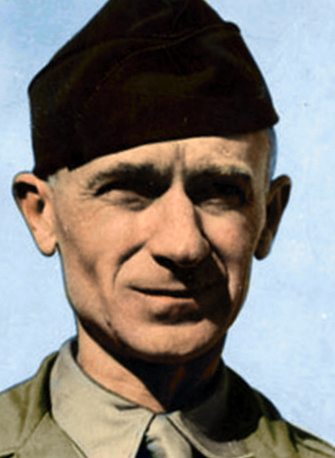
Roving Reporter
By Ernie Pyle
On the North African desert –
During most of our 200-mile journey, the soil seemed to be dirt, rather than sand, and the trucks swirled up a cloud of dust that was truly suffocating. The trucks were open, and we sat in the back ends on bedding rolls and boxes. We all wore goggles or dust glasses. Most of us hadn’t shaved for days. Within half an hour everybody’s whiskers were so caked with dust that we looked like a new kind of fur-bearing animal. It took days to get the dust out of our eyes and noses.
During the trip we ate a two-gallon can of hard stick candy, which the Army issues in this war. We talked some, but it was too rough and dusty to talk much.
In midafternoon of the first day, four planes came into view. We couldn’t recognize them, so we got out and started looking for ditches. They went on over and paid no attention. And we realized they were British.
Ernie sees a mirage
Even though it was still wintertime, we can now say we’ve seen the famous Sahara mirages. Several times we all saw a long line of trees, straight and regular as though lining an avenue, about three miles away. Unfortunately, they were sitting on top of a lake, and since trees don’t grow on lakes and since there wasn’t any lake anyhow, we figured we must be seeing things.
We met a few small camel trains when we first started, and we thought that was big stuff, seeing real camels on the desert. But before the trip was over, we’d seen so many camels we didn’t even look. They’re as common as cattle are at home. The desert is full of them, grazing in herds. Always there is an Arab, often a child, tending them. The camels twist their necks and look as you go by. I’d never noticed it in circuses, but when you get close a camel, you see that its head and neck look just like a huge snake. And when a camel turns around and looks at you, it gives you the creeps. I don’t think I shall lay plans for running a camel ranch after the war.
Camel herders are friendly
Often the Arab shepherds would wave at us, and occasionally they gave us the V-sign. But they were too far in the desert to have heard of the American “okay.”
Once we saw a fox, or what looked like a fox, and one of the soldiers shot at it with his rifle. Again, just at dusk we saw another, and there was a mad scramble for all the rifles lying on the floor. The fox got away, and I was thankful I didn’t get shot myself, what with rifle barrels whisking past my nose in all directions.
In midafternoon of the first day, we went through a large village which was built for camel traffic, and camels only. It was so narrow the truck scraped on both sides.
Speak of the devil–
I remarked that I hoped we didn’t come to a right-angle turn in the street, and no sooner had I spoken than we did come to one. Well, not quite a right angle, or we couldn’t have made it, but it was a jog of about 20 feet. It took us a quarter of an hour of backing and filling to get the trucks into position to make the turn.
Hundreds of Arabs came pouring out of the mud buildings, and we had a large and appreciative audience. One black-bearded old Arab with a wooden leg took charge of the free-advice department, and told the drivers in language they didn’t understand just how to do it. They paid no attention.
No matter where or when you stop, an Arab will suddenly appear. He’ll stand around just looking unless you speak to him, and then he’ll smile and try to answer. Several times we were stopped way out in the desert by white-gowned Arabs with long rifles slung over their shoulders. Apparently, they were soldiers, although they looked and dressed like all the others.
Desert spooky at night
The first night we continued to drive after dark. The moon was brilliant, and it gave the whole vast desert and the hills that dotted it a kind of ghostliness.
Suddenly the truck stopped and there around us were five Arabs out of nowhere, all gowned in white, and riding five beautiful white horses. Over their shoulders were slung the longest rifles I’ve ever seen.
In the half-light they did indeed seem romantic and like men out of mystery. They rode far back on their horses, and they could ride like the wind. They spoke in low voices, almost in harmony with the spookiness of the desert moonlight.
I don’t know what they said, but it was obvious they were patrolling throughout the night in that special part of the world which is their own, and which only they can ever fully comprehend. If we had been Germans instead of Americans, I doubt that we would have gone any farther that night, or any other night.