The Brooklyn Eagle (June 12, 1944)
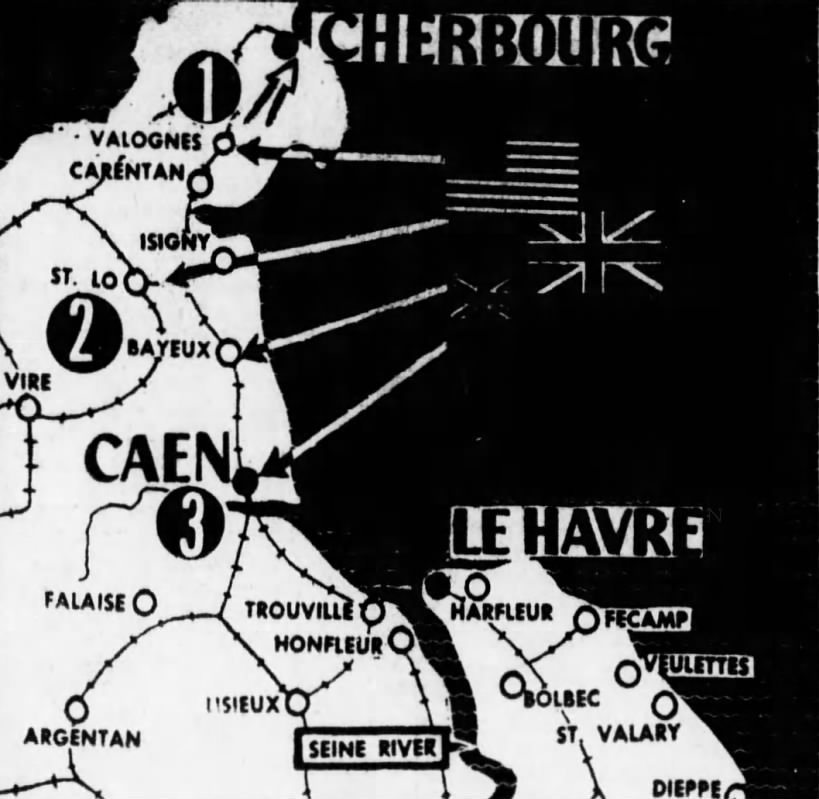
Drive on Cherbourg: Allied troops moved a step closer to their coastal objective with the capture of Carentan (1). Meanwhile, a U.S. spearhead drove into the approaches to Saint-Lô (2) and British forces took a number of villages east of Caen (3) in a flanking movement. Bayeux has become the base for operations aimed at cutting off the Cherbourg Peninsula.
1,400 U.S. BOMBERS RIP FRENCH TARGETS
Record force hits bridges and airfields
Fortresses, Liberators escorted by huge armada of fighters
London, England (UP) –
More than 1,400 U.S. heavy bombers – the biggest force ever dispatched on a single mission – smashed at 16 German airfields and six bridges in France today to lead thousands of Allied planes supporting the invasion campaign in Normandy.
The record fleet of Flying Fortresses and Liberators was escorted by strong forces of Mustang, Lightning and Thunderbolt fighters comprising an armada of probably more than 2,150 planes.
Seven bombers and 14 fighters were missing, an announcement of the mission said. U.S. fighters shot down at least 17 German planes.
From daybreak until early evening, the skies over northern France were black with raiding fleets taking advantage of clearing weather to bring the full Allied aerial striking power to the support of embattled ground troops.
In the first 18 hours from midnight to 6:00 p.m., the combined air forces had flown some 6,000 sorties and it appeared certain they would top the 10,000 mark by tonight.
Plane pound troop columns
Fighters, fighter-bombers and giant four-engined U.S. bombers swarmed over the enemy wherever they found him. They hit his troop columns with blockbusters, rockets and machine-gun fire and they tore up his road lines and airdromes in one of the most savage tactical assaults of the war.
Almost 1,000 Flying Fortresses and Liberators, accompanied by about 750 U.S. fighters, split up into dozens of task forces to roam over a vast area of northern France, bombing 15 key fighter bases and the Rennes and Amiens railway junctions.
The escorting fighters, meeting only limited enemy fighter opposition, dive-bombed and machine-gunned Nazi airdromes and road lines.
By nightfall, official reports showed that nine Allied planes were lost, excluding U.S. heavies, whose losses were not immediately announced, and at least 21 enemy fighters were shot down.
The German DNB News Agency said violent air battles raged all across the invasion beachheads and asserted that German fighter-bombers attacked Allied tank columns around Caen.