The Pittsburgh Press (April 3, 1945)
Japs digging in on Okinawa
Yanks split island, move within 6 miles of its capital city
The Yanks on Okinawa today sliced the Jap island in two, widened their hold on Nakagusuku Bay, secured Zampa Cape and moved within six miles of the capital, Naha. Allied observation planes were already using Yontan and Kadena airfields, and early use of the fields by fighters and bombers was forecast.
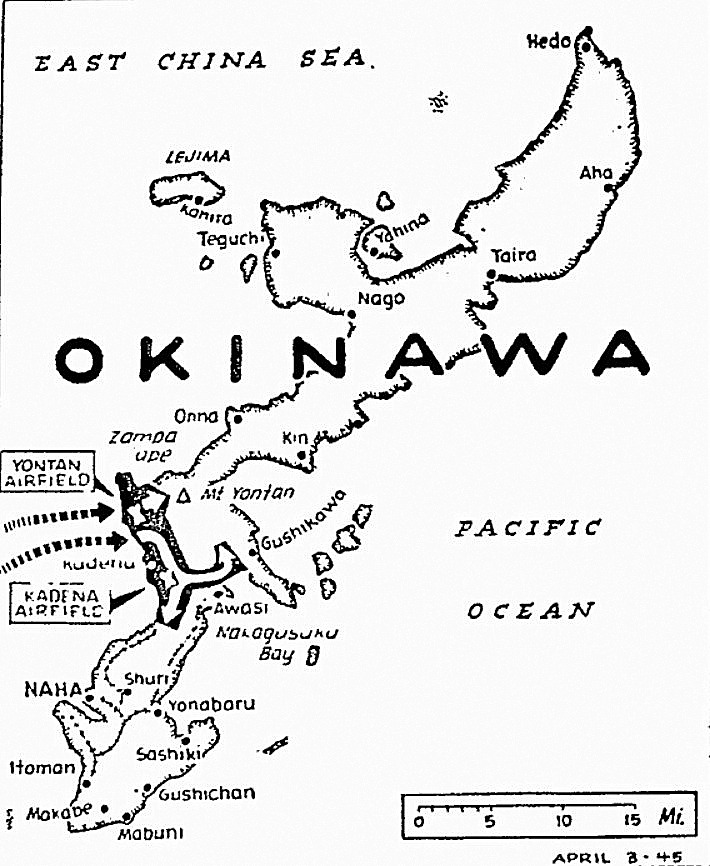
GUAM (UP) – Army invasion troops who sliced Okinawa in two with a six-mile dash to the east coast widened their hold on the vital Nakagusuku Bay anchorage to at least three miles today and still were advancing.
Other units of Maj. Gen. John R. Hodges’ XXIV Army Corps advanced south along the west coast to within a little more than six miles of Naha, capital of Okinawa, in the first hard fighting of the three-day-old invasion.
Indications grew that the Japs were preparing to defend a line across the narrow isthmus just above Naha. The Japs were reported “digging in.”
Marines at the northern end of the Tenth Army’s front broadened the west coast beachhead to at least 10 miles with an advance of more than a mile.
The Marines cleaned out and secured Zampa Cape and sent an armored spearhead along the coastal highway to the north.
Casualties continued astonishingly light on both sides.
The XXIV Corps’ push to the east coast gave the Americans a wide corridor from which to attack either north or south. It also secured a foothold on all vital north-south communications.
United Press reporter Edward L. Thomas said the first doughboys reached the beaches of Awasi Harbor near Tobaru Village at 3 a.m. yesterday. They had achieved in 36 hours what the original invasion schedule said might take more than five days. Awasi Harbor lies at the northern end of Nakgusuku Bay and today the troops were probing forward out of the peninsula.
Mr. Thomas said the troops sliced through meager Jap resistance “like a hot knife through butter” in their dash to the east coast.
It was indicated that the troops had seized control of the northern face of the Awasi hill mass dominating the Bisha Gawa Valley and territory to the north. The victory firmly anchored the American beachhead 362 miles southwest of Japan proper.
Maj. Gen. Roy S. Geiger’s III Marine Amphibious Corps extended the west coast beachhead another 3,000 yards to the north by pushing across the base of Zampa Cape to the approaches of 770-foot Yontan Zan peak.
Observation planes were operating from Yontan and Kadena airfields captured in the first hours of the invasion. Engineers were rushing repairs to the fields to permit their use by fighters and bombers.
Reinforcements pour in
The 1,400-ship invasion fleet continued to pour reinforcements of men, tanks, guns and supplies across the invasion beaches unmolested while 1,500 carrier planes shuttled protectively overhead.
Warships in the armada joined carrier planes in supporting the ground forces, hurling everything from 16-inch shells to flaming rockets into already-burning Naha and other enemy strongpoints.
Jap planes made a feeble attack on the invasion armada Sunday night and five were shot down. A Jap communiqué claimed that 13 more U.S. warships had been sunk and 17 damaged.
A CBS correspondent broadcasting from the fleet and Tokyo claims that 150 ships had been sunk since the start of the invasion operations were just about 99.44 percent wrong.
Though the Jap communiqué obviously was exaggerated, there was no inclination at Adm. Chester W. Nimitz’s Pacific Fleet headquarters here to write off Okinawa as already won. On the contrary, hard fighting was anticipated as the invaders come to grips with the enemy garrison totaling 60,000 to 80,000 troops.
The Jap commander was expected to fight desperately to gain time while Japan itself rushes construction of anti-invasion defenses. Next on the American invasion schedule may be Japan itself.
Big fight ahead, Navy warns
WASHINGTON (UP) – A Navy spokesman voiced surprise today at the “amazingly light” U.S. casualties on Okinawa. But he warned that when the Japs come out of hiding, they will fight as fanatically as on Saipan and Iwo Jima.
The official said the bulk of the Jap defenders probably would be encountered as U.S. forces drove southward.