90 years ago today.... (9-18-31)

793.94/2120: Telegram

The Secretary of State to the Consul at Geneva

[Paraphrase]

Washington, October 15, 1931 — 11 a.m.

93

Your 201, October 15, 10 a.m. The purpose of this Government in regard to your cooperation with the League is clearly defined, I think, in the opening statement you have been authorized to make at the Council meeting. Therefore, if you are invited to sit with the Committee of Five, I have no objection provided it is understood that your participation solely concerns the discussion of treaties to which this country is a party. It is the purpose of this Government to cooperate with the efforts of those who now are meeting at Geneva by whatever conference method is most appropriate to secure peace in Manchuria.

STIMSON

The Evening Star (October 15, 1931)

JAPAN RESENTS INTERFERENCE OF U.S. IN FAR EAST CRISIS BUT ALLOWS PARTICIPATION
Stimson’s Advice to League to Apply Pressure is Declared ‘Unreasonably Harsh and Strong’

Notes Withheld from Public in Fear of Anti-U.S. Feeling
Geneva Invites United States Help in Far East Crisis After Japan Assails Interference

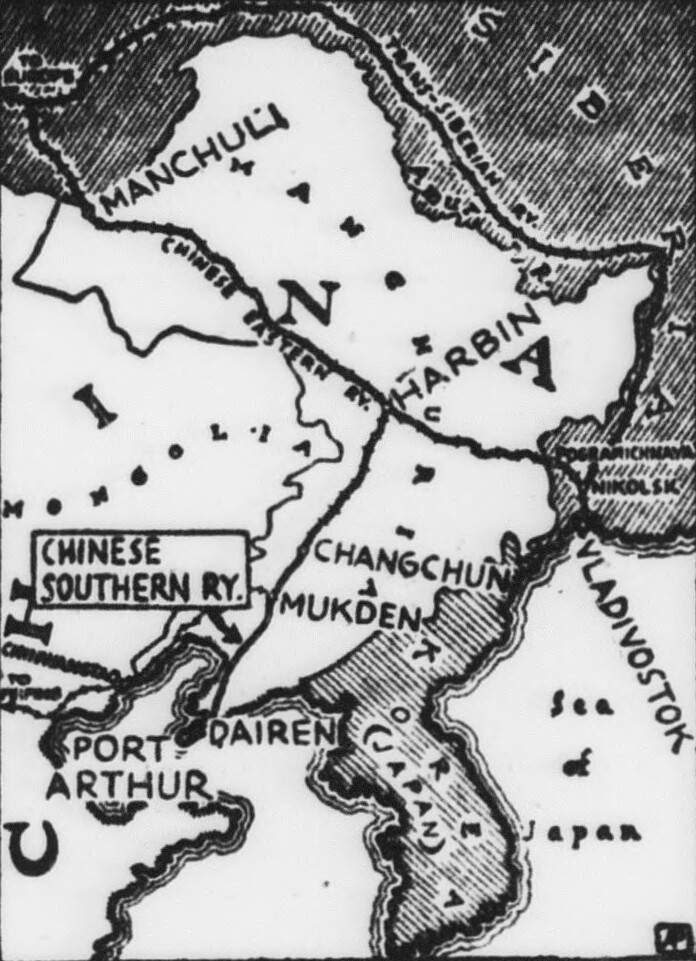
Trouble Zone


Map of Manchuria, scene of Chinese-Japanese difficulty

GENEVA (AP) – The League of Nations Council was reported tonight to have decided to ask the United States to participate in a search for means of settling the Sino-Japanese troubles in Manchuria.

The decision was reached by the five principal powers represented on the Council, despite some objections by the Japanese member on juridical grounds, it was said.

This information was circulated informally at the close of a private session of the five principal members, after which the full Council went into private meeting.

⁕ ⁕ ⁕

TOKIO (AP) – The Japanese foreign office today instructed its delegation in Geneva to use every effort to see that the proposal for including an American representative in the League of Nations Council during discussion of the Sino-Japanese trouble be dropped.

The Tokio government adopted the view thr.t an unfavorable impression already had been made upon the Japanese generally by American Secretary of State Stimson’s note to the League on October 9, advising it to “in no way fail to assert all the pressure of authority within its competence” toward a settlement of the Sino-Japanese trouble.

The foreign office spokesman characterized this as “politically unfortunate, indeed.” Japanese officials apparently considered the Stimson note “unreasonably harsh and rather strong, to say the least,” in view of the Japanese contentions from the beginning that the Manchurian affair was merely a controversy between two neighbors and that no outside interference was desired, more particularly on the part of the United States at this time.

Instructions Sent Delegates

The proposal caused more or less commotion at the foreign ministry, which lost no time in sending instructions to its Geneva representatives.

The foreign office took the view that, under the circumstances, it should make Japan’s attitude clear at the earliest possible moment, officials feeling that the Japanese public would not tolerate “America and the League working together in the Manchurian tangle, which is purely an affair between China and Japan.”

The spokesman for the foreign office said:

“There is all the difference in the world in America as an outsider keeping itself informed as to the League’s activities, compared with its actual participation in the Council’s sittings.”

In connection with the foreign office’s contention that public opinion would not approve of America taking an active role at Geneva, the spokesman emphasized that it was “most assuredly not due to any unfriendliness on the part of Japan, but more as a matter of principle.”

Anti-U.S. Feeling Feared

The spokesman asserted that two Washington memorandums (presumably notes urging peace and proposing confinement of troop activities in Manchuria to the requirements of international law) had been withheld from the Japanese public on the ground that they might stir up anti-American feeling.

The spokesman referred to similar instances in which he said Japanese opinion was easily inflamed when it was felt that outsiders were interfering in this country’s affairs.

Only a part of the message filed by Kenkichi Yoshizawa. Japan’s representative at Geneva, reporting the league’s proceedings, had been received here, some of them apparently having been delayed en route.

Because of this the Tokio government withheld its reply pending receipt of Yoshizawa’s message in full, and sent instructions to the Geneva delegation to do its utmost to persuade League officials to abandon their proposals for actual participation by America.

Attitude of Fairness Strewed

The foreign office emphasized that Japan was facing the Manchurian situation with the fairest stand and participating in the League Council’s proceedings.

“It is difficult.” the foreign office commented, “to understand why in the present instance of the Far East alone exception should be made and America should be invited to take part in the council meetings.”

Continuing, the informal statement said:

“If America has any intention of making the present participation in the League’s debate serve as a precedent and accordingly attending the League’s sessions in the future, surely there is cause for congratulations. But if American participation is exceptional and limited to Far Eastern troubles only, there appears to be something unfair and irrational regarding such a step.”

“Big Five” Get Together

League Stirred by News from Tokio on U.S. Participation

GENEVA (AP) – News from Tokio that Japan would consider American participation in the settlement of the Sino-Japanese dispute “unfair and irrational” stimulated interest in League circles today.

The Japanese suggestion that the United States should be congratulated if she intends for this incident to be a precedent was interpreted in some quarters as tantamount to insisting on America’s entry into the League.

The Council’s “big five,” including Foreign Minister Briand, Lord Reading and Dino Grandi, met privately in the League secretariat at noon to talk over the situation.

The Council decided yesterday to invite a delegate of the United States government to sit in at its sessions in a consultative capacity, but the suggestion met with strong opposition from the Japanese representative, Kenkichi Yoshizawa. It was agreed to withhold a formal invitation until the receipt of official word from Tokio.

It was admitted in league circles the council was within its rights in asking America’s cooperation whatever the outcome. Such an invitation would be based on the Briand-Kellogg peace pact, the sponsors of which are connected with league activities.

The possibility of the United States joining in the peace program of the League for the first time almost over shadowed the issue itself. The unprecedented participation of a non-member in the League’s deliberations was regarded as posing a number of delicate questions as to such a nation’s responsibilities, rights and relations to members.

An examination of the Leagues machinery for enforcing its decisions in the event that Japan finally rejects its intervention revealed that article 18 of the covenant provides for sanctions both of a military and economic nature.

It was recognized that no member of the League would consider using military force to bring Japan to terms and that economic pressure was the only possible alternative. Many observers doubted seriously, however, whether any nation would agree to a boycott or a severance of trade relations.

The fact that all countries are heavily depressed economically led to the conclusion that any interference with the normal commercial relations of the Asiatic country would intensify her own troubles if not those of all nations doing business with her. The boycott of Japanese goods in China was cited as proof of this premise.
Direct Negotiations with Tokio Denied

Chinese Legation Labels Reports on Manchurian Peace Moves as Propaganda

The Chinese legation today denied a report, published in yesterday’s newspapers, that Gen. Tsiang Tso-ping, Chinese Minister to Tokio, had started direct negotiations with the Japanese foreign office concerning the Manchurian dispute.

A report that an important member of the Chinese Nationalist party had intimated to the Japanese Minister to China that negotiations would be opened with Japan in the event the League of Nations failed to adjust the differences between the two Oriental powers also was refuted.

Both reports were characterized by attaches of the Chinese legation as “Japanese propaganda, designed to throw dust in the eyes of the world.”

U.S. Asks Tokio to Withdraw Objection

Geneva Plans Given Debuchi
Gilbert Would Help League to Invoke Kellogg Pact
By the Associated Press

The American government is making an effort to have Japan withdraw objections to a representative from this country participating in efforts by the League of Nations for peace in Manchuria.

Informed of the Japanese stand, Secretary Stimson today called in Ambassador Debuchi of Japan and explained to him the status which Prentiss Gilbert, American consul general at Geneva, would have if invited to participate in the League’s discussions.

Gilbert’s part would be that of an observer to help efforts by the League to invoke the Kellogg-Briand pact for the renunciation of war.

Procedure is Explained

The Secretary of State explained the American representative at Geneva would not participate in any procedure under the League covenant’s instruments to avert war.

The Ambassador is communicating this information to his government.

The Japanese position in the Manchurian troubles, as outlined to the American government by the ambassador, is that Japan will withdraw its troops to within the railway zone at any moment guarantees are given for the safety of Japanese lives and property in the sections now occupied; that military measures so far taken are of a defensive nature and that war with China is unthinkable.

Upon leaving the Slate Department the Ambassador emphatically denied any communication to Tokio from the American government had not been published because of its tenor.

“Only one formal communication has been received from the American government and it has been published,” the ambassador said.

He referred to a note sent to both Japan and China early in the troubles urging that hostilities cease.

Mistaken Impression Seen

Japan’s strong stand against American participation in the League’s efforts was regarded at the State Department as indicative of a misunderstanding of the American position.

Department spokesmen reiterated the only desire of the United States is to see that Japan and China do not resort to war.

President Hoover is keeping in direct touch with all developments.

It was a desire to aid in efforts to use the Kellogg-Briand anti-war pact in its first big test that led this government to depart from its policy of isolation from the League to the extent of indicating that it would participate actively if invited.

Row in Congress Seen

The possibility of controversy in Congress over the administration’s willingness to sit with the League in Chinese-Japanese discussions has given new flavor to the long-drawn-out Manchurian difficulties.

While officials awaited reports from Geneva upon Tokio’s attitude they were not oblivious to the avidity with which Capitol Hill sought further exposition of this government’s policy.

Secretary Stimson and his advisers took the position, however, that the forces of world peace have reached a crucial stage. It was with this in view that the State Department empowered Prentiss Gilbert, American consul general at Geneva, to join the League’s discussions were the invitation unanimously extended. Secretary Stimson was not disposed, though, to inject this government into the sessions so long as Japan maintained its objections.

Since the United States is not a member of the League, Gilbert was instructed to avoid discussions of the Oriental nations’ obligations under the League covenant. But this country’s entire in fluence will be thrown behind any effort by the League to invoke against China and Japan their pledges in signing the Kellogg-Briand pact.

Doubts League’s Service

At the Capitol speculation was current as to the possible effect of the administration’s decision upon this country’s adherence to the World Court through the revised Root protocol. It had been expected that President Hoover would submit the protocol to the Senate for action at the impending session.

U.S. Minister in Nanking

Hopeful Sign Seen in Arrival of Johnson and British Diplomat

NANKING, China (AP) – Nanking watched with interest today the actions of United States Minister Nelson T. Johnson and the British Minister, Sir Miles Wedderburn Lampson, both of whom arrived here yesterday from Peiping.

Nationalist government officials seemed to see in the visit of the two diplomats a hopeful sign toward solution of the Sino-Japanese controversy.

Johnson did not reveal his plans, but admitted that he had been ordered to move to Nanking, the new capital, by Washington. The length of his visit here, he said, was indefinite, “depending upon Manchurian developments.”

Pays Respects to Chiang

He conferred late yesterday with Frank W. Lee, China’s acting foreign minister. Later he paid his respects to President Chiang Kai-Shek.

Sir Miles, who flew from Peiping, arrived too late for any formalities, but he was expected to visit the President and acting foreign minister today.

Hongkong dispatches said Eugene Chen, minister of foreign affairs in the South China insurgent government, telegraphed the League of Nations an assertion, “The anti-Japanese boycott movement can be ended only by Japan by a policy based on frank and honest recognition of Manchuria as a real and integral part of China and consequent adjustment of rights and interests claimed by Japan.”

Negotiations Progress

Negotiations between the southern insurgents and the central government toward a reconciliation meanwhile were said to be progressing satisfactorily.

There was some tension reported in Canton, seat of the southern government, as the result of the killing of the Chinese students by police last week following an anti-Japanese demonstration.

Far East Crisis is Blamed on New Tokio Aggression

But China is Represented as Seeking to Avoid Clear Settlement
By PAUL SCOTT MOWRER
By Cable to the Star

GENEVA, Switzerland – I am enabled to reveal today from authoritative inside sources the “low down” of the Sino-Japanese crisis – namely, what each power really thinks of the other’s actions and motives divested of diplomatic verbiage.

The Chinese viewpoint is as follows:

Manchuria’s three provinces are an integral part of China, the part, indeed, from which the rest of China for many long years was ruled. Japan’s so-called rights there are a result of a series of aggressions ended in unjust agreements, which China was obliged to accept against its will and which the Nanking government does not recognize.

The present crisis is a result of new and premeditated aggression by Japan with a view to consolidating its anomalous position in Manchuria by military force. The time was carefully chosen. All the world was deeply preoccupied with the great economic depression and 16 Chinese produces were flooded and millions of its inhabitants homeless.

Japan’s Aim Defined

Japan’s aim is to terrorize the population, discredit the Nanking government, establish its own puppet government at Mukden, exclude all forms of foreign intervention and gradually force China into direct negotiations wherein, under the pressure of Japanese military occupation, the Nanking government will be obliged to accept Japan’s dictation. Japan’s conduct is a challenge to new China and an affront to other powers.

China will resolutely refuse any sort of direct negotiations with Japan until, first, the Japanese troops are withdrawn into the railway zone, thereby establishing the status quo ante, and, second, responsibility is fixed for the present crisis and reparations are agreed upon.

Against this must be balanced the Japanese viewpoint, thus:

Japan’s predominant interests in the Far East, which have been duly recognized by the United States and others, center in Manchuria. To establish its position there, Japan has fought two wars. Its rights, fixed by treaties and agreements, are clear.

Under the Japanese administration and policing of the South Manchurian Railway zone and economic development, wherein Japan has already invested $1,000,000,000, Manchuria has been a peaceful and prosperous land, whose population has doubled during the last 20 years. The rest of China has been torn by civil wars. The distracted population has been emigrating to Manchuria at the rate of 1,000,000 a year, in order to take advantage of the peace and prosperity afforded by Japan there.

Won’t Recognize Rights

However, the Nanking government refuses to recognize Japan’s rights. It has deliberately provoked on many occasions anti-Japanese agitation. Its agents have molested Japanese subjects, of whom there are 1,500,000 in Manchuria, including 1,200,000 Koreans.

Contrary to the treaty, the Chinese have built a new railroad parallel to and competing with the South Manchurian line. They have blocked, in devious ways, the extension of South Manchurian railway blanches. They have illegally confiscated lands developed by Korean rice growers. They have contested the right of Japanese subjects to own and lease land.

Chinese troops murdered a Japanese captain traveling under a regular Chinese pass and refused reparation of any sort. Chinese troops September 18 attacked Japanese railway guards and blew up a part of the track of the South Manchurian road. Under these deliberate provocations to Japan’s interests and honor. Japan could not remain inactive.

Bandits Roam Country

Japan, even today, has only 14,000 troops in Manchuria, which is fewer than the treaty allows for policing of the railway. Chinese troops there number more than 200,000. Under the cover of anti-Japanese agitation and general unrest, large bands of bandits are roaming the country, some of these bands numbering 5,000. Japan cannot abandon its nationals to these conditions. It cannot withdraw its troops until order is really restored.

Nanking’s promises in this respect have been proven ineffective many times. The Nanking government is effective at propaganda and agitation, but it is unable to keep order. What Japan now proposes to Nanking is complete negotiation in which the whole question of Chinese and Japanese relations will be taken up and settled. Equivocation cannot continue.

China, by appealing to the League of Nations and working on the sympathies of the United States, is trying to avoid a clear and peaceful settlement with Japan, in order to continue its agitation and provocations. The League of Nations and the United States could do a good service if they would persuade China to negotiate direct with Japan. Japan intends to ask nothing unreasonable of the Nanking government. By attempting to mediate, however, the league and the United States are merely encouraging Chinese agitators and stiffening Japanese opinion, thus making final settlement more difficult.

In any case, Japan is unwilling to accept any outside mediation on this question any more than the United States would accept mediation in the question concerning the neighborhood of the Panama Canal Zone.

Japan is Regarded Superior at War

China’s Million Soldiers Seen No Match for Smaller Force of Island Empire

NEW YORK (AP) – President Chiang Kai-Shek’s threat that China will make war on Japan in ease the League of Nations, falls to get justice for “China has caused considerable speculation as to what form war would take in case Japan and China should formally open hostilities.

The Sino-Japanese war of 1894-1895, over the effort of China to hold its special position in Korea against Japanese opposition, lasted less than a year. China’s navy was sunk very speedily and almost without a struggle and Manchuria and Shantung Provinces were invaded by the Japanese armies, for which the Chinese were no match.

First Plan Blocked

After Japan had captured ail sea approaches to Peking (as it was then called), China sued for peace. By the treaty of Shimonoseki, China was forced to recognize the independence of Korea, which made it possible for Japan to annex that country eventually. China also ceded the Liaotung Peninsula in Manchuria to Japan, but Russia. Germany and France blocked Japan’s seizure of that peninsula then, and it was not until after Japan defeated Russia at arms that the Japanese realized their ambition to dominate the railways of South Manchuria.

China is now so disorganized politically and in a military way that the million and more soldiers the Chinese republic claims to have are regarded by military men of the west as almost useless. The Chinese armies lack the training and equipment necessary to cope with Japan’s modern army, even if the latter has only 200,000 soldiers in its regular organization.

A clash at arms between China and Japan probably would be largely a naval affair. Chinese ports could be speedily blockaded by the efficient Japanese navy, and warcraft of the Japanese could, enter the Yangtze River without great opposition and shell the new Chinese capital at Nanking and the center of the Chinese steel and munitions works at Hangkow.

China’s Collapse Complete

The fighting between China and Japan which began August 1, 1894, was virtually finished by March of the following year, when China’s collapse was complete, although there had really been no major land engagements and the sea fighting of China was farcical in the face of Japan’s superior modern craft.

Granting that other powers remain neutral, military and naval men are of the opinion that Japan could again force China to sue for peace within a few months and probably without the landing of many additional Japanese soldiers on Chinese territory.

By moving the capital from Peiping to Nanking on the Yangtze River, the Nationalists of China put the center of their government within reach of foreign navies. Thus, Nationalist China has created for its capital the very danger Russia and Turkey eliminated by leaving Leningrad and Constantinople in favor of Moscow and Angora.

Sino-Japanese Peace Adjustment Forecast

Newton D. Baker Praises Stimson, Holding League Should Be Able to Forestall War.

CLEVELAND, Ohio (AP) – Newton D. Baker, former Secretary of War, forecast last night that the League of Nations will soon find away to adjust the Manchurian issue between Japan and China.

Speaking at the Euclid Avenue Congregational Church, he said that “if the League can’t prevent war there is nothing that can.”

He praised the action of Henry L. Stimson, Secretary of State, for bringing the influence of the United States to bear on the controversy, describing it as “the greatest step we have taken toward the creation of a peaceful atmosphere and joining in operation of the established peace agencies.”

U.S. State Department (October 15, 1931)

793.94/2139: Telegram

The Consul at Geneva to the Secretary of State

Geneva, October 15, 1931 — 9 p.m.
[Received October 15 — 7:11 p.m.]

202

Department’s 90, October 14, 3 p.m. After protracted private session of Council which has just concluded Drummond informs me as follows:

As expected, the Japanese opposed extending an invitation to the United States to participate within the Council in discussion of the Pact of Paris. No compromise was effected and the Council after exhaustive discussion of Japanese legal objections proceeded to vote on the basis of the question being one of procedure (see Consulate’s 195, October 13, 9 p.m.). A resolution was then adopted by which the United States will be invited to participate in such discussions with only the dissenting vote of Japan. It is expected that the invitation will be finally approved and issued some time tomorrow. A Council meeting has been tentatively fixed for 10 a.m. to confirm publicly this decision.

There is still hope that the Japanese at the last moment may withdraw their opposition and thus make the decision unanimous.

GILBERT